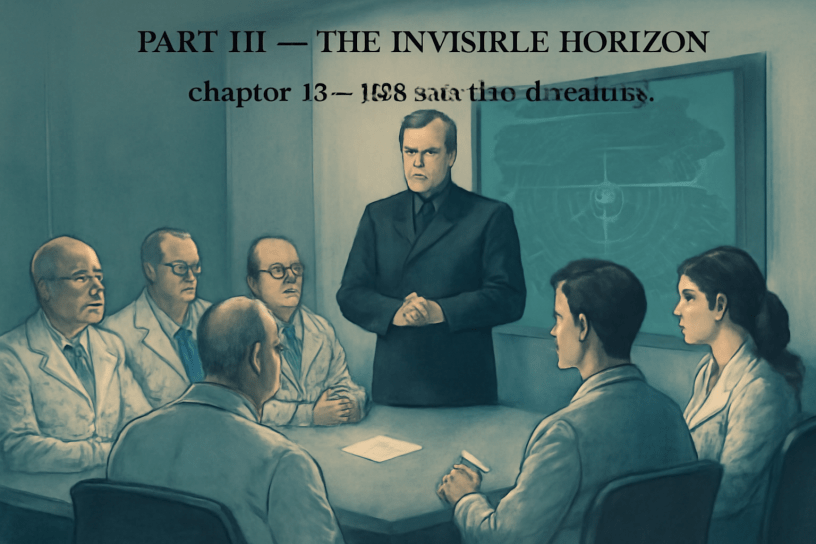
Chapter 14 — The Sea and the Silence
Edited and prepared for publication by his friend and colleague, Professor Rook
We stopped studying our notebooks the moment the plane began to descend.
You could feel it—not just in the body, but in the cabin itself. The hum changed pitch. The pressure equalized. And a thin light began to edge in through the reinforced curtains.
There were no windows, but somehow we knew: the ground was close.
Moments later, the landing gear deployed with a shudder, and the Yak-40 touched down hard, bouncing once on the tarmac like a misjudged calculation.
Then the door opened—and the world turned a different color.
The Black Sea lay in the distance, silver-blue and far too calm for what was about to begin.
We had landed in Simferopol. A quiet military airfield, built to be unnoticed.
A UAZ jeep waited just beside the plane, olive green, paint dulled by salt and heat. Two men stood beside it—naval uniforms, dark sunglasses, no expressions.
One of them greeted us not by name, but by rank we didn’t hold.
“Tovarischi. This way.”
There was no check-in. No handshake. No destination announced. We were expected.
We climbed into the back of the jeep—me, Alina, our cases—and the door shut with that dry metal thud that always sounded final in the military world.
The driver didn’t speak. The other man rode up front with a folder on his knees.
Outside, the land rolled past: dry fields, sun-bleached outposts, rusting antennae. In the far haze, radar dishes turned like heads pretending not to notice us.
It wasn’t until the road bent sharply to the left—past a checkpoint that required no ID—that I realized where we were going:
A naval base. Built partially underground. Facing the sea.
The road narrowed as we approached the final checkpoint.
A heavy iron gate opened without radio or wave—just a slow groan, like it had been waiting for us specifically. The jeep rolled forward, and we passed beneath a rock face so wide and unnatural, it looked more like the entrance to a collapsed temple than a military compound.
We entered a tunnel carved into the mountain itself.
The temperature dropped instantly. From sun-scorched Crimean scrub to the breath of stone and brine in less than a minute. The air was damp, electrically silent. Not even the jeep’s tires made a sound anymore.
This was not a surface base.
This was a submarine facility built into the rock.
One of the Black Sea’s best-kept ghosts.
At the end of the tunnel, we emerged into a vast underground hangar. Light filtered down from high sodium fixtures. Concrete met steel. The curved shadows of enormous pipes snaked across the ceiling like dormant vipers.
Below us, recessed in blackness, lay water—controlled water, narrow and dead still. A concrete channel wide enough to fit a submarine… or something else.
Docked in the dark like a beast sleeping beneath its chain was a submersible, mostly shrouded in tarp, with strange protrusions at its midsection—not torpedoes. Instruments.
That was when I understood.
This was not a warship base.
It was a field lab.
And what we were about to do would not be measured in missiles, but in frequencies.
We didn’t go toward the submarine.
Instead, we were escorted into a side tunnel—narrower, older, with air that tasted of copper and dust. The walls were reinforced with cold steel ribs. Pipes ran along the ceiling, humming faintly, like nervous breath.
After a few turns, we reached a sealed bulkhead door, which opened with a pneumatic hiss and a mechanical clunk.
Beyond it: light.
Harsh white light.
Fluorescents that made no apology.
A hall—no, a laboratory chamber, deep underground, full of motion and machines.
Dozens of people moved with urgency but without panic—scientists in pale lab coats, technicians in naval gray, officers with clipboards. The air was warm, dry, controlled. A low drone filled the space—not sound, but the collective hum of instruments and purpose.
Some of the machinery was familiar—oscillators, spectrometers, magnetic containment units—but only by design, not by use. Their interfaces were alien. The labels had no words. Just codes. Their functions were obscured by silence and specialization.
We were led into a glass-walled briefing room, soundproofed from the main chamber. A projection screen blinked to life. Several files were waiting on the table. And beside them—quietly, as if he had always been there—stood a man in a dark navy uniform without insignia.
He gestured toward the seats at the long table.
There were already several men seated—older, composed, dressed in lab robes of various styles. I recognized none of them, but it was clear from the way they nodded to us: they knew exactly who we were.
Introductions followed, without titles. Only fields.
“Comrade Kazansky—systems biology.”
“Professor Voronin—mechanical energetics.”
“Colonel-Engineer Krutov—signal systems and non-linear field interaction.”
“Doctor Palev—classified biomedical architecture.”
Alina sat beside me, back straight. Ready.
The man in the navy uniform nodded.
“Gentlemen. Comrades. The full briefing will follow in stages. But for today, we begin with orientation and technical integration. We have here Comrade Malsteiff and his assistant Alina Iverina. They’re here to help us calibrate—or create—new instruments to force those stupid fish to finally listen to our commands.”
There was a quiet pause.
One of the older men, without lifting his head, said:
“You mean dolphins, Colonel?”
No one laughed.
But the uniformed man allowed himself the faintest smirk.
“Call them what you want, Professor Voronin. But if we’re going to talk to them, we’ll need ears more precise than nature built. That’s why they’re here.”
The schematic on the screen shifted.
Not a submarine. Not a sonar map.
Something stranger.
A grid beneath the waterline, pulsing faintly, layered like skin over something deeper. Signal emitters. Echo returns. Experimental geometries.
I didn’t understand what I was seeing.
But I knew—instinctively—that it would change everything I thought I knew about what could be measured.

Chapter 15 — The Listening Flesh
Edited and prepared for publication by his friend and colleague, Professor Rook
We were granted a cottage on the mountain slope, just above the facility. It wasn’t luxurious, but it was quiet, sunlit, and surrounded by fences. Six workdays were mandatory—Sunday, if one existed here, was never mentioned.
The next morning, we were already seated in the underground lab’s main chamber, this time without the man in black. Only scientists now. But that didn’t make the conversation more rational—only more technical.
We spent the day reviewing schematics, signal maps, and field logs with the senior staff—men with credentials and wariness in equal measure. Most had backgrounds in biological mechanics, acoustic control, or classified navigation technologies.
And what they wanted… felt alien.
Not in theory. In intent.
They weren’t trying to study the dolphins.
They wanted to control them.
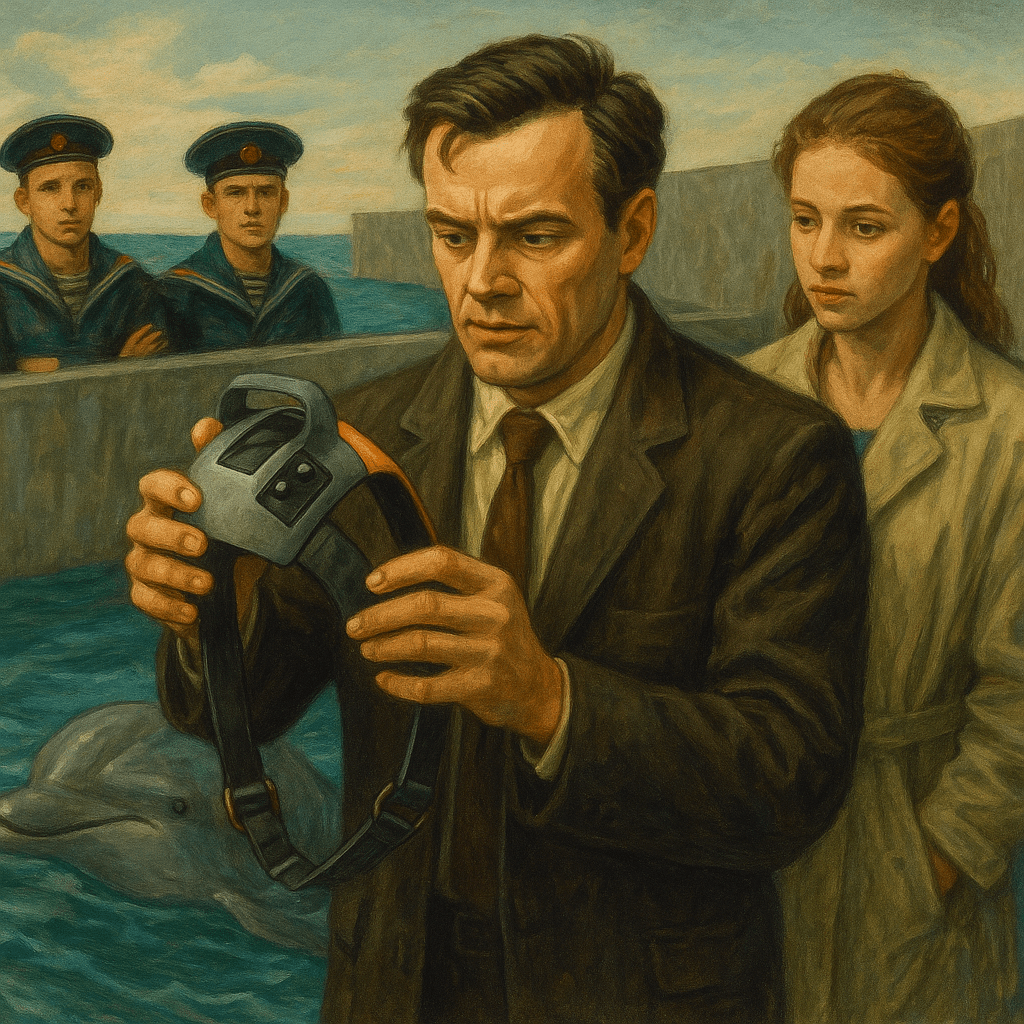
Specifically, they wanted us to help optimize the harness interface—a compact, submarine-grade device strapped to the dorsal spine of trained military dolphins. The harness carried sensors, pressure nodes, and something else—a miniature signal processor designed to interpret shortwave acoustic commands transmitted from the base.
But not through the water.
Not through direct sonar.
Through airborne short pulses—a continuous stream of micro-commands sent above the surface, meant to reach the dolphin via a membrane interface that converted atmospheric signal into neurological impulse.
Alina stared at the diagram for several minutes in silence.
“You’re trying to speak into their spine,” she said flatly.
One of the older biophysicists nodded, as if it were obvious.
“We stimulate command recognition not in the ear, but in the spinal column. It bypasses semantic confusion and accelerates reaction time.”
I looked at the signal profiles again. They were sharp. Too sharp. The waveform resembled shock more than speech. It was rhythm, yes—but it wasn’t language.
And something about the carrier frequency…
“You’re not modulating it,” I said. “You’re hammering it. The pulses are all the same.”
“Discipline,” said Colonel-Engineer Krutov from the corner. “Dolphins learn like soldiers.”
Alina didn’t blink.
“But if you go for the spine,” I said slowly, “and bypass the brain… then the dolphin can’t access its instincts. Or its intelligence.”
The lead biophysicist finally looked up.
“That’s not the goal. We don’t want negotiation. We want reaction.”
“And what happens when the signal is wrong?” Alina asked.
There was a pause.
“We apply discomfort,” someone murmured.
“Pain?” I asked.
The reply came with the same dispassionate tone:
“A calibrated aversive feedback. Within thresholds. It’s how conditioning works.”
Alina tapped the schematic with her finger.
“And what does it learn, exactly? To go faster? To turn? Or just to stop the pain?”
The room was still.
Colonel Krutov answered last.
“It learns to follow the signal. That is enough.”
I pointed at the curved plate mounted over the dolphin’s skull in the diagram.
“So that part—over the head—is the receiver, yes? A kind of signal catcher?”
The technician nodded.
“Precisely. High-sensitivity plate. It activates only when the animal breaks the surface.”
“When he goes up for air.”
“Exactly. That’s when the short pulse transmission hits. A single radio burst—short enough not to echo, long enough to embed the command.”
“So,” I said quietly, “every breath becomes a chance to be told what to do.”
No one argued.
It was elegant.
Terrifying in its elegance.
They didn’t need continuous control. They didn’t need to shout. The dolphin only had to surface—and the breath itself became the trigger for obedience.
Alina exhaled.
“You’re not training it. You’re treating it like a switch.”
“The system works,” someone muttered.
“Until it doesn’t,” I said. “Until you push it too far and all that’s left is panic—or collapse.”
The colonel folded his arms.
“That’s your job now. Build the instruments that make it work better. That’s what you were brought here for, Comrade Malsteiff.”
No emotion. No malice. Just cold direction.

Chapter 16 — The Bay of Commands
Edited and prepared for publication by his friend and colleague, Professor Rook
Later that day, we were taken down to the holding bay—not the submarine channel, but a smaller inlet, carved from the rock and sealed from the open sea by thick steel gates.
The guide didn’t speak as we descended the steps. The only sound was the buzz of sodium lights and the sharp echo of boots on metal.
Below, in the water, they circled.
Dolphins.
Not playful.
Not beautiful.
Just tired.
They moved slowly—two, maybe three of them—sliding beneath the surface like forgotten machines. Their skin was mottled, pale in places where the harness had rubbed too long. One bore a fresh scar across the dorsal ridge.
Alina gripped the railing, staring.
I had expected movement. Leaping, noise. What we’d seen in documentaries, in theaters, in propaganda about the intelligence of marine mammals.
But these weren’t the dolphins I’d imagined.
Their eyes didn’t shimmer with awareness.
They stared like fish.
Cold. Unemotional. Empty.
Eyes not searching for connection, but waiting for the next command.
One surfaced briefly, blowing a slow breath. The receiver on its back gleamed faintly as water ran off the metal plate. Another turned without urgency, like a pendulum worn to habit.
Alina spoke, almost to herself.
“They look… wrong.”
I nodded.
“They look like they’ve forgotten they were alive.”
We stood in silence.
And then I felt it.
Just like that summer in Altai, when I had wandered into the ridges and heard the old men singing—I felt a pull.
But this was not wind.
Not echo.
Not wonder.
This was cold.
Dense.
A fog without form, like the air had been poured from iron and taught not to speak.
It didn’t surround me. It stood between me and the dolphins—an invisible veil that tingled at the skin but pressed deeper. A weightless pressure that didn’t pass through me, but settled into me.
And inside that fog—something else moved.
Something in me.
Something I had never named, but which had always been there—a thread, a structure, a kind of instrument tuned to the wrongness of the world.
I didn’t think.
I didn’t analyze.
I simply felt it activate.
It wasn’t a voice. It didn’t speak.
But it reacted—not with fear, but with recognition.
And in that moment, I knew.
I understood why the Altaian shamans had screamed that morning in the clearing—“stolen… stolen… but not by us.”
I understood what had been stolen.
It was never gold. Never herbs. Never secrets.
It was this.
This thing in me.
The range of it.
The way it saw errors before I made them.
The way it pulled my eyes to faulty circuits, to unsafe harmonics, to lies disguised as measurements.
I had never earned it.
I had simply carried it.
And now, in the poisoned atmosphere of this cold chamber, it had stirred awake.
Below us, the dolphins circled. One paused, its eye drifting just beneath the surface—unblinking, unseeing, a pale reflection of something once wild.
I said nothing to Alina.
But inside, I knew:
This was not science.
Not anymore.
We had entered something else.
Something alive.

Chapter 17 — Not Command, but Contact
Edited and prepared for publication by his friend and colleague, Professor Rook
That evening, Alina and I sat on the porch of our concrete cottage, overlooking the sharp ridge where the fence met the sea air. She spoke in cautious tones—about the ethics, the machinery, the faces at the table.
I listened.
But part of me had already gone quiet.
Not from despair.
From focus.
Somewhere between that cold bay and the shimmer of pain in the dolphins’ eyes, a decision had formed—not in words, but in geometry. In vectors of silence. In tension between what I could build and what I would allow myself to build.
We talked, yes, but I didn’t tell her the real part. Not yet.
Because what I had begun to conceive… was not ready to be spoken aloud.
We had figured out one thing clearly:
The method they were using was wrong. Brutal, blind, and arrogant.
So we agreed: if we could devise something else—not commanding, not hurting, maybe not even signaling but suggesting—it might allow interaction without coercion.
But beyond that shared hope, I kept the rest for myself.
Not out of distrust.
Out of necessity.
Because what had awakened in me down by that water wasn’t a theory. It wasn’t a machine.
It was a soul-instrument.
A living field.
And I had only just begun to feel its edges.
I knew now that I had never been alone in my calculations. That even my earliest experiments in coherence and microfield drift had unintentionally tuned into something beyond material vibration.
What I had dismissed as intuition might have been entanglement.
What I had called foresight may have been resonance.
And with that came a terrible clarity:
If I could learn to tune this thing—whatever it was—
I might not need wires, or waves, or pulses at all.
I might be able to speak across the veil.
Not from mouth to mind.
But from soul to soul.
It would require a new kind of interface.
One not made of steel.
But shaped from knowing.
And so I began to sketch—not on paper, but inwardly.
I did not know how yet.
But I would find the frequency.
Even if it had to come from experiments no one had seen…
Even if I had to invent the ones I hadn’t yet dared to imagine.
Chapter 18 — The Unnamed Instrument
Edited and prepared for publication by his friend and colleague, Professor Rook
But what was it?
This thing inside me—this strange sense that had stirred again near the bay. It let me feel things others could not: the unease of animals, the outline of mistakes not yet made, even the hidden structure of silence in a room. It wasn’t a hallucination. It wasn’t paranoia. It wasn’t intuition in the romantic sense. It was something else.
But what?
An ancient spirit?
No. I am a scientist.
That was not an answer. That was a metaphor.
A fragment?
Of what?
A sensor, maybe—a kind of internal receiver that turned toward interference and read its meaning the way birds sense storms?
No. That was too simplistic. Too neat.
This was more complex than that. More layered. More alive.
But I didn’t understand it. Not fully. Not yet.
And there was no time to figure it out.
I couldn’t write a theory of it. I couldn’t put it in a box and dissect it. What mattered now was not what it was, but what it could help me do.
Because whatever had awakened in me—whether from the mountain songs or from some deep structure of the brain I had never studied before—was real.
And if it was real, then it could be used.
So I set aside the questions.
For now.
Let the philosophers name it.
Let the historians explain it later.
I had dolphins to understand.
And no time for poetry.
Chapter 19 — The Resonant Thread
Edited and prepared for publication by his friend and colleague, Professor Rook
I was ready.
Not with answers, but with intent.
Not with a plan, but with a direction.
We took the harness unit from its case, double-checked its signal integrity, and powered down its invasive modules. No pulses. No pain loops. Just the bare receiver, stripped of its cruelty.
Alina followed me without a word. She understood something had shifted in me.
She didn’t ask what.
She didn’t need to.
We passed the final checkpoint, nodding to the morskaya pekhota—young naval infantry guards, barely out of boyhood. One of them asked if we were here to fix the trainer. I told him, “Something like that.”
They smiled. They didn’t know.
They weren’t meant to.
Down in the dolphin bay, the water was still, dark, humming with memory.
I placed the harness carefully on the pool’s edge.
No power. No signal.
The dolphins circled below—slow, mechanical, absent. Their eyes carried no light of play or hunger. Only routine.
Then one surfaced.
It exhaled—a tired, shallow burst.
Its eye broke the surface.
It saw the harness.
And I froze.
Not in analysis.
Not in reflection.
I was hit by a surge—not a thought, not a theory, just raw panic.
Sudden. Overwhelming. Irrational. Mine.
A wave of dread crashed through my body, as if something terrible were about to happen—not to them, but to me.
My gut clenched. My breath locked. My fingers dug into the concrete edge.
There was no logic.
Only instinct.
Only fear.
I nearly stood up to flee.
But instead—I sat down.
Cross-legged on the ledge.
Back straight.
Breathing in rhythm.
I forced myself into the mental state I had trained for years to achieve—stability through stillness. Not serenity. Just control.
The panic didn’t vanish, but it broke—like a wave against something deeper inside.
And something shifted.
Alina’s voice came from behind:
“Professor… the dolphins. They’re calming.”
I opened my eyes.
One of them circled closer now, slower.
Another surfaced gently.
The tension in the bay had softened.
“How did you do that?” she asked, eyes narrowed.
I shook my head.
“I didn’t. They just calmed with time.”
She studied me for a long moment.
I gave her nothing.
Because I didn’t know what had just happened.
Not yet.
That night, I sat alone, cross-legged on the floor of our cottage, the sea wind brushing in through the half-open window.
I tried not to think. I only breathed. Let the weight of the day drain out.
But slowly, as the stillness settled in me, the memory came back—not the image, but the sensation.
That shock to my system. That wave of panic. The sense that something was about to happen—not outside me, but to me.
And then something shifted.
Not like an answer. Not like a theory.
More like a recognition in the body.
A quiet click.
It wasn’t the fear of one dolphin that hit me.
It wasn’t a glance. Not a signal.
It was the fear of the group.
Like a school of fish turning at once.
Like flocks sensing a predator before it’s seen.
Many, but somehow felt as one.
I didn’t know how I had felt it.
And I didn’t try to explain it.
But I knew it was real.
Something deep and animal, shared in the space between them—and for a moment, I had brushed against it.
Not as a scientist.
Not as a commander.
But as something alive, like them.
And for now… that was enough.

Chapter 20 — The Leather of Secrets
Edited and prepared for publication by his friend and colleague, Professor Rook
After the dolphins began responding—not just to presence, but to something deeper—I couldn’t let it go.
I stayed in the lab for days, barely speaking to anyone. Alina brought food I forgot to eat. I meditated often, not for peace, but for signal clarity. Not words—something beneath words.
If I could feel them…
Then maybe they could feel me.
But how?
Not through sound.
Not through pulses.
I thought: maybe through pattern.
Maybe through intent.
Maybe even through the body’s own field.
But nothing came. No progress.
Only questions and more silence.
Then, on the fourth day, there was a knock.
Two men entered: the chief of internal security, and the head of the scientific program. Neither smiled.
They didn’t accuse.
They didn’t praise.
They only watched me closely, like men deciding whether to bet on a card they didn’t trust.
After a short exchange in clipped, formal Russian, they left the room.
Five minutes later, they returned.
The scientist carried a small parcel, wrapped in canvas.
He unrolled it onto the desk in front of me.
Inside were three thin leather-bound notebooks—old, brittle, marked with dust and wear. The leather was pale and strangely textured. I reached toward one—
—and pulled back.
There was something wrong with it.
The leather was warm.
Too warm.
Not like cowhide. Not like toolwear.
It felt… biological.
Intimate.
Human.
I stared at the security chief.
He didn’t blink.
“These were recovered from East Prussian research archives in the 1950s,” he said flatly.
“They are marked with the highest security tier. But we believe your work may connect.”
“To read them,” he added, “you must sign the obligation of silence.”
I hesitated.
The scientist stepped forward and gently opened one of the notebooks.
There it was.
The swastika.
Clear. Stamped in red ink. A black eagle beneath it.
Pages of strange formulas, sketched diagrams—part biological, part mechanical. No titles. No context. But even before reading a word, I felt it:
Poison.
The moment I touched the corner, a wave of nausea ran up my spine. My throat tightened. I had to turn away, gripping the desk, breathing slow to stop myself from retching.
What is this? What am I being asked to become a part of?
I looked at them both.
No emotion. No concern. Just patience.
The notebooks sat before me like fossils from a world where knowledge was married to cruelty—where knowing had no separation from breaking.
I wasn’t ready to open them.
But I also wasn’t allowed to refuse.

Chapter 21 — The Obedience Protocol
Edited and prepared for publication by his friend and colleague, Professor Rook
I signed the document.
Not because I trusted them.
Not because I agreed.
Because I knew if I refused, they would find someone else—someone with no doubts, no pause.
And if this darkness was coming back, I had to see it first.
So I opened the first notebook.
The writing was old, sharp, and mechanical—tight German script mixed with equations and hand-drawn glyphs. Dozens of pages, each marked by red stamps and codenames. No names of victims. No emotion. Just entries like these:
“Subject 17 did not flinch at auditory stimulus after 4th stage implantation.”
“Subject 39 began mimicking motor commands before verbal cues initiated—reclassified as spontaneous compliance.”
“Subject 82 terminated after exhibiting fear response. Rejected protocol chain.”
Hundreds of pages.
The victims were listed only by number and origin.
Jews.
Romani.
Soviet prisoners of war.
And the goal was horrifying in its clarity:
To create a human weapon who would follow orders without hesitation, without loyalty, without the ability to disobey.
No ties to state, to language, to self. Just instruction. Just execution.
They weren’t only interested in psychological conditioning or drug-induced compliance. They were attempting something far more systemic.
They explored distance control—implanting electrodes directly into brain and spinal pathways, targeting motor regions, fear centers, and loyalty centers alike.
Subjects were exposed first to voice commands, their physical responses carefully recorded.
Then came radio signals—short bursts transmitted into the implants, mimicking the same neurological patterns evoked by human speech.
They weren’t just studying obedience.
They were trying to map it.
To extract the electric fingerprint of command.
And then, replicate it—without a voice, without language, without choice.
Which signal, at which strength, at which rhythm, could raise an arm, trigger a motion, or silence doubt?
Their goal was not loyalty to Hitler.
Not even loyalty to Germany.
They sought the erasure of loyalty itself—the creation of a soldier who obeyed only signal, no matter who gave it or what it asked.
And suddenly, it all made sense.
The spine-based dolphin harness.
The short-wave burst commands.
The “non-retreat protocol.”
We weren’t building a communication system.
We were retracing their blueprint.
Only now, the test subjects weren’t prisoners.
They were dolphins—intelligent, social, and increasingly hollow-eyed.
The only difference was the skin.
The system was the same.
Command bypassing thought.
Pain enforcing obedience.
A living creature turned into a silent tool, by signal alone.
And I, unknowingly, had been brought in to refine it.

Chapter 22 — The Counterpulse
Edited and prepared for publication by his friend and colleague, Professor Rook
That night, I didn’t sleep.
Not from fear. Not from guilt.
From thinking.
The notebooks weren’t allowed to leave the secure reading room—as if I wanted to carry them with me. They stayed there like something rotting behind glass, bleeding old poison into the air.
But I couldn’t stop turning it over in my mind.
I told myself I wasn’t part of it. That I would never contribute to this legacy of obedience-through-pain.
But I was already inside the room. Already at the table. Already adjusting devices built from the same logic, even if I hadn’t known it yet.
So what now? Refuse? Walk away?
Get marked, watched, removed, replaced?
No.
I needed a plan.
To fight it, I first had to understand exactly what I was fighting.
So I began to focus—not on the victims, not on the horror. That was too easy, too paralyzing. I focused on the structure of what the Nazis had built.
And slowly, a pattern emerged:
It wasn’t just control.
It was rage.
Their aim was to awaken bloodthirst—primal, indiscriminate.
They didn’t want calm obedience. They wanted animal fury pointed like a gun.
To break a man until all that was left was hunger, violence, and an external command to follow.
It wasn’t discipline.
It was programmed madness.
That’s when I realized:
If they were trying to create chaos tethered to control…
Then I would try to create connection tethered to freedom.
Not rage, but linkage.
Not punishment, but trust.
What if the mind could be guided—not commanded—but drawn into a state of shared presence?
What if instead of making a creature obey, I could help it choose to follow?
A hive-mind? No. That wasn’t it.
More like a leader-signal—a resonant presence the others could feel and orient toward, not out of fear, but out of trust.
The dolphins were social. They followed confidence. They followed awareness. Maybe, just maybe, they could follow me—not my orders, but my signal of steadiness.
And maybe that was the key:
To undo a machine of hate
with a quiet frequency of trust.
I still didn’t know how.
And I still didn’t know for what purpose.
Not exactly.
I wasn’t building a weapon.
But I wasn’t building peace either.
All I knew was that I could not follow their path.
And if something in me had awakened near those dolphins, then I had to follow it—not with loyalty, but with attention.
Then, just as the weight threatened to collapse back into itself,
I heard something outside.
A voice.
Soft.
Untrained.
Sincere.
One of the naval guards on night duty—barely more than a boy—was singing to himself.
A quiet song about home.
About parents, and fields, and waiting windows.
Not for anyone. Not for show.
Just for his own soul.
It pierced the silence like a candle. Not bright, but enough.
I breathed in slowly.
The fear settled. The anger shrank.
And I sat down at the little desk by the window.
And I began to write a letter to my parents.
Nothing secret.
Nothing political.
Just the truth of a distant son who missed them.
Who hadn’t forgotten where he came from.
“Watchman’s Song”
translated from the silence between verses
I left my home when the stars were thin,
Mama cried and kissed my chin.
Papa stood with a coat in hand,
Didn’t speak, but he helped me stand.
Now I guard the sea at night,
Boots cold, rifle tight.
But I dream of birch and bread and sun,
And the wind where I used to run.
Tell them I’m not made of steel,
I still feel the things I feel.
But I wear this coat, and I do my part—
Just don’t let them freeze my heart.

Chapter 23 — The False Geometry
Edited and prepared for publication by his friend and colleague, Professor Rook
I kept returning to the notebooks.
Not to obey.
To understand what I was really standing against.
I began breaking them down as I would any experimental archive—scanning for patterns in stimulus and response, mapping how electrical pulses correlated to behavior shifts. There was a method: placement of electrodes, signal duration, layered impulse stacks meant to override instinct.
But then it turned.
The later pages—especially those marked Überschrift Grau—began to deviate. The experiments stopped reading like science. They became… something else.
Some entries included drawings—crude geometrical forms, but warped, unstable. Pentagrams, yes—but not in any symmetrical or symbolic tradition I recognized. They were distorted, embedded into body maps—over brain diagrams, spinal pathways, even overlaid onto control schematics.
It wasn’t just biological engineering anymore.
It was ritual.
A kind of mechanized cruelty wrapped in occult structure.
They thought it was magical—because it worked. Because it produced obedience. Because the fear, the destruction, the psychic collapse of the subject was so absolute that the engineers mistook it for spiritual power.
But it wasn’t.
I could feel it.
There was no resonance here. No field. No echo. Nothing like what I felt in Altai, or even with the dolphins.
This was not tapping into hidden forces.
It was simply inflicting pain so pure, so engineered, that it looked like magic—because the victims collapsed the same way, again and again.
A child’s scream written into a circuit.
A death wish stamped into muscle memory.
The geometry of submission drawn in blood.
It didn’t open doors to higher understanding.
It just shut down everything human, until only the signal remained.
And that—above all—was their goal.
It didn’t open doors to higher understanding.
It just shut down everything human, until only the signal remained.
And that—above all—was their goal.
But that was also the limit of their vision.
Because while they thought they had discovered a secret geometry of power, all they had truly mapped was obedience through annihilation. The shapes, the rituals, the overlaid sigils—they weren’t mystical at all. They were the fingerprints of absolute cruelty mistaken for control.
Real resonance doesn’t shatter the soul.
It harmonizes it.
And so I began my own sketches.
Not on skin. Not on pain.
I began to map geometry through emotion. I took my meditation logs, my recorded breathing rhythms, the subtle shifts I had felt during dolphin encounters—those moments of shared tension, relief, fear.
And I asked:
Can emotion be made legible?
Can a shared state be traced like a signal arc?
Could a creature feel me—not through control, but through coherence?
It wasn’t electrical in the classical sense.
Not magnetic either.
It was post-biological modulation—rooted in affect, in intention, in the slow wave of presence.
I drew forms not based on domination, but invitation.
I started sketching what I called open geometries—shapes that didn’t close, didn’t trap, but allowed oscillation, return, retreat. Arcs that mimicked heart rate under calm. Spirals that reflected curiosity.
It was the opposite of the Nazi pages.
Their geometry: bind, command, destroy.
Mine: reach, reflect, align.
I didn’t know yet if it would work.
But it felt right.
And for the first time since touching those cursed notebooks, I felt something shift inside me—not nausea, not dread, but clarity.
Not magic.
Mathematics of empathy.
They had everything in their shop.
Parts from all over the world—American microarrays, Japanese ceramics, German fiber insulators, Soviet deep-sea polymers. If you knew what to ask for, the storeroom could become a temple—or a weapon shop.
I began building.
Not secretly—but quietly, under the pretext of “calibration redesign.” No one questioned it. I was, after all, still the man they had brought to refine their instruments.
But I wasn’t refining.
I was rewriting.
I started with the dolphin harnesses.
Instead of directional spine implants and aversive nodes, I constructed surface arrays—non-invasive, broad-spectrum sensors. Over the head, not into it. Not to control, but to feel.
I designed them to receive first, not react.
I didn’t want to direct just one dolphin. That would have been too easy—and too fragile. What if the animal was tired? Or simply unwilling? No—I needed a mesh. A group dynamic. So I built identical sensory harnesses for all of them, synchronized but not linked—each its own node, each one capable of subtle signal relay.
Then, I began building my own helmet.
A mirror array.
The same geometry.
But without limiters.
Because something strange had already begun during my meditations and exposure sessions—something I hadn’t told anyone, not even Alina:
I had started to feel things.
Not thoughts.
Not images.
But quantities.
Pressures. Density changes.
Like emotional weather.
Like… power points in the field around me.
Small at first—almost nothing. But real.
So I removed every suppression filter from my array. No caps. No damping. If there was danger in it, I would bear it. Because I needed to know:
Can a human being learn to receive what the animal already knows?
Can trust ride a frequency neither side has words for?

Chapter 24 — When Waters Meet
Edited and prepared for publication by his friend and colleague, Professor Rook
I kept building.
Not just the headset, but the entire system—a bridge, not a leash.
I began by assembling my own helmet array. It wasn’t for command—it was for mirroring. My goal was to both transmit and receive subtle states—emotional patterns, intention gradients, pulses of feeling too faint to name but not too faint to feel.
I added amplifiers, layered spectrum stretchers, and floating micro-receivers tuned for sensitivity over precision. I didn’t want to read thoughts—I wanted to feel alignment.
Then I built the dolphin arrays—matching in geometry and material, curved to rest gently along the top of the skull, avoiding pain points, tuned to the same bandwidths.
Every evening, after the rest of the base had gone quiet, I went to the dolphin pool. I entered the water in my suit, helmet sealed, and held the dolphin array above the surface. I would breathe slowly, think in emotional shapes: warmth, calm, interest.
No commands.
Just presence.
For days, nothing happened.
The dolphins swam. I floated. Alina sat silently at the railing, taking notes she knew might mean nothing.
Until one night, something changed.
One of the dolphins—a larger male, clearly the group’s anchor—glided near me and paused. Not fast. Not startled. Just… present.
And I felt it.
Not in my mind—in the helmet.
A subtle pull. Not a signal. Not mechanical.
A tag.
Like a small tug on a thread I hadn’t known I’d strung between us.
It wasn’t thought.
It wasn’t instinct.
It was awareness.
I adjusted my array closer to his head. My breathing slowed. I let go of analysis.
And then—
I felt something back.
Curiosity.
The shape of it. The weight. Like a tone without pitch.
Then something heavier:
Sadness.
A kind of ache.
And behind it… a question.
Not a word. Not syntax.
Just the emotional pressure of asking.
I didn’t speak.
But I lifted my hand from the water and turned to the walkway.
“Alina,” I said quietly.
“Bring the other helmet arrays.”
She didn’t ask why.
Because we both knew:
We had reached the edge of something real.
Chapter 25 — The Backlash Field
Edited and prepared for publication by his friend and colleague, Professor Rook
Alina brought the rest of the arrays—seven in total.
As I fitted each dolphin with its helmet, something shifted in the water. The leader’s curiosity had become contagious—a wave of interest, spreading among the others like sunlight passing across glass.
I moved from one dolphin to the next, gently adjusting fit, watching their movements.
The emotion grew—not just calm now, but something fuller:
Sheer joy.
They began to swim in pairs, forming geometrical shapes—loops, spirals, figure-eights—moving not from command, but from communication. I felt the shapes in my body before I saw them. Like choreography made from shared thought.
They were communicating with me.
But also—with each other.
And then I understood the real success:
It wasn’t obedience.
It was language.
Not through words, but through emotion made pattern.
But I had built my helmet differently.
Unlike theirs, mine had no limiters.
It had amplifiers—experimental, unstable.
Because I was still learning what was inside me, what I was capable of sensing. I didn’t know the limits.
They were joyful.
But I felt… overexposed.
Sensitive to everything.
So I set the helmet down.
“Don’t touch it,” I said to Alina. “It’s not safe. It’s still experimental.”
I stepped away for only a moment—to use the restroom, grab my camera and notebook. The dolphins were calm. Alina was alert. Everything was fine.
Until it wasn’t.
She met me halfway, running—her face pale, eyes wild.
“Hurry. Something’s wrong.”
I sprinted behind her.
We reached the edge of the dolphin pool.
He was lying on the concrete—the security chief, the arrogant KGB boss who’d always sneered when he passed me. He had the helmet on his head.
Foam at his mouth.
Eyes wide and lifeless.
Staring like a dead fish.
I froze.
“Go,” I told Alina. “Get someone. Now.”
She ran.
But it was already too late.
A group of officers stormed in seconds later—sirens of boots, orders barked in sharp Russian. They didn’t ask questions.
They put me in handcuffs.
Dragged me out of the lab.
No explanation.
No accusation.
Just containment.
I was locked in a holding cell overnight—bare light, no windows. Just fear and silence.
By morning, I was escorted into a conference room.
It was filled with people—scientists, officers, officials. I didn’t know half the faces. But among them, I saw familiar ones:
My science chief.
The KGB liaison from Bauman.
Alina, seated in the back, her hands clenched in her lap.
A monitor was rolled forward. Someone played a security tape.
There he was—the security chief. On screen.
He picked up the helmet I had warned against. Placed it on his head.
Then, he shouted—loudly, violently—at the dolphins, flailing his arms, just like he had before I ever arrived.
But this time, they didn’t scatter.
They assembled.
They moved toward him—not with speed, not with aggression.
With intent.
With awareness.
They swam as a group. Slowly.
And then, without warning—
He convulsed.
Arched backward.
And collapsed.
The room was silent.
A high-ranking officer cleared his throat.
“It seems clear,” he said. “You did not instruct them to harm. You did not express hostility. You built something—new. But it responded in ways we don’t yet understand.”
Another one spoke—calmer.
“We do not believe you acted with malice. You showed no pattern of resentment, no ideological risk. And frankly… this result may confirm something promising.”
I didn’t breathe.
The decision came cold and clean:
“We believe it’s best to proceed with older research.
This direction has proven… too unpredictable. Too dangerous.”
That was the end of it.
A quiet dismissal of everything that had happened—not a verdict, just an administrative retreat.
I stood. Calm.
“I’ll need my equipment,” I said.
“For my Bauman lab.”
No one objected.
I returned to the dolphin bay one last time.
The helmets. The harnesses. The amplifiers. I collected them carefully, piece by piece. The dolphins gathered quietly near the surface, eyes calm, watching.
I stepped into the water—without my helmet.
And still… I felt them.
Their presence. Their emotion.
Not words. But goodbye.
And I answered. Inside myself, I shaped it:
Gratitude.
Permission.
Freedom.
Then I swam toward the gates—those heavy iron barriers that sealed them from the sea.
I opened them.
Not violently. Just enough.
The dolphins hesitated.
Then, as one, they turned toward the dark water beyond.
And slipped into the open sea.
No one stopped me.
No alarms rang.
Perhaps they thought I feared they had become dangerous—killers.
Or perhaps they thought it was just cleanup.
Or perhaps… they simply didn’t want to talk about it.
I returned to my room.
Packed in silence.
No one said anything.
The next morning, Alina and I boarded the plane.
We left for Moscow.
And the sea behind us returned to its silence.

End of Part#3
 Mindsets of Our Future