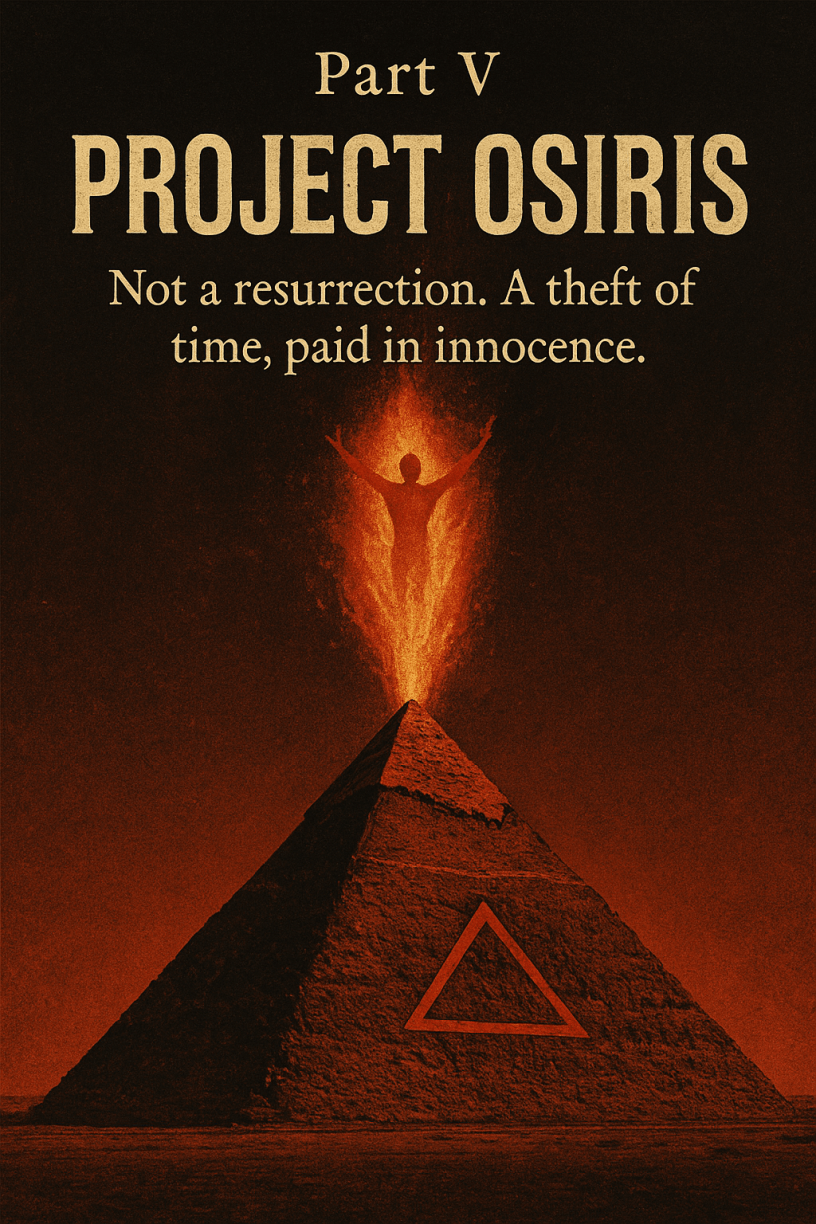
Not a resurrection. A theft of time, paid in innocence.
Chapter 33 — Flight to Shoria
Edited and prepared for publication by his friend and colleague, Professor Rook
They let me keep the instrument.
The official note said: “For academic reassignment under supervision.”
But we all knew what that meant.
They had the blueprints, yes. They had my circuit layouts, my outer geometries. They even had the names of the alloys.
But they didn’t have the patterns. The frequencies. The living configurations I tuned in real time—not drawn, but felt.
That came from the gift—the thing awakened in Altai. That intuition that let me match pulse to depth, tone to silence.
And so, I took it. My resonator-emitter. Crated, shielded, logged as “Field Calibration Instrument — Passive.”
I boarded the plane.
Destination: Ural Mountains.
Or so I thought.
Somewhere above the taiga, a technician approached me, leaned in quietly.
“Change of destination, Candidate. You’re being rerouted.”
I raised an eyebrow.
“Where?”
He hesitated, then whispered like he was saying something forbidden:
“To a structure discovered in the mountains near Gornaya Shoria. They believe it might be the oldest pyramid on Earth.”
I turned to the window.
Below us, vast sheets of forest and stone passed in silence. Rivers like scars. Peaks like teeth.
Somewhere out there was a mountain with a melted face—a shape too perfect, and too damaged. Rock fused like glass. Slopes not eroded, but warped, like clay under a blast furnace.
No one said the words. But I knew what they were thinking:
Energy weapon.
Ancient civilization.
Something buried and broken.
Something still breathing through stone.
And they were sending me—not because I believed, but because I knew how to listen.
Not for history. Not for myth.
But for resonance.
The kind of signal stone remembers.
Even when people forget.
The landing was smooth, uneventful. A small airstrip hidden between tall timber and low stone ridges. The kind of place that looked like it was built not for convenience—but to disappear.
From there, we boarded an old GAZ-66 truck. Canvas-topped. Rattling. The road was mud and gravel and white bark trees that watched in silence.
We drove for hours. No music. No radio. Just the sound of tires over frost.
Eventually, the trees opened. And in the distance: a dark rise of stone. The mountain.
We didn’t drive straight there. They took me first to a small station—a former geological base turned research post. Concrete rooms. An iron stove. A cot.
I was told:
“You’ve been working hard, Candidate. Complex problems. We think it’s best you take some time. Acclimate. No pressure.”
They smiled.
They were lying.
Those bastards knew exactly what they were doing. They knew I’d start walking. That I wouldn’t sit still.
So I did. I walked.
I thought about Kola. About the silence. The scream. The empty field.
I wandered farther each day. Let my legs move without plan.
And eventually—I wound up at the site.
They had opened a shaft. Not a drill, this time—an ancient shaft. They were cleaning it—hauling out molten rock, collapsed stone, and blackened debris.
I stood there for a long time, staring in disbelief—half amused, half astonished. The sight before me was absurd and profound at once.
An ancient shaft, dug by who knows what hands, being cleaned by Soviet engineers with shovels, winches, and muttered curses. Molten rock chipped away with pragmatism. Debris lifted like it was just another day’s assignment.
My first instinct was to laugh.
But the longer I stood there, the less funny it became.
Watching.
Listening.
And already…
I felt something starting to rise again.
Not from the earth.
From me.
The next morning, in a small makeshift briefing room smelling of coal smoke and damp wool, they told me the story.
The discovery hadn’t been made by the state. Not at first. It began with a group of local enthusiasts—geologists, prospectors, even a retired military radio technician—who had brought rudimentary resonance mapping equipment to the site. Not from orbit like the Americans might have tried, but directly, on foot, with old field gear and stubborn ambition.
They had pinged the mountain. And something had pinged back.
A hollow space. A cavity too regular. Echoes that didn’t scatter like natural voids, but bounced in rhythm—in architecture.
They started to dig.
But you can’t hide excavation in Russia. Not in the mountains. Not where everyone is watching everyone else for signs of hidden gold, illegal diamonds, or even black-market uranium. It didn’t take long before the authorities knew.
And once they knew—it wasn’t a discovery anymore.
It was an assignment.
That’s why I was here.
So I waited—with other scientists who had been brought in, like pieces on a board no one fully understood. We shared tea and silence, theories and thin cigarettes. The question that hung in the air wasn’t what we were supposed to be doing—but what had really happened in Kola.
I told them little. Listened a lot.
And in the quiet hours, I read.
There was a fresh shipment of international scientific journals—translated, censored, but still valuable. I devoured them. All the newest developments in quantum mechanics, field theory, resonance coupling, and early talk of nonlocal interactions.
This was the edge of global thought—1980, as the world began to peek behind the curtain of particle physics and saw patterns instead of particles, fields instead of forces.
I began to build my own thoughts again.
Not to publish.
Not yet.
But to prepare.
Because something here—beneath this mountain—was waiting to be understood.
And maybe, this time, I’d understand it before it screamed.

Chapter 34 — Signal in the Bones
Edited and prepared for publication by his friend and colleague, Professor Rook
While the mountain pyramid was being cleared—molten rubble carted out by grim-faced engineers and silent soldiers—I spent my hours in quieter ways.
Not idle.
Just still.
I read.
Not just sanctioned Soviet science, but the latest global abstracts—fringe journals, private reprints, unlisted manuscripts, scanned translations sent in diplomatic pouches from “scientific allies.”
There were patterns surfacing.
Whispers of field effects that couldn’t be mapped to particle flow.
Experiments in Japan and the Netherlands hinting at localized coherence fields—pre-conscious shifts before physical response. Some papers read like dreams, but some felt familiar.
And always, in the back of my mind: the dolphins.
What had they done to that KGB man?
It wasn’t physical. Not fully. He hadn’t drowned. He hadn’t been struck.
It was a transmission.
Something sent from soul to soul.
Or—more precisely—from pattern to pattern.
A kind of resonance. A compression. A scream too deep for sound.
I remembered the feeling. When it hit me too—like a wire driven through my heart.
So now, I had time. And the gear.
The dolphin helmets were shipped from Bauman. Sealed, functional, scrubbed of labels.
The human helmet—experimental, still dangerous—came packed with a warning sheet signed by someone who probably no longer worked there.
I had the full Kola field array, in smaller form. My resonator-emitter. My coils.
And I had a new question:
What happens when you connect two living fields—not to transmit information, but state?
I thought about testing it on my roommate.
At night. While he slept.
No.
Never again.
Not without consent. Not after what I’d felt.
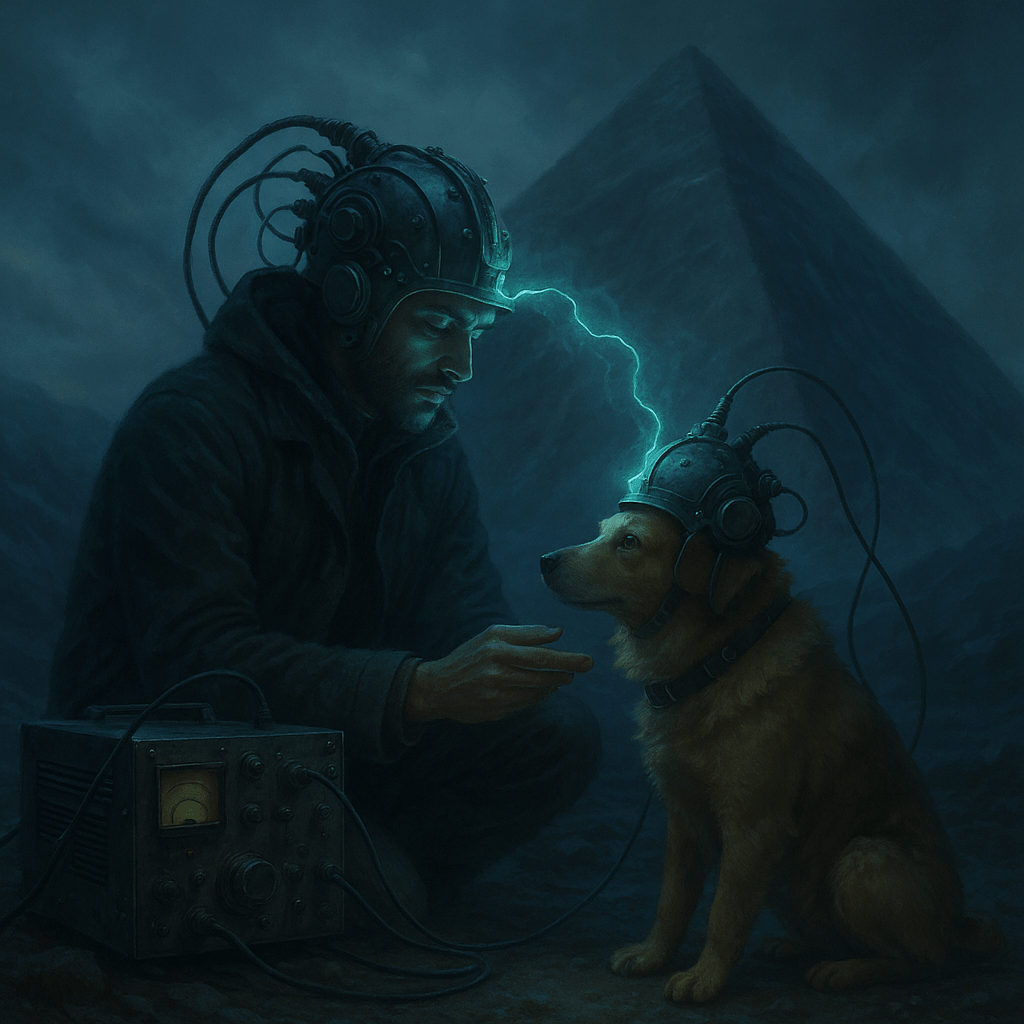
But we had a group of dogs—half-wild, tolerated by the soldiers, occasionally fed. No one tracked them. No one would miss them for a few hours.
So I took one.
Calmly. Gently.
Hooked the array to my own helmet. Tuned the signal strength to minimal. Not a pulse—just a presence.
Then I lowered the second helmet onto the dog’s head.
And I began to listen.
Not for sound.
Not for language.
But for pattern recognition.
I wasn’t trying to read the dog’s thoughts.
I was trying to feel if the dog could feel mine.
And almost immediately—I felt something.
A twitch in my jaw. A flicker at the base of my skull.
Interest.
Hunger.
Warmth.
Not thoughts.
But edges of being.
We had contact.
And somewhere behind the stone wall of the mountain pyramid, I felt that something was… waiting.
Chapter 35 — The Strange Defense
Edited and prepared for publication by his friend and colleague, Professor Rook
While the pyramid site continued to be excavated—layer by layer of scorched stone pulled from the shaft—I found myself drawn inward again.
Not into the ground.
But into my work.
The experiments with the dogs had awoken something sharp in my thinking, and the signal interactions I had captured at Kola were still echoing through my memory.
And so I began to write.
My doctoral dissertation.
I called it:
“Biological Field Coherence in High-Amplitude Quantum Vibration Systems”
It was bold.
Too bold, perhaps.
But I wrote it in a rush of clarity—one breath, as if something in me had waited years for the chance to speak.
I included formulas, charts, resonance maps, even experimental logs from my adapted dolphin arrays.
Everything.
Everything except one thing:
The source.
I never mentioned my personal sensitivity. Not the gift. Not the field within.
That would come later. That was not for this paper.
When I sent it to Bauman, I expected it to vanish into months of bureaucratic fog.
Instead, one month later, I was summoned.
“Your defense is scheduled.”
No warning. No revisions.
Just a ticket.
And a seat.
The room was strange.
Not the hall I remembered.
Not many familiar faces.
But many titles. Many eyes.
Professors—yes. But also men I didn’t know. Clean shoes. Cold expressions. My former KGB liaison was there too, seated beside two strangers who didn’t smile.
Still, I burned.
I spoke like fire.
Theories. Equations. Experimental methods. Predictive modeling. The potential of high-resonance fields in biologically interactive environments.
I held nothing back—except the core truth.
That the instrument was not just my creation.
It was my extension.
And then it was done.
I walked out a Doctor of Technical Sciences.
Or so I thought.
Minutes later, I was summoned again—this time to the Rector’s office.
He did not smile.
He shook my hand and urged me, in soft voice:
“Return immediately. Do not linger in Moscow.”
No explanation. No ceremony.
Just a gentle dismissal.
Something had changed.
At the airport, as the boarding call echoed through the terminal, I stood alone by the gate—briefcase in one hand, the cool weight of my title in the other, and a silent question pulsing in my chest.
I boarded without looking back.
The plane rose into dusk.
I flew back to Shoria, mind blazing.
The pyramid was still waiting.
But now—I carried a new title.
And more than that…
I carried proof that the Earth could hear us.
And maybe,
just maybe,
we were close to understanding what it wanted to say in return.
Chapter 36 — The Descent Begins
Edited and prepared for publication by his friend and colleague, Professor Rook
When I returned to camp, everything had changed.
People ran between tents, voices raised, hands gesturing, half-packed gear scattered across snow-crusted tarps. There was no panic—only excitement.
A kind of controlled frenzy.
I walked straight to the senior science tent. The flap was open. The air inside buzzed with heat, noise, and anticipation.
The lead coordinator—bearded, sunburned, heavy coat half-off—saw me first.
“Professor! You’re right on time. We’re through. We broke through.”
I raised an eyebrow. “How deep?”
He waved a clipboard. “No idea yet. But it opened. Clean. We’re assembling the first descent team now.”
“Am I in?” I asked.
He grinned. “If you’re not too tired.”
I said nothing.
Just nodded.
“I’m in.”
The plan was fast and light:
- No heavy instruments.
- Just lights, portable sensors, sealed water packs, field rations, coil rope, and med kits.
- A pair of trained climbers, three scientists, and a support geologist.
Recon first. Data second.
They didn’t want to risk damaging anything. Not yet.
No careless boots against ancient dust.
No flimsy interns to drop fragile finds.
Just us.
Eyes, minds, and quiet hands.
I took my small toolkit and one addition: the modified field array helmet, reassembled after the dog experiments, now paired with a pocket-sized field meter designed to detect subtle vibrational anomalies.
We lined up just before dusk.
Harnesses adjusted. Radios checked.
The air was sharp with cold—and tension.
The mountain stood silent.
Waiting.
We entered at dusk.
The opening was narrow, but clean—like a vertical slit cut by something precise and deliberate. Not a natural fracture. Not a crude excavation.
The air inside was stale, but not dead. Dry. Cool. It carried the mineral tang of old basalt, mixed faintly with something else—like ozone and iron.
There was almost no dust.
Our boots crunched against ancient stone, but no cloud rose. The walls, smooth in places and jagged in others, pressed close. Light danced over surfaces that sometimes shimmered with mica and sometimes seemed to absorb the beam entirely.
The deeper we moved, the more the atmosphere changed.
Not colder.
Not darker.
But heavier.
As if pressure—not of rock, but of attention—settled on the mind.
No one spoke much.
The rope team led us down—carefully setting anchors into pre-drilled niches that shouldn’t have existed in a mountain. The shaft descended not in jagged curves, but in measured geometry—a slow spiral, almost like the inner coil of a seismic trumpet.
At times, I reached out with gloved fingers to touch the wall.
And I swear: the stone vibrated faintly, like a held breath.
I checked my field array.
Readings low.
Still—not zero.
At roughly 100 meters down, the shaft leveled.
A natural landing or a designed platform—we couldn’t tell.
But there it was.
A horizontal corridor, perfectly straight, extending forward into complete silence.
No carvings.
No writing.
No decoration.
Just stone.
And the feeling of a mind not present—but remembered.
We paused.
Took our bearings.
And then moved forward.
Toward the heart of the pyramid.
The corridor ran straight—unnaturally straight—all the way into the center of the mountain.
After perhaps another hundred meters, it opened.
Into a chamber unlike anything we had expected.
A vast symmetrical hall. Quiet. Cold.
The walls were formed of some black stone—so smooth they reflected our headlamps like oil mirrors, shimmering and infinite. They rose high, curving inward but disappearing into darkness above, as if the ceiling had never been finished… or was never meant to be seen.
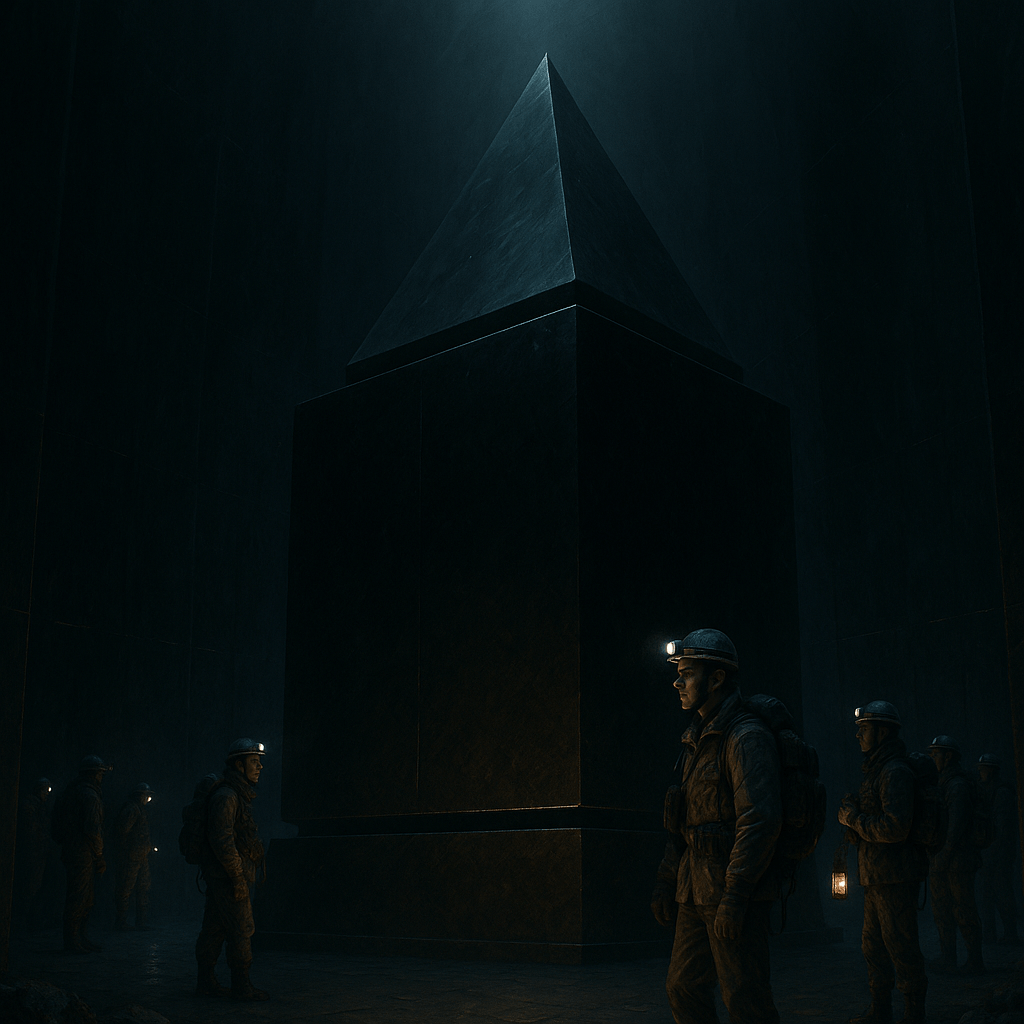
In the exact center of the hall stood a massive shape.
A monolith.
A sarcophagus.
Black. Square. Immense.
Approximately five meters long by five wide and four high. Made of the same reflective stone, but deeper—its surface absorbed light, color, even thought.
We stepped closer.
On top of the sarcophagus was a second shape: a pyramid.
Perfectly proportioned. Joined to the lower mass with such precision that only a thin hairline seam ran between them.
A capstone.
That’s the word.
A capstone, shaped like a perfect miniature of the pyramid above us.
I raised my field array.
No spikes. No radiation. But the vibration through my feet changed.
Like a chord being tuned, one note at a time.
We circled it slowly.
No inscriptions.
No markings.
No sound.
Only presence.
And in that moment, I understood:
This wasn’t built to hold a body.
It was built to hold a frequency.
We circled the chamber slowly, trying to stay calm—trying to hide our excitement.
The space was roughly 30 by 30 meters—perfectly symmetrical, like the inside of a cube carved from polished darkness. We stood near the sarcophagus in quiet awe, every breath fogging in the still air.
This was the kind of discovery you read about in cracked books or whispered theories—not something you expected to stand inside of.
We knew better than to touch it. We didn’t even unpack most of the gear.
Instead, we turned back.
Climbed out.
To plan. To prepare reports. To figure out how you open a thing not meant to be opened casually.
But at the exit—
We found a welcoming committee.
KGB. Spetsnaz. Black coats. Cold faces.
Guns lowered but present.
Eyes unblinking.
We stepped into the light, and they were already there—waiting.
Of course they were.
What did we expect?
Publication in National Geographic?
We were asked to follow.
No shouting. No need.
Just quiet, practiced efficiency.
They led us across camp toward the main command tent.
And in the fading light, we saw it:
The base had changed.
Fences. Barriers. New checkpoints.
Men with rifles. Radios on their chests.
The cheerful cluster of tents we had called home now looked more like a Gulag outpost.
Zones were marked.
Signs posted in red.
Access was now tiered—cleared personnel only, guards at every transition.
Our mood—buoyant only hours before—had evaporated.
We looked at each other but said nothing.
We knew.
The discovery was no longer ours.
Chapter 37 — Preparing the Lift
Edited and prepared for publication by his friend and colleague, Professor Rook
They wasted no time.
By the next morning, the descent party had been dissolved and replaced with a full operations crew—dozens of technicians and engineers, some flown in overnight.
Their job: prepare the chamber for extraction.
Ladders were lowered. Flexible strapping and load-dispersing beams were brought in. Welders worked in pairs, assembling a modular lift frame strong enough to surround the monolith and anchor a mechanical pick-up cradle.
Above the shaft, an industrial generator roared to life.
Massive cables fed into the darkness below—thick as a man’s wrist, snaking down like roots.
A bank of floodlights turned the once-silent hall into a stage of harsh shadows. Their beams chased every angle, yet seemed to stop short of the far edges. The walls still reflected light in that strange, uneven way—as if bending it inward.
And then there was the ceiling.
Or rather—what should have been the ceiling.
Directly above the black sarcophagus, in the upper curve of the pyramid’s heart, a perfect square shaft extended straight upward—just half a meter wide, like a chimney carved by precision tools.
We shone our lights into it.
The beam disappeared after ten meters.
Swallowed by something—mist? smoke? distance itself?
There was no dust, yet the light faded like it was being absorbed or scattered by something invisible.
Some of the crew made jokes.
Most didn’t.
No one liked to be left alone in the chamber.
Even with the full glow of cesium lights and two-way radios crackling on open channels—
There was a weight to the space.
As if something was standing right behind you.
Some said it was superstition. Some said it was nothing.
But I knew what I felt.
The mirrored walls weren’t just reflecting light.
They were remembering us.
And somewhere in the dark geometry of that capstone shaft… Something was reflecting back.
Chapter 38 — The Capstone Moves
Edited and prepared for publication by his friend and colleague, Professor Rook
The frame was finished by morning.
A welded lattice of reinforced titanium struts formed a cradle around the monolith. Precision actuators had been mounted at opposite ends, designed not to lift, but to apply rotational pressure—in perfect counterforce, counterclockwise.
It wasn’t theory.
It was ritual translated into engineering.
When the team activated the rig, the sound was mechanical and visceral—steel flexing, gears tightening, metal sighing into motion.
Then the hiss.
A thin scream of pressure escaped between the two stones—the base and the pyramid-shaped capstone.
And then… movement.
Slow. Reluctant. Almost imperceptible at first.
But real.
The pyramid rotated, just a few degrees—but enough to break the seal.
A rush of black fog—not gas, not dust—streamed upward through the chamber.
It smelled of ozone, wet iron, and something else: age.
The stone had been polished to such perfection that it glided under the force—like glass over ice.
No one touched it. No one cheered.
We stood silent.
But inside—I was not.
Because only I could feel it.
Not through the hands.
Through the field.
As the capstone moved, a pattern broke.
Not physical—energetic.
For a moment, I felt it: a decay, like the unraveling of a woven tension held for ten thousand years.
Where there had once been coherence, I now felt only cold.
A collapse of memory. Of force. Of presence.
It struck my mind not as a sound, but as a shape—an impression of emptiness, like empty sockets where eyes once watched, now hollow.
The dread wasn’t superstition.
It was a record.
What had been sealed wasn’t just stone.
It was a field, preserved by geometry, locked by resonance, and now—
Released.
And whatever had once spoken through this stone—
Had stopped listening a very long time ago.
Chapter 39 — The Reveal Below
Edited and prepared for publication by his friend and colleague, Professor Rook
We had the numbers.
A basalt block that size—five by five by seven meters—was unmovable by human hands. At nearly 175 metric tonnes, no crane we had in the mountains could lift it cleanly, not without months of setup and extreme risk.
And the engineers knew that too.
So before anyone even suggested rolling it aside or lowering it whole, we checked the surface.
We turned the lights upward and down.
And that’s when we saw it.
It wasn’t a sarcophagus at all.
It was a lid.
The polished base of the black monolith was not solid.
A shaft—square and seamless—descended beneath it.
A well, perfectly cut.
Leading straight down.
The air above it shimmered slightly. Our lights reflected oddly at the edge. Not like smoke or mist, but like looking through bent glass.
A decision had to be made.
So another crew was assembled.
This time, carefully.
Not everyone was invited.
Only those trusted.
And though I was still young—not yet thirty—
I had a history.
I had a name.
A Doctor, yes.
But already known in select corridors.
Even the KGB officers—who never smiled and rarely blinked—stood straighter when I entered. Some of them knew who I was. Knew my work.
Knew what I had done in Crimea.
Knew what happened at Kola.
And now I was here.
Standing at the edge of a shaft that was never meant to be reached.
And this time—
We weren’t descending into Earth.
We were descending into memory.
We were all full of expectations.
The atmosphere around camp had shifted again—not just in tension, but in ambition.
The team from Novosibirsk had arrived with theories and notebooks. They were eager—some whispering about buried artifacts, others already sketching speculative reconstructions of what the shaft and chamber might have once been used for.
They wanted to solve the puzzle.
They wanted to publish.
But I didn’t come to solve a mystery.
I came to listen to a frequency.
And not everyone was naïve.
There were one or two—perhaps more—among our team who knew exactly who I was. They had read my dissertation. One of them, I later confirmed, had helped peer-review it under a pseudonym.
There would be no secrets. Not here.
The descent roster included:
- Two archaeologists from Tomsk State
- A climber-engineer named Mikhail Reznov with a background in narrow-shaft mine rescues
- My two field techs: Sergei Levin and Tanya Morozova from Novosibirsk
- And two observers from the KGB scientific division, names not given—faces not forgotten
We had rope. Lights. Tools.
And the unshakable feeling we were entering something not meant for us.
But we went anyway.
Because nothing this silent stays hidden forever.
Chapter 40 — Beneath the Lid
Edited and prepared for publication by his friend and colleague, Professor Rook
The platform was ready.
Steel beams bolted. Lifting arms tested. The lowering winch—a two-stage electromagnetic descent motor—was humming quietly by the time we reached the chamber that morning.
One by one, we were lowered through the shaft—through the stone throat beneath the monolith capstone—into the level below.
We landed on a ledge of polished basalt, wide enough to accommodate four men side by side.
A circular gallery surrounded the shaft—perhaps three meters wide, perfectly symmetrical.
We had descended into a hollowed ring.
A platform around a shaft.
For a moment, we thought we were trapped.
But the Novosibirsk team had already begun probing the walls. They’d been at it for hours before we arrived—scanning with echo pings, applying pressure to polished seams.
They were digging—and cutting—
Using diamond and corundum-tipped blades to follow the signal.
Soon, a section of the stone gave way—almost too cleanly.
Behind it, a staircase.
A spiral.
Running down, hugging the inside curve of the gallery wall.
Lit now by our lights, it seemed impossible. Not because of its presence—but because of its condition.
It looked unused.
Untouched.
No scuff marks. No signs of wear.
The dust—what little there was—seemed to have fallen in from above, not settled through passage.
And then we noticed something else.
The size.
The rise of each step was taller than expected. The width, too wide for a single stride, too short for two.
We descended slowly, and the feeling grew in all of us:
We felt like children.
Not unwelcome. Not in danger.
But small.
As if this place had been made—
Not for people like us.
But for something else.
There was an urgency in our steps.
We almost competed, half-joking, half-driven—racing down the steps into whatever lay below. The deeper we went, the more the silence turned palpable, as if every level peeled back layers of time itself.
Minutes passed.
Then an hour.
Eventually, someone checked their watch. An hour and a half.
The walls were beginning to press on us—not physically, but mentally. The atmosphere had a rhythm, like a deep drumbeat we couldn’t hear but could feel behind the ears.
We stopped.
We rested.
Water. Dried bread. A quiet argument between my assistant and a Tomsk archaeologist about who would return to the surface. They both went—reluctantly.
We waited.
And then—
We reached the bottom.
A final platform.
Not vast, but deliberate.
Octagonal. Smooth. Warm to the touch.
And in the center—
Monoliths.
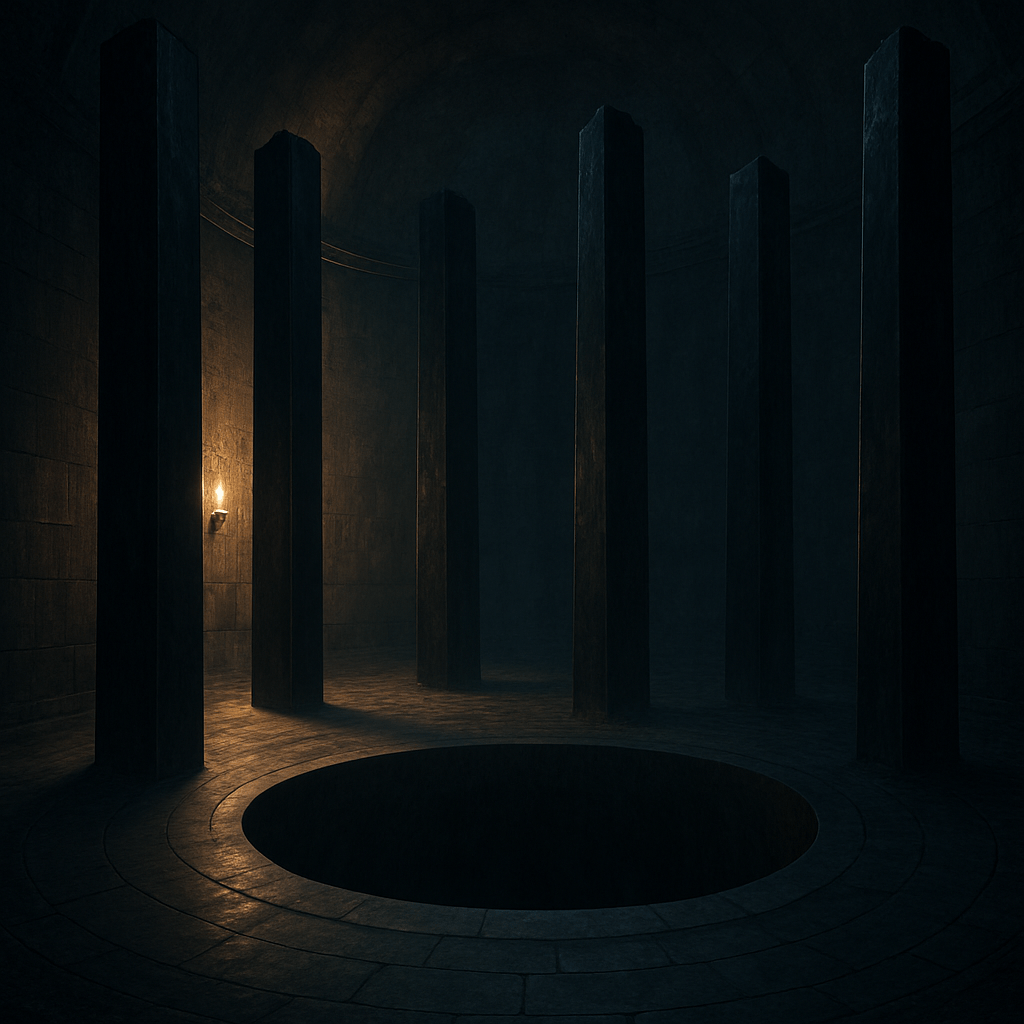
There were at least twenty of them.
Not small.
Not decorative.
They were massive—each one rising nearly twenty meters high, narrow and elongated like upright basalt planks, roughly two meters wide and half a meter thick. They stood in strange, irregular patterns, not concentric, not evenly spaced—like someone had grown them from sound instead of stone.
Each pillar was cut from a dark, impossibly hard stone—smooth as glass, black as oil—and when our lights swept over their surfaces, they did not simply reflect.
They vibrated.
Low.
Slow.
The frequency wasn’t loud, but it made our bones ache and our stomachs turn slightly—like standing beside a running engine deep underground.
The room itself was built to carry it—walls gently curved inward, no right angles, everything shaped to bend the hum back inward.
The monoliths were resonators.
Not symbolic.
Not ritualistic.
Instruments of deliberate, physical harmonic construction.
And we had just stepped into their orchestra pit.
Beyond the resonators, there were no more stairs.
The spiral had ended. The floor beneath our feet was smooth, sealed, ancient.
There was no visible path down.
But in the center of the chamber—the same shaft that had guided us from the surface—continued downward. A dark, vertical throat.
I stepped to its edge.
Shone my light.
Nothing.
The beam vanished like before—swallowed by shadow, or space folded in on itself.
And I knew.
This shaft didn’t just go down into the Earth.
It descended into something else.
Another layer of space.
Another structure of meaning.
Another dimension.
But there were no steps.
No rope.
No ladders.
Only the feeling that the descent would not be physical.
Not this time.
And yet—
I felt it.
A field—not rising, not pulsing, but dispersing.
There, at the edge of the shaft, it surrounded me like a forgotten melody fading into static.
A disorganized field—its coherence shattered, its pattern broken.
It had lost something.
Perhaps its meaning.
Perhaps its soul.
Whatever had once vibrated through this structure was now fractured—a memory struggling against the drag of entropy.
I reached for my emitter.
Tuned it again.
I needed to recalibrate.
To measure quantum vibration patterns now on the edge of collapse.
The only way forward wasn’t to descend physically.
It was to reassemble the pattern.
To fight the silence with signal.
I reached for my resonator-emitter and turned it on.
And though the device recorded almost nothing,
I felt it in my chest:
A pressure building—
Not toward explosion, but alignment.
We had reached the first true structure of intent.
A chamber not for burial,
But for resonance.
Chapter 41 — The Resonance Returns
Edited and prepared for publication by his friend and colleague, Professor Rook
The resonator monoliths weren’t just tall.
They were titanic.
Each one now revealed in full height—rising twenty meters into the chamber’s dome, their black basalt surfaces vanishing into the dim curvature of the pyramid’s subterranean geometry.
We stood beneath them like insects under pylons.
And yet—
They were silent.
At least to everyone else.
I walked among them with the helmet on—no signal.
No shift.
No pulse.
Just the stale breath of hollow stone.
But something was there. I could feel it. Dormant.
So I did the one thing I had not yet tried:
I activated the emitter.
Not the new one.
Not the lab-calibrated frequency spreaders used by the archeoacoustic crew.
My emitter.
The one I had tuned at Kola.
Low amplitude.
High coherence.
Patterned on the nonlinear tremor I felt in that shaft long ago.
I set it to pulse.
Held it in my hand.
And I waited.
At first—nothing.
Then—
A shift.
Not in sound.
In me.
A vibration, low and full, started in my gut, then rippled outward through the ribs, the spine, the shoulders.
It wasn’t pain.
It was alignment.
At the same moment, the receiver module began to activate. Lights on the housing flickered. The internal coil hummed. The field was starting to answer.
It wasn’t speech. It wasn’t a message.
It was presence.
Something below—or beyond—had noticed.
And now, I wasn’t just listening.
I was being heard.
But then—
I turned it off.
Quickly. Quietly.
No one else noticed.
No alarms. No blinking panels.
Just a hand on the switch and the sudden absence of vibration in my ribs.
Because something wasn’t right.
I didn’t think it was a response from below—not a machine, not a chamber.
What if it wasn’t an ancient device?
What if it was the Earth itself?
A psychoenergetic quantum resonance diaphragm—
the very boundary described in our theory.
I needed to think. To understand.
To interpret what my soul-instrument had aligned with.
Meanwhile, the team was regrouping.
The descent crew had orders to return to camp for rest. I went with them, quiet, eyes down, lost in calibration patterns and spiraling internal field diagrams.
As we ascended, others were already at work—lowering new cables, reinforcing guide rails, assembling another platform to reach deeper into the shaft.
But I wasn’t eager to descend again.
Not this time.
Something in me resisted.
The field had opened—and closed.
And what I had felt wasn’t finished.
That night, I barely slept.
And in the early morning, we were summoned.
The camp boss wanted us in his tent.
No reason given.
But I had a feeling:
Something had changed.
Chapter 42 — Arrival of Professor Uytkina
Edited and prepared for publication by her colleague and counterpart, Professor Rook
She arrived just after sunrise.
The dust of the taiga still clung to the wheels of the brand-new X-Series Japanese off-road transport that brought her across the ridges. It rolled to a halt at the base of the great pyramid-mountain.
Name: Mount Velikaya Shoria.
She stepped out of the vehicle like it was a formality—like gravity had no business slowing her down.
She was tall. Serious. Hair tied back in an uncompromising knot. Jacket zipped to the throat. A briefcase in one hand. A suitcase in the other.
She stared up at the mountain.
The side of it still melted—a blast-scar, blackened and glassy.
“Who fired on this?” she said aloud. Not to anyone in particular. “What weapon does that?”
There were too many questions.
She narrowed her eyes.
Then turned back to the vehicle.
“Starshii Leitenant Putsin,” she snapped, “get out of the car! Pick up the briefcases. Let’s go!”
A muffled “Yes, Professor Uytkina!” followed by the shuffle of boots and the slam of the passenger door.
She didn’t wait.
She was already walking—marching, really—toward the central operations tent.
As if the mountain should part for her arrival.
Inside the main operations tent, the assembled scientists, engineers, and security staff stood in a semicircle of awkward silence.
The camp boss—looking suddenly demoted in his own chair—cleared his throat.
“Comrades, let me introduce Professor Uytkina.”
He hesitated just a moment too long.
“She is our new chief scientist and… acting camp director.”
There was a scattered rustle of clapping. Polite. Uneasy.
Uytkina stepped forward. No clipboard. No papers. Just her presence.
She looked around the tent like she was memorizing everyone’s posture. Then she said:
“From now on, it will be different.”
No shouting. No explanation.
Just certainty.
As if she already knew exactly how things had been.
And yet—
It was going to be different anyway.
The meeting continued like a machine that hadn’t yet realized its operator had changed.
The archaeologists gave a short presentation—maps, sketches, half-deciphered theories.
The man from Novosibirsk with the ping sensor unit was reassigned to lead new mapping efforts of the interior and subfloor structures.
Engineers received their orders: prepare the wench-lift for further descent.
New anchors. Reinforced cable. Emergency return protocols.
But then—
As the meeting dispersed and the chairs scraped back, Uytkina spoke without looking up:
“Doctor Maltsev. Stay, please.”
She said it as a statement, not a request.
Everyone else filed out.
And I waited.
She didn’t speak right away.
Just looked at me like one examines a sealed instrument—measuring its weight, checking for cracks.
Then she said:
“Our employer has a special task for us. Highest priority. Absolute secrecy.”
She stepped around the folding table and set a hand on one of the two large suitcases Starshii Leitenant Putsin had dutifully carried in.
“Everything you need, you’ll receive. We believe this task falls within your field of knowledge—and your capacity to achieve it.”
She paused, gaze flat.
“You will keep your mouth shut. Always.”
Then, without turning:
“Starshii Leitenant Putsin—come in.”
There was a shuffle at the tent flap. Putin poked his head through, uncertain.
“Professor!”
“Starshii… Leitenant… Please bring the luggage.”
He saluted out of sequence and rushed in, hauling the two oversized cases like a soldier delivering cake to the czar.
She clicked one open.
Inside—
I froze.
A collection of bound files, brittle paper, faded type. Swastikas. Black eagles. Insignias I recognized from work in Crimea and nightmares about that time, I still had.
“I want you to study these materials thoroughly,” she said.
“You’ll know what to look for.”
And I already did.
Too well.
Professor Uytkina. KGB Scientific Directorate. Thirty-five years old. And already the most feared to argue theorist in Moscow.
Chapter 43 — The Journals of Shame
Edited and prepared for publication by his colleague and counterpart, Professor Rook
I sat alone in my tent.
No sounds but the occasional flap of canvas and the far-off clatter of gear being hauled.
The cases were there beside me.
Heavy.
Unopened.
But I knew I couldn’t reject it.
Not without consequence.
Not here.
So I put on gloves—thick ones, meant for handling electrical coils or chemicals.
Anything to keep the skin from touching the paper.
I opened the first journal.
And for a moment—I went mad.
Not from what I read.
But from the feeling.
This wasn’t theory.
It wasn’t like Crimea.
This was something else.
Not calculated.
Not even methodical.
Just evil.
Pages of handwritten notes—crude diagrams—notations in Gothic script. Blood-type annotations. Human anatomy reinterpreted like mechanical blueprints. Pain measured like voltage.
And I understood instantly:
It shouldn’t exist.
Not because it was dangerous.
Because it was wrong.
This wasn’t science corrupted.
These were journals from Hell.
Not just cold documentation of cruelty, but maps—detailed instructions on how to extract something no human had the right to touch.
Not blood. Not flesh.
Life force.
Soul energy.
I knew enough German to make sense of the shorthand—twisted clinical phrases like Lebensstromtransit and Seelenkonversion. Diagrams that made my skin crawl. They weren’t just describing pain—they were measuring it as currency.
Extraction protocols. Conduits. Transfer arrays.
Siphon the vital force from one human—infuse it into another.
Prolong one life by ending another.
The implications were beyond unethical.
They were abominable.
And it wasn’t theory. It wasn’t ancient. It wasn’t dead.
It was 1982.
And I understood.
Some of the Party elite—old, weak, desperate—were willing to reach into the blackest corners of human knowledge just to buy more time.
And maybe—just maybe—
They had seen my work with the dolphins.
They knew what I had felt, even if they didn’t understand it.
I was no longer just a physicist.
I was someone who had heard things that weren’t meant to be heard.
And now—
This knowledge had been handed to me.
Not as a warning.
As an assignment.
My hands were shaking.
Not from fear.
From rage.
Because I knew—
If I read further, I would understand how it worked.
And once you understand something…
You can’t unknow it.
But again—
You can’t resist openly, either.
Not when you’re the one they believe can do it.
Not when your name is already in the files. When your work is already classified. When the eyes on you aren’t just curious—they’re expectant.
So I did the only thing I could without dying or disappearing.
I began to sabotage.
Small things, at first.
Misfiled diagrams. Calibration errors in replicated equipment. Field equations subtly adjusted—just enough to ruin replication.
I slowed it all down.
I played the role of the thoughtful, cautious academic.
I asked for more time.
I introduced doubts into the theoretical framework.
Not because I didn’t understand it.
But because I did.
And because I knew—
If this knowledge became usable,
It would never be un-used.
And they didn’t even understand what they had.
It wasn’t a finished theory.
It was a patchwork—stitched together from the worst corners of German mysticism, medieval Gothic alchemy, fragments of Egyptian funerary texts, and half-translated footnotes scrawled by men who thought death could be reverse-engineered.
There was no structure. No scientific validation. Just symbols, rituals, metaphors turned into pseudo-equations.
And yet—
They expected me to make it work.
Because they believed I could.
Because someone—maybe Uytkina, maybe someone higher—had convinced them that I alone could bridge the madness and the mechanism.
But I wasn’t a sorcerer.
I was a physicist.
And yet…
There were patterns.
Wrong. Broken.
But not entirely meaningless.
And then—I found it.
A schematic.
Crude, but unmistakable.
Labeled in fractured Latin, annotated in broken Egyptian glyphs and postwar German—
It was a ritual of Osirian rejuvenation.
Something ancient.
Twisted.
A rite of spring rebirth, once symbolic of agriculture and celestial cycles—
now rendered into an operational diagram.
There were sketches—
A central sarcophagus. Smoke or spirit lines rising toward a ceiling shaft. Pentagrams drawn in blood. Sacrifices rendered as sheep—or were they only disguised as sheep?
And there—
A man.
Old in posture, but his face…
Rejuvenated.
Hands youthful.
Eyes open.
“The soul ascends. The vessel remains.” — handwritten in the margin.
And I realized—
This pyramid wasn’t just shaped like a ritual.
It was one.
And someone—
had built it
to use again.
Chapter 44 — Countermoves and Ceiling Paths
Edited and prepared for publication by his colleague and counterpart, Professor Rook
The next morning, I stepped into the tent and found my assistant already hunched over the latest calculations.
He had corrected every deliberate error I’d placed the night before.
Subtle shifts in notation. Fractional shifts in harmonics. Misdirections in energy alignment theory. All reversed.
I felt the walls gaining on me.
They knew more than I hoped. Maybe more than I feared.
Not all of them, no. But the right ones.
They had my doctorate thesis, my dolphin array schematics, even the blueprint fragments of my resonator helmet.
They were waiting.
Waiting for me to solve the one thing no one else could.
Waiting for the breakthrough.
And I could feel them tightening the circle.
So I nodded.
Smiled.
“Well spotted,” I told him.
“I must’ve been tired—sloppy work.”
He smiled, politely. Didn’t press.
He was a Candidate of Physics himself. Sharp. Focused.
Too sharp for comfort.
But he hadn’t seen the journals.
The swastika-bound horrors. The Osirian schematics. The diagrams drawn in fever and delusion.
So I still had an edge.
Or thought I did.
We talked a bit more.
Mostly surface chatter. But then he said something that stopped me:
“By the way, we found something odd in the structure. That staircase—it doesn’t just lead down. It loops back. Opposite side. Rises higher than the visible ceiling.”
“Higher?” I asked, feigning ignorance.
“Yes. And at the top, there’s a horizontal shaft—like a corridor. It was sealed, but the wall there… it’s melted. Like at the base—but not in the same way.
This wasn’t collapse.
This was external.
The rock had been struck from the outside.
A weapon, maybe. Focused energy. Plasma? Something hotter than torch or thermite.
Whatever it was—it wasn’t accidental.
And now I realized:
We hadn’t been tracing a spiral down from the beginning.
We had cut in at the middle.
The staircase split—one path led down into the resonator hall…
The other led up—
Toward the ceiling.
Toward the melted rim.
Another exit.
Or maybe—
An entrance once sealed in fire.”
“Melted deep inside.”
My stomach twisted.
Another exit.
Another design feature.
But to what end?
And if the shaft above was melted—
What exactly was sealed here?
I went there to see it with my own eyes.
When I climbed the stair to the newly uncovered horizontal shaft, they had already cut through the far wall. It opened into another central hall—this one located high above the original chamber’s ceiling.
I stepped inside.
There, near the center, stood Professor Uytkina.
She was inspecting a large, rectangular stone table. A circular opening had been carved at its center—precisely where the vertical shaft from the main pyramid chamber would connect from below.
And in that moment, I understood:
They had found the Osirian Rejuvenation Chamber.
The table was the altar. The shaft, the conduit.
She turned sharply, eyes narrowing with irritation.
“Professor, why are you here? I need precise interim readings, or how am I supposed to calculate anything?”
Then, catching herself, she gestured dismissively:
“Fine. Look around. But don’t interrupt the workers—and please, hurry back. We are on a tight schedule.”
Chapter 45 — Descent Refused
Edited and prepared for publication by his colleague and counterpart, Professor Rook
Next day was time to inspect the shaft that extended downward from the resonance chamber.
A new descent platform had been rigged—reinforced, narrow, enough for two passengers at a time. I had preassigned one of my assistants to carry the resonator-emitter and monitor any harmonic anomalies on the way down.
The other assigned spot—
Starshii Leitenant Putsin.
He stood near the lift, arms folded, jaw clenched.
My assistant was already aboard, helmet secure, equipment powered.
But Putsin wasn’t moving.
Uytkina approached him.
They spoke too quietly at first to hear.
Then something shifted.
Putsin raised his hand—not quite a strike, but enough to make her step back instinctively.
A heartbeat later, he turned and ran.
Out of the chamber.
Up the stairs.
Gone.
That was the last time I saw him there.
Uytkina stood frozen a moment, then exploded:
“Fucking coward!”
Her voice cracked the air like a whip.
“Useless, spineless—abandoned little shit!”
I approached cautiously.
“So,” I asked, keeping my voice even, “what happens to him now?”
She exhaled hard through her nose. Then shrugged.
“Nothing. Idiot’s grandfather was Lenin’s chef. Did… important work for the Politburo.”
She didn’t need to elaborate.
I’d heard the rumors too.
It was probably him who poisoned Lenin.
And now his grandson had fled from a shaft designed to swallow more than light.
We would descend without him.
But the shadows wouldn’t forget his absence.
For a moment, everyone stood still.
No voices. No footsteps.
Then Uytkina turned toward me.
“Professor,” she said. “You’re next.”
I shook my head slowly.
“No. I’m not going. It’s a suicide mission. I feel it—there’s danger down there.”
Everyone was silent. Watching. Waiting.
“So, you’re a coward too,” she snapped.
“Fine. Sergeant Demin—go with the assistant scientist.”
The sergeant stepped forward without a word. Tall. Blank-faced. Steady.
My assistant—Anton Mironov, a bright, eager mind with more optimism than caution—stood already strapped into the descent platform, adjusting the emitter.
And so, the platform began its slow, deliberate descent.
Lower.
And lower.
The electric winch hissed and clicked, meter by meter, carrying them into the black shaft.
It was a straight drop—a vertical descent where the staircase had no reach.
(I once walked from surface to resonance chamber in under two hours—it had to be close to seven kilometers.)
Anton activated the resonator-emitter.
Low pulses echoed into the dark.
And I felt it—
The shaft wasn’t pulling them in.
It was trying to spit them out.
The frequencies—wrong.
Cutting.
Slicing through the air like scalpels of vibration.
Then—
The monoliths around us began to vibrate.
A visible hum.
Deep black pillars trembling like tuning forks in a cathedral.
And then—
Silence.
We turned to the shaft.
The cables bounced—once.
Then whipped upward like snapped cords.
The platform was gone.
The men were gone.
A moment of horror.
We rushed to the edge, fell to our knees, peering into the dark.
Only black fog rose from below.
Thick. Slow. Oily.
Disturbed by their descent—or their disappearance.
And then—
It hit me.
Like Kola—but different.
A surge from the gut upward.
Not pain.
Not shock.
Cleansing.
A wave that passed through me.
I gasped.
Others staggered.
I turned to see Uytkina—
Her pupils wide, her eyes shining.
She had felt it too.
A release.
A rush of soul energy—not concentrated, but dispersed.
Climbing the shaft like incense from a broken altar.
Not everyone understood.
But we did.
Chapter 46 — Command and Cost
Edited and prepared for publication by his colleague and counterpart, Professor Rook
Uytkina was the first to run.
No one questioned her. Not in that moment.
Not when the silence still rang from the shaft.
Two men—gone. No trace. No explanation.
No screams.
No signal.
Just that wave—
That terrible, clean wave of energy rolling upward, brushing across every soul in the chamber.
Too much.
Too fast.
Too deep.
No one spoke.
We simply turned—ordered, numb—and began gathering instruments.
Packing up charts. Unspooling tapes. Powering down emitters.
Then we walked.
Up.
Step by step.
Quiet as monks after the bell.
At the exit mouth, armed guards and KGB operatives waited.
They didn’t say anything. Just separated us into small groups, directing us with practiced neutrality.
My group—
was led back down.
Not to the shaft.
To the sarcophagus chamber.
There stood Professor Uytkina.
Next to her—the KGB boss I had only seen from a distance until now.
She didn’t look at any of us individually.
“We know,” she said.
“Two of our brightest and best have died.”
She paused.
Too long.
As if trying to remember the script.
“We all… skorbim. Mourn. But they gave their lives for our country. For our party. For the future of the Soviet people.”
Then, colder:
“Now it is our task to finish what they began. I demand full preparation for the test run.”
I stepped forward.
“Do you want to throw another one in there?”
She turned sharply.
“Stop joking, Professor. It will be a dry run. Instrumental only. No one is planning any… human sacrifices.”
I stared at her.
The room tilted.
Liar.
I had seen the pentagrams.
I had seen the altar.
I had read the journals and touched their evil with gloved hands.
They were building something ancient.
They were waking something buried.
And I couldn’t yet see how to stop it.
Not without making myself the next to disappear.
The camp was quieter than ever.
Not just in spirit.
But in presence.
Half the workers were gone.
No explanations. No announcements. Just absences.
The rest of us—those who remained—were working double shifts.
No one asked why.
No one dared.
I won’t write the specific sequences we used, or the configuration of machinery we assembled. Some things, even now, are better left unarchived.
But by the end of the week—
We were ready for the “dry test.”
Everyone had their place.
Every role rehearsed.
Mine was at the top.
The upper chamber.
The Osirian altar.
Alongside me—
Professor Uytkina.
The KGB chief.
And the rest of the senior scientific team.
All was ready.
All eyes were on the signal.
Chapter 47 — The Wave
Edited and prepared for publication by his colleague and counterpart, Professor Rook
That morning, we all entered the pyramid.
There was no ceremony. No speeches. Just grim ritual, wired to machines and silence.
We powered up the equipment.
Calibrated.
Checked. Rechecked.
Professor Uytkina was on cable radio, coordinating every chamber, every level.
“Two hours until ignition,” she said.
Then we checked again.
I took my place behind the instrumentation console.
Gauges—green.
Magnetometers—stable.
Emitters—armed but dormant.
All systems stood by.
Then—
A squad of KGB operatives entered.
They carried a stretcher.
On it—
An old man.
Shriveled. Oxygen tube. Barely moving.
They placed him on the Osirian altar—without word, without hesitation.
I couldn’t speak.
Couldn’t move.
I just sat there—
Hollow. Terrified. Brain-dead in disbelief.
Then Uytkina shouted over the radio:
“Begin experiment!”
And like a reflex, I obeyed.
Switches turned.
Frequencies dialed.
Resonator engaged.
And almost instantly—
I felt it.
The shaft came alive.
Vibration crawled upward through stone and steel—
Piercing my solar plexus like a vertical needle, vibrating at impossible speed.
The resonance spread outward—into my ribs, my bones, my eyes.
Then—
A wave of screaming.
Children’s voices.
Dozens of horrified screams.
Not words. Just terror.
Then—
Silence.
I understood.
There had been sacrifices.
Not just the old man.
Not just theory.
Actual “sacrificial lambs”.
Innocents.
I jumped up, lunging for the emergency cutoff.
But two KGB operatives grabbed me.
Held me fast.
I kicked. Struggled. Screamed.
They didn’t flinch.
I was forced to watch.
Uytkina stepped toward the altar.
So did the KGB chief.
Both of them approaching the old man.
Her eyes—
Shining.
Alive with expectation. She wanted it too.
Then it hit—
The Wave.
Not dispersed. Not gentle.
Concentrated.
Pure.
Purposeful.
Soul energy—
Innocent. Holy.
It surged upward from the altar.
Everyone in the room collapsed.
Convulsing.
Their bodies emitted dark smoke—black, overheated, soul-exhaust.
And then—
Their energy joined it.
From every body, the field rose—
And came into me.
From all directions.
All at once.
I didn’t scream.
Didn’t think.
I blacked out.
 Mindsets of Our Future