Chapter One: Saturn Evacuation
It was the 23rd century, and Earth had grown hungry.
After centuries of strip-mining its own crust and bleeding Mars of its red marrow, the Inner Planets Confederation turned its gaze outward. The Asteroid Belt and Kuiper regions, once frontiers of exploration, had become battlegrounds of economy and power.
At first, the Belt was only a supplier—vast mines operated by private oligarchs and industrial AI, feeding the Confederation’s endless need. But over decades, the suppliers became rulers. Wealth congealed into a few dynasties, and the Belt Conglomerate emerged—a fusion of corporate sovereignty and genetic engineering, ruled from palatial habitats buried deep in the ice shadows of the Kuiper Belt.
They controlled the flow of every rare element, every isotope needed for fusion, AI growth, and terraforming. They named their prices. And they demanded obedience.
The Confederation called it monopoly. The Conglomerate called it evolution.
To maintain their grip, the Conglomerate began reshaping the humans who worked in the depths—those born in low gravity, under flickering stars, far from the ancestral Earth. To survive, they were cut, wired, and rebuilt. Augmented with exo-musculature, synthetic lungs, neural ports, and memory slots. They weren’t born machines.
But they were made close enough.
The Confederation, afraid to admit how dependent it had become, began a secret project. Warp drive. Real, faster-than-light propulsion—not tethered to known physics, not reliant on Conglomerate supply lines.
They built only one ship: UTA Erebus, forged in stealth over Europa’s night sea. A deep-space war-cruiser wrapped in black armor and silence. She made one voyage—to a nearby star system—and returned weeks ago with proof.
It worked.
Now she was back. And she had one last mission before she could leave Earth’s gravity well behind for good.
She had come to evacuate the scientists.
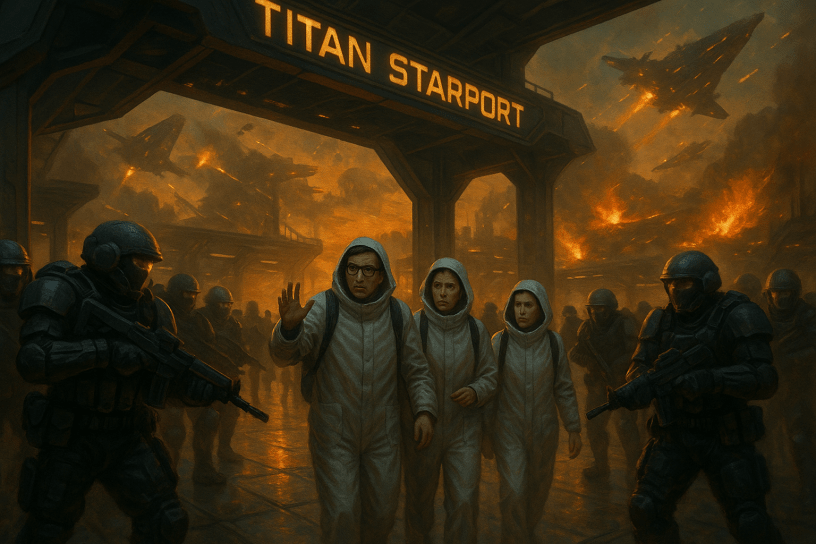
Titan Ascension Terminal
The sky above Titan boiled with war.
Inside the terminal, the concourse trembled like a stricken beast. Impacts shuddered through the walls—some distant, some too close—and the translucent ceiling flexed as the vibration sensors tried to compensate. Sirens wailed in three-tone emergency cycles. Not for fire. Not even for bombs. These sirens were designed for crowd control.
The air was thick with fear—bitter sweat, stale breath, children’s screams. People crushed toward the docking gates in an indistinct roar of panic. Parents lifted children overhead. Some cried. Some didn’t. The worst had gone silent.
Outside, beyond the magshielded windows, the moon’s gray skies were torn open by plasma contrails and defense flares. High above, two massive fleets were locked in orbit: the Belt Conglomerate’s assault ships, black and jagged, trading fire with the battered remnants of the Inner Planet Confederation’s Civil Fleet.
The Confederation ships had no warp drive. No escape.
All they could do was hold the line, long enough to let the shuttles fly.
At the heart of the terminal, two kinds of Marines held two kinds of ground.
The Civil Fleet Marines—in standard power-assist armor, gray and blue—held back the crowd, trying to manage boarding by clearance level. Their lines were buckling, shields cracking from the press of people.
But the other Marines didn’t break ranks.
The Erebus Marines stood out like shadows in a fire. Black-exo, no insignias, eyes hidden behind polished visors. They didn’t speak to civilians. They didn’t assist with general boarding. They were there for one purpose only:
To extract the scientists.
Their names were on a manifest. If your name wasn’t on it, you didn’t exist to them.
Among the horde stood Professor Alan Korr, hair plastered to his head with sweat, face streaked with smoke and blood from a shallow head wound. Two assistants hovered behind him, pushing crates sealed with quantum locks. Each box bore the crimson insignia of Experimental AI Division.
“Don’t drop that one!” Korr shouted. “It contains—no, never mind. Just hold it like your life depends on it. Because it does.”
One of his assistants—Mina, barely twenty and already shaking—nodded, eyes glassy.
Nearby, Dr. Mira Solari cursed in three languages as she yanked her floating research case through a broken queue barrier. Behind her, Lira and Kael Dalen advanced with their children: Klara, ten, and Lukas, seven. Lira, visibly pregnant, had a determined calm etched into her face, the kind forged in deep labs and now tested under orbital fire.
A young voice: “Mama, are the bad ships winning?”
Lira knelt, holding Lukas close. “No. But we have to go fast, okay?”
Overhead, the concourse loudspeakers stuttered:
“…PRIORITY BOARDING—SCIENTIFIC MANIFEST ONLY… SECURITY SWEEP IN PROGRESS… DO NOT—”
The message cut into static as the lights dimmed. A blast—closer this time—rattled the floor panels.
Then: movement.
A tunnel of Marines pushed through the concourse—Erebus’s elite, forming a wedge of black and blue. One of them shouted over the din, visor amplified:
“Professor Alan Korr. AI Division. Manifest confirms. You move now.”
A massive armored gauntlet gripped Korr’s shoulder, pulling him into the corridor. His assistants scrambled after, crates bumping against legs.
“Kael and Lira Dalen, Project Veil, two dependents—confirm,” another Marine called.
“Yes!” Kael yelled. “Wait, three—she’s—”
“I’m pregnant,” Lira finished calmly.
The Marine nodded. “Confirmed. Follow the sweep.”
But just as they started forward, a scream erupted behind them—Lukas had been pulled back into the crowd. Lira turned, eyes wide.
A shorter Marine—red stripe on the shoulder—dived into the crowd, lifted the boy like a toy, and tossed him safely back to Kael.
“Thank you,” Kael gasped.
The Marine said nothing.
Then—a new figure.
An elderly woman, wild-eyed, reached out and grabbed Lira’s arm. Beside her, a tiny boy with soot-streaked cheeks stood silently.
“Please,” the woman whispered. “Take him. He’s my grandson. Ralen. They’ll kill him if he stays.”
Kael looked at Lira. She was already kneeling.
“Hi, Ralen,” she said softly. “Would you come with us?”
The boy didn’t speak. He just nodded.
As Lira stood, she looked at the closest Erebus Marine.
He looked back through his visor.
For a moment, they saw each other.
And then—he turned his head away. As if he’d seen nothing.
The column moved forward.
“CLEAR THE WAY!”
The last few names were called. The final crates were dragged behind the line. A civilian man tried to rush the ramp—he was thrown back like a ragdoll.
The last thing anyone heard from the crowd as the gates slammed shut was a single voice:
“You’re just leaving us?!”
And the Erebus Marines didn’t respond.
Because they weren’t here for them.
They were here for the ones who could build a future.
They were here for the scientists.
Chapter One: Saturn Evacuation
It was supposed to be silent.
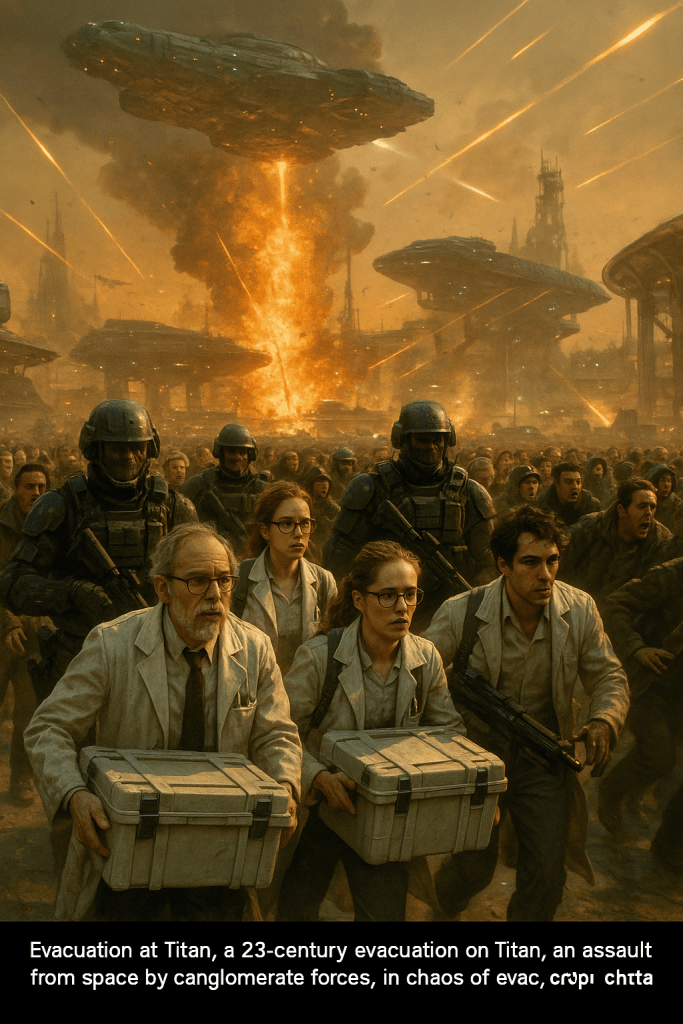
Titan’s Ascension Terminal—a sprawl of alloy, transparent domes, and vertical docks—had been built for calm departures. For intersystem prestige. For ceremony.
But today, it shook.
The concourse trembled like an animal trying not to scream. Distant impacts rolled through the foundation, one after another. Some were orbital strikes. Others were closer—maybe in the city. No one knew anymore.
The transparent ceiling had long since gone opaque from blast shielding. But flashes of fire and arcs of plasma still bled through the seams, throwing jagged shadows across thousands of desperate bodies.
Sirens screamed in triple-tone. Red strobes. Panic strobes.
And still the crowd pressed forward.
Families clung to each other. People climbed onto benches, shoulders, cargo crates—anything that would lift them higher. The gates to the docking spine remained sealed, guarded by ranks of Earth Fleet Marines in full exo-armor.
They had orders: protect scientific personnel only.
Every evac shuttle on Titan was spoken for. Not enough space. Not enough time.
But one ship—Erebus—had returned from her first warp-capable journey beyond Sol only days ago. She had orders to evacuate only scientists and high-priority research assets.
Everyone else… was a footnote.
Near the Priority Zone
Professor Alan Korr stumbled forward, one hand on his cracked glasses, the other dragging a grav-sled of cryo-sealed AI cores.
“Careful! That’s a decade of work!” he shouted, too late to stop a jolt from a stray elbow.
Beside him, Mira Solari—his co-lead—cursed under her breath as she steadied another crate. “We should have stayed on Proxima’s moon. At least there, the death is quiet.”
The Dalen family followed just behind—Kael, a systems engineer with grease still smeared across his sleeves, and Lira, visibly pregnant, one hand gripping her daughter Klara’s shoulder, the other holding seven-year-old Lukas’s hand.
A small boy walked with them—Ralen, a silent shadow who had joined them when an old woman thrust him into Lira’s arms in the chaos.
All of them were scientists. All of them had clearance. And all of them looked terrified.
Marines & Boarding
Marines from Erebus moved with silent efficiency—exosuits trimmed in dark blue, helmets polarized. They scanned IDs, confirmed crates by barcode, and ushered groups toward the final ramp.
These weren’t riot control officers. These were shipboard personnel, trained for starborne emergencies, not city riots.
They didn’t bark. They didn’t shove. But they didn’t wait, either.
A scientist screamed when one of the crates tipped—glass and datachips scattering. A Marine caught her arm and muttered, “Move now. We’ll send recovery bots later.”
But there wouldn’t be a later.
One civilian broke the line, sprinting for the ramp—his face bloodied, hands clawing.
A Marine from the Earth fleet caught him mid-leap with a hydraulic arm, throwing him back into the crowd. No sympathy. Just execution of orders.
The ramp to the Erebus shuttle opened with a mechanical shriek.
“Aegis-7,” read the lettering—sleek, reinforced, atmospheric and orbital capable, bristling with directional thrusters and shield emitters.
It was the last one down from Erebus. And it would be the last up.
Inside the Shuttle
The interior swallowed the evacuees in layers.
Scientists were seated first, their harnesses auto-locking into gravity-synced chairs that lined either side of the bay. Beside them, crates of scientific gear were mag-clamped to floor tracks, sealed in sensor-proof containers.
Marines stood between them—magnetically anchored to the deck, one hand gripping bulkhead straps, weapons slung and ready. They formed a protective perimeter without blocking anyone’s view.
Because everyone was watching the viewport.
Outside, the sky over Titan was burning.
Streaks of fire marked every shuttle that didn’t make it. Blasts from orbital weapons painted the atmosphere like a dying aurora. Erebus’s escort fighters—Falcon-class interceptors—danced through the chaos, weaving between Conglomerate drones and hardlight flak like wasps in a tornado.
Some of them burned. Some didn’t return.
Inside the shuttle, a child asked, “Why are they shooting at us?”
Nobody answered.
The Pilot Speaks
“Ensign Vale,” came the voice over comms. Calm, clipped. The pilot.
“We’re clear for ascent. Strap in. If you’re not strapped in, lock to something. Magnet boots on. This’ll be rough.”
She didn’t exaggerate.
The engines screamed.
The shuttle lifted with a shudder, slamming bodies back into seats, twisting the floor as directional jets countered turbulence. One jolt nearly broke someone’s shoulder restraint. The hull groaned under atmospheric resistance.
Outside, a Conglomerate drone fighter flashed past—sleek, black, no markings. It launched a burst of plasma at one of the ascending shuttles.
That shuttle exploded mid-climb. The cabin of Aegis-7 flared with reflected light.
Screams—then silence.
Scientific Cargo
In the rear cabin, sealed crates shimmered with isolation fields. Labeled: Project VEIL, Project KORE, Quantum Simulation Lab, Neuronet-Lattice Archive.
Mira Solari whispered, “If these don’t make it to the Moon… we’re all extinct.”
One Marine turned his head slightly toward her—silent acknowledgment. But he didn’t speak. Not their job.
Kael looked across at Lira. She nodded, eyes hard. Ralen sat between them, unmoving.
The Battle Outside
Through the viewport, Titan receded—gray and burning. Erebus loomed above like a shadowed mountain in orbit. Around her, Earth Fleet ships formed a broken defensive line.
Falcon interceptors streaked past the shuttle again, engaging Conglomerate drones in vicious spirals. The Erebus’s dorsal turrets opened fire, clearing a corridor through debris and hostiles alike.
Ensign Vale’s voice returned: “They’re making us a path. We hold that line, or we burn.”
Outside, shuttles from other ships tried to rise too—civilian transports packed to the hull. Many were too slow. Several were hit mid-climb.
Only Aegis-7 had a clear fire corridor.
Only Erebus had a mission that mattered.
One by one, the other dots on the screen winked out.
The Erebus’s manifest was almost aboard.
And this shuttle was her final lifeline.
Chapter One (continued): Falcon Reforged
Outside – High Titan Orbit
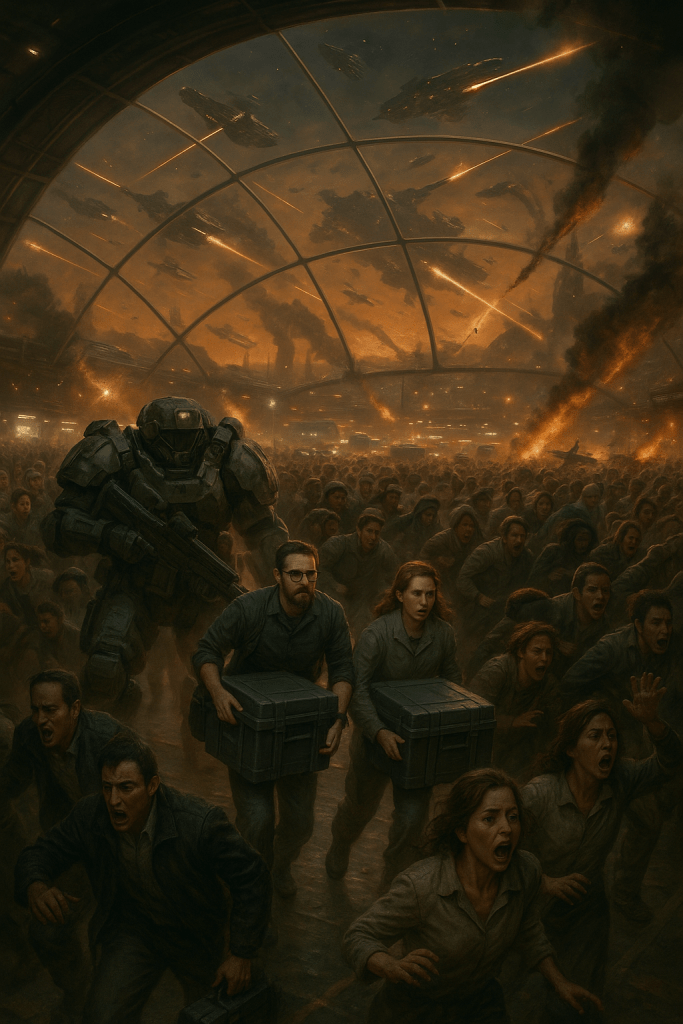
The shuttle Aegis-7 pitched sharply as a plasma burst sliced past her nose. The shields absorbed most of it—still, the flash was too close.
Inside, passengers cried out. A grav-cart of sealed lab crates rattled violently. One of the Marines shot out a hand and mag-locked it without a word.
“We’ve got company!” Ensign Vale barked over the intercom, her voice thin with stress. “Conglomerate fighters are peeling off the perimeter net. They’re… they’re chasing us.”
Another burst came from above—a streak of white-hot particle fire, carving through space where the shuttle had just been.
Vale’s fingers danced across her controls, firing directional thrusters. The shuttle rolled, ventral-first, shield arrays shimmering.
“Erebus, this is Aegis-7—requesting fighter cover! We’re under active pursuit.”
Erebus – Tactical Command Deck
“Contact confirmed,” said Tactical Chief Reyes, scanning the fire-control holosphere. “Three Conglomerate interceptors. They’ve broken formation. Heading for the shuttle. Vector one-zero-nine.”
Captain Elena Veyra stood stone-faced at the central command nest, eyes on the shuttle’s tiny glowing icon as it threaded through a hazard field of debris, flare mines, and hunter drones.
She didn’t hesitate.
“Deploy secondary wing.”
“Squadron Four,” Reyes confirmed. “Launching now.”
“Route them through Corridor Seven,” Veyra added. “And… prep Icarus.”
Reyes blinked. “They haven’t tested in combat yet.”
“Then they’re about to.”
Erebus – Hangar Bay Omega
The newest generation of Falcon-class interceptors sat prepped and powered on the automated catapults, shimmering with flight-readiness. Sleeker than their predecessors. Brighter engines. Reinforced chassis. Wired for interface with Quantum Hold systems—but untested in war.
Pilots scrambled in.
“Falcon Four, status green,” called Lt. Kai Lennox, snapping his helmet into place. “Pre-launch checks complete.”
Next to him, Lt. Vera Amani slid into her cockpit, brow damp with nerves. “You ever run with Q-Hold in atmosphere?”
“Simulator. Once. Not a fan of puke,” Kai muttered.
“Time to improvise.”
Across the deck, red lights flared.
LAUNCH.
Eight interceptors rocketed from Erebus’s underbelly, afterburners blazing. They banked hard into descent—racing to meet the Conglomerate fighters in mid-orbit.
Aegis-7 – Under Fire
Ensign Vale could see the enemy craft now—black-carbon wings, no visible cockpit, just glinting sensor nodes and flickers of red illumination. Their movements were unnatural—stop-and-pivot maneuvers that should tear a normal craft apart.
They flew like insects, but faster.
Vale jinked hard right. One of the passengers screamed as their viewports lit up with the flash of nearby flak.
“I need those fighters!” she snapped.
“Hold tight,” came Captain Veyra’s voice, suddenly in her ear. Calm. Absolute.
“They’re coming.”
The Dogfight
Falcon Squadron Four dropped in like knives.
“Target lock,” Kai Lennox muttered. “Picking up lead. Fox three.”
A missile streaked toward the nearest Conglomerate fighter—who flipped on its axis and slid under the blast like liquid metal. It returned fire instantly, scorching Kai’s wing.
“Shields down twenty!” he shouted.
Another Falcon pilot—callsign Razor—was clipped by particle scatter. Her hull spun twice before she corrected.
“No kills,” Vera cursed. “We’re losing ground.”
“Do not break formation,” Reyes ordered over the fleet-wide channel.
But it was no use. The Conglomerate fighters weren’t just fast. They were coordinated. Calculating. Mechanical.
Falcon pilots began to fall into defensive patterns—rolling to protect the shuttle rather than push forward. No one was dead yet. But they were losing ground.
Erebus – Bridge
“They’re outmaneuvered,” Holt growled. “If we lose the shuttle—”
“They won’t,” Veyra said. Her voice never raised. “Activate Icarus.”
“Captain—”
“Do it. I want Q-Hold online.”
Reyes keyed the command.
“Falcon Four, this is Erebus. Stand by for Q-Hold integration. You’re about to fly differently.”
Inside the fighters, HUDs blinked.
Q-HOLD SYSTEM SYNCING…
TIME OFFSET STABILIZED.
SENSORY FIELD ISOLATION ENGAGED.
Then it hit.
Inside the Fighters
It was like everything paused—and kept moving.
Every Falcon pilot felt it: a strange suspension, like their bodies had separated from the ship—but were still in control. Their vision cleared. Noise faded. The usual jerks and tugs of G-forces… gone.
Their bodies were frozen in time, but their thoughts raced ahead.
Instincts sharpened. Each micro-adjustment of a control stick now felt like premonition—as if the ship moved with their thoughts, before they acted.
Vera Amani blinked, then whispered:
“…It’s like I already know where to turn.”
Lennox laughed, just once.
“Now we’re flying.”
The Counterattack
Falcon Squadron changed.
No more hesitations. No more tailing and reacting. They began to anticipate the Conglomerate’s moves—dancing between blasts with surgical elegance.
One enemy fighter pivoted to flank the shuttle’s rear.
Kai was already there. A hard loop. Laser burst. The drone exploded into a silent bloom of shrapnel.
Another dived. Vera banked low, inverted, released a single graviton mine.
The enemy dipped into its path—destroyed instantly.
“Erebus, this is Falcon Leader. We’re clean.”
“Understood,” came Captain Veyra’s reply. “Aegis-7, corridor is clear.”
Vale’s voice cracked through, still tight with adrenaline.
“Copy that, Erebus. Resuming ascent. Thank you.”
Tactical View – Bridge
Commander Holt crossed his arms, watching the screen.
“First combat test,” he muttered. “And they flew like they’d done it for years.”
“Because we gave them what the enemy lacks,” Veyra said. “A human mind that sees just far enough forward. Not programming. Not guesswork. Premonition.”
The Conglomerate fighters regrouped, warping back to the far side of Titan.
They weren’t defeated. Not yet. But now, they knew the Falcon wing had changed.
And Erebus wasn’t just a target anymore.
She was a threat.
Chapter Two: Command and Consequence
UTA Erebus – Primary Bridge
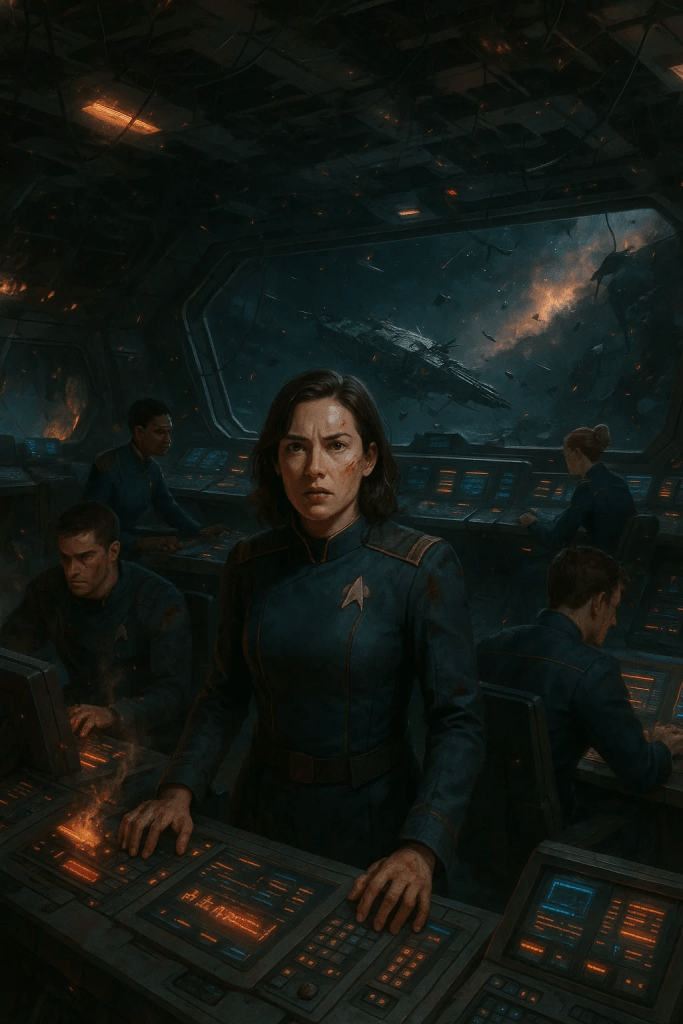
The bridge of the Erebus was quiet, not from calm, but from calculation.
Holo-screens bloomed across every surface—target vectors, orbital maps, thermal overlays, and endless combat telemetry. The massive curved viewport at the fore showed Titan as a ruined crescent, shrouded in smoke trails and laser-scorched scars.
Beyond the moon, a dozen ships from the Inner Planets Confederation and Earth’s Joint Command fought—and lost—against the Conglomerate swarm.
Captain Elena Veyra stood at the central rail, hands behind her back, eyes locked on the stars. She hadn’t blinked in thirty seconds.
“Shuttle Aegis-7 is approaching,” Lt. Juno Reyes reported. “Falcon escort is clean. No pursuers.”
“Time to dock?”
“Eighteen seconds.”
Commander Holt studied the strategic feed, jaw rigid. “We’re barely holding the corridor open. The Mantua just lost her dorsal plate. The Tartarus is leaking from midsection.”
“The Admiral will call,” Veyra said.
He did.
Incoming Transmission – Dreadnought Vindicator
The fleet’s flag signal cut across all comms—red priority.
“Erebus, this is Admiral Cestus aboard Vindicator. Confirming your jump capability is still online.”
Veyra stepped forward, clasped her hands behind her back. “Confirmed, Admiral. Warp systems are green. Holding for civilian payload.”
“We need that jump. Now,” Cestus snapped. His voice was like steel under strain. “All other fleet assets are nuclear drive only. We’re at 63% casualty rate on orbital ships, and ground evac is cut off. We’re exposed and falling fast.”
“Understood.”
Cestus didn’t pause.
“The Conglomerate is shifting priority toward you, Captain. We believe they’re attempting a soft capture. No heavy ordnance yet. They want Erebus intact.”
Veyra’s brow lifted slightly. “Warp tech is their primary objective.”
“Secondary objective’s the Titan labs. You’re carrying the last of both.”
The comms feed flickered with data—emergency fleet status, failure rates, compromised hulls, burning drive cores.
“I need you to jump, Captain. Get the scientists out. The knowledge must survive.”
But Veyra didn’t respond right away.
She turned slightly, looking to Reyes, then to Holt.
“Put me through to the Admiral. Private band.”
A pause. Reyes nodded. “Channel open.”
Veyra’s voice dropped an octave. Quiet. Strategic.
“Sir, permission to offer an alternative.”
Cestus raised an eyebrow. “Captain?”
“They want Erebus. If we jump now, we escape. But they’re watching every move. Every vector. Their fleet will close ranks the moment we charge up. The rest of yours—Earth ships, Mars ships, all of them—won’t make it.”
The Admiral’s silence stretched.
“I suggest we make them chase us,” Veyra continued. “We go silent. Fake a drive failure. Begin drift. Let them believe we’re losing power, not preparing a jump.”
“You want to bait them.”
“I want to draw them away from your ships.”
“You’ll be surrounded,” Cestus said. “They’ll try to board.”
“I’m counting on it. Let them get close. When they fully commit…”
Veyra turned back to the viewport.
“…then we jump.”
Cestus exhaled. “You’ll be flying blind. No corridor. No nav buoys.”
“We’ve jumped farther with less.”
A long pause. Then:
“…Very well. You’ve bought us a chance, Captain. All fleet ships will divert power to propulsion and scatter the moment you fake engine failure. We’ll pray they bite.”
“No prayers needed, Admiral,” Veyra said. “Just send the thank-you note to the kids who make it out.”
He nodded once.
“Get it done, Erebus. All of us are counting on you.”
Shuttle Bay Theta-Seven
The Aegis-7 screamed into position, hull scorched, but intact. Falcon fighters veered off as soon as docking clamps caught the shuttle’s underbelly.
Inside, passengers sagged in relief as the outer airlock hissed and rotated.
The bay opened with a howl of sterilizing steam, Marines already in place—weapons down, guiding evacuees with practiced calm.
Lira Dalen carried Ralen in one arm, Klara by the hand. Kael behind her, Lukas in tow. Scientists gripped sealed data cores. Others clutched children, tools, or nothing but wide eyes.
Professor Alan Korr nearly collapsed from the ramp, still holding his AI satchel.
“Don’t drop that,” he muttered to no one. “It’s got… everything.”
The roar of the corridor faded as bay seals locked behind them.
One of the Marines spoke softly. “Welcome aboard Erebus, Doctor.”
Bridge
Reyes turned to Veyra, nodding.
“Shuttle docked. Payload secured. Ready for next phase.”
Captain Veyra stepped to the command rail and gave one simple order:
“Power down external drives. Drop shields. Begin drift.”
“Drift pattern?” Holt asked.
“Like we’ve lost main power. But not dead. Just slow.”
“And when they come?”
“When they all come…”
She nodded once.
“…we’ll light the sky on fire.”
Chapter Three: Threshold
The bay doors sealed with a thunderous hiss.
Inside the docking collar, steam and hydraulic heat still lingered in the air as marines surged forward to secure the ramp. The scientists staggered out—dazed, sweat-slick, many still clutching data crates, personal bags, or each other.
On the bridge, Captain Elena Veyra stood beside the command nest, her eyes locked on the tactical holosphere.
“All fighters—tight orbit. I want Falcon and Echo squadrons cycling defensive rings within two kilometers. Full spread. If even one of them breaks toward the Erebus, I want a pincer intercept, not a chase.”
“Confirmed,” said Lt. Reyes from the fireboard. “Falcon One confirms vector. Echo en route.”
On the holosphere, green markers peeled off, forming a rotating ring around the ship. The Erebus hung like a fortress between Saturn’s curve and the trailing chaos of Titan’s low orbit.
Veyra toggled her headset.
“Bridge to Flight Control. Ensign Vale and shuttle Aegis-7 secured?”
A beat. “Affirmative, Captain. They docked hot, but intact. No injuries reported from flight crew. Shaking nerves, mostly.”
“Copy that. Get Vale to medbay for a neural flush, then debrief her in thirty.”
To her side, Commander Holt folded his arms. “What about the evacuees?”
Veyra keyed internal comms. “Kane, report.”
In the shuttle bay, Master-at-Arms Riko Kane’s voice came back hard and fast. “Scientists secured. Dalen family with them. Escorting all priority personnel to Quarters Delta and Lab Bay Three. Marines are restricting access—cargo checks underway.”
“Any issues?”
“No panic, no incident. One crate burst in transit, otherwise clean. Civvies are just… stunned. Processing.”
“Understood. Carry on.”
Bridge sensors blinked—fresh contact.
“Captain,” Reyes said tightly, “we’ve got new vectors—Conglomerate lightcraft. Gunboats, mostly. Nothing big yet.”
Veyra narrowed her eyes. “Testing the perimeter.”
“They’re not firing. Yet.”
“They will. Reyes—transfer fire control to Icarus. Let the AI run suppression coordination.”
“Aye, ma’am. Icarus online in 3… 2…”
The ship’s lights shifted subtly. A low chime echoed through the bulkheads. The Erebus’s battle AI was now fully engaged, linking fighter squadrons, gun crews, and reactor control into one seamless tactical net.
The viewscreens showed it all: the blackness of space riddled with luminous trails of missile locks, engine burns, and flickering drone pings. The Conglomerate wasn’t committing its fleet yet—but the pressure was rising.
A burst of static bloomed across one screen.
“Incoming call from Peregrine, Admiral Cestus’s flagship.”
“Put it through.”
The image snapped on—Admiral Gaius Cestus, helmet under one arm, the glow of war bleeding from the display behind him.
“Captain Veyra. Your fighters bought us precious time. The final wave of civilian shuttles is halfway up from Titan. We’re still holding the perimeter—barely.”
“We’re on station, sir. Erebus remains intact and fully powered.”
“Then listen closely. Once the last evac shuttle clears, we’re going to scatter. My ships can’t outrun the Conglomerate in a straight fight. And we can’t win this head-on. But you, Erebus—you can.”
Veyra straightened. “We’ll draw them, Admiral.”
“Make it look real, Captain. They don’t want you destroyed. They want your drive.”
“Then we’ll show them just enough to chase.”
Cestus gave a hard nod. “Good hunting, Erebus. Signal when clear.”
The comms cut.
For a moment, the bridge was silent.
Then Veyra turned to her crew. “All hands—battle stations. Fighters stay tight. We begin fake systems degradation in thirty seconds. Engineering, prep auxiliary reactors to spike—look like damage, not sabotage. Reyes, prep deck cameras for external leak simulations.”
Holt raised a brow. “And the scientists?”
“We hold them deep. Quarters Delta sealed. No contact. Their job is survival.”
“And ours?”
She stared into the screen, where enemy gunships edged closer.
“Ours is to bleed just enough to matter.”
Below, the crew moved with renewed urgency.
Chief Engineer Volkov was already muttering into his headset: “Reactor is spinning down to limp-mode. Warp coils faked offline. Shield harmonics adjusted. She looks like she’s limping. But she’s not.”
Veyra stepped closer to the main viewscreen, where a dozen Conglomerate ships were altering vector. A cluster of them split from the Titan blockade. Their targeting cones were all lining up—on her.
“Bait’s taken,” Reyes murmured.
Commander Holt adjusted his uniform, voice low and dry: “Well, Captain, you always said this ship was built to be chased.”
Veyra allowed herself a razor-thin smile. “And to survive it.”
External View – Erebus Vector Shift
The Erebus rolled out of formation slowly, turning wide and sluggish as if wounded. Her drive plume flickered erratically. Anyone watching would see a ship trying to retreat, failing. Bleeding power. Dying quietly.
The Conglomerate ships followed like wolves spotting a limping stag.
Inside the command sphere, the lights dimmed—part of the ruse. Artificial inertia softened. Internal temperature dropped by four degrees.
And yet, beneath that illusion, the Erebus was alive.
Pulse-guns tracked. FTL coils built charge in secret. Icarus, the ship’s AI, reduced her emissions by 98%, making her look like little more than an engine-out cruiser dragging refugees.
Conglomerate Pursuit Ships: 14
Enemy Target Priority: Erebus
Inner Planets Evacuation Corridor: STABILIZING
Time to Jump: 90 seconds
Critical Jump Window: 120 seconds
Captain Veyra stood like iron at the center of it all.
And whispered to the ship: “Now you earn your name.”
Scene: Erebus Turns Into the Fire
Bridge – UTA Erebus
T-minus 90 seconds to full disengagement maneuver
The tactical table pulsed red across its surface, the silhouette of the Erebus slowly rotating within the storm of approaching hostiles. Captain Elena Veyra stood with her arms crossed, eyes fixed on the display. Her voice was calm, stripped of all panic, shaped for moments just like this.
“Helm,” she said. “Initiate the roll. Let them see what they want.”
“Aye, Captain,” replied Lt. Reyes, fingers dancing across the holographic controls. “Beginning slow rotation. Pitching five degrees low, armor side to threat vector.”
The Erebus began to turn.
On the main viewscreen, the stars shifted. Not with grace—but with gravity. The dorsal plating arced into the firestorm. The broad, scorched belly of the cruiser exposed itself like an invitation. To the Conglomerate, it looked like vulnerability. An injured animal showing its soft throat.
It was bait.
“All batteries: hold fire until my mark,” Veyra commanded. “Falcons: stay on intercept vectors. Protect the corridor. Don’t chase shadows.”
Outside, the void came alive.
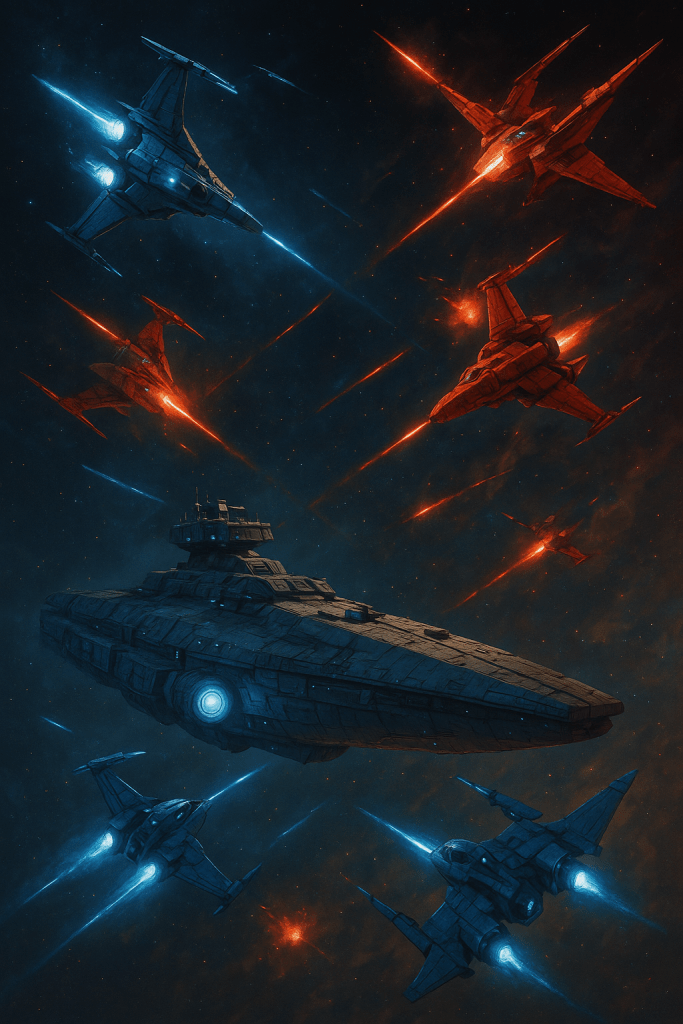
Conglomerate fighters broke formation—like sharks scenting blood in the water. They accelerated toward the exposed flank of Erebus, their black, angular shapes gleaming with residual heat. Among them drifted heavier frames—boarding modules, retrofitted assault sleds with magnet-claws and cutting talons.
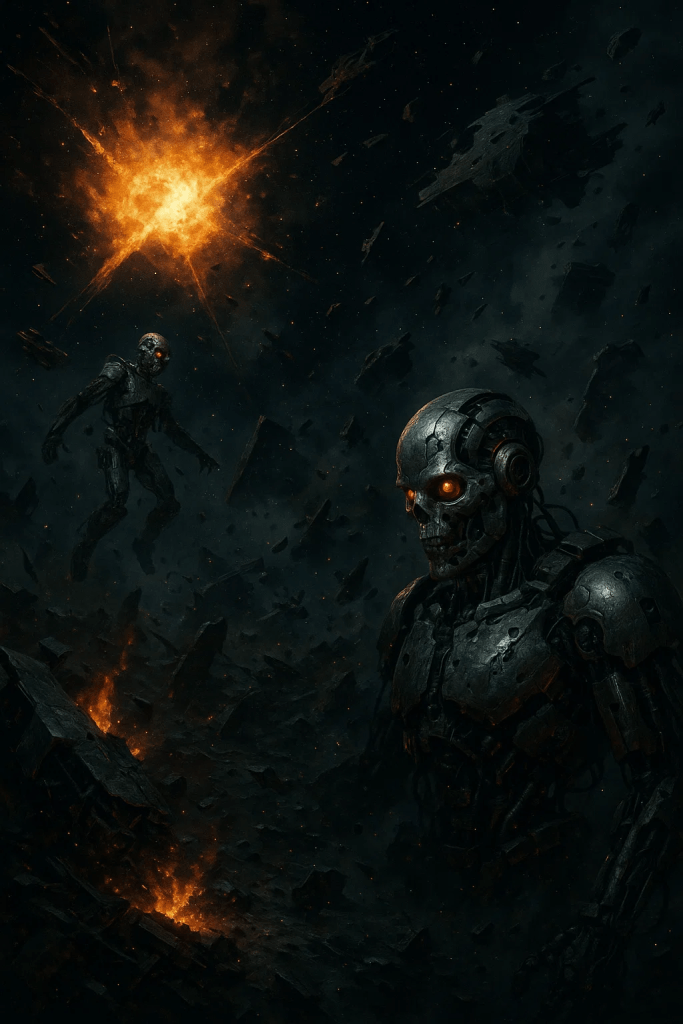
Inside their glassless cockpits, the pilots sat like statues—eyes wired, limbs fused into place. Cyborgs, stripped of everything but the mission.
Capture the warp ship.
From the Erebus’s bridge, it looked like a tornado made of metal and malice.
“Sweet Mother of Stars…” Reyes murmured, watching the radar bloom.
“Let them come,” Veyra said coldly. “We’ll kill the belief out of them.”
Turret Control – Deck Gamma
Chief Gunner Morven watched through the magnified optics as the swarm came.
“Marking boarding sleds. Fifteen… twenty… Thirty-two—oh, they’re greedy today.”
From multiple hull points, the Erebus‘s point-defense grid came online.
The moment the first wave passed the perimeter threshold—
“MARK!” Veyra snapped.
The ship breathed fire.
Railguns thundered in coordinated bursts, lancing through enemy lines. Flak shells bloomed in precision arcs, shredding fast-movers. Energy grids locked, arcing lightning across hull seams to dissuade contact. Where boarding sleds managed to latch, internal turrets rotated and spat plasma into magnetic clamps before they could even cut.
Dozens died in a second.
Still they came.
Falcon Squadron broke through the upper layer like razors, intercepting the fast attackers aiming for the engines. Ensign Petrovic veered hard starboard, decapitating a cyborg-piloted drone with a clean plasma burst.
“They’re trying to stick on the belly!” she shouted. “But it’s a meat grinder down here!”
Inside the shuttle bay, warning lights flashed red, then white, then red again.
Lt. Cross’s voice came through:
“Boarding attempt in Hangar Two—negative, scratch that. Sled torched by hull sweep. No breach.”
Erebus kept turning—like a giant in slow motion, enduring every hit.
And then—the silence broke.
A ripple of explosions traced down the left flank of the cruiser as a cluster of enemy drones miscalculated and drifted into the auto-mined defense zone. Bodies and broken frames tumbled through space like confetti, trailing metal shrapnel and synthetic blood.
On the bridge, Veyra watched it all, unmoving.
Reyes turned slightly. “They’re not trying to destroy us anymore. They’re swarming like we’re already dead.”
“They think we’ve lost the drive,” Veyra replied. “Let them.”
Holt leaned in. “We’ve bought the Admiral his corridor.”
Veyra gave a nod, eyes still on the screen.
“Good. Then we’re done bleeding for now.”
Chapter Four: The Price of Fire
The Erebus turned slowly, exposing her scarred flank to the void.
From a distance, she looked wounded — energy flares sputtering from one ventral nacelle, dorsal armor blackened with impact scoring. A shiver of power bled off the warp collar as if something inside her had fractured.
The Conglomerate took the bait.
Every remaining ship in their fleet shifted vector at once.
Fighter swarms pulled away from the Inner Planets flotilla. Gunships peeled off from high-atmo blockade. The dreadnought Curia Volant, an obsidian fortress with plasma spines and reactor-fed claws, turned on axis and gave chase.
“They’re coming,” said Lt. Reyes, her eyes locked to the tactical holosphere.
“Full commitment,” Holt added. “They’ve thrown everything at us except their forward reserve.”
“They will,” Captain Veyra said. “They think we’re cracked open. They want the drive.”
“And the scientists,” Holt muttered.
“Then let’s show them what they’re chasing.”
Outside, the Conglomerate armada surged forward—dozens of vessels, from small corvettes to the monstrous Curia Volant, each accelerating hard, engines glowing with blood-orange radiation.
The Erebus leaned into her course, drifting slightly, giving the illusion of damage-induced list. Armor vents stayed open too long. Reactor output flickered in rhythmic pulses—a false distress signal encrypted in plain sight.
Inside, she was anything but broken.
Bridge – UTA Erebus
Timestamp: T-180 to Warp
“Enemy formation closing. Estimated intercept in ninety seconds,” said Sensor Chief Harlan.
Reyes traced two fingers across the fireboard. “Gun crews locked. Aft rail batteries hot. Torpedo tubes on staggered delay.”
Veyra gave the nod. “Hold fire until the first sleds reach hull. They need to think we’re trying to run—not fight.”
A voice cracked through from Engineering: Volkov.
“Auxiliary reactors spiked. Outer hull plating modulated. Fake the damage much more and we will lose structural integrity.”
“Noted, Chief. Just keep it in the red until we light them up.”
Exterior – Defensive Perimeter
Falcon and Echo squadrons soared close to the Erebus, flying tight rotational arcs.
Pilot chatter flickered over encrypted comms.
Frost: “Twelve sleds inbound. Big ones—cyborg delivery pods.”
Spitfire: “Shields?”
Frost: “Minimal. They want them on our ship.”
Petrovic: “Then we kill them before they land.”
The new-model Falcon interceptors split into attack wings—sleek, angled, thruster-loaded warbirds optimized for fast-breaking maneuvers.
Their cockpits flickered as Quantum Hold activated.
One by one, the pilots fell into that eerie stillness—body suspended, mind unbound, the sense of cause-and-effect decoupled from time. They didn’t think about what would happen. They simply acted.
And struck.
Outer Hull – Section Gamma-9
The first Conglomerate sled slammed into the hull with a shriek of steel on steel.
Mag-clamps deployed instantly. Hatch plates hissed open.
Cyborgs spilled onto the hull.
No mouths. No words. Just armored frames built for hostile environments—black-carbon limbs, hydraulic joints, fusion claws.
UTA Marines were waiting.
Master Sergeant Tahlia Venn’s team opened fire from behind cover formed by anti-radiation fins and heat exchangers. Blue ion rounds tore across vacuum, lighting up the void in staccato bursts.
“Push them off!” Venn’s voice barked in the helmet feeds. “No prisoners!”
Corporal Ramesh lunged across hull plating, firing from the hip. One cyborg reached him—a blade arm extending—and Ramesh planted a demo charge in its chest.
They both went flying.
Another wave of sleds struck further along the hull—thirty cyborgs in one drop. Venn cursed.
“Delta and Epsilon squads, redeploy to Gamma ridge! Move!”
The hull lit up with weapons fire. Marines in mag-boots surged forward under full vacuum—no cover but what they carried, no sound but their own breath and blood in their ears.
Bridge – Erebus
“They’re swarming the hull,” Holt reported. “Two sleds breached outer armor near the comms spine. No internal penetration yet.”
“Detonate fallback charges if they get close,” Veyra said.
“Understood.”
Reyes’ console flashed. “Dreadnought Curia Volant has entered weapons range. Their main batteries are tracking.”
“Not firing?”
“Not yet. They want us dead—but intact.”
“Then they’ll get their fight.”
Space – 7km off port side
The dreadnought loomed—five times the mass of Erebus, moving like a glacier with teeth.
Gunports opened. Energy began to build.
Back on Erebus, Reyes gave the word.
“All batteries, open fire.”
Battle Begins
The Erebus roared to life.
Aft railguns thundered—massive kinetic slugs fired in synchrony, their impact cones shredding one of the Conglomerate’s cruiser escorts. The ship broke apart in a cloud of frozen atmosphere and metal shards.
Pulse lasers lit up next—lancing through the void, catching enemy fighter waves mid-dive. Half a squadron disappeared in one sweep.
The Curia Volant fired back.
Plasma beams slammed into Erebus’s flanks—some absorbed by shield grids, others gouging armor. The ship shuddered.
On the hull, Venn’s marines held the line—flashing across maintenance ridges, swinging under magnetic plates, dodging fléchette bursts and fusion arcs. Cyborgs moved like insects—efficient, tireless, relentless.
But human instinct still had teeth.
Venn shot one point-blank, flipped over its disintegrating frame, and landed in a three-point brace, laying down cover fire as Corporal Park set off a proximity mine.
Above them, the Falcon interceptors danced.
Frost: “Taking heavy fire. These bastards are smart—”
Spitfire: “They’re trying to box us off from the Erebus!”
Petrovic: “Split the formation. Break their lock!”
Missiles flew. Chaff burst. One Falcon took a glancing hit and spun out—flaring smoke—but recovered.
Frost veered hard, looped under the keel of a burning Conglomerate sled, and fired straight into a pod before its cyborgs could deploy.
She banked away just as it exploded.
Bridge
“Dorsal shields at 62%,” Reyes snapped. “We need to punch free or we will be boarded.”
Veyra didn’t flinch.
“We hold until Icarus gives the jump vector. Until then—we bleed them.”
Space – 3km from starboard
A Conglomerate assault barge swung wide—its launch bays opened, and six more sleds screamed toward the Erebus in coordinated arc.
Falcon Squadron saw them too late.
Only two were shot down before impact.
More cyborgs hit the hull.
On the command feed, Venn’s voice came through distorted but clear.
“They’re coming in waves, Captain! We’re holding, but we can’t hold forever!”
Veyra turned to Holt. “Get the jump vector. Prep for FTL on my command.”
Chapter Five: Tornado
The Erebus rotated slowly at the center of the maelstrom.
Not fleeing. Not yet. Her keel pitched half a degree every fifteen seconds, drifting on artificial tremors — a decoy for an unstable core. But inside, the calculations were already spinning.
Warp coils warmed. Energy routed to auxiliary lattices. AI prediction buffers came online.
Thirty seconds to jump.
Outside, the ship spun like the eye of a tornado. Enemy fire screamed past in every direction—laser bursts, rail slugs, electron torches, a rain of silent death that had yet to break her spine.
On the outer hull, the last of the Marines fought barehanded, magnetic boots planted, armor scorched. They wrestled the Conglomerate’s boarding cyborgs in the shadow of plasma scoring and shattered fins.
Bridge – UTA Erebus
“Falcon squadron breaking off final sweep,” reported Reyes. Her voice was hoarse, jaw clenched. “Four units remaining. They’re redirecting to recovery vectors.”
“Let them dock,” Captain Veyra said. “We need every soul. We jump together or not at all.”
Commander Holt’s eyes didn’t leave the holosphere. “They’re still not firing to kill.”
“Not yet,” she said quietly.
Twenty seconds.
Sensor boards lit with pulsing red.
“Enemy dreadnought is realigning. Target lock detected—multiple missiles, torpedoes, beams. This is it,” Reyes said.
“They see the warp signal,” Holt muttered. “They know we’re leaving.”
“Not just leaving,” Veyra corrected. “We’re escaping with everything they want.”
Exterior – Near Orbit
The Curia Volant shuddered as its broadside aligned.
From its maw came the final strike: four sleek, cylindrical warheads—antimatter torpedoes, silver and burning with containment halo fields.
Behind them, the entire Conglomerate fleet unleashed its fury.
Particle beams lanced forward. Gamma-ray cannons fired in rippling arcs. Coherent radiation slashed through space. A stream of high-velocity shells pounded toward Erebus like the beat of some ancient war drum.
Fighters peeled away, realizing too late what was coming.
The Erebus glowed.
Blue-white arcs of pre-jump harmonics cascaded over her hull. A corona of distortion rippled outward from the warp collar as the field began to form.
Bridge
Reyes shouted: “Antimatter torpedoes incoming!”
“ETA?” Veyra demanded.
“Eight seconds!”
“Icarus—punch it.”
[WARP FIELD STABILIZING]
Energy screamed through the decks. Lights dimmed. Systems blinked, rerouted, shut down. The entire ship shuddered under its own power.
[JUMP INITIATED]
Outside – Impact
Just as the Erebus began to vanish into quantum space, the antimatter torpedoes struck the outer edge of the forming warp bubble.
The blast was instant.
A sun was born.
A blue-white core of annihilation bloomed where the Erebus had just been—a detonation that rippled outward in a silent, blinding cascade. The proximity to the Conglomerate fleet was fatal.
Five frigates were vaporized instantly—reduced to molecular ash in the expanding shockfront. Fighters caught mid-acceleration disappeared in rippling heat shadows. At least one command cruiser lost structural cohesion, its spine breaking like glass under a sledge.
The Curia Volant took the edge of the blast—its forward hull blackened, sensors fried. It reeled back, inertial dampeners failing.
Titan Orbit – Confederation Ships
On the other side of the battle, the fractured fleet of the Inner Planets saw the light… and the gap.
“Erebus is gone.”
“Did the make it? It’s our hope, they did.”
“Conglomerate ships crippled. Now or never!”
Admiral Cestus didn’t hesitate.
“All ships—scatter! Run for the Earth corridor. Burn your cores and don’t look back.”
Silence
Where the Erebus had been, there was nothing.
Not even wreckage.
Just twisted radiation echoes…
 Mindsets of Our Future