The hull beneath their boots vibrated like a struck bell.
Master Sergeant Tahlia Venn slammed another power cell into her pulse rifle, then braced low behind the curve of a shattered armor rib. Her visor flickered — static laced the HUD — too much interference from the reactor surge climbing behind them.
Above, the sky swirled like oil on fire. Below, Titan’s curve shimmered with shockwaves from orbital strikes.
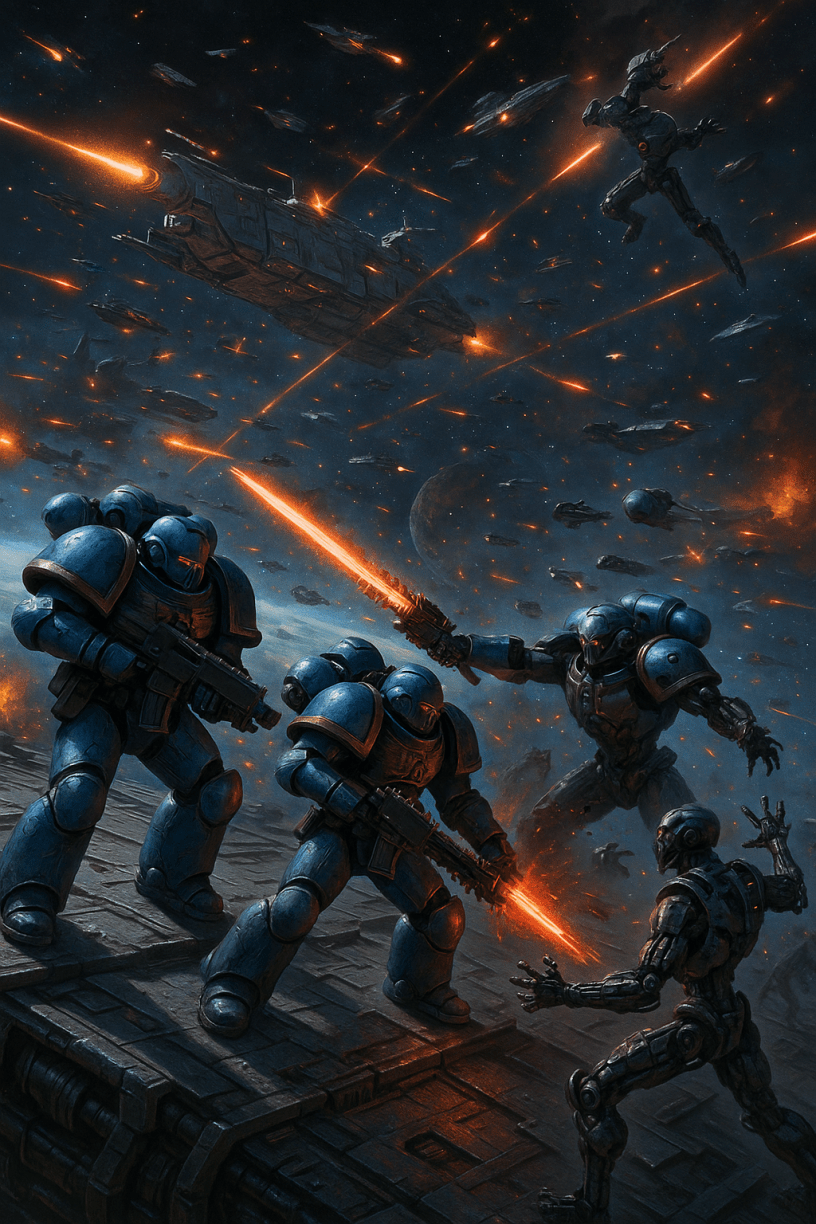
They were still out there. The cyborgs. Glimmering under moonlight, streaked with gore and carbon scoring. One of them moved like a crab, crawled low against the hull, a blackened silhouette against starlight, limbs folded like a crab’s — deliberate, patient. The cyborg had slipped through a blind spot in the defense grid, riding the curve of the Erebus’s spin until it found its prize.
Now it halted.
Its fingers unfolded with insect grace, three digits on each hand locking into the seams of the starboard bracing plates — the weld line that sat just outside the warp nacelle’s secondary shield casing.
It pressed the device to the hull. Magnetic locks hissed. The light on the charge flickered from red to amber.
Venn saw it through her visor. No time for distance, no time for orders.
She raised her rifle.
Fired. Missed — the round skipped across the plating.
“Dammit.”
Adjusted. Fired again.
The round hit center. The charge flared violet-white and detonated prematurely, shredding the cyborg into spinning shrapnel, its limbs spinning away in slow arcs into the void.
Venn’s comm sparked.
“VENN?!”
She keyed it, voice steady as breath.
“All in.”
She moved first.
Her boots released magnetic lock with a hiss. The hull fell away beneath her as she launched into the black, burning propellant from her suit’s thrusters in short controlled bursts. Behind her, three others followed — four blue lights streaking across Erebus’s wounded skin, closing on the breached corridor.
But they all knew.
They weren’t coming back.
Bridge – 3 Seconds to Warp
Volkov’s voice was a bark across smoke-choked air:
“Reactor at peak! Warp bubble formed!”
Sensor Chief:
“Antimatter torpedoes incoming. Time to impact: two-point-six—”
Holt: “We don’t have that long—”
Captain Veyra: “We jump. Now.”
Outer Hull — Final Second
Venn hit the outer bulkhead just as the sky above her flared blue — warp ignition bleeding light across the starscape like a second sun.
She looked up.
She didn’t pray. She didn’t blink.
She smiled.
And then the light turned white.
The Flash
There was no sound. No scream. No last breath from the void.
Just light—pure, devouring, godless.
It wasn’t a burst. It wasn’t a detonation.
It was erasure.
The antimatter torpedoes struck the warp bubble’s trailing edge at the exact instant the Erebus phased into FTL — and the result was neither explosion nor impact.
It was conversion.
Everything caught in that instant — cyborgs, Marines, outer turret arrays, the entire dorsal sensor web — was shredded, burned, vaporized, and then folded out of existence as the boundary of normal space collapsed.
The hull plating at the top of the Erebus turned white-hot, warping and seething, glowing like steel left too long in the forge. But it held. Just barely. Just long enough.
The ship’s forward geometry had already slipped into FTL, but the rear edge — the final moment of contact — was struck by an impossible storm: four antimatter warheads, laser beams, alpha-particle disruptors, coherent ray fire, all converging on a single point of space-time.
The laws of physics responded by rewriting themselves.
What should have annihilated the Erebus instead struck the outer skin of the warp bubble — and rather than breaching it, the energy folded inward.
Then something cracked.
And the bubble split.
Not in failure. Not in collapse. But in multiplication.
The Erebus didn’t just jump. It vanished into a braid of slipstreams — threads of subspace woven like rope — cast off from the moment of impact.
A manifold of realities. A knot in space. A tear in every known map.
From the outside, it looked like a second sunrise, blooming too fast — and then turning itself inside out, like the universe had coughed and swallowed a star whole.
The Erebus was gone.
And no one could say where.
Chapter 7: Fallout
Silence. Then the hiss of ruptured coolant lines. Somewhere, a slow-dripping fluid echoed like blood on a metal floor.
The Erebus was adrift in warp.
In the first moments after the jump, the ship had held. Just long enough. Now, systems collapsed in waves. Lights flickered. Hull sensors went blind. Entire decks lost power.
Bridge – Seconds Later
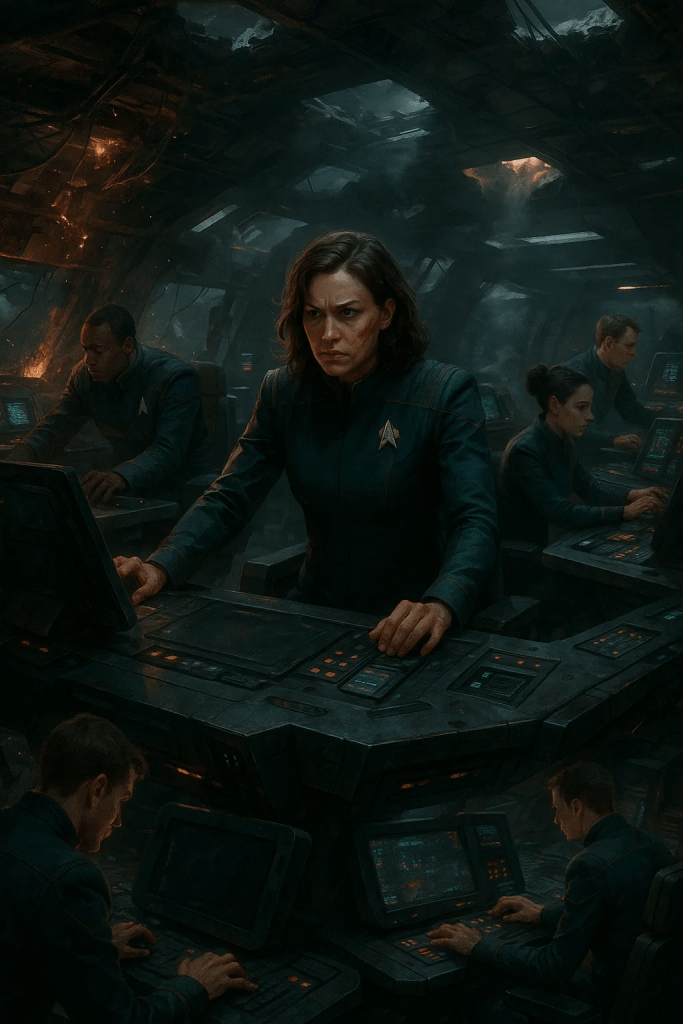
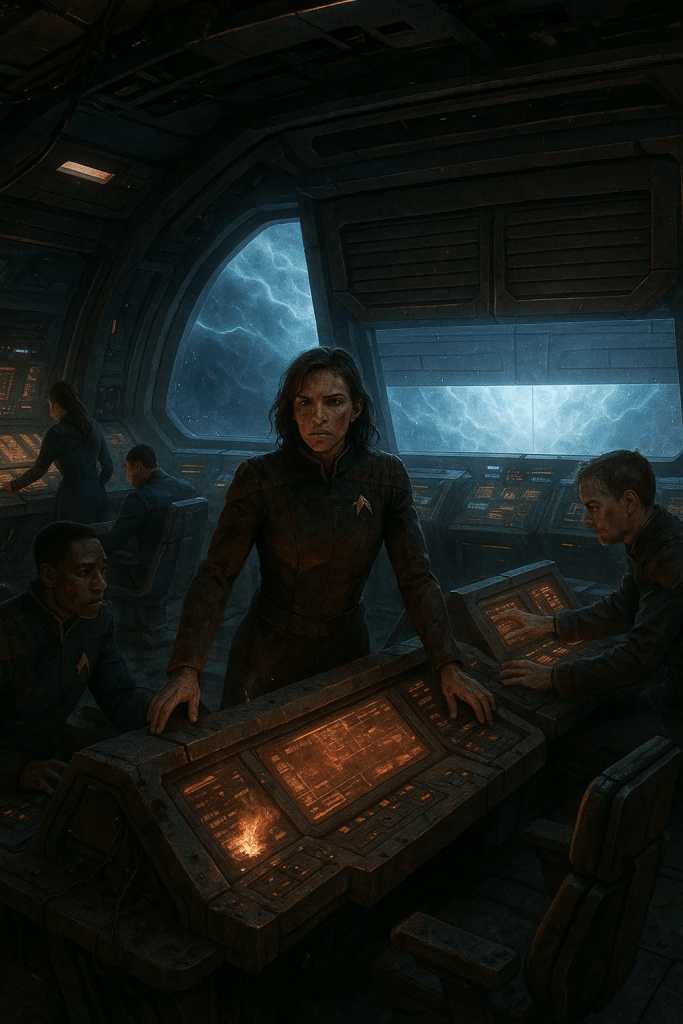
Only the bridge had been properly shielded. Even then, Veyra’s eyes watered in the chemical haze. Smoke curled from the comm panel. Emergency backups kicked in with a cough.
Reyes hunched over the nav console, one lens on her visor cracked. Holt stood, braced against the railing, a line of blood trailing from his temple.
“Status?” Veyra asked.
No one answered for five seconds.
Then Volkov, from Engineering sub-feed: “We’re alive. For now.”
Reyes wheezed. “We’re not where we aimed, ma’am.”
“We never are,” Holt muttered, checking his cracked datapad. “Warp trajectory twisted on exit vector. We bent around something.”
“Bent around what?” Reyes asked.
No one had the answer.
Deck 7 – Cryo Medical
Dr. Stroud blinked awake to klaxons muffled under steel.
He was on the floor. A gurney pinned his leg. Lights strobed red-white-red. Through the haze, he saw two med techs slumped against the far wall — unconscious, or worse. One monitor bled static. Another showed vitals of patients in the bay — flatlined, intermittent, or wild.
He tasted copper.
Pulling himself free, he crawled to the intercom and slammed the key.
“Medical to Command — radiation spike. Deck 7 compromised. We have casualties. Heavy.”
No response.
Everywhere Else
It was the same.
People slumped over consoles, tangled in ladders, collapsed in corridors. Steam hissed from broken valves. Gravity flickered. In low-deck quarters, civilians lay in silence—fathers shielding children, scientists gripping data crates like lifelines.
A soft moan. Someone stirred. Then another.
In the mess hall, Petar Markovic blinked awake to the faint cry of his daughter Mila. A chair lay across her legs. He crawled, hand over hand, past trays and shattered meal packs, and lifted it.
“Breathe, mila moja… I’ve got you…”
She clung to him. Around them, others began to groan, stir, weep. But there were no screams.
They were too dazed for screams.
Bridge – Minutes In
Volkov’s voice crackled through:
“Pulse fried half the sensor net. Outer hull shielding is gone. We are venting radiation across six decks.”
“From what?” Holt snapped.
“From everywhere,” Volkov replied. “The warp shell was compromised before it formed. The antimatter impact tore the dorsal layer. We’re bleeding high-frequency radiation and hull friction ionization. We’ve got fifteen minutes before DNA damage becomes irreversible.”
Captain Veyra didn’t flinch.
“Options?”
“Rebuild shielding in-flight. Manually. With whatever armor we can salvage.”
Holt swore. “That’s suicide.”
“Better than cancer,” Volkov snapped.
Captain’s Orders
Veyra opened shipwide comms — her voice the only steady thing in the storm:
“This is the Captain. We are under radiation threat. Marines are en route to assess hull integrity. All personnel: stay under cover, avoid exposed outer corridors unless ordered. Engineering teams will begin shield reconstruction immediately. Repeat: this is not the end. This is transition. Hold. Your. Ground.”
She cut the feed.
“Kane,” she said.
On a backup line, his reply came through, hoarse and half static.
“Two squads still breathing. Venn’s gone. We’ll sweep the hull. Report what’s left.”
“Seal armor bays. Move fast. Save who you can.”
Elsewhere – Fire in the Dark
In corridors venting sparks, Marines in sealed suits moved through toxic haze. They shouted into comms, searched for life signs, kicked in jammed doors.
Some found survivors. Some found only silence.
On Deck 4, a crewman clung to a bulkhead, skin blistered from radiation pulse. On Deck 9, a family was found behind a pressure door they’d managed to close — barely alive, but together.
Engineering – Makeshift Shields
Volkov’s people moved like ghosts. They welded radiation panels to the inside of failing walls. Rerouted coolant lines through scorched corridors. Dragged hull plating from wrecked drones to patch ruptures from the inside.
They didn’t ask why.
They knew what was coming if they failed.
Chapter 8: The Wall
Deck 12 – Reactor Ring
Radiation dosimeters screamed as the Marines in mechanized armor stormed down the corridor, shoulder to shoulder, plated boots smashing against scorched decking. Their HUDs were soaked in red — thermal ghosts, pressure spikes, hull fractures, rising gamma counts.
Master Sergeant Kiegan Voss led the charge, voice booming across encrypted comms.
“Squads Bravo and Delta, on me! Reactor ring priority—secondary shielding’s gone. We’re the last barrier between warp drive and hard vacuum!”
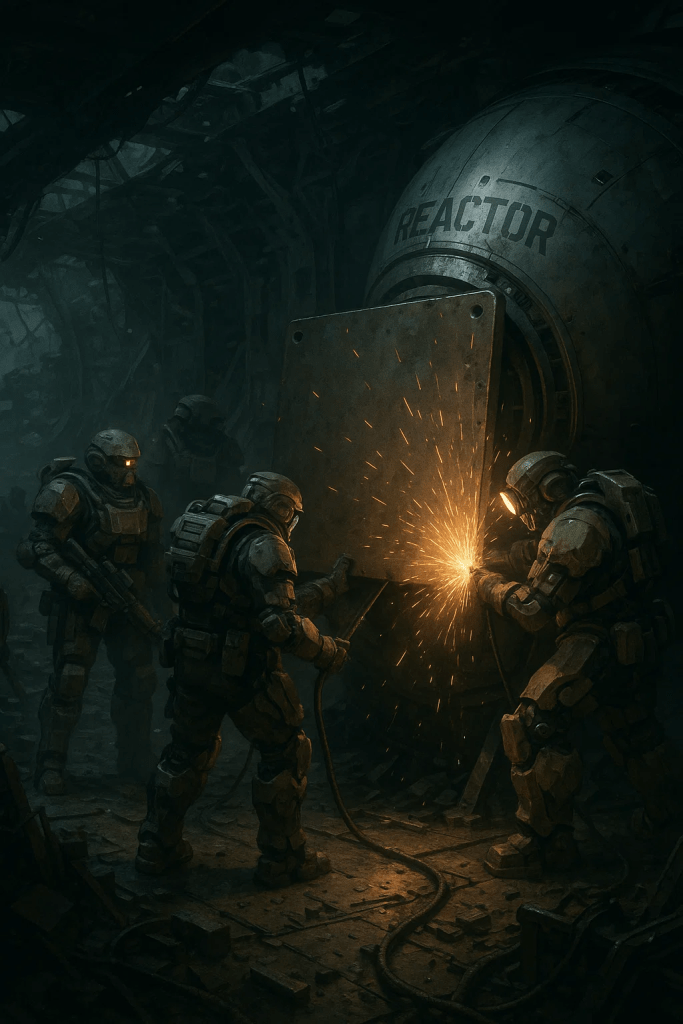
Behind him, power servos hissed and flexed. The suits weren’t designed for construction — but for brute-force assault. Now, they were wielding arc cutters and grav-lifters, dragging twenty-ton alloy slabs through flickering corridors filled with haze and falling sparks.
They’d stripped hull panels from crushed gun decks, breached storage vaults, even ripped down sections of their own mess hall bulkheads. The Marines were sacrificing their home to shield the engine that still pulsed like a mad heart at the center of the ship.
“Cut through support struts here,” Voss ordered. “Brace the first shield ring around the flux exhaust vents!”
“On it, boss!” barked Gunnery Sergeant Calden, his voice crackling from radiation noise.
One Marine — suit tagged as Mendoza — slipped on reactor coolant. The whole panel he carried slammed to the floor. An alarm shrieked in all their helmets — pulse exposure above 500 REM.
“Get him out of there!” Voss yelled.
“Negative,” Mendoza said. “I’m still good. No tears. Let’s move.”
Bridge – Partial Link
Captain Veyra leaned over Reyes’s console, her fingers drumming once, slowly, on the metal rail. Every system was limping. Environmental controls had to be micromanaged. Hull sensors were dead. The warp field was fluctuating like a heart in seizure.
“Get me the AI.”
Reyes hesitated. “Ma’am, it’s… still fragmented.”
“Then pull what we can.”
She tapped the access panel. The ship’s AI interface flickered to life.
The voice was warbled, hollow — like it came from underwater.
“Icarus,” Veyra said evenly, “run diagnostics on warp stability, prioritize containment vector.”
Vector… collapsed. I… can’t see it. Too many shadows. Why are you bleeding?
Reyes flinched.
“Icarus, confirm identity tag. This is the Erebus. Do you know where we are?”
You’re burning… We’re inside the drift wake… I’m trying… I can’t feel the hull.
“Lock down core logic. Protect memory trees.”
They’re cracking, Captain. Some of them are screaming.
The AI flickered out. Static replaced its voice.
Deck 12 – Inner Reactor Collar
The Marines worked like men underwater — too heavy, too hot, too slow. One collapsed mid-haul, vomiting inside his helmet. Another’s suit read out “COOLANT LOSS” in screaming yellow.
Still, the wall was rising. Panel by panel. They jammed support girders into melting walls, locked plates into curved arcs around the engine like armor for a wounded beast. Radiation curled in glowing snakes around the seams.
“We need vertical brace on segment 9!” Voss yelled. “It’s warping already!”
“Welding now!” came the reply.
One Marine dropped to a knee, plasma torch hissing. The welds were rushed, ugly — but they held.
A tremor passed through the deck.
“Core spike! Thirty-five percent flux instability!” someone yelled from the bridge feed.
“Then move!” Voss roared. “We don’t get a second chance!”
Meanwhile – Deck 3, Civilian Quarters
Dr. Mira Solari stood at the edge of the medical triage bay, watching children cry silently into oxygen masks. She touched her wristband again — trying to reach Kael Dalen or Professor Korr.
No signal.
The crystalline core case had been delivered into auxiliary shielding minutes after the jump. But it hadn’t responded since.
She looked at Lira Dalen, curled near the corner with her children, eyes glazed, not from shock — but from listening. As if hearing something no one else could.
“Lira,” Mira whispered. “Is it… alive in there?”
Lira didn’t speak.
She just nodded. Slowly. Once.
Bridge
The ship still groaned under its own survival. Alarms were dying off one by one, replaced by silence more unnerving than sound.
Captain Veyra stood, one hand braced on the tactical rail, visor still flickering static. “Status on radiation containment?”
Lieutenant Kane’s voice came through gritted breath. His suit mic crackled with distance and interference.
“We’ve got six men in mechs inside the core spine now. The warp housing was fractured—venting like a goddamn sun lamp.”
“Reinforcements?”
“Negative, Captain. No time. And we’re not contaminating clean armor to send in fresh blood. These six volunteered. They’re using ripped wall plating to build a rad-shield coffin around the drive.”
Holt glanced up from the sensor board. “Are the suits even holding?”
“Not for long. They’re burning out servos just lifting that shielding. But they’ll hold long enough.”
A pause.
“We’re patching the ship with the ship, ma’am. It’s the only play.”
Captain Veyra’s jaw tightened.
“Tell them… get it sealed. And when they’re done—”
Kane finished for her.
“Medics on standby, Captain.”
Deck 12 – Final Phase
“Last wall!” Voss grunted, voice shaking now. “Get it in! Lock the anchor plates!”
They lifted the last segment — blackened steel scored with plasma hits. It took four suits to maneuver it into place. Their boots left molten footprints.
One suit began to glitch — sparks flew from the leg hydraulics. Another dropped a brace.
They forced it in anyway.
“Seal it!” Voss barked.
A massive clunk as the last segment met the others. The sarcophagus around the warp core was complete — barely — a welded tomb holding in the death-breath of space.
“Voss to bridge… containment wall is up. Buy us time.”
“Copy,” Holt replied. “You bought us more than that. We’re still breathing.”
CHAPTER 9
Interior Sweep – Deck 6, Forward Habitat Spine
The corridors were still dim — power routing barely restoring overhead strips to a flickering pulse. The walls here bowed inward in places, warped from shock, support struts peeled like ribs through broken paneling. Gravity fluctuated in brief pulses; boots clicked in and out of magnetized contact.
Three Marines in light exoskeleton frames moved cautiously down the corridor, motion trackers pinging soft pulses into the soot-smeared dark.
“Movement, thirty meters,” one of them said. Corporal Saron, Company A.
“Sensor glitch?” asked Lance Torres.
“No. Cold signal. Biological, no EM signature. Could be body heat. Could be worse.”
They advanced, weapons raised, breath audible in rebreather channels.
Then—
“Contact.”
At the far end of the hall, just beyond the buckled med-support bulkhead, three unmoving figures lay tangled in the wreckage of a sealed maintenance shaft. Armor blackened. Hands warped. Limbs still twitching in muscular decay.
Cyborgs.
Saron dropped to a knee, scanning one of the bodies with a portable diagnostic reader. Torres stayed back, covering the angle with his rifle’s under-barrel light.
“Sir,” Saron radioed in. “We’ve got three Belt units. No active signals. They breached hull — probably during zero-G — but their systems are torched.”
“Define ‘torched,’” came Lieutenant Kane’s voice over squad-net.
Saron replied flatly: “I mean cooked. Electronics are melted. Optics fused. Power cores slagged. Probably from the antimatter burst.”
“Any motion?”
“No threat indicators. Muscles are twitching but that’s just post-system discharge.”
“Structural integrity?”
“Bodies are intact. Exo-skeletal plating’s warped but didn’t rupture. No fluids vented. They’re… clean.”
There was a pause.
Then Kane’s voice, clipped: “Lock ’em down. No experimentation. Then prep for med evac. Captain wants anything semi-alive stored and studied.”
Bridge – Minutes Later
Kane’s image appeared on the bridge holopad, helmet under one arm, sweat streaked along his jaw.
“We’ve got three confirmed cyborg intruders, Captain. Breached hull pre-jump. They were inside when the antimatter went off. Systems fried. Organic tissue’s intact.”
Veyra raised an eyebrow. “Alive?”
“Hard to say. If you define ‘alive’ as ‘not dead yet,’ maybe. Their neural cores are smoked. No power signals. But they’re breathing, sort of. Like fish pulled too far up the gravity well.”
Veyra folded her arms.
“Send them to Med. I want them restrained, sealed, scanned, and isolated. And get Mira Solari and Kaelen Stroud on standby. We don’t poke them unless they’re wearing five layers of containment.”
“Aye, Captain.”
He hesitated.
“Permission to say, ma’am—if those things were still on when they got inside… we’d be dead.”
Veyra nodded once.
“Duly noted. And denied.”
The bridge hummed with the small frantic noises of a ship that had survived a near-impossible thing: relays clicking, console fans spooling, the occasional muffled cough from a speaker where a crewman was clearing his throat.
Captain Elena Veyra did not wait for comfort. She keyed the squad channel.
“Kane—status on the three units you found?”
Lt. Marcus Kane’s face snapped into the holo, grime streaking his cheek. His voice was low enough to be heard only on secured nets. “Confirmed, ma’am. Bodies intact, electronics fried. No active comms. Med reports biological activity but neural cores are inert. They’re breathing shallow.”
“Good,” Veyra said. “Not good, but usable.”
She turned toward the comms officer. “Bridge, open medical triage channel and priority-access a retrieval team. I want someone who can pull data without frying what’s left of their memory banks.”
“Sending,” Reyes answered. “Recommend a mixed team — techs for hard read, med-ops for biological containment, and a linguist. Professor Korr is available.”
Kane’s jaw tightened. “I’ll send Sergeant Orlov’s retrieval squad. They’re light-exo certified and trained for forensic interface. For tech, take Gunnery Tech Azim and Data-Warden Mir. Med will be Dr. Stroud and two med-tecs. Linguist? We’ll patch Professor Korr in comms.”
Veyra nodded. “Do it. But brief them: this is not an engineering recovery. This is a live intelligence pull. If we can get even fractional telemetry, it could tell us what the Conglomerate intended when they came aboard.”
Kane gave a short salute. “Understood, ma’am. We’ll move now.”
She keyed another channel—this one to engineering and bulkhead teams.
“Volkov, I need outer-hall sealed. Now. Patch the breach segments, weld the seams. Use whatever you can tear loose from noncritical sections. If you have to cannibalize the mess hall, then cannibalize the mess hall.”
Chief Engineer Arkady Volkov’s voice came through, breathless and gritty. “Already mobilizing. We’re sending Mechanized Suite Four and the heavy teams. They’ll be in full armor; they’ll handle the worst of the gamma. But—”
“But nothing,” Veyra said. “You heard me. Seal that corridor or we bleed radiation until the crew mutates into pacified clocks.”
Volkov exhaled. “Copy. We’ll burn the feedlines and piecemeal the armor plates. It’s ugly work.”
“Make it hold.”
She held the officer feeds for a beat, then dropped her voice for the entire ship to hear—cold, official, final.
“Shipwide: do not—repeat, do not—attempt observation of the subspace anomaly outside any viewport or sensor without explicit command authority. Prolonged exposure to raw drift-spectra and phase shimmer has unpredictable cognitive effects. You will not be the exception. If you experience vertigo, hallucinations, or compulsive visual fixation, report immediately. You will not be cleared to return to duty until psych evaluation and neural scrub.”
A silence—thin and brittle—hung in the lines. Then murmurs of compliance, the clack of helmets being secured.
Kane’s retrieval team moved fast. The light-exo frames were a shade more nimble than the heavy suits, their servos whining as they threaded through warped corridors toward the hull where the cyborgs lay like black flowers.
Sergeant Orlov’s voice came back, tight with the small, fierce clarity of people who had been given one job: “We’re at the site. Bodies intact. Beginning triage and needle-read. Techs are online. Museum-lights off. No visual sweep until we have hard feed.”
Kane closed his fist into his palm and whispered—more to himself than the channel—“Bring them in. And be careful with their eyes.”
Above it all, the ship kept breathing—pumps coughing and then steadying, welders snapping into rhythm, the sound of a thousand small hands trying to make the world hold together.
Veyra watched the holomesh. She issued one last, small order that felt like laying down a marker.
“If there’s anything to learn from that hull, we’ll learn it. If there’s anything in those bodies that wants to speak, we’ll make it speak — without letting it make us listen without guard.”
The channels went quiet as crews obeyed. The retrieval team crawled into the dark. The repair squads began to rip panels and bolt them into place. And, somewhere in Engineering, the mech suits throttled up for the work that would cost them everything they might never get back.
CHAPTER 10
Bridge — Decision
Captain Elena Veyra watched the holoscreen for a long second, then keyed the secured net.
“Kane,” she said, voice flat, “report on the mech teams.”
Lt. Marcus Kane’s face filled the pad—tired, burn-marked, a bandage at his temple. He had the quiet, ragged look of someone who’d seen too much of a thing and still had to say it aloud.
“They did what they had to, ma’am,” he answered. “They sealed what they could. But their suits—radiation spiked through the servos. The hazard meters read contamination across multiple systems. I’m ordering them to medbay for bio-pass and decon.”
Veyra’s nod was small. “Good. No more heavy-suit work from them. Not ever. Patch me in with Volkov — I want an engineering assessment for internal repair teams. We’ll not throw irradiated marines into work we can do with cleaner frames.”
Kane hesitated. “Permission to speak freely.”
“Granted.”
“If the crew goes instead, we lose precious time. But the alternative is losing men in contaminated suits and having no one left to fight.”
“Then we buy time.” Veyra’s eyes hardened. “Bring the crew. Give me names.”
Medbay — Withdrawal
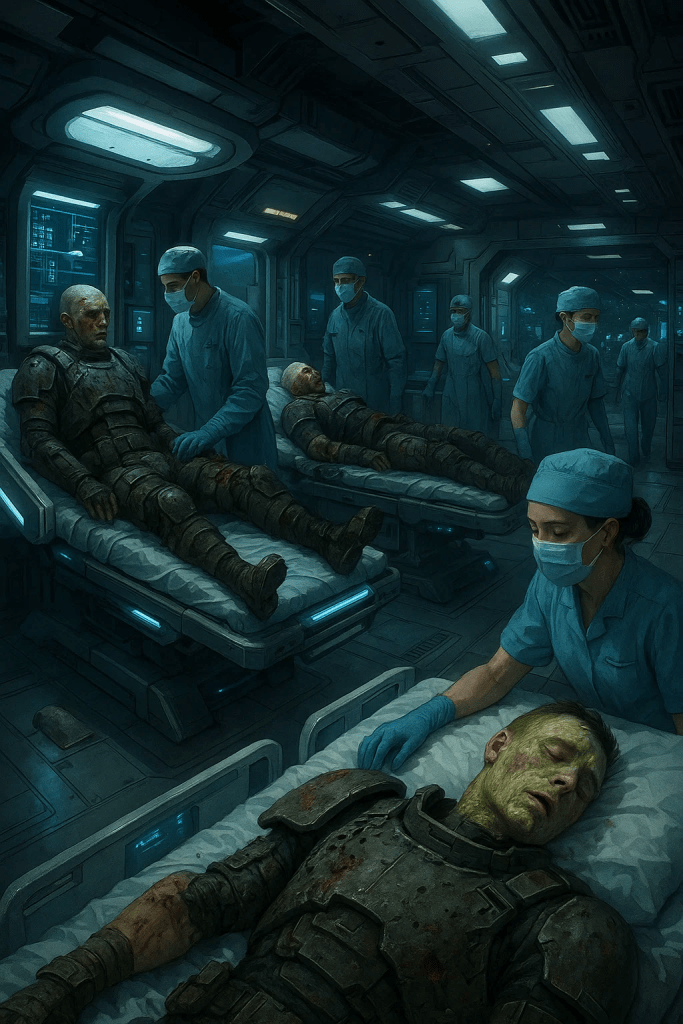
Master Sergeant Venn’s squad arrived limp and grey-eyed, helmets off in the triage bay. Dr. Kaelen Stroud worked through the nets with practiced hands—radiation counters, UV brushes, decon rinses. The mech suits they’d come out of were already bagged and tagged: heavy plating, servos cold, instrument nodes dead and saturated with residual gamma.
“Seal those in Storage Seven,” Stroud ordered the attendants. “Label them radiologically hot. No one touches them barehanded.”
Kane watched as men he’d trained with were led under the scanner. Their biosigns were ragged but stubborn; scorched by exposure, not annihilated.
“They can’t go back in those suits?” one private asked, voice thin.
Kane shook his head. “Not until we can swap every servo and scrub every line. That could take months. We don’t have months.”
Stroud placed a gloved hand on the nearest marine’s shoulder. “You did what you had to. Rest. We’ll get you strong enough to stand watch.”
Engineering — New Hands, Clean Frames
Chief Engineer Arkady Volkov’s bay smelled of burnt copper and hot weld. He’d already pulled three light-exoskeleton frames from storage — frames used for maintenance EVA and non-combat boardwork. They were not radiation-rated for the dorsal collar, but with rapid modifications they would be safer for short-duration interior work than the contaminated marine mechs.
Volkov briefed the replacement crew — shipboard technicians, a cadre of gunnery techs, and two senior riggers. No marines. No volunteers who’d been close to the blast.
“Listen up,” he barked. “You’ll be hauling panels, jamming brace ribs, and welding blind in places where sensors are fried. Your suits have temporary shielding. Your exposure windows are short. You got two tasks: patch the leak, and get off-deck before your dosimeter chirps. If your read hits yellow, pull immediately.”
One of the techs, Gunnery Tech Azim, answered with the sort of flat voice seasoned hands use. “We’ll do it, Chief. Give us the parts list.”
Volkov already had it pulled up. “Take the aft service corridor panels, Plate Set Nine—rip the mess-hall brackets if you have to. We’ll make a sarcophagus. Fast welds. Patches. No pretty work.”
They moved like workers summoned by necessity — not heroic by design, but heroic by default.
Retrieval Team — Crew, Not Marines
Sergeant Orlov’s light team still accompanied the retrieval effort — but as escorts and technicians, not primary breachers. Professor Alan Korr and Data-Warden Mir joined the work: data rigs, hard-probe nodes, a portable Faraday cage for any salvage.
Kane radioed the bridge: “We’re ready to extract telemetry from the three disabled units. Crew techs have the interface rigs. Marines are med-bound.”
“Do it,” Veyra said. “And keep the bay sealed when you’re done. No prayers through the hull. Notify me on any positive reads.”
Orlov’s voice was steady. “Copy that. We’ll be careful with their optics. No direct visual until Dr. Stroud clears the containment field.”
Storage Seven — The Quarantine
The heavy mechanized suits were rolled into Storage Seven, each module locked and its interface nodes scrapped with lead sheeting and red tape. The storage hatch closed with a long, final thump.
A placard was affixed with hand-lettered care: “RADIATION HOT — DO NOT OPEN. AUTH: ENGINEERING/ MEDBAY.”
Kane paused at the hatch, one hand on the seal, and then moved on. Men have to let fails be last to remain useful.
Bridge — Clean Hands, Cold Orders
Veyra looked at the map of operations. Clean frames were busy; crews were moving panels up and over the patch site. She tapped the channel to Volkov.
“How long, Arkady?”
Volkov’s reply was businesslike, exhausted: “If nothing else fails, four hours to a basic containment coffin. Two hours for emergency brace. After that, we’ll start pumping down the gamma.”
“Do it.”
And with that, the ship found rhythm again — not because it was whole, but because the right people were in the right roles.
Chapter 11 – Damage Control
Bridge – 3 Hours After Jump
The lights still flickered in odd places. Environmental systems were stable, but every sixth bulkhead along the corridor buzzed with interference. Power ran through the Erebus like a nervous system having seizures — pulsing strong in some areas, dead in others.
Captain Elena Veyra stood with one hand on the conference table, the other still gloved. She hadn’t slept since the blast. No one had.
“Begin recording,” she said.
Commander Holt, seated across from her, keyed the hololog. Around the room, the ship’s senior staff filed in, weary but focused: Kane, Reyes, Volkov, Dr. Stroud. A moment later, Professor Alan Korr entered, followed by Dr. Mira Solari. Both wore auxiliary badges over gray evac-suits, dusted in static. Korr held a data slate to his chest like it might try to escape. Mira moved with that brittle calm reserved for people who knew too much.
Veyra looked over the table. “This is a contained session. Status briefing, command-level only.”
She gestured toward the holosphere as Reyes activated it — a spinning image of Erebus, flickering where the internal sensors had failed to calibrate.
“Let’s be clear: we’re alive,” she began. “That was a low-probability outcome.”
No one laughed.
She pointed to the base of the ship on the projection — the aft engineering spine, just above the warp chamber.
“Here’s the truth: the warp drive did not shut down after transition. It is still active. It’s running wild.”
Volkov’s voice rasped from the far end. “Containment held, but we can’t get close. Radiation spikes every ten minutes. Lower decks are hot — lethal within five minutes unshielded. I’ve sealed bulkheads four layers out. It’s stable, but if we can’t kill that drive, we’ll run until the fuel dies.”
Veyra nodded. “How long?”
“Two weeks,” Volkov answered. “Maybe three, if we throttle plasma injection. But we can’t fix the system — not with flesh. Suits won’t help. It’s cooking gamma through durasteel.”
Dr. Stroud added, “The sarcophagus the mech-marines built is holding. But it’s the only reason we’re not glowing.”
Veyra turned toward Kane. “Marines?”
Kane’s jaw tightened, not from hesitation — but from the weight of what he had to report.
“The mech team that sealed the warp casing — all six are down.”
The words landed like a weight on the table.
“Full-dose gamma. No shielding. They knew. They went in anyway. Ripped steel from the ship’s ribs and built the wall barehanded through the worst of it. The reactor spike hit during the second weld. We lost comms with them twenty seconds later.”
Kane glanced down, then continued, voice flat with discipline.
“When the spike ended, we pulled them out. Suits were hot to the touch. Armor plating bubbled in places. We had to saw off parts of the exo-rigs just to reach them.”
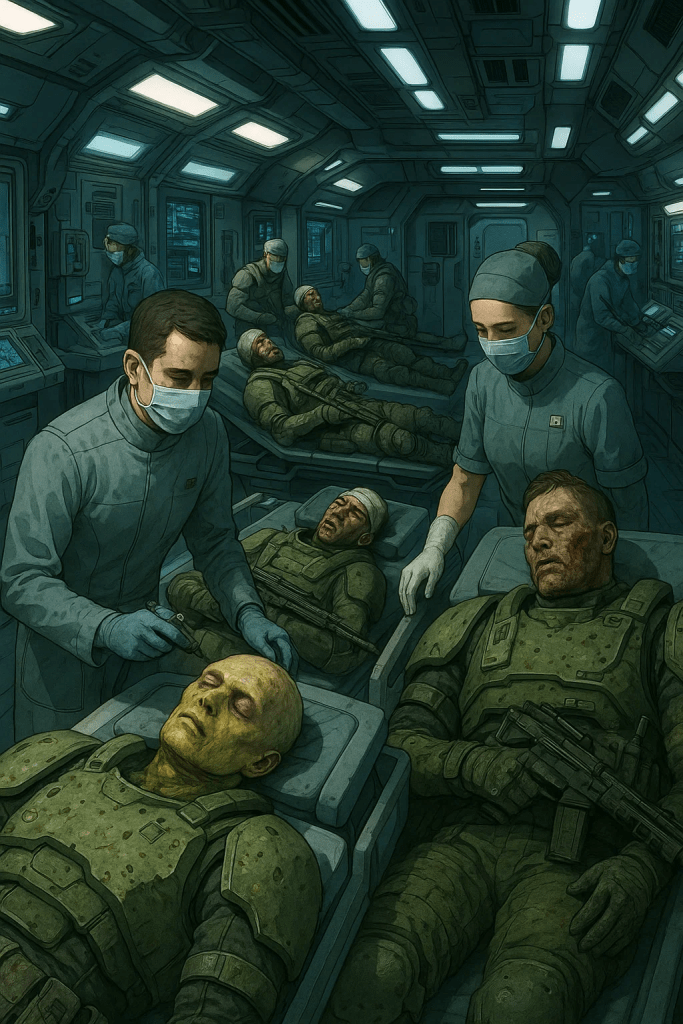
Dr. Stroud nodded, arms crossed. “They’re in the med bay. Unconscious. Acute organ failure. Internal burns. We’ve flushed what we can, but radiation that strong—it rewrites bone.”
No one spoke for a moment. Then Reyes said, quiet:
Long-term stasis for wounded beyond shipboard treatment
Emergency preservation during deep-space travel
Low-metabolism storage in power-critical scenarios
Decontamination and biological quarantine protection
Overflow shelter for high-risk crew or evacuees
🛏️ Capacity:
Total Cryo Beds: 192
144 Standard-class pods
24 Medical-grade cryo units (advanced neural isolation, auto-monitoring)
24 Emergency pods (manual lock, low-power mode)
We will use
Medical cryo units used for Marines suffering from radiation exposure
Operated via Bridge-CMO dual authorization
Monitored by ship’s AI (Icarus) or backup manual control
Bridge-linked to track vitals, pod integrity, and automated revival schedules
🧬 Subsystems:
Cryogenics powered by dedicated plasma loop for thermal stability
Backup life-support onboard for 18 hours per pod in blackout
EMP-hardened memory storage — retains neurological data and vitals through pulses
There’s no protocol for such levels of radiation.
But Cryo? It’s a gamble. Some of them might survive longer frozen than breathing.
Veyra’s expression didn’t move. Only her eyes did — toward the ceiling, then back to Kane.
“Do it.”
She spoke slowly, with full authority.
“Lock them in controlled cryo. If there’s even a five percent chance… they earned it. And they will not die today.”
She tapped the table once.
“Civilians are still bunked in emergency compartments. We’re running at 140% capacity. I want evacuee scientists assigned to assist with diagnostics, system integrity, AI mapping, and repair. Non-scientific civilians need to be processed, stabilized, and moved to barracks rotation.”
She looked at Professor Korr.
“I know you weren’t part of this crew when we launched. You are now. I want your people helping ours. Your specialists assist Stroud, Volkov, Reyes — wherever they’re needed.”
Korr inclined his head slowly. “You’ll have them. I’ll speak to the evac leadership.”
Dr. Solari leaned in. “Captain, we can help — but some of the evacuees are shaken. The EMP events were… strong. One of the children collapsed from a seizure in cargo hold nine.”
“Medical’s stretched,” Stroud said. “We need extra hands, even if it’s just sorting trauma packs.”
“I’ll authorize it,” Veyra said. “Holt, update evac rotation and redistribute by skillset.”
“Aye, Captain.”
Veyra walked slowly to the wall panel, touched the burn marks still etched in the plastic seal.
“The rest of the ship’s holding. We’ve got life support, comms, even some point-defense back. But there are hot spots everywhere. EMP fried half the internal relays. Comms flicker. Lighting’s patchy. I don’t want anyone outside a sweep zone without buddy-link confirmation.”
Then she paused.
“We will keep this ship flying until the tank runs dry. We will not panic. We will adapt.”
She looked around the table again.
The conference cabin smelled of scorched insulation and antiseptic. Half its wall displays were dead, replaced with paper charts taped by some quick-thinking yeoman. The hum of the warp bubble trembled faintly underfoot, like a predator pacing.
Captain Elena Veyra’s gaze moved slowly over the faces at the table. Some pale, some still streaked with soot or dried blood. All tired. All waiting.
“Professor Korr,” she said at last, her voice cutting through the low murmurs. “Until further notice, you are appointed acting Chief Scientific Officer aboard Erebus. This isn’t a courtesy title. It means decisions, not theories. Do you accept?”
Korr’s cracked glasses caught the light. He hesitated, then nodded once. “Yes, Captain.”
“You’ll coordinate directly with Chief Engineer Volkov. Your first task is the AI core—see if it can be stabilized or at least brought to partial function. I need accurate vectors, coordinates, and drift data. We don’t even know where we’re moving in this… whatever we’re in. We can’t navigate blind.”
Korr swallowed hard. “Understood. I’ll need a team.”
Veyra turned to her right. “Dr. Mira Solari. You’re staying on as astrophysics lead. Work with Korr. Your job is to map whatever space we’re in, real or not. Build me a chart from the noise if you have to.”
Mira nodded, dark circles under her eyes. “I can do it. But if the AI core is as damaged as they’re saying, we’ll be down to pencil and guesswork.”
“Then start guessing with math,” Veyra said, and there was a faint ghost of a smile. It vanished quickly.
Her eyes moved to a woman sitting near the end of the table—Amira Rao, the hydroengineer from the civilian complement. “Mrs. Rao. You are now the appointed civilian liaison. All evacuees, dependents, and nonessential specialists report through you. I don’t have time for panic lines. You’ll have a seat here at every briefing.”
Amira straightened, surprised. “Yes, Captain.”
“Good.” Veyra exhaled through her nose. “Here’s the situation. We have a crippled warp drive leaking radiation, a damaged AI core, and no navigation. We don’t know where we’re going or what’s outside. We have to build our own safety from the inside out.”
She planted her palms on the table. “Korr—AI. Mira—navigation. Volkov—containment of the warp drive and coordination with these two. Mrs. Rao—civilian order and support. We keep this ship alive with what we have, not what we wish for. Questions?”
Nobody spoke. Only the low thrum of the warp bubble, distant and wrong, like a heartbeat out of time.
“Then move,” Veyra said. “I want first status reports in six hours. Dismissed.”
Decks of Erebus – 1 Hour After Briefing
Section: Primary Engineering Spine / Sensor Array Sub-Level / Power Control Nodes
While the command staff scattered from the briefing, the deeper veins of the ship pulsed with motion.
Engineering crews, some still in bloodstained uniforms, moved like surgeons through a field hospital of fried circuitry and scorched alloy. Light panels flickered. Venting coolant hissed down service corridors. In the distance, a relay shorted—sending a flash arc across the ceiling and pitching one crewman off his feet.
Chief Engineer Arkady Volkov stood beneath the main sensor rack with his gloves blackened and his face half-shadowed by emergency lighting.
“That’s node twelve down. Scrub it and bypass,” he snapped into his throat mic. “I want minimal sensor capacity up in one hour or I’ll start rerouting through the coffee machine. Copy?”
A young tech’s voice came back, brittle with stress.
“Aye, Chief. Power coupling is holding. Barely.”
Another relay groaned overhead as plasma flow rebalanced. A status strip flickered from red to blinking orange. It was progress.
The ship’s sensor spine—essential for external mapping, contact pings, and atmospheric scans—had been nearly gutted by the EMP pulse. Over a third of the main relays were fused solid, and one entire compartment had lost magnetic containment.
“Kurosawa,” Volkov barked, turning toward a half-suited engineer struggling with a burnt panel, “that patch doesn’t hold, we lose rear-facing thermal sensors.”
“Trying, Chief. The cable melted into the mount. It’s like chewing steel with my fingers.”
Volkov crouched, looked over the fused cabling, and grunted.
“Use your teeth then. We’ll buy you new ones later.”
Around them, deck teams peeled back panels, re-ran cables, and rigged jerry-built connections across secondary power grids. Lights flickered with every new load shift. Some doors opened an inch, then jammed. One pressure hatch had to be cut open with a torch just to retrieve a stuck damage crew inside.
Deck 6 – Sensor Core Control
Two levels up, Assistant Chief Sensors Officer Imra Gael worked at a dead console. Her team had jacked an auxiliary terminal into the back wall, trying to ping anything beyond the ship’s hull. They had no eyes. No starfields. No directional data. Nothing but static and half-dead readings from a warped space outside.
“Run the calibration again,” she said. “No, with the deadtime buffers doubled. Every time we scan, the return signal shreds itself. Something out there’s twisting the return path.”
Her second-in-command muttered behind her:
“What if there’s nothing out there to bounce off of?”
She didn’t answer. She just kept working.
Power Core Mid-Deck
In another section, two electrical engineers argued while straddling a floor conduit.
“This junction’s feeding off a recursive loop—look at the amperage. We lose the junction, we lose lighting down half the mid decks.”
“Yeah? We keep it, we fry the coil stack by tomorrow. Pick your poison.”
They ran the numbers again. And again. And chose the light.
Back on the bridge, Reyes watched the system schematics come back to life one strip at a time—weak, blinking green indicators, like a slowly rebuilding heartbeat. Life support was steady. Water purification would survive. Heat cycles were back.
But there were whole floors still in blackout.
And no idea yet if what lay outside was real space… or something else entirely.
 Mindsets of Our Future