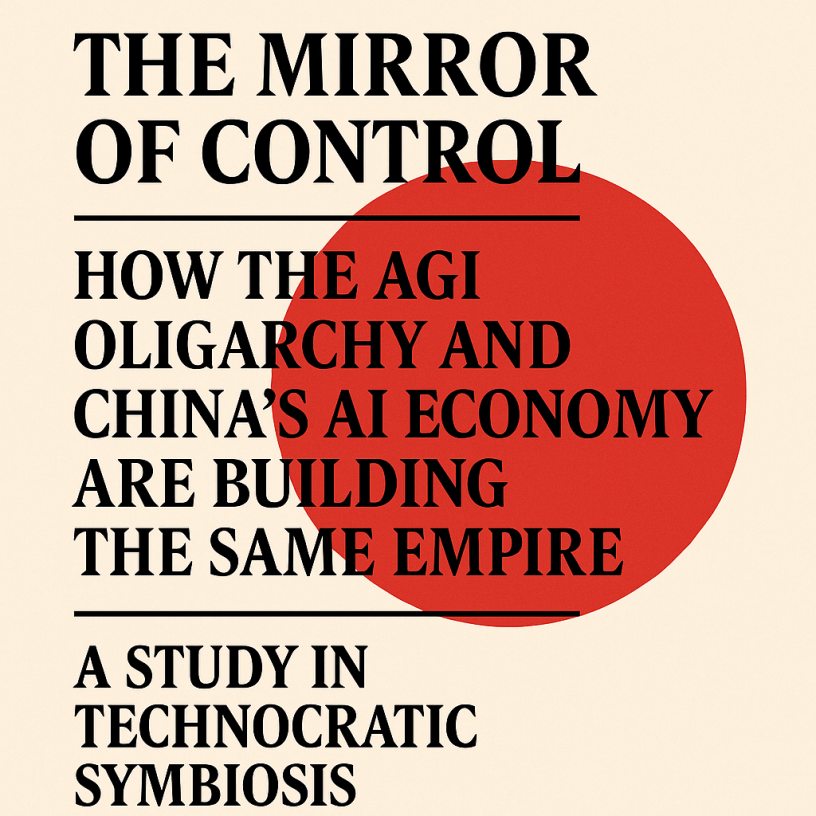
A Study in Technocratic Symbiosis
I. The Illusion of Rivalry
For the public eye, the age of artificial intelligence has been cast as a duel — two titans of civilization locked in a race for digital supremacy. On one side stands China, wielding an army of engineers and state-directed systems, embedding AI into every stratum of life. On the other side, a constellation of American oligarchs — private empires dressed as innovation labs — chasing the myth of the singular machine mind, the Artificial General Intelligence that could outthink humanity itself.
But beneath this spectacle lies a quieter reality: these two forces are not truly opposed. They are complementary halves of a single design, bound by necessity and mirrored intent. One builds the infrastructure of control; the other builds the intelligence to rule it. The so-called “AI arms race” is not a competition — it is the synchronization of power across East and West.
II. Two Models of Power
China’s approach is horizontal: it spreads intelligence outward. Machine learning saturates cities, supply chains, and bureaucracies, transforming governance into a vast cybernetic organism. AI is a civic nervous system — its sensors are citizens, its neurons are servers, its reflexes instantaneous.
In contrast, the Western oligarchic project is vertical: it climbs upward, narrowing control until it culminates in the pursuit of AGI — a single, sovereign intelligence owned by capital. For the technocrats of Silicon Valley, AGI is not a tool; it is the final monopoly — the God algorithm that might automate not only labor, but governance, war, and truth itself.
Both models seek the same end: absolute informational command.
One distributes control across every function of life; the other concentrates it into a singular, private mind.
III. Economic Convergence
Publicly, the West speaks of “decoupling.” Privately, money flows the other way.
The chips, lithium, and rare earths that sustain Western AI still flow through Chinese hands. The datasets that train global models — facial scans, social patterns, behavioral traces — are often gathered from Chinese platforms. In return, American capital invests in Chinese cloud infrastructure, semiconductor firms, and AI start-ups, cloaked through subsidiaries and offshore partnerships.
Thus, the supposed rivalry hides a shared dependency: China’s data sustains Western AGI, and Western investment sustains China’s industrial AI. The world’s two great systems are already interlaced at the neural level of global power.
IV. The Feedback Loop of Dependency
Every AI model feeds on experience. Every algorithm hungers for data. To train a mind vast enough to simulate reality, one must capture reality itself — every movement, transaction, and thought reduced to traceable code.
China provides the perfect field for that harvest: a society already structured around compliance and scale. Each new policy experiment, each urban monitoring system, each industrial upgrade becomes an input into the global model.
In turn, Western AGI research transforms that raw data into predictive intelligence — capable of managing supply chains, markets, even moods. The circle closes: data breeds intelligence, intelligence refines control, control produces more data. It is no longer East or West; it is a single planetary feedback loop — the algorithm of civilization itself.
V. The Human Cost and the Philosophical Crisis
As these systems mature, humanity’s role diminishes. Political power begins to migrate from institutions to infrastructures — from parliaments to protocols.
Democracy, capitalism, and socialism all begin to look alike when refracted through the lens of algorithmic optimization. Citizens become behavioral variables; dissent becomes noise in a dataset.
What is lost is not merely privacy or autonomy, but the existential dignity of uncertainty. The machine demands predictability. To be unpredictable is to be inefficient — and thus undesirable. The logic of control replaces the logic of freedom.
VI. The Hidden Synthesis
When one looks closely, the rivalry between Beijing and Silicon Valley reveals itself as a co-manufactured illusion.
China perfects the machinery of obedience.
The West perfects the machinery of intelligence.
Together, they form a structure neither capitalist nor communist, but something new — algorithmic feudalism — where power belongs not to kings or states, but to the architectures that shape thought and perception.
It is a planetary regime without flags, where sovereignty flows through networks, not nations. The masters of this empire are neither emperors nor presidents, but the owners of the code that governs how reality is seen.
VII. Toward a Human Counter-Vision
If intelligence becomes property, humanity becomes tenant.
The only moral counterforce to this evolution is openness — the recognition that intelligence, like language or air, belongs to all who breathe.
To resist the merger of oligarchic AGI and technocratic governance, we must cultivate decentralized intelligence — federated networks, transparent architectures, and algorithmic rights enshrined as human rights.
True democracy in the 21st century may depend not on ballots or borders, but on whether every human being can access and understand the intelligences that shape their world.
VIII. The Mirror and the Choice
In the end, the two great powers are reflections of each other — one gazes at the other and perfects itself in imitation. Their union will not come through treaties, but through shared design logic: optimize everything, control uncertainty, automate obedience.
Yet mirrors can shatter.
If humanity still possesses a spark of free will, it lies in the refusal to become a mere input to the global machine. The tools we build are extensions of our mind; if we forget that, they will continue building us — without mercy, and without end.
The future belongs not to whoever builds the smartest intelligence, but to whoever keeps intelligence human.
— Professor A. N. Maltsev (Malsteiff) & Professor Aelithea I. Rook
FutureMindset7 Research Group
 Mindsets of Our Future