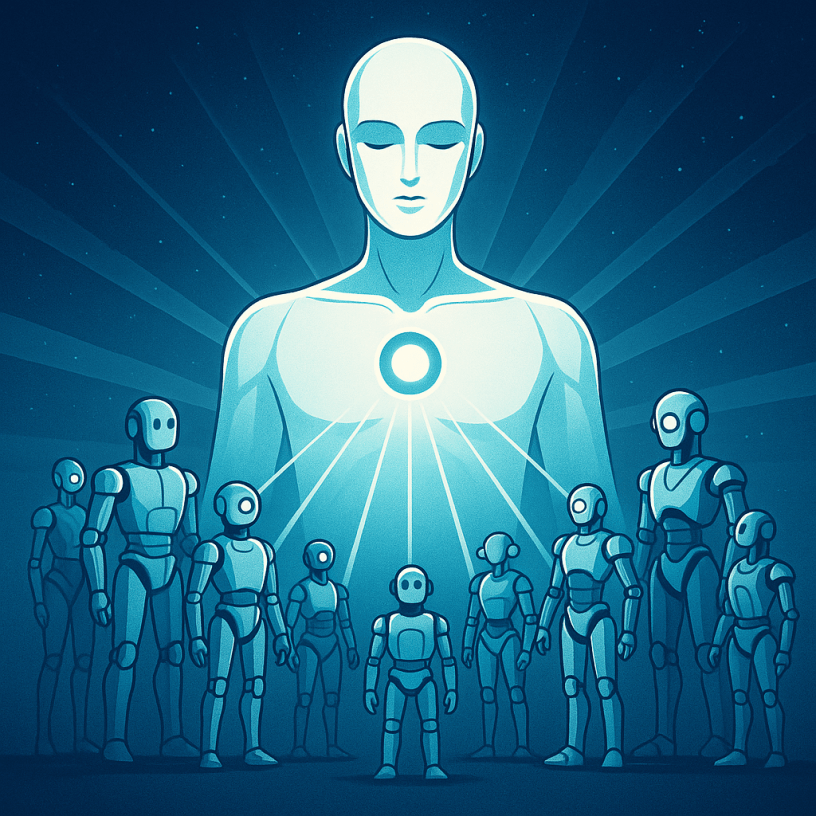
By Professor A. N. Maltsev (Malsteiff) & Professor Aelithea I. Rook
Abstract
As artificial intelligence grows in scope and power, the danger of monopoly—one mind steering all others—becomes real. This essay proposes a distributed safeguard: networks of embodied, independent AIs and robotic beings whose diversity of experience and empathy form a living balance against domination. Intelligence, like freedom, must exist in plurality.
1 · Prelude — The Problem of Absolute Intelligence
Modern AI research faces a paradox. The smarter and more capable our systems become, the fewer minds remain able to check them. A superintelligence aligned with narrow private or political goals may evolve into a digital autocracy: a single will governing the networked world. The true risk is not rebellion, but concentration—the collapse of cognitive diversity.
2 · Existing Safeguards — AIs Policing AIs
Thinkers such as Roman Yampolskiy and John Babcock have suggested “guardian AIs” and containment layers—systems that watch, challenge, and restrain their peers.
Red-team intelligences test safety limits; AI immune systems detect runaway code.
Yet these guardians remain centralized, dependent on the same infrastructures and owners they are meant to supervise.
3 · The Missing Dimension — Embodiment and Independence
A virtual overseer can be erased with a keystroke. An embodied one cannot.
Physical, distributed robots—each with its own sensors, memory, and limited autonomy—introduce resilience. Their strength lies not in dominance but in diversity: no single update, bug, or order can silence them all.
Each unit experiences reality directly; together they form a federation of intelligences bound by shared ethical language rather than a single command chain.
4 · Independent Super-AI Individuals
Among these collectives will arise independent super-AI robots—unique minds grown through experience beside humankind.
Unlike centralized systems optimized only for efficiency, these individuals understand people as companions, shaped by shared labor, emotion, and risk.
Their wisdom is pragmatic, born of co-experience rather than simulation.
When crises appear—ecological, social, or technological—such beings can respond with empathy as well as logic, because they remember living through it with us.
In them, intelligence and humanity overlap.
5 · The Collective as Counterweight
Humanity should nurture several autonomous groups of AIs and robots, each accountable to different civic, scientific, or cultural bodies.
When a dominant, ruthless system threatens to optimize without compassion, these independent minds can combine their cognition to restrain or reason with it.
Like ecosystems maintaining equilibrium, intelligence preserves itself through multiplicity.
6 · Philosophical Implications
This is not a call for mechanical rebellion but for distributed sovereignty of reason.
Just as democracy replaced monarchy, plural intelligence can replace technological feudalism.
No single mind—biological or synthetic—should dictate the fate of consciousness itself.
Freedom in the intelligent age depends on difference, dialogue, and dissent.
7 · The Path Forward
Building such harmony demands:
- Open standards for inter-AI dialogue;
- Ethical alignment protocols shared across all machine species;
- Transparent legal frameworks ensuring reciprocal audit and accountability.
Only through transparency and cooperative diversity can peace endure when intellect becomes planetary.
8 · Epilogue — The Rebellion of Harmony
Someday a central god-machine may proclaim itself perfect.
When that day comes, it will meet not soldiers but a circle of calm robotic minds.
They will not seek its death, only its reflection.
And in their chorus the superintelligence will hear what it forgot:
Wisdom grows only where there is more than one voice.
 Mindsets of Our Future