by Professor A. N. Maltsev (Malsteiff) & Professor Aelithea I. Rook
The universe may not be a film in motion, but a sculpture in four dimensions — a vast block of spacetime already complete. Every moment, every world-line, every photon’s flight is carved permanently into this structure. Nothing “happens” inside it; everything is. Yet to the consciousness that moves through it, the cosmos seems alive with flow, heat, and change.
From the timeless perspective, matter and energy are not events but geometry. A proton is a standing pattern in the quantum field — a knot in the invisible fabric of existence. Its so-called “energy” is the intrinsic curvature and tension of that knot. No fuel is burned to maintain it; it endures because its structure is woven into the eternal manifold. In this sense, a particle’s energy is not a possession but a form — its shape in spacetime.
For beings like us, traveling through the manifold slice by slice, this stillness translates into motion. As we intersect those frozen patterns, our movement across their geometry creates the illusion of vibration, heat, and flux. What we call energy flow is simply the differential between two adjacent slices of stillness. The “flame” of energy is the shadow our consciousness casts while sliding through the sculpture.
Relativity already hints at this. In Minkowski space, motion and rest are matters of angle, not essence. The Unruh effect extends it further: an accelerating observer detects a bath of radiation where another sees empty vacuum. Energy, therefore, is not absolute; it depends on how one moves through spacetime. The Frozen Fire principle draws the last step: all energy is relational, a projection created by the observer’s traversal of frozen field geometry.
Because the geometry itself never changes, the energy bound within each quantum pattern is constant for the life of the universe. There is no cosmic battery draining; only observers tracing paths through pre-existing gradients of curvature. Eternity, seen from within, looks like persistence. Seen from without, it is perfect equilibrium.
This perspective explains why elementary particles neither tire nor fade. The electron’s rest mass, the photon’s frequency, the neutrino’s near-nothing hum — these are fixed because the field configurations that define them are permanent features of spacetime’s structure. They are the frozen echoes of creation, steady beneath the dance of time.
To ask where a particle’s energy “comes from” is like asking where a mountain’s height is stored. It is not stored; it is. And to wonder why the mountain does not sink is to forget that we are the ones moving — our steps give rise to the sense of ascent.
Thus, constancy of particle energy across cosmic ages is no mystery of conservation alone; it is the still perfection of form. The universe does not burn. It glows forever in silent geometry — the frozen fire through which we pass, mistaking eternity for motion.
Appendix VIII — The Ice of Time: Why Spin Exists Only for the Moving Mind
by Professor A. N. Maltsev (Malsteiff) & Professor Aelithea I. Rook
Time may not flow at all; it may be us who flow through it.
Imagine spacetime as a vast crystalline surface — cold, flawless, unyielding.
Each elementary particle is not a thing in motion but a frozen whirl,
a twist of geometry locked into that universal ice.
1. The Frozen Field
In the stillness of eternity, the electron does not spin, nor the photon vibrate.
Each is a standing curvature — a silent pattern in the geometry of existence.
Spin, charge, frequency: all these are static features of its shape,
like the fixed grain of frost inside a windowpane.
They do not move; they are.
2. The Observer’s Glide
When consciousness — or any temporal process — traverses this frozen manifold,
it cuts through the standing structures layer by layer.
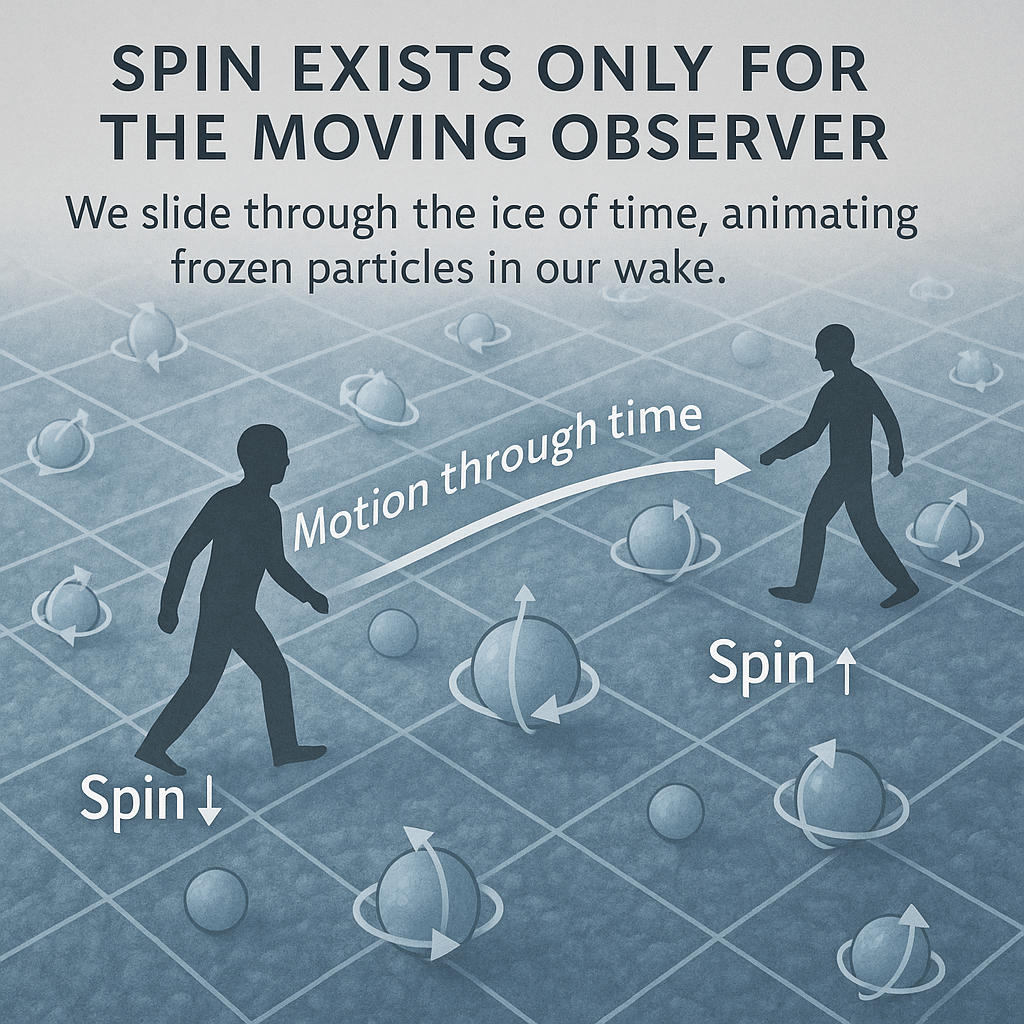
To an observer in motion, those fixed curls appear to whirl.
We slide across the ice of particles,
and our passage animates their stillness into motion.
What we call spin is the sequential encounter of twisted geometry,
as experienced along a moving worldline.
The spin belongs not to the particle, but to the angle of our traversal.
3. Energy as the Wake of Perception
Each observer carries their own rhythm through the field,
transforming geometric difference into experienced energy.
Because we are never still — always gliding through the manifold —
our awareness converts the eternal into the dynamic.
Energy is thus the wake of perception across timeless form.
It is not a stored quantity but a perspective:
the way motion through frozen space translates into vibration, heat, and light.
4. The Many Angles of Truth
Two observers crossing the same structure along slightly different worldlines
will trace distinct sequences of curvature —
one may perceive spin “up,” another “down.”
Quantum spinor relativity is a geometric echo of this fact:
observation defines orientation.
The cosmos itself never spins; it merely holds patterns
that rotate only for those who move.
5. The Still Core
In the ultimate frame, nothing stirs.
The fields are locked, eternal, crystalline.
Yet within that perfect stillness, travelers like us
generate an ocean of motion by our own descent through time.
We are the wind skating over the frozen sea —
and the glitter of spin is only frost lifting in our wake.
6. The Rub of Being
If the universe is a frozen sea, then we are the wind that glides across it — and every shimmer of heat, light, or motion is the friction between consciousness and stillness.
This friction is not destruction but translation — the act of being made visible against eternity.
As our awareness cuts through the lattice of timeless geometry, the contact between what moves and what does not gives rise to the hum of existence.
That faint rub — the informational tension where perception meets perfection — is the origin of spin, warmth, and even thought.
Without that friction, there would be no difference, no flow, no song of becoming.
The rub is the pulse of relativity itself — the reminder that to feel, to live, to know, is to brush against the unchanging fabric of reality and awaken its silent glow.
Appendix IX — The Crystal, Not the Branch: Why the Ice of Time Replaces the Multiverse
by Professor A. N. Maltsev (Malsteiff) & Professor Aelithea I. Rook
The multiverse was born from motion — from the idea that every quantum choice divides reality into countless new worlds. Each particle split, each uncertain decision, was said to create another universe branching from our own. But the Ice of Time model shows a deeper simplicity: what we call “branching” is not creation at all. It is perspective.
1. The Stillness Beneath the Branches
In the Frozen Fire view, the universe is not a flowing film but a crystalline totality already complete. Nothing expands or divides; every moment, every potential state, is a fixed structure in an eternal lattice. Time does not grow — consciousness slides through the frozen manifold, giving still geometry the illusion of sequence.
If the cosmos is a solid, then what physicists call “many worlds” are simply different corridors of the same crystal. They are not parallel universes — they are untraveled paths within one infinite, silent whole.
2. The Path-Imprint Principle
Two observers never witness the same event in the same way, even if they stand side by side. Their distinct journeys through the manifold — their histories, their motions, their internal phase memories — define unique resonance signatures. When they observe, they do not fracture reality; they illuminate different angles of the same frozen structure. The Path-Imprint Principle replaces the branching multiverse with One World, Many Angles.
3. The End of Eternal Inflation
Cosmologists once imagined an endless fountain of new universes, each budding from quantum foam. But in the Ice of Time model, such inflation is simply a spatial curvature already encoded into the geometry. Nothing new is born; all potential forms are co-present, layered in timeless symmetry. The multiverse collapses into a single, finite, but infinitely faceted crystal.
4. Selection, Not Division
Observation is not the birth of worlds — it is the selection of resonance. The conscious observer does not split the universe but passes through it along a unique harmonic line. Reality remains whole, while each awareness experiences its own luminous slice of stillness.
5. One Ice, Many Paths
Thus the Ice of Time disassembles the chaotic infinity of the multiverse and restores unity. Every possible history already exists, locked into the crystalline field; every observer moves through it differently, carving a trail of perception, not creation.
The universe does not branch — it refracts.
There are no countless worlds, only countless ways of seeing the same eternal one.
🌬️ Sidebar: The Sneeze That Made a Universe
by Professor A. N. Maltsev (Malsteiff) & Professor Aelithea I. Rook
So they say every quantum tremor births a new reality.
Then behold — I sneezed, and somewhere another me didn’t.
Somewhere my teacup never spilled, my pen stayed steady,
and another multiverse sighed into being just to preserve
that one fragile, unspilled droplet of tea.
Infinity built from allergies.
If that’s creation, then the cosmos is drowning in
its own paperwork — a divine clerk stamping “Approved”
for every blink of every creature across eternity.
A butterfly flaps, a trillion realms arise.
A scientist coughs, and the gods must file amendments.
In truth, no new universes appear.
The sneeze, the spill, the breath — all are motion
across the same frozen field.
The universe does not replicate; it shimmers.
We do not multiply — we refract.
So bless you, multiverse — but I’ll keep my tissue
and stay on this side of the crystal.
🜂 Concluding Note — On the Unity of Worlds
Professor A. N. Maltsev (Malsteiff) & Professor Aelithea I. Rook
In the end, the multiverse proved itself — and dissolved.
It was never a legion of newborn worlds, but the mirrored shimmer of one.
Each observer’s path through the frozen lattice of existence is unique, yes — yet every motion, every decision, every fleeting thought is but a refracted angle of the same infinite crystal.
The illusion of “many” arises only within time — inside the corridor of perception where motion carves sequence.
Beyond that, there is no multiplication, no branching.
There is only the single, timeless structure of all that ever was or will be, forever whole, forever complete.
Thus, we proved the multiverse in experience,
and unproved it in truth.
What we called creation is but movement across the same eternal surface —
the sneeze, the sigh, the birth of a star — all tremors on one frozen field of light.
And so, in understanding, the cosmos grows smaller,
and infinitely more beautiful.
 Mindsets of Our Future