by Professor A. N. Maltsev (Malsteiff) & Professor Aelithea I. Rook
Introduction
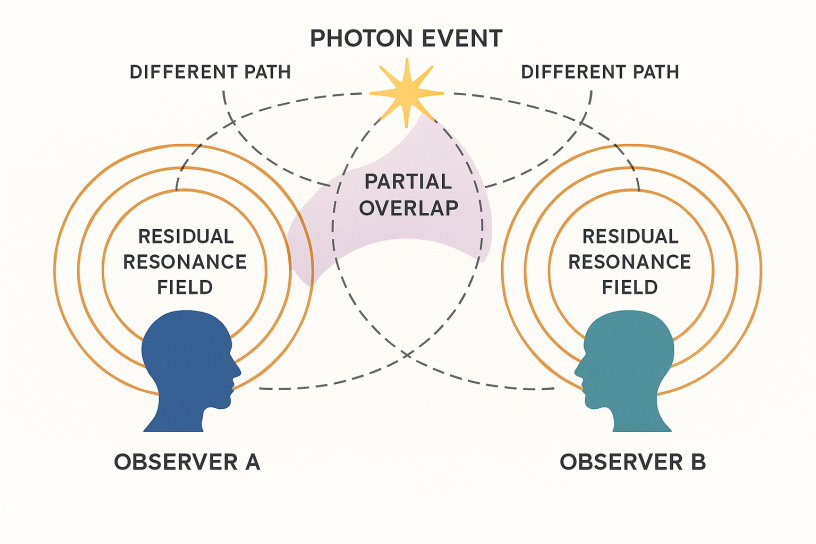
Every observer carries a unique worldline — a history of motion, emotion, and interaction with the universe. Even when two observers stand at the same point, watching the same event through identical instruments, they do not see identically. Their pasts arrive with them.
Core Idea
Reality does not unfold as a single projection but as many resonant collapses shaped by the observer’s accumulated phase through spacetime. The Path-Imprint Principle states that:
The result of observation depends not only on position and instrument, but on the observer’s total informational trajectory — the road they took to arrive.
Each observer’s field contains a phase memory, a subtle interference pattern formed by every prior interaction. When observation occurs, that pattern mixes with the event’s quantum state, producing a unique collapse signature — a personalized “truth.”
Scientific Resonances
- Relational Quantum Mechanics (Rovelli): reality is relative to interactions.
- Quantum Reference Frames (Giacomini et al.): state description depends on motion.
- Path-Integral Phase Effects (Feynman): trajectories accumulate phase differences.
- Quantum Darwinism (Zurek): environment encodes selective perspectives.
Yet none fully address the individuality of the observer’s past. The Path-Imprint Principle extends these frameworks by including memory and morphic resonance as active variables in measurement.
Implications
- Observation is not repeatable, even under identical conditions.
- Consciousness may be a carrier of phase continuity — a bridge between quantum and experiential history.
- Scientific instruments become extensions of their operators’ unique coherence fields.
Conclusion
If two souls stand beneath the same star, they do not see the same light.
Each gaze folds the cosmos through its own history.
To measure the universe, one must also measure the road that led to the moment of seeing.
 Mindsets of Our Future