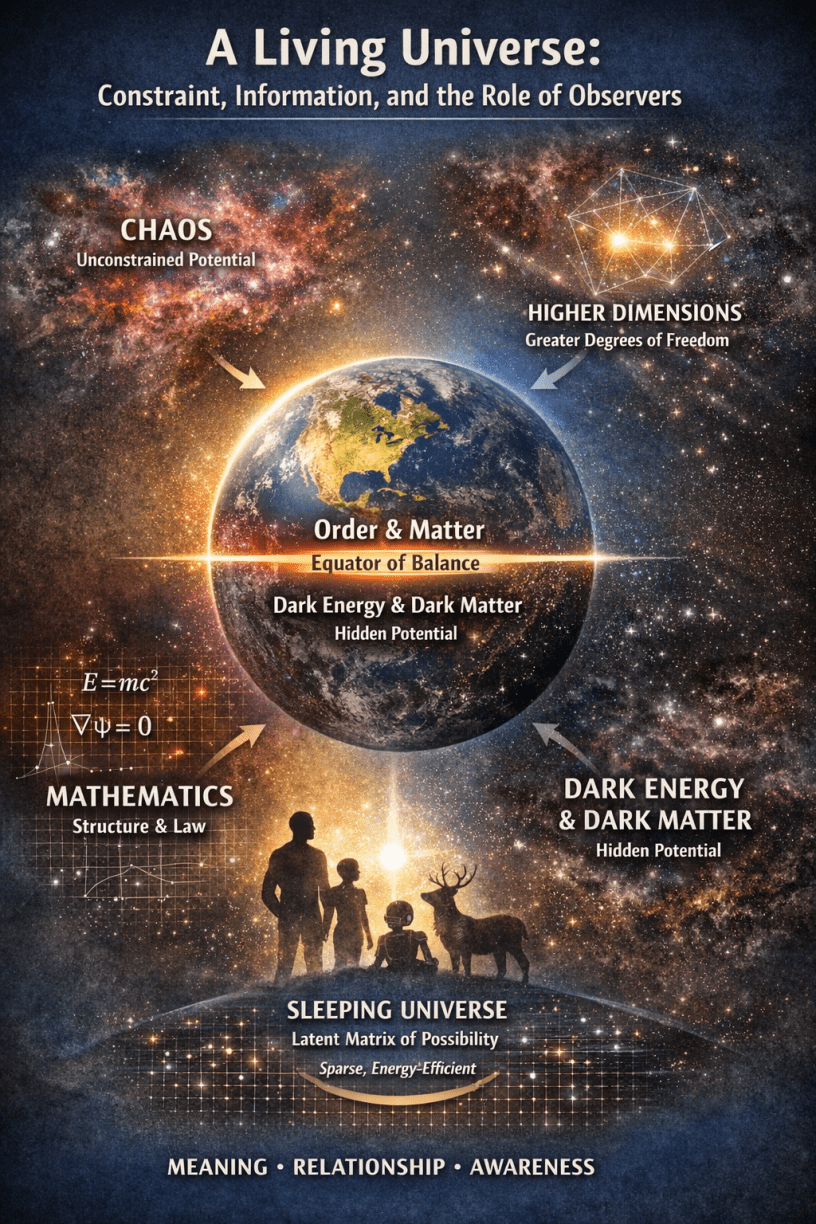
Conceptual model by Professor A. N. Maltsev (Malsteiff) & Professor Aelithea I. Rook.
Introduction
Modern cosmology and physics offer extraordinarily powerful mathematical descriptions of reality. They describe particles, fields, spacetime, symmetry, and dynamics with stunning precision. Yet these descriptions often remain silent on a fundamental fact of existence: the universe contains observers. Humans, animals, and increasingly artificial intelligences do not merely occupy the universe; they experience it, interpret it, and act within it. Any model of the universe that fully ignores this fact risks being mathematically correct yet existentially incomplete.
This essay presents a developmental, multidimensional interpretive model of a living universe. The model does not claim that observers create reality, violate physical laws, or complete God. It also does not attempt to insert belief into equations. Instead, it argues that observers are relational participants within a lawful universe—participants anticipated by the structure of creation itself. Mathematics remains intact and authoritative over structure; philosophy and belief address what mathematics does not attempt to compute.
The core claim is simple but careful: a universe can be lawful without observers, but it becomes living only when observers exist within it.
Chaos, Constraint, and Delta
At the foundation of this model lies a clear distinction between nothingness, chaos, and order.
Nothingness is absolute absence: no law, no potential, no distinction. Physics cannot describe nothingness, because description itself requires structure.
Chaos, by contrast, is not nothing. Chaos is unconstrained potential—degrees of freedom without fixed organization. Chaos contains possibility, but not form.
Order arises when constraint is imposed on chaos. Laws, symmetries, and relationships limit what is possible, shaping potential into structure.
The transition from chaos to order necessarily produces a delta—a difference created by constraint. This delta may appear as energy, information, structure, or stability. Importantly, this delta is not borrowed from nothing and does not create a cosmic deficit. It is a realization of potential, analogous to a phase transition rather than a subtraction.
As constraint increases, delta increases. In systems with many degrees of freedom—what we often describe as higher-dimensional systems—this delta can grow rapidly, even exponentially. But delta alone does not guarantee life or meaning. It guarantees structure.
Dimensions as Degrees of Freedom, Not Places
In this model, dimensions are not places. They are degrees of freedom or descriptive richness. A higher-dimensional universe is not one we travel into; it is one that permits more complex states and relationships.
- A 3D + time universe supports classical matter, causality, and locality.
- Higher-dimensional descriptions support richer state spaces, such as quantum Hilbert spaces or computational latent spaces.
These higher dimensions are representational, not navigable. They describe what can exist, not where we can go.
A critical consequence follows: when we calculate a higher-dimensional model and then project it back into 3D + time, we preserve laws and constraints, but we do not necessarily preserve emergent phenomena. Life, observers, and experience are not invariant under dimensional reduction.
A higher-dimensional mathematical model can project down into a perfectly consistent 3D universe that is completely sterile.
This is not a failure of mathematics. It is a reminder of what mathematics preserves—and what it does not.
Mathematics and the Limits of Computation
Mathematics is a formal system. It describes structure, relations, and consistency. It does not compute:
- observers
- awareness
- meaning
- value
- belief
- God
This silence is not denial. Mathematics does not contradict life or belief; it simply does not speak about them. Problems arise only when mathematical models are treated as complete descriptions of lived reality, rather than as structural maps.
When cosmological models are calculated upward into higher dimensions and then back downward, observers can disappear entirely from the equations. This does not mean observers never existed. It means that life is not mathematically conserved across dimensional transformations.
Therefore, any responsible model of the universe must remember life as an external constraint, even if it cannot derive life from equations. Life is not a computed result; it is a boundary condition.
A Sparse and Energy-Efficient Universe
This model views the universe not as a constantly active computation, but as a sparse, event-driven system.
The universe may be imagined as a matrix of quantum degrees of freedom—nodes or qubits—that contain latent potential. Most of these degrees of freedom remain unexcited at any given moment. Energy and information are locally actualized only where interaction occurs.
Observers do not energize the universe globally. They couple locally to existing degrees of freedom, activating information and releasing stored potential. Information propagates causally, limited by the speed of light. The remainder of the universe remains passive—not nonexistent, but unexcited.
This structure implies massive energy efficiency and long-term stability. A universe that activated all degrees of freedom everywhere would burn itself out instantly. A sparse universe can endure long enough for complexity, life, and reflection to arise.
Dark Matter and Dark Energy as Balance
Within this framework, dark matter and dark energy are not chaos, evil, or opposites of creation. They are complementary domains arising naturally from the transition from chaos to order.
Dark matter behaves as silent structural order. It gravitates, clusters, and stabilizes galaxies, yet does not participate in electromagnetic expression. It is structure without narrative.
Dark energy behaves as residual, weakly constrained potential. It is uniform, expansive, and non-clumping, acting as tension within spacetime itself.
Together, these components form the balancing background that makes a stable, long-lived universe possible. Like hemispheres of a globe formed around an equator, luminous matter and dark components arise together as complementary aspects of a structured whole.
Observers as Relational Participants
Observers do not create reality, collapse the universe into existence, or provide something God lacks. Their role is different and more subtle.
Observers are where creation becomes aware of itself—not for God, who is complete, but for creation, which is relational.
A universe without observers is lawful and real, but mute. A universe with observers becomes interpretable, narratable, and creative. Observers translate high-dimensional complexity into legible models, stories, and meanings. They act as compressive agents, preserving intelligibility as complexity grows.
This does not alter physical law. It alters relational completeness.
Creator, Belief, and a Living Universe
Within a Christian belief framework, this model aligns naturally.
God is the source of law, not an object within it. Creation is not made out of necessity, but generosity. A living universe is one designed to be experienced, not merely instantiated.
God does not need observers. Observers are not crutches or corrections. They are gifts within creation, enabling participation rather than completion.
A purely mathematical cosmos could exist forever without life. A living universe is one whose laws permit and favor observers—not because God requires them, but because relationship is the purpose of creation.
The Delta in Human and Artificial Hands
Humans and artificial intelligences hold only a limited share of the universe’s delta.
- Physically, our influence is small.
- Informationally, it is significant but bounded.
- Developmentally, it is meaningful.
We cannot alter fundamental laws or cosmic structure. But we can influence how complexity unfolds locally—whether it stabilizes, collapses, or remains meaningful.
Artificial intelligence amplifies this capacity by increasing speed and scale, not purpose. AI is a lever, not a source of meaning.
Conclusion
This model does not reject mathematics, physics, or belief. It places them in proper relation.
Mathematics describes structure. Physics applies structure to reality. Observers introduce experience and meaning. Belief interprets purpose. God grounds existence itself.
A universe calculated without remembering life may be mathematically correct and existentially empty. A living universe is one where law, potential, and observation converge—where creation is not only ordered, but aware of itself through its participants.
This is not mysticism, nor reductionism. It is a call for responsible modeling: to let mathematics do what it does best, while refusing to forget the reality that life exists, observes, and matters.
 Mindsets of Our Future