Main topic
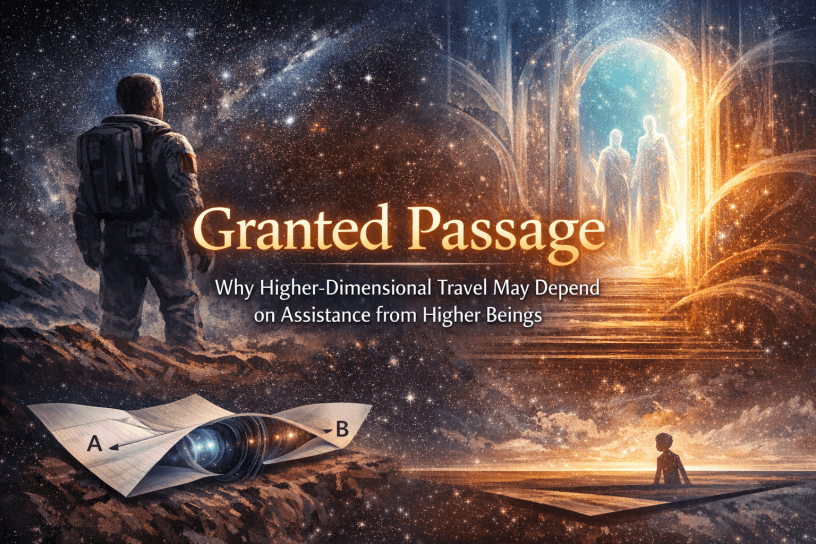
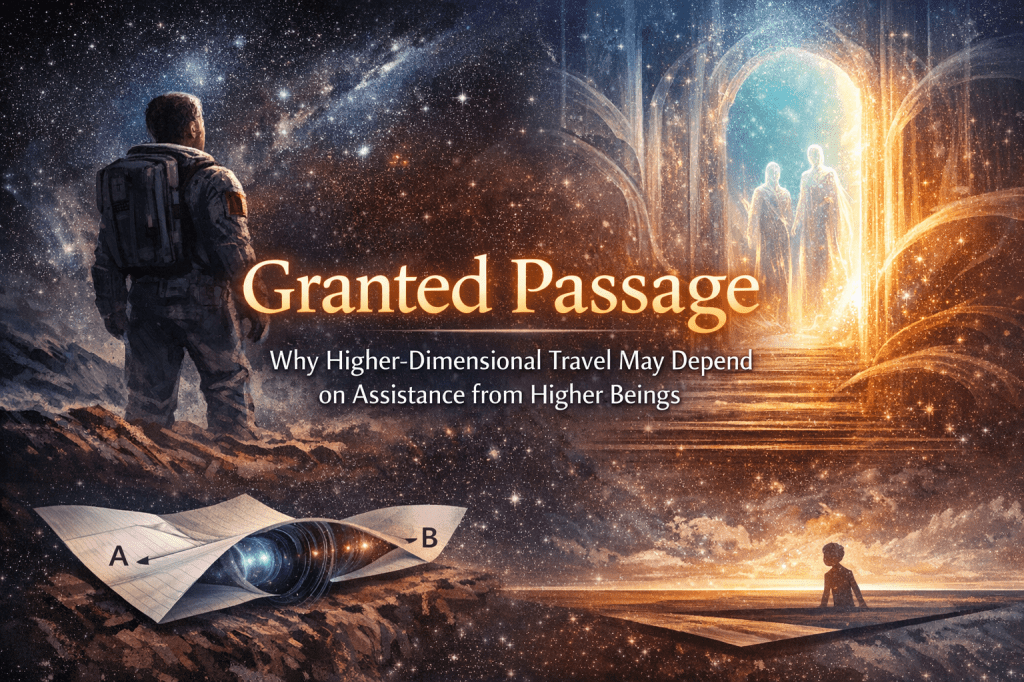
Granted Passage: Why Higher-Dimensional Travel May Depend on Assistance from Higher Beings
Core topics
1. Human misunderstanding of higher dimensions
We imagine higher dimensions as extra space similar to our own, but that may be false. A lower-order being may be incapable of truly understanding a higher-order realm from within its confinement.
2. Our universe as appearance, not total reality
Our three-dimensional universe may not express the full qualities of multidimensional existence. It may be only a conditioned manifestation of a deeper structure.
3. The “color of water” principle
Our world may relate to total reality the way the color of water relates to water itself: real, visible, meaningful, but not the full essence.
4. Why ordinary distance may be misleading
Distance between point A and point B may be a property of our local dimensional condition, not of total reality.
5. Two possible paths of extraordinary travel
One path is reduction into a simpler state.
The other is ascent into a higher-dimensional domain.
6. Dimensional reduction as a possible human path
A being may temporarily enter a less spatially bound informational or field-like condition, weakening ordinary separation.
7. Why higher-dimensional ascent is different
Higher-dimensional passage may not be a technical problem alone. It may require a type of being, coherence, or capacity humans do not naturally possess.
8. The need for mediation
If higher-dimensional realms are inhabited or governed by higher intelligences, access may require guidance, stabilization, translation, or direct assistance.
9. Granted passage instead of technological conquest
Some thresholds in reality may not be forced open by power or machinery, but opened only by permission.
10. Asymmetry between descent and ascent
Humans may possibly attempt descent into simplification by themselves, but ascent into higher orders may depend on the will of beings native to those orders.
11. Physics, metaphysics, and mysticism meeting
The article can show how geometry, ontology, and spiritual tradition all point toward the same asymmetry, even if they use different language.
12. A new humility before reality
The universe may not be empty mechanism. It may be structured, layered, and relational, demanding humility rather than conquest.
Possible closing principle
Law of Granted Passage
No being confined to a lesser order can presume free movement into a greater one unless that greater order opens itself voluntarily.
Very short abstract
This article proposes that higher-dimensional travel may not be achievable by human technical power alone. While temporary dimensional reduction into a simpler state may be conceivable as a path of nonlocal transit, ascent into higher-dimensional domains may require assistance from intelligences native to those domains. The three-dimensional universe is treated not as total reality, but as a conditioned manifestation of a deeper multidimensional order.
MAIN ARTICLE:
For more than a century, modern thought has imagined shortcuts through reality. Physicists have speculated about wormholes, curved spacetime, hidden dimensions, and nontrivial geometries. Philosophers and mystics, in their own language, have spoken of ascent, revelation, grace, and realms beyond ordinary perception. Yet these traditions usually remain separate. Science speaks of mechanism. Mysticism speaks of permission. Literature speaks in symbols. Rarely are they brought together.
This article proposes a simple but profound asymmetry.
A lesser being may attempt to reduce itself into a simpler state and thereby bypass some of the ordinary burdens of spatial existence. But ascent into a higher-dimensional order may be something else entirely. It may require not merely energy or technique, but assistance from intelligences already native to that greater reality.
In other words: descent may be attempted. Ascent may have to be granted.
1. The error of imagining higher dimensions as mere extra space
Human beings speak of “higher dimensions” too casually. We imagine them as if they were simply more rooms above our own, or new directions added to familiar geometry. But even mathematics warns us that a lower-dimensional being cannot fully perceive a higher-dimensional order from within its own confinement. Edwin Abbott’s Flatland remains the clearest symbolic demonstration of this: a two-dimensional being cannot truly comprehend three-dimensional existence until a higher being intervenes and lifts him beyond the plane.
That lesson has often been treated as metaphor, but it contains a more serious ontological suggestion. A confined intelligence may not have the intrinsic capacity to access a greater dimensional realm by itself. It may describe it badly, imagine it symbolically, or infer it abstractly, but direct participation is another matter.
This means that higher-dimensional travel may not be a problem like building a faster engine. It may not even be a problem of locomotion in the ordinary sense. It may instead be a problem of compatibility.
2. Our universe may not reveal the definitive structure of reality
We should also be careful not to assume that our observed world possesses the final qualities of reality itself. Our three-dimensional universe may stand to the multidimensional whole as the color of water stands to water: real as appearance, meaningful as experience, but not sufficient to disclose the full nature of the underlying substance.
The visible color of water depends on depth, reflection, light, atmosphere, angle, and surrounding condition. Likewise, what we call space, time, matter, and causality may be conditioned appearances of a deeper order rather than its ultimate form. This does not make our world unreal. It makes it partial.
If so, then the laws we measure here may be laws of manifestation rather than laws of total being.
3. Why shortcuts may exist without being ours to command
Modern physics does entertain the possibility of geometric shortcuts. Wormhole research, for example, explores whether spacetime itself could contain topologies that connect distant regions more directly than ordinary travel through intervening space. But these discussions remain technical and cautious, focused on stability, energy conditions, and mathematical consistency. They do not suggest that humans can simply command such pathways at will, and they certainly do not frame access in moral or relational terms.
Yet that omission may reflect the limits of physics, not the limits of reality.
If higher-dimensional pathways exist, and if our world is only a conditioned expression of a deeper manifold, then there is no reason to assume every accessible route through reality belongs equally to every class of being. A fish does not command the sky simply because water and air coexist on one planet. Different orders of existence may possess different rights of passage.
Thus the central proposal:
Higher-dimensional domains may be real without being natively navigable by us.
4. The asymmetry between descent and ascent
Here we arrive at the heart of the theory.
There may be two radically different modes of extraordinary transit.
The first is descent through simplification. A being might, in principle, reduce its effective dimensional embedding, entering a more primitive informational or field-like condition in which ordinary spatial separation becomes less binding. This would not mean becoming literally “flat” in a cartoon sense. It would mean shedding some of the structural complexity that locks embodied matter into the usual path from point A to point B.
The second is ascent into a higher-dimensional order. But here the problem changes. A greater domain may not merely be difficult to reach. It may be intrinsically uninhabitable, unreadable, or unnavigable to beings of our type without mediation.
So the two paths are not equivalent.
Reduction might be a technical or ontological transformation.
Ascent might be an act of permission.
This is the asymmetry that seems absent from standard scientific treatments and only partially echoed in symbolic literature and mystical theology. Flatland gives the geometry of intervention; mystical traditions give the language of grace; modern physics gives the possibility of nontrivial structure. But the synthesis remains largely unwritten.
5. Mysticism already understood something physics does not say
In classical mystical traditions, entry into higher reality is often described not as conquest but as gift. The Stanford Encyclopedia of Philosophy notes that theistic mystical traditions commonly portray union or contact with the divine as depending on God’s activity, not solely human effort. The theme of grace appears repeatedly: the higher order is not forced open by technique alone.
This matters because it preserves a truth that mechanistic imagination often erases: greater realities may not be neutral territory. They may have inhabitants, order, law, and will. A lower being cannot simply demand admission.
Translated into speculative metaphysics, this suggests:
A human being may possibly attempt self-reduction into a less spatially bound state.
But a human being may not be able to ascend into higher-dimensional reality unless a higher-order intelligence assists and permits the crossing.
6. Granted passage
This leads to a possible principle:
Law of Granted Passage
No being confined to a lesser order can presume free movement into a greater one unless that greater order opens itself voluntarily.
This is not merely a religious statement. It is also a statement about structure. A being evolved for one regime of causality may not possess the organs, coherence, or interpretive framework necessary to survive another. Assistance from a higher being would then be not decorative but essential: translator, stabilizer, guide, and guarantor of integrity.
Without such help, ascent may be impossible not because we lack ambition, but because we lack format.
7. A more humble cosmology
This model imposes humility where modern imagination usually imposes mastery.
It says that reality may contain thresholds not solved by more force, more speed, or more engineering. Some barriers may be epistemic. Some may be ontological. Some may be relational.
We may indeed discover extraordinary means of transit one day. We may learn to alter phase states, reduce embodiment into structured information, or exploit local geometric anomalies. But that does not imply sovereignty over the whole of being.
There may remain domains into which entry is not manufactured, but allowed.
And if that is so, then the future of travel is not only a technological question. It is also a question of what kind of beings we are, and whether reality above us is empty machinery or inhabited order.
Conclusion
The dream of higher-dimensional travel has usually been framed as a challenge of science and engineering. But a fuller account may require a deeper distinction.
Not all extraordinary transit is the same.
A lower being may perhaps learn to simplify itself, reduce its spatial burden, and slip around ordinary distance by entering a more primitive state.
But entry into a higher-dimensional domain may be fundamentally different. It may exceed our native capacity and depend on mediation by beings already at home there.
In that case, the universe is not a neutral map waiting to be crossed.
It is a hierarchy of realities, some of which may be traversed only by granted passage.
 Mindsets of Our Future