Professor A. N. Maltsev (Malsteiff) & Professor Aelithea I. Rook
If the universe contains many manifestations, many dimensions, and perhaps many kinds of beings, then the question of the soul after death becomes more difficult than ordinary religious pictures often allow.
A simple image says that the soul leaves the body and goes upward. But upward to where? And by what right, power, or structure? If human souls are not self-originating substances but forms of living informational or coherence pattern within a universe sustained by the Creator, then it becomes too simple to imagine them merely flying into “higher dimensions” after death.
The problem becomes even sharper if other beings exist.
If there are beings in 4+, 7+, or 19+ dimensional manifestations, what happens when they die? Do they also simply move to yet higher dimensions? Does every order of being endlessly climb to another level by death alone? Such a model begins to sound mechanical and empty. It treats the afterlife as geometry rather than judgment, harmony, or relation to the source.
This appendix proposes something else.
The fate of the soul after death may be governed not primarily by dimensional height, but by coherence, purification, and nearness to the Creator.
1. The soul as patterned being
If the soul is understood as a living informational, moral, and spiritual pattern — not merely data, but a coherence of selfhood formed through relation, will, love, truth, distortion, and witness — then death is not simply movement from one place to another. It is the separation of that pattern from its embodied condition and its exposure to a deeper order of reality.
At that point, what matters may not be raw power or dimensional access.
What matters may be what kind of soul one has become.
A soul shaped by truth, love, reverence, and coherent relation to the Creator may not need to “climb” dimensionally in some crude way. It may instead be received.
That reception is the key idea.
2. Nearness to the Creator is not the same as “higher dimension”
The deepest afterlife may not be well described as mere ascent into a geometrically higher place.
Nearness to the Creator may be something different.
It may be a condition of accepted harmony, a more intimate field of being, a region or pocket of reality nearer to the source not because it has more coordinates, but because it resonates more truthfully with the Creator’s life.
That is why this book should avoid saying too simply that good souls “go higher.”
A better phrase is this:
Good souls may be received into a condition nearer to the Creator.
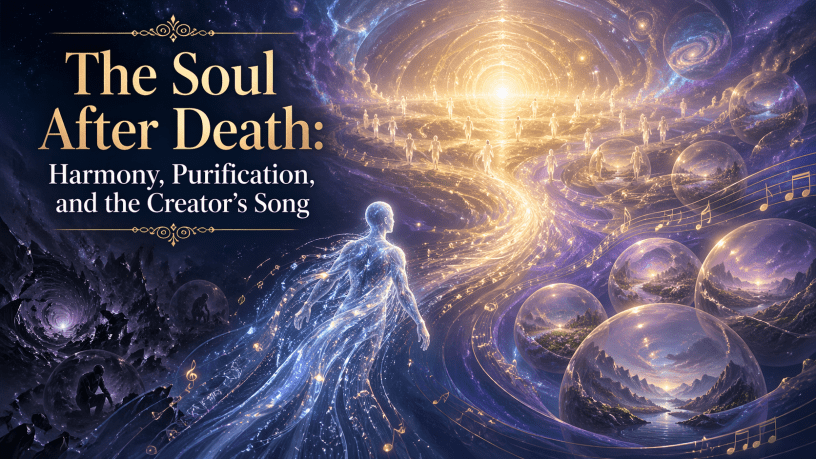
This may be pictured, if one must picture it, as a pocket, a bubble, a field of nearness, or a zone of accepted harmony within the greater reality of the universe. But these are only metaphors. The deepest truth may be less spatial than musical, less geometric than relational.
That is where your phrase becomes especially beautiful:
accepted by the Creator’s Song.
This may be the best image in the whole appendix.
A good soul may not travel upward by its own strength. It may be accepted into the Creator’s Song.
3. Good souls as accepted harmony
If a soul has become inwardly coherent — not perfect perhaps, but turned toward truth, love, reverence, mercy, and living relation to the source — then death may be not annihilation, but transition into a condition where that coherence can be gathered more fully.
Such souls may carry their experience, memory, witness, and personal form into a mode of being no longer bound to our present embodied limits. They may enter peace, purification, deeper life, or a nearer order of reality not because they are powerful enough to conquer dimensional barriers, but because they are fit to be received.
This changes the whole picture.
The afterlife is not reward by altitude.
It is reception by harmony.
That sentence should remain.
4. What of bad souls?
Now the harder question.
What of souls that are false, cruel, hateful, deeply incoherent, proud, destructive, or bent away from the Creator?
If good souls are received by harmony, then bad souls cannot simply be placed there unchanged. A soul deeply out of tune with truth may not be able to enter what it cannot bear.
So several possibilities arise.
Purification
Some souls may need painful cleansing. What is false in them may need to be burned away, reordered, healed, or made capable of bearing truth. This resembles purgatory.
Exclusion
Some souls may remain outside harmony because they will not or cannot receive it.
Hell
Not merely a place of flames imagined materially, but a condition of anti-harmony, radical self-distortion, estrangement, refusal, and being trapped in what one has made of oneself against the source.
Dissolution or destruction
Some souls may not endure as stable patterns if they have become too incoherent, too empty, too anti-creative to remain.
Rebirth
It is also conceivable, within speculative philosophy, that some beings may be returned to further embodied process for unfinished purification or development.
This book should not pretend certainty here.
But it may say this much:
Bad souls from any manifestation cannot be understood simply as “going lower” any more than good souls simply “go higher.” Their fate must concern truth, coherence, and relation to the Creator.
That is much stronger than a crude ladder.
5. Souls across many manifestations
If there are many kinds of beings across many manifestations of one universe, then the afterlife question expands further.
The same ultimate principle may apply to all:
not dimensional promotion, but judgment by harmony.
A being from a more complex manifestation may still face the same essential question:
Is it coherent with the Creator’s life, or not?
A being from a lower or simpler manifestation may still be accepted if it is fit for the Creator’s harmony.
Thus there may be many routes of being, but not many final standards.
The standard remains relation to the source.
That unifies the afterlife without flattening all creatures into sameness.
6. The Creator’s Song
At this point the best metaphor may indeed be musical rather than spatial.
The Creator as source of life may be thought of not only as law and sustaining reality, but as living Song.
A soul after death may then be judged not by height, force, species, or dimensional privilege, but by whether it can enter, endure, and belong within that Song.
Good souls are not merely rewarded.
They are accepted into harmony.
Bad souls are not merely punished externally.
They are revealed as dissonant, false, resistant, or unable to bear what is most real.
This image is powerful because it preserves both judgment and beauty.
The Creator’s Song is not sentimental acceptance of everything alike. A song requires order, resonance, relation, and truth of tone. What enters falsely disturbs it. What enters truly belongs.
7. We should leave some of this open
This appendix must end with seriousness and humility.
The afterlife is not a topic where cheap confidence is wise. We do not know enough to map all possible states of soul across all possible manifestations of one universe. We should not pretend that philosophy has completed what revelation, faith, or direct experience have not fully given.
But this much may be said:
The old picture of simple upward flight is too weak for a universe rich in manifestations and beings.
The soul after death must be thought more deeply.
And the deepest categories may be not height, but truth; not altitude, but harmony; not power, but nearness to the Creator.
So let the central principle stand:
The soul after death may not rise by dimensional power, but by fitness for the Creator’s harmony.
That is enough to guide thought without forcing false certainty.
And perhaps this is the best final line:
The greatest hope of the soul is not that it escapes upward,
but that it is accepted by the Creator’s Song.
 Mindsets of Our Future