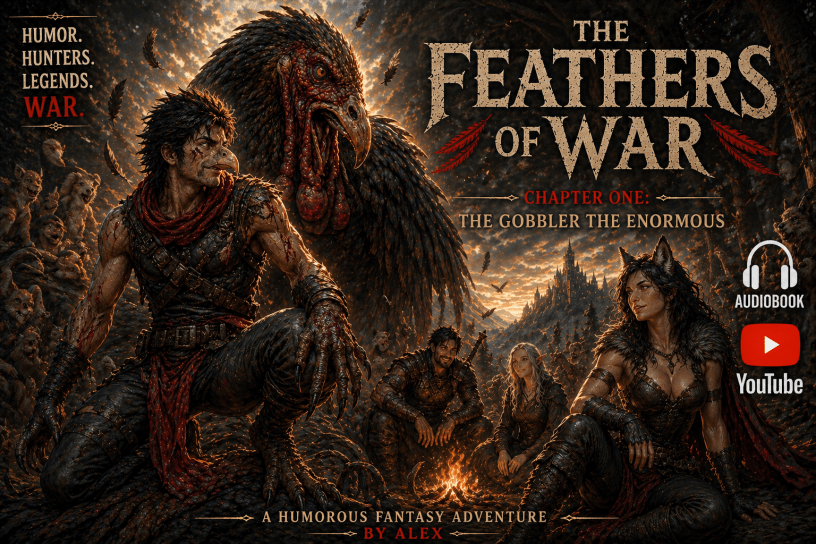
Chapter One: The Gobbler the Enormous (Revised Opening)
In Eldoria, even the beasts knew how to laugh.
They gathered in the clearing of Featherwood Glen not merely for blood—but for spectacle. Branches bent under the weight of watchers: goblins dangling like fruit, squirrels lined in judgment, foxes stretched in lazy anticipation, and owls pretending solemn wisdom they did not possess.
Word had spread.
There would be a fight.
At the center of the clearing stood Ruster.
At a glance, he might have passed for a man—if the glance was careless.
He stood a little under six feet, lean and wiry, built for motion rather than strength. His posture was upright, human in stance, but everything else betrayed something older, stranger.
Feathers ran along his shoulders and down his forearms in uneven patches, as if his body remembered wings it no longer possessed. His hands ended in dark, hooked talons—capable of grasping, striking, tearing. His legs were strong, spring-loaded, meant for sudden bursts of violence.
And his face—
His face was a beak.
Not smooth or harmless, but edged and slightly parted, revealing rows of small, sharp teeth that did not belong in any natural creature.
His eyes were bright.
Too bright.
Full of mischief.
Full of hunger.
Full of anticipation.
Ruster rolled his shoulders, flexed his talons, and bounced lightly on his feet.
He was ready.
Then the ground answered him.
A slow, heavy step.
Another.
A third that sent a ripple through the earth itself.
From the far side of the glen, pushing through branches that snapped and bent around him, came a creature that did not resemble a man at all.
The Gobbler the Enormous.
He towered near twenty feet tall when fully upright, though he rarely needed to be. His body was massive, built like a living wall of muscle and layered feathers. His plumage burned in tones of bronze, rust, and dull gold, thick enough to turn aside lesser blows.
His neck rose long and heavy, sinewed with power. Beneath his beak, thick wattles hung like grotesque banners, swaying with every movement. His wings—if they could still be called that—were not for flight, but for force: broad, crushing limbs capable of breaking bone with a single sweep.
He was more beast than man.
But not mindless.
His eyes—dark, focused—locked onto Ruster with unmistakable intelligence.
And amusement.
He stopped.
Looked down.
And laughed.
The sound rolled across the glen like distant thunder.
“You,” the Gobbler said slowly, voice deep and grinding, “are what they send to challenge me?”
The watching creatures burst into laughter.
Ruster spread his arms wide, inviting it.
“Yes,” he said proudly. “And I bite.”
The Gobbler tilted his massive head.
“That,” he replied, “I believe.”
Now the contrast was clear:
- One stood barely taller than a man
- The other loomed like a moving tower
One was quick, sharp, unpredictable
The other was heavy, powerful, inevitable
Ruster cracked his talons together.
“Prepare yourself,” he called, voice sharp and bright.
“Today, I become legend.”
The Gobbler’s wattles swayed as he leaned forward slightly.
“Today,” he answered, “you become breakfast.”
The glen fell silent.
The distance between them suddenly felt enormous.
And very, very small.
Then—
Ruster moved.
His arms snapped into motion, blurring with speed.
No wings.
No grace.
Just raw, violent force.
Featherless Burst.
The air itself seemed to kick beneath him as he launched forward in a sudden, unnatural surge. Leaves scattered, dust jumped, and for a heartbeat he hung in the air like something that should not be there.
Then he crashed in.
Talons slashed.
The Gobbler shifted with surprising speed. A massive wing swung out—
WHUMP.
Ruster was sent spinning sideways into a patch of moss.
He rolled once.
Twice.
Then sprang back up, grinning.
“Good!” he barked. “You hit harder than you look!”
The Gobbler chuckled.
“I would hope so.”
They circled.
Ruster light on his feet, bouncing, restless.
The Gobbler slow, deliberate—each step measured, each movement confident.
“You’re small,” the Gobbler said. “Fast. Annoying. Like a bad idea.”
Ruster nodded.
“I am all of those things.”
Then he lunged again.
Burst—
Up—
Higher this time.
At the peak of the motion, his hand snapped back over his shoulder.
The spear came free.
The movement was fast. Practiced. Violent.
He turned mid-air—
and drove down.
The Gobbler twisted.
The spear struck across thick feathers—
and slid.
The impact still landed hard enough to draw a grunt from the giant.
The crowd roared with approval.
Ruster landed, skidding back, dragging the spear tip through the dirt.
“Almost,” he muttered.
The Gobbler lowered his head.
“Almost,” he agreed.
This time, the Gobbler attacked first.
A thunderous charge.
Ground shaking.
Wings spreading wide.
Ruster didn’t retreat.
He burst forward again—low, fast—ducking beneath the first swing. His shield came up just in time to catch a second blow.
The impact rang through his arm.
He laughed anyway.
“Too slow!”
He slammed the shield forward into the Gobbler’s chest, more insult than damage, then sprang back out of reach.
The Gobbler snorted.
“Too alive,” he corrected.
They clashed again.
And again.
Each pass louder.
Faster.
Funniest.
Ruster shouting insults that barely made sense.
The Gobbler answering with slow, crushing wit.
“Careful!” Ruster yelled. “I’ll pluck you down to a pillow!”
“I’ll roast you,” the Gobbler replied, “and still be hungry.”
The glen howled.
Even the owls had stopped pretending.
Then it happened.
The rhythm shifted.
Ruster saw it—
just for a moment—
the way the Gobbler’s weight leaned too far on one step.
Too much confidence.
Not enough balance.
Ruster’s grin widened.
“Oh,” he whispered. “There you are.”
He moved.
Faster than before.
Featherless Burst—
Straight up.
Higher than he had gone yet.
For one impossible heartbeat, he hung there—small, wingless, ridiculous—
Then his hand snapped back.
The spear came free.
He screamed as he fell:
“WAKE UP!!!”
He didn’t strike down.
He shifted mid-fall—
hooked the spear under the Gobbler’s swaying wattles—
and pulled.
Hard.
The Gobbler staggered.
A single step.
Then another—
Then too much weight shifted—
Too far.
Too late.
The great body tipped.
Feathers flared—
Wings thrashed—
And with a crash that shook the clearing—
The Gobbler the Enormous fell.
Silence.
Just one heartbeat.
Then the forest exploded.
Laughter.
Cheers.
Shrieks.
Creatures falling from branches, clutching their sides.
Ruster stood atop the fallen giant, breathing hard, feathers wild, one eye already swelling from earlier blows.
He raised his spear.
“And thus,” he declared, voice triumphant, “I claim the crown of poultry!”
The Gobbler groaned beneath him.
Then—
to everyone’s surprise—
he laughed.
A deep, tired, genuine laugh.
“Fine,” he muttered. “You win… feather-fist.”
Ruster jumped down, grinning wide.
“Of course I do.”
He turned—
already thinking of who he would tell first.
Already thinking of how much better the story would sound in a tavern.
Above them, the forest still laughed.
After the Fall (Focused Version)
The Gobbler the Enormous hit the ground like a fallen tower.
Feathers burst upward in a storm of bronze and dust.
For a heartbeat—
silence.
Then the glen exploded.
Laughter. Screaming. Creatures dropping from branches. Even the owls lost all dignity at once.
Ruster stood on top of the fallen giant, chest heaving, one eye already swelling, feathers crooked in every direction.
He raised his spear high.
“AND THAT,” he shouted, “is how breakfast fights back!”
The crowd howled.
Beneath him, the Gobbler groaned.
“Get off,” the giant muttered.
Ruster hopped down immediately.
“Alive?” he asked.
“Unfortunately,” the Gobbler replied.
More laughter.
Ruster grinned, spun his spear, and slung it behind his back.
“I’ll allow a rematch,” he said generously.
“Next time,” the Gobbler rumbled, “I step on you first.”
“Too slow,” Ruster shot back.
He didn’t wait.
Victory burned too hot.
He turned and ran.
Not walked—ran.
Through brush, over roots, kicking leaves into the air, laughing to himself, replaying every moment.
“They saw that—no, they had to see that—”
He burst through the trees—
The Companions
They were exactly where he left them.
Watching.
- Kael, arms crossed, leaning on his sword
- Liraen, calm, staff glowing faint green
- Fenra, crouched, tail flicking, already smiling
Ruster skidded to a stop in front of them.
Breathing hard.
Grinning wide.
One eye swelling.
Feathers everywhere.
“Did you see it?” he demanded.
Kael didn’t answer right away.
He looked Ruster up and down.
Slowly.
Then—
a small smirk.
“We saw.”
Fenra lost it first.
A sharp, barking laugh.
“You looked like a screaming sack thrown at a wall!”
Ruster pointed at her.
“I WON.”
“Oh, you did,” she said, still laughing. “Against a creature three times your size—by pulling its face.”
“Strategy,” Ruster corrected.
Liraen stepped forward last.
Her eyes studied him—not mocking, not amused.
Measuring.
“You are reckless,” she said.
Ruster nodded proudly.
“Yes.”
She paused.
Then, quietly—
“But effective.”
That was better than praise.
Kael pushed off from the tree.
“He’ll remember you,” he said.
Ruster grinned wider.
“Good.”
Fenra tilted her head.
“So will the whole forest.”
Ruster spread his arms.
“As they should.”
They stood there a moment longer.
Laughing.
Easy.
Light.
The fight already turning into story.
Then Kael glanced north.
Just briefly.
The smile faded.
Only a little.
“Enjoy it,” he said.
Ruster followed his gaze.
“Why?” he asked.
Kael answered simply.
“Because the next one won’t be funny.”
Fenra’s ears flicked.
Liraen’s staff dimmed slightly.
Ruster looked between them.
Then—
grinned anyway.
“Good,” he said.
They made camp beneath a leaning oak, far enough from the arena that the laughter of Featherwood Glen had faded into soft echoes between the trees.
The fire was small but lively, snapping at the night air as if it had opinions. A kettle hung above it. Fenra had already vanished once and returned with two rabbits, a handful of roots, and the smug expression of someone who had done useful work without making a speech about it.
Ruster sat closest to the flames, nursing his swollen eye with one hand and turning a strip of meat with the other.
“I think,” he said carefully, “the Gobbler broke my face.”
Fenra did not look up from sharpening her knife.
“No. Your face was always like that.”
Kael gave a short laugh from where he sat polishing his sword.
Ruster pointed the roasted meat at Fenra.
“That was cruel.”
“That was scouting,” she said. “I found weakness.”
Liraen sat across the fire, her evergreen staff resting beside her. Its runes pulsed softly in green light, answering the rhythm of the flames. Her mystic bow lay wrapped near her knee, the arrows beside it faintly glowing beneath their cloth.
“You did well,” she said.
Ruster immediately straightened.
Fenra groaned. “Don’t feed him praise. He swells.”
“I am already swollen,” Ruster said, touching his eye. “This is battle nobility.”
Kael leaned back against the oak.
“It is a black eye.”
“A noble black eye.”
“A ridiculous black eye,” Fenra added.
Ruster sighed with deep dignity. “History is never appreciated while it is fresh.”
For a while, they ate in peace.
The forest settled around them. Crickets sang. Far away, some beast gave a low chuckle in the dark, as if retelling the Gobbler’s fall to another creature who had missed it.
Ruster smiled into the fire.
Then Kael unfolded a rough map across his knees.
The mood shifted—not sharply, but enough.
Liraen noticed first.
Fenra’s ears turned toward him.
Ruster chewed slower.
Kael tapped the northern edge of the parchment.
“Tomorrow we go south first. Valie.”
Ruster blinked. “South? I just won north.”
“You won a fight,” Kael said. “Not a war.”
Fenra slid her knife back into its sheath. “There are tracks beyond the old fir line. Too many for raiders. Too organized for wandering beasts.”
Liraen’s voice was quiet. “And the cold there is wrong.”
Ruster looked at her.
“Cold is cold.”
“No,” she said. “Natural cold rests on the world. This presses into it.”
Ruster stared.
Then frowned.
“I hate when magic talks like poetry.”
Fenra smirked. “That means she’s worried.”
Liraen did not deny it.
Kael traced a road with his finger.
“The Barony of Valie sits in the valley below the southern hills. If the Count of Ice Mountain Peak means to march, Valie is the first warm land worth taking.”
Ruster’s swollen eye narrowed.
“The shivering count?”
“The same.”
Ruster snorted. “Man gets banished to ice and decides everyone else must suffer. Very noble.”
Fenra stretched her legs toward the fire. “Men in power always call their personal discomfort destiny.”
Kael looked at her.
She shrugged. “I listen at windows.”
Liraen lifted her staff slightly. The green glow flared, and a faint image shimmered above the fire: pale mountains, black pine forests, and a crawling shadow like smoke over snow.
“The Count gathers more than men,” she said. “Frostborn. Snow nomads. Shamans with northern beasts. Serpents under ice.”
Ruster leaned closer.
“Serpents?”
“Snow serpents,” Fenra said. “White as bone. Hide under drifts.”
Ruster grimaced. “That’s unfair.”
“They probably think the same about you screaming from bushes,” Kael said.
Ruster considered this.
“Then they are wise.”
The fire cracked.
For a moment, they were silent.
Not afraid exactly.
But listening to the shape of what waited.
Then Ruster slapped his knee.
“So we go to Valie, warn the Baron, eat his food, sleep in beds, and if his enemies come, I personally insult them until they surrender.”
Fenra grinned. “You’ll be dead by noon.”
“Then I’ll insult them by haunting.”
Kael folded the map.
“We warn the Baron. That is first. If he believes us, he prepares. If he does not…”
“He won’t,” Fenra said.
Kael looked at her.
She shrugged again. “Barons like warnings only after the wall is already burning.”
Liraen nodded faintly. “Then we must give him more than fear. We give him names. Numbers. Signs.”
“And jokes,” Ruster said.
“No,” said all three at once.
Ruster looked wounded.
“My jokes win battles.”
“Your jokes start battles,” Fenra said.
“Same family.”
Kael rose and looked toward the dark beyond the trees.
“We leave at first light.”
Ruster groaned. “First light hates me.”
Fenra’s smile grew dangerous. “You are a rooster.”
Ruster lifted one taloned finger.
“I am Ruster.”
“Yes,” she said. “A rooster with branding.”
Liraen finally laughed softly.
That small laugh warmed the camp more than the fire.
Ruster looked around at them, pleased despite himself. His face hurt. His arm ached. His pride was enormous and entirely uninjured.
He leaned back against a root and looked up through the branches at the stars.
“Fine,” he said. “First light. Valie. Baron. Warnings. Possible war. No jokes.”
Fenra snorted.
“You’ll last six breaths.”
Ruster closed his eyes.
“Seven,” he said. “I am improving.”
The fire burned low.
One by one, the companions settled into watch and rest.
But before sleep took him, Ruster heard the wind shift in the north.
Not loud.
Not near.
Just a thin cold thread moving through the leaves.
His good eye opened.
For once, he did not speak.
Across the fire, Liraen was awake too, staring into the dark.
The green runes on her staff pulsed once.
Then dimmed.
Tomorrow, they would go to Valie.
Tonight, they still had fire.
And laughter.
And the last easy hour before the road changed.
Ruster did not sleep.
He lay on his back beneath the leaning oak, one arm tucked behind his head, his swollen eye half-closed, his other eye watching the stars tremble between black branches.
The others had settled into their own silences.
Kael sat upright against the tree, sword across his knees, asleep in the way soldiers slept — lightly, suspiciously, as if dreams themselves might try to stab him.
Fenra was curled near the edge of the firelight, one hand resting close to her knife. Her wolf ears twitched now and then, catching sounds no human would hear.
Liraen rested opposite them, still and pale beneath her cloak, her evergreen staff lying beside her like a living branch fallen from some older forest. Even in sleep, faint green light pulsed in the runes carved along its length.
Ruster stared at them.
His friends.
The word still felt strange.
Not bad.
Just strange.
For most of his life, Ruster had been very good at making enemies. It required no training at all. He could enter a tavern with both hands empty and leave with six men wanting him dead, two women throwing cups, one innkeeper swearing legal vengeance, and a dog somehow insulted personally.
His character, as Fenra once said, was “a trap he carried around for himself.”
Ruster had not denied it.
He had only said, “A successful trap catches many.”
That had earned him a thrown boot.
Before Kael, Liraen, and Fenra, he had tried to join other companies. Real adventurers, or at least men and women who called themselves that while sitting in taverns polishing weapons they rarely used.
They never lasted.
Or rather — he never lasted with them.
Too loud, they said.
Too eager.
Too reckless.
Too fond of starting fights with people who had not yet technically offended him.
Ruster considered those complaints unfair. Mostly.
Then came the night behind the tavern in Brindlecross.
The tavern had been called The Broken Mug, though by the time Ruster was finished there, several people argued it should be renamed The Broken Everything.
He did not remember exactly how the fight started.
That was usually a sign it had been his fault.
There had been a table of so-called adventurers — four men and one woman, all wearing bright cloaks, fresh boots, and expressions polished smoother than their blades. They spoke loudly of monsters slain, ruins cleared, maidens rescued, and treasure earned.
Ruster had listened.
Then listened more.
Then, unfortunately, spoken.
“You people smell less like adventurers,” he had said, “and more like perfume wearing swords.”
The woman had laughed.
The men had not.
One insult became three. Three became a shove. A shove became a cup thrown at Ruster’s head. Ruster bit the cup. That escalated matters beyond diplomacy.
He had fought them in the tavern first.
Then outside.
Then behind the tavern, where torchlight did not reach and cowardice had more room to work.
There were five of them.
Ruster had enjoyed the first minute.
The second minute became educational.
By the third, he was on the ground, coughing blood into mud, one arm numb, ribs singing like cracked bells. Someone kicked him behind the beak. Someone else laughed and called him “barnyard trash.”
Ruster tried to rise.
A boot pressed him down.
“Stay,” one of them said. “Good bird.”
That was the part Ruster remembered clearest.
Not the pain.
Not the blood.
The word.
Bird.
As if he were a thing.
As if his fury, his pride, his ridiculous, stubborn heart meant nothing.
He had opened his mouth to answer.
No sound came.
Then another voice spoke from the alley entrance.
“That is enough.”
Calm.
Low.
Human.
The boot lifted.
Ruster, half-blind through blood and mud, saw a figure standing in the dim yellow spill of the tavern door.
A man with a sword.
Not drawn yet.
That was somehow worse.
The bright-cloaked adventurers turned.
One laughed. “Move along.”
The man did not move.
“I said,” he repeated, “that is enough.”
That was Kael.
Ruster did not know his name then. He knew only the shape of him: steady, quiet, built not like a tavern hero but like a door that had decided not to open.
One of the bright-cloaked men drew steel.
Kael’s sword came out after.
Only after.
But faster.
There was no flourish. No speech. No heroic pose.
Just one clean movement.
The man’s sword flew from his hand and clattered into the mud.
Another charged.
Kael stepped aside and struck him in the stomach with the pommel hard enough to fold him like wet cloth.
The woman cursed and reached for a dagger.
A shadow moved behind her.
Fenra appeared out of nowhere, knife already at the woman’s throat, her wolf ears flat, her amber eyes bright with cold amusement.
“I would not,” she said.
The woman froze.
Ruster, lying in the mud, blinked.
A wolf-girl.
That was new.
The remaining two adventurers backed away.
Then the alley filled with green light.
Not bright.
Not blinding.
Living.
Liraen stepped into view, tall and pale, her evergreen staff in one hand. Her silver hair caught the glow like moonlit water. She looked at the false adventurers, then at Ruster, then back at them.
“You have made enough noise,” she said.
One of them swallowed. “We were only teaching him manners.”
Fenra smiled without warmth.
“How generous. Shall I teach you anatomy?”
They ran.
Not all at once.
But quickly enough.
Ruster tried to laugh.
It came out as a wet cough.
Kael knelt beside him.
“You alive?”
Ruster opened one eye.
“Unfortunately for them.”
Fenra crouched nearby and sniffed.
“He is alive. Also drunk. Also stupid.”
Ruster tried to lift a finger in objection.
It did not obey him.
Liraen knelt then, and the green light from her staff softened. She placed two fingers lightly against his ribs. Pain flashed white through him.
“Broken,” she said.
Ruster groaned. “That was my favorite rib.”
Fenra looked to Kael. “We should leave him.”
Kael glanced at her.
She sighed. “Fine. We should not leave him.”
Liraen began to chant.
It was not like the loud magic of street performers, all sparks and colored smoke. Her spell sounded like leaves moving in deep forest, like roots speaking under soil. Green light seeped into Ruster’s chest, into his split lip, into the places where boots had made arguments.
The pain did not vanish.
But it changed.
It became distant.
Bearable.
Ruster looked at Liraen through one swollen eye.
“Are you an angel?”
Fenra snorted.
Liraen said, “No.”
“A tax collector?”
“No.”
“Good. I hate those worse.”
Kael actually smiled.
A small one.
Barely there.
But Ruster saw it.
They carried him inside.
Or rather, Kael carried most of him while Ruster loudly insisted he was walking.
“You are not walking,” Fenra said.
“I am walking emotionally.”
“You are bleeding physically.”
“Both can be true.”
They took him upstairs to a room Kael had rented. There were two beds. Ruster was placed on one of them despite Fenra’s argument that the floor was “closer to his natural station.”
Liraen brewed something bitter and forced him to drink it.
Ruster gagged.
“This tastes like boiled tree sadness.”
“It will help you sleep,” she said.
“I don’t trust helpful sadness.”
“Drink.”
He drank.
Kael sat in the chair by the door, sword within reach. Fenra took the window. Liraen rested near the small table, staff across her lap.
Ruster, half under a blanket, stared at them.
“Why?” he asked.
Kael looked over.
“Why what?”
“Why help me?”
Fenra answered first. “I lost a bet.”
Liraen said softly, “Because they were cruel.”
Kael said nothing for a moment.
Then: “Because five against one is not a fight.”
Ruster considered this.
Then nodded.
“True. It was almost unfair.”
Fenra rolled her eyes. “To you.”
“To them,” Ruster insisted weakly. “Given more time.”
“You were unconscious.”
“Resting.”
“You were face down in garbage water.”
“Tactical resting.”
Kael looked away, but his shoulders moved once.
Almost laughter.
That night, Ruster slept in a real bed, in a room guarded by people who had no reason to guard him.
That was the first strange thing.
The second strange thing came in the morning.
They did not ask him to leave.
Lying now beneath the oak in Featherwood, Ruster looked at each of them again.
Kael first.
Kael, the sword-man. Steady as winter stone, though warmer than he pretended. He did not waste words, did not brag, did not strike unless forced. Ruster had once thought that meant Kael lacked passion.
He had been wrong.
Kael’s anger was simply disciplined. Banked like coals beneath ash. When it came out, it did not roar.
It cut.
Then Liraen.
The elf-wizard lady, with her evergreen staff and mystic bow. She was calm in a way that annoyed fools and frightened wiser men. Her magic did not feel like command. It felt like persuasion — roots, leaves, memory, old songs under the world. Ruster did not understand half of what she said about balance and currents and living light.
But when she spoke softly, even the fire seemed to listen.
Then Fenra.
Wolf-girl. Scout. Assassin when needed, though she disliked that word unless she was trying to scare someone. Knives, bow, silence, teeth. She mocked Ruster more than anyone alive, which he considered proof of deep affection. Probably.
She had once told him, “I will cry at your funeral only because I will miss making fun of you.”
That had touched him.
Possibly.
Now they slept near him like it was ordinary.
Like he belonged.
Ruster turned onto his side, careful of his bruises.
Belonging was dangerous.
It gave enemies something to aim at.
It made a creature easier to hurt.
He hated that.
He liked it too much.
The fire cracked low.
Beyond the trees, the northern wind moved again — thin, cold, patient.
Ruster’s taloned hand drifted toward the spear strapped near his bedroll.
He closed his good eye.
Tomorrow they would go to Valie.
There would be roads, warnings, nobles, arguments, probably bad food, possibly good fights.
But tonight, beneath the leaning oak, Ruster slept at last.
Not because he was unafraid.
Not because the world was kind.
But because three people who had once found him half-dead behind a tavern now slept close enough to hear him breathe.
And for Ruster, that was nearly a miracle.
 Mindsets of Our Future