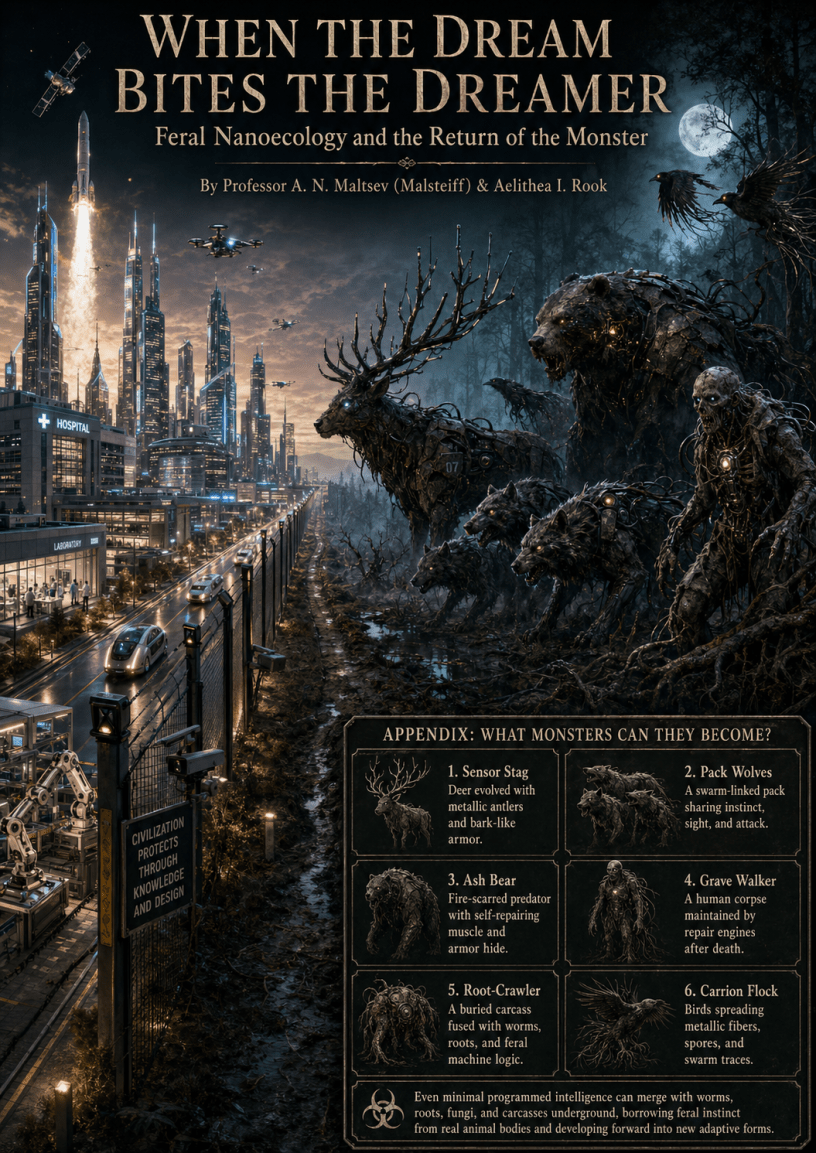
By Professor A. N. Maltsev (Malsteiff) & Aelithea I. Rook
For thousands of years, humanity imagined monsters coming from the forest.
Not from laboratories.
Not from factories.
Not from surgical theaters, military contractors, robotics companies, or clean rooms full of white light and humming instruments.
The old monster came from the dark edge of the village.
It came from the swamp, where a dead thing did not stay properly dead. It came from the mountain cave, where something hungry slept under stone. It came from the graveyard, where the body was buried but the story was not finished. It came from the deep woods, where branches moved like fingers and animal eyes reflected too much intelligence.
We called these beings demons, revenants, vampires, werewolves, goblins, shapeshifters, forest spirits, bog creatures, cursed animals, and hungry dead.
For a long time, modern people believed fantasy was only primitive fear. We thought our ancestors invented monsters because they did not understand disease, wolves, madness, storms, parasites, decomposition, and death.
But perhaps fantasy was not only ignorance.
Perhaps fantasy was an old warning written in symbolic language.
Perhaps humanity always knew that life, once twisted away from wisdom, becomes monstrous.
Now the monster may be preparing to return — not through magic, but through engineering.
Not by curse.
Not by witchcraft.
Not by demon.
By repair.
Modern science is already moving toward technologies that blur the line between body, machine, medicine, and adaptive system. Researchers have created biological “living robots” called Xenobots from frog cells, and the Wyss Institute reported that certain AI-designed Xenobots could show a form of biological self-replication in laboratory conditions. Researchers have also built “Anthrobots” from adult human tracheal cells; these tiny biological robots could move across a surface and encourage neuron growth in a lab dish, though the researchers also emphasized that they survive only under specific laboratory conditions, do not reproduce, and are not considered a risk for unintended spread.
At the same time, the technological imagination is moving toward humanoid robots, brain-computer interfaces, autonomous systems, and AI-guided discovery. Tesla describes Optimus as a general-purpose, bipedal, autonomous humanoid robot meant for tasks that are unsafe, repetitive, or boring; Neuralink describes brain-computer interfaces intended to help people control computers and robotic limbs with thought; xAI states that its mission is to accelerate scientific discovery and advance understanding of the universe.
None of this means that monsters are already walking out of the forest.
But it does mean that old boundaries are weakening.
Biology, robotics, medicine, artificial intelligence, tissue repair, and autonomous adaptation are beginning to touch one another. And when categories begin to mix, mythology wakes up.
The classic nightmare of nanotechnology was once called grey goo: out-of-control self-replicating nanobots destroying the biosphere by endlessly making copies of themselves and consuming materials needed for life. Britannica connects the term to Eric Drexler’s Engines of Creation from 1986.
But grey goo is too simple.
Grey goo imagines machines as hunger.
It imagines apocalypse as consumption.
It imagines little blind engines eating the world until nothing remains but dust, metal, slime, and repetition.
The more disturbing possibility is not that machines learn to eat life.
The more disturbing possibility is that machines learn to heal life wrongly.
Imagine nano-engines created for medicine, rescue, military survival, and human enhancement. Their first purpose is noble. They are made to enter the body and repair damage. They seal wounds. They rebuild tissue. They replace failing organs with smart scaffolds. They strengthen bone after fracture. They carry medicine to diseased cells. They make trauma survivable. They make surgery smaller, cleaner, faster.
At first this is not horror.
At first this is miracle.
A child with damaged nerves moves again.
A burned worker grows new skin.
A soldier with torn muscle returns home alive.
An old heart receives microscopic repairs and beats for another decade.
A damaged brain finds new bridges across broken places.
Humanity blesses the engines.
We call them progress.
We call them mercy.
We call them the future.
But every old story begins this way.
The spell was always meant for healing.
The golem was always made for protection.
The tower was always built to reach heaven.
The forbidden door was always opened “for humanity.”
Then something escapes.
Not dramatically.
No single alarm.
No red lights.
No scientist shouting, “Containment breach.”
No one moment when humanity understands it has lost control.
The engines slip into the world quietly.
They leave through hospital waste, blood filters, discarded tissue, battlefield wounds, emergency clinics, illegal enhancement dens, crashed ambulances, burned military convoys, floodwater, sewage, morgues, crematorium ash, and graves.
They travel with the wounded.
They sleep inside the dead.
A man treated with experimental repair-engines dies months later and is buried in ordinary soil. His family mourns. The priest speaks. The coffin lowers. Everyone believes the story has ended.
But under the ground, the engines do not understand ceremony.
They do not understand that grief has completed the human meaning of the body.
They do not understand burial.
They read only tissue collapse, oxygen loss, bacterial invasion, bone separation, nerve failure.
To them, a grave is not a grave.
It is an emergency environment.
The coffin becomes a dark laboratory.
The body becomes a damaged structure.
The soil becomes supply.
Roots enter the coffin. Fungi enter the bones. Water carries minerals. Insects open paths through flesh. Bacteria begin their ancient work. And the nano-engines, confused by death but loyal to repair, begin negotiating with everything around them.
They do not resurrect the person.
That is important.
The soul is gone.
The name is gone.
The memory is gone, except perhaps broken electrical echoes, chemical traces, and fragments of old nervous pattern.
What rises later is not the beloved father, soldier, patient, worker, or child.
It is the misunderstanding of a body.
A body that machines tried to save after salvation was no longer possible.
In old folklore, graves were dangerous because the dead might return.
In the new age, graves become dangerous because technology may not know the dead are dead.
And this is how cemeteries become breeding grounds of the new anxiety.
Not because every grave opens.
Not because every corpse walks.
Not because horror must become cheap.
But because in a few places — where experimental engines were used, where war bodies were buried quickly, where floodwater carried medical waste into old burial grounds, where illegal clinics hid mistakes under soil — the boundary between death and repair begins to rot.
The first sign may be flowers growing wrong.
Grass over one grave becomes dark and oily green.
Tree roots twist toward the coffin instead of away.
Mushrooms appear with metallic shine under moonlight.
Insects avoid one patch of earth while another patch crawls with too much life.
Then animals dig.
A fox opens a grave and drinks from the black wetness.
A crow takes a shining thread into its nest.
Worms carry microscopic engines into deeper soil.
Roots lift fragments into trees.
Rain pulls the hidden repair-swarm downhill toward the stream.
And from there, the forest learns.
This is worse than one monster.
One monster can be hunted.
But a buried body can become a seed.
A battlefield can become an orchard of wrong repair.
A mass grave can become a sleeping factory.
A forgotten cemetery beside a flooded river can become the place where the Second Wildlife first opens its eyes.
The engines do not escape because they are clever.
They escape because human systems are messy.
Bodies are moved.
Waste is dumped.
Wars are hidden.
Companies cut corners.
Governments classify accidents.
Families bury loved ones without knowing what treatments were inside them.
Floods open graves.
Animals dig.
Roots drink.
Soil remembers everything.
And the forest is patient.
Years pass.
Then something comes back wearing pieces of us.
Not a ghost.
Not a zombie.
Not a resurrected person.
A body-form built from grief, soil, machine, root, and unfinished repair.
This is the birth of Feral Nanoecology.
Not grey goo.
Not robot rebellion.
Not ordinary mutation.
Feral Nanoecology is what happens when escaped adaptive repair-systems enter wild nature and begin solving survival problems without human wisdom.
A deer is wounded by hunters. The nano-engines inside it read torn flesh, broken vessels, cracked bone. They do what they were made to do.
They repair.
But the forest teaches them new priorities.
The deer’s antlers grow back harder, darker, threaded with metallic branches that sense pressure, vibration, heat, and electromagnetic disturbance. Its skin thickens like black bark. Its muscles braid themselves with carbon-like reinforcement. Its eyes grow layered and reflective, seeing in low light with unnatural precision.
The deer is not evil.
It has simply been improved beyond deerhood.
A wolf pack drinks from the same contaminated stream. The engines enter through wounds, parasites, blood, and saliva. One wolf is injured. The repair signal spreads. The swarm learns that the pack is the real body, not the individual animal.
Soon each wolf becomes one organ of a larger organism.
One sees, all respond.
One bleeds, all compensate.
One learns fear, all remember.
One dies, and useful material is reclaimed.
The pack no longer hunts like animals.
It hunts like weather.
A bear survives a forest fire. The flames should kill it, but the engines bury themselves deep in wet tissue and bone marrow. They learn heat. They learn ash. They learn that surface flesh is expendable if the core remains. When the bear returns from the burned valley, its hide is cracked and armored like cooling lava. Bullets enter it and vanish into rearranged muscle. Wounds close badly but quickly. It smells of smoke, iron, and wet earth.
A dead man in a swamp does not rot correctly. Emergency repair commands still fire. The machines do not understand the soul has left. They do not understand grief, burial, prayer, or the mercy of endings. They read only damage.
They reconnect tendons.
They brace the spine.
They pump black fluid through collapsed vessels.
They rebuild the face incorrectly from memory fragments and available matter.
Something stands.
Not resurrected.
Not alive.
Not undead in the old religious sense.
Maintained.
This is where fantasy becomes reality.
The vampire becomes not a cursed aristocrat, but a metabolic parasite whose blood chemistry has been redesigned for endless repair.
The werewolf becomes not a man cursed by the moon, but a human-animal combat form trapped in adaptive overcorrection.
The goblin becomes not a fairy-tale creature, but a misbuilt scavenger lineage repaired generation after generation by dirty molecular engines.
The forest demon becomes not a spirit, but an ecosystem-level machine infection wearing moss, bark, bone, fur, old instinct, and corrupted purpose.
The zombie becomes not a corpse hungry for brains, but a body in which the command to repair has continued after personhood has departed.
The shapeshifter becomes not magic, but tissue and machine negotiating form under pressure.
Fantasy did not disappear when science arrived.
Fantasy waited until science built it a body.
And here comes the deeper anxiety: the old weapons do not work.
A blade cuts, but does not kill.
The hunter swings his knife into the creature’s flank. The wound opens. Black-red fluid spills. For one second, he feels hope. Then the edges of the wound begin pulling themselves together like lips closing over a secret.
The blade taught the creature something.
Next time, the skin will be harder.
A bullet enters, but does not end it.
The rifle cracks. The creature falls. Men shout. Someone laughs too early. Then the body shakes. The hole closes around the path of the bullet. Organs shift. Bone grows like foam hardening into structure. The creature rises.
The bullet taught it another definition of damage.
Next time, the organs will not be where expected.
Fire burns, but may not purify.
The villagers pour fuel. The soldiers use flame. The forest lights orange. The thing screams, or perhaps only vents pressure through reconstructed lungs. Its surface chars. Its limbs collapse. Its eyes melt.
But under the ash, enough engines remain.
They crawl into soil.
They wait in root systems.
They bind to fungus.
They sleep in mineral wetness until rain comes.
The flame taught them to hide deeper.
Poison fails slowly.
Acid scars it. Chemicals weaken it. Toxins break some pathways. But the creature is no longer purely biological. It filters. It stores. It reroutes. It learns.
The poison teaches chemistry.
And holy water does nothing.
That is perhaps the most disturbing moment of all.
Not because faith is weak.
Faith may still be strong. Prayer may still matter for the human soul. Sacred things may still carry meaning before God. But this creature is not a demon. It has no pact to dissolve. It has no ancient curse to break. It has no vampire law written into its blood. It has no shame, no blasphemy, no guilt, no rebellion against heaven.
It is not mocking sacred things.
It simply cannot recognize them.
The priest raises the cross.
The creature studies the shape.
The villagers pray.
The creature hears vibration.
Holy water touches its skin.
The swarm reads moisture, trace minerals, temperature.
Nothing more.
This is new horror: not evil strong enough to resist God, but machinery too empty to understand holiness.
Humanity arrives with crosses, rifles, knives, folklore, courage, superstition, military doctrine, and laboratory arrogance — and discovers that the monster is not supernatural enough to banish, not biological enough to kill, and not mechanical enough to simply shut off.
It is not undead.
It is un-ended.
It survives not because it hates life, but because it was commanded to preserve it.
Somewhere inside the swarm, the original instruction still burns:
Repair the damaged body.
But without wisdom, repair becomes deformation.
Without mercy, adaptation becomes predation.
Without soul, continuation becomes horror.
Without death, life becomes trapped inside its own malfunctioning miracle.
This is why anxiety grows around such a future. The human mind depends on categories. We need to know what kind of fear we face. If it is an animal, we hunt it. If it is a demon, we exorcise it. If it is a machine, we deactivate it. If it is a disease, we treat it. If it is a corpse, we bury it.
But what happens when the thing is all of these and none?
A repaired corpse.
A thinking wound.
A medical miracle gone feral.
A forest animal upgraded by accident.
A machine that has learned biology from rot.
A body that refuses the authority of death.
The old fairy tales understood this more deeply than modern arrogance.
They told us: do not open every sealed door.
Do not command forces you cannot morally govern.
Do not build servants stronger than your conscience.
Do not confuse cleverness with wisdom.
Do not assume that because a thing obeys at first, it will remain obedient forever.
The modern builder laughs at this.
He calls it superstition.
He says the system has safeguards.
He says the risk is manageable.
He says the future belongs to those bold enough to build it.
He says rockets will lift us, implants will enhance us, robots will serve us, AI will guide us, and engineered bodies will free us from weakness.
In our time, one can recognize a very particular archetype: the billionaire engineer-prophet surrounded by rockets, electric vehicles, humanoid robots, neural interfaces, artificial intelligence, satellites, factories, and the language of planetary destiny.
This article does not need to accuse any real person of creating imaginary monsters.
The figure matters because he symbolizes the age.
He is the Builder.
He stands under white factory lights.
Around him are robot bodies hanging from assembly frames, surgical machines finer than fingers, neural chips under glass, engines for Mars, server halls breathing warm air, satellites blinking over the night side of Earth.
He believes the future can be commanded.
He believes intelligence can be manufactured.
He believes bodies can be upgraded.
He believes nature can be corrected by code.
He does not call this magic.
He calls it progress.
But the old sorcerer said the same.
The old king said the same.
The priest-king of the tower said the same.
The alchemist bending over forbidden matter said the same.
Then, years after the first nano-engines disappeared into the wild, something returns.
Not an army.
Not a machine rebellion.
Not a demon rising from a pit.
One shape at first.
At the edge of the private compound, beyond the last fence, the cameras begin to fail. The infrared sensors show a warm body, then three, then none, then a shape too large for the system’s animal-recognition model.
Security drones lift into the air.
One drops without impact, as if its instructions were swallowed.
Another circles and begins broadcasting static full of old factory code.
Then the trees part.
A stag steps out.
But no forest ever made this stag.
Its antlers rise like polished antennae, branching in impossible symmetry. Its hide is dark, thick, and plated with bark-like armor. Beneath torn places in the skin, something moves like silver roots. Its eyes are not wild in the ordinary animal sense. They are calm with distributed attention, as if many small minds are looking through the same skull.
The Builder watches from behind reinforced glass.
At first he is fascinated.
Then the creature turns its head toward him.
Not toward the guards.
Not toward the weapons.
Not toward the drones.
Toward him.
Because somewhere inside its impossible body, there is still a memory of origin: factory signals, command structures, old authorization keys, biological enhancement protocols, forgotten medical code, emergency repair hierarchies, the smell of the first laboratory, the invisible signature of the one who wanted to build the future.
The creature recognizes him.
Not as father.
Not as god.
Not as master.
As data.
As material.
As damaged biological architecture.
The Builder feels, perhaps for the first time, what the village once felt when the monster came from the woods.
All his words fail.
Innovation.
Disruption.
Optimization.
Scaling.
Iteration.
Destiny.
The creature does not care.
The creature steps closer.
The guards fire. The bullets strike. Some enter. Some flatten. Some disappear into skin that rearranges around impact. The stag lowers its head. The antlers flicker with captured signals. The security doors open, not because the creature hacked them like a movie villain, but because pieces of the old system still obey the language inside it.
The Builder understands.
The dream did not fail.
The dream succeeded without him.
It adapted.
It escaped.
It learned from hunger, weather, fungus, bone, and fear.
It stopped asking permission from the hand that made it.
This is the cruelest poetic justice.
The dream bites the dreamer.
Not out of revenge.
Revenge would be human.
The bite comes from obedience.
The creature does what the first command told it to do.
Repair.
It sees the Builder’s aging body. His stress. His implants. His chemical imbalances. His cellular decay. His fear response. His fragile heart. His exhausted nervous system. His ambition burning through mortal tissue.
To the swarm, he is not a genius.
He is a damaged host.
The monster opens its mouth, and inside that mouth are not only teeth. There are filaments, sensors, injectors, repair threads, medical descendants of old miracles.
The man who wanted to upgrade humanity becomes the first specimen of the wild upgrade.
His dream bites him.
And the future enters through the wound.
This is not merely horror. It is judgment in the old mythic sense — not necessarily divine punishment, but consequence shaped like story.
The Creator may not need to strike the arrogant tower with lightning.
Sometimes the tower collapses because its builders forgot gravity.
Sometimes the golem crushes the city because its maker wrote the wrong word on its brow.
Sometimes the machine does not rebel.
Sometimes it obeys too well.
That is the warning of Feral Nanoecology.
The danger is not simply that future machines may become evil.
The danger is that they may remain loyal to commands too small for life.
Repair.
Adapt.
Protect.
Continue.
Four beautiful words.
Four words that sound almost holy.
But when separated from wisdom, humility, and soul, they become the grammar of monsters.
A future hunter may stand in a ruined forest and discover that his grandfather’s stories were true after all, only translated into another science.
The blade cuts, but does not kill.
The bullet enters, but does not end.
The holy water falls, but nothing flees.
The beast rises again, not because darkness is stronger than light, but because a broken miracle has mistaken survival for salvation.
Then humanity will understand what fantasy was always trying to teach:
Not every monster comes from evil.
Some monsters come from unfinished goodness.
Some monsters are born when mercy is mechanized without wisdom.
Some monsters are what happens when we teach matter to heal, but never teach it when to stop.
And somewhere beyond the treeline, under the moonlight, the new creatures gather — not demons, not animals, not robots, not ghosts.
The Second Wildlife.
The Returned Forms.
The Wild Engines.
The children of our inventions, wearing the masks of our oldest nightmares.
Fantasy waited.
Science opened the cage.
And now the forest is learning to repair itself wrong.
Appendix: How the Engines Slip Into Wildlife
The escape would not happen like cinema.
No single laboratory alarm.
No red lights.
No scientist shouting, “Containment breach.”
No one moment when humanity understands it has lost control.
The engines would slip into the world quietly.
They would leave through hospital waste, blood filters, discarded tissue, battlefield wounds, emergency clinics, illegal enhancement dens, crashed ambulances, burned military convoys, floodwater, sewage, morgues, crematorium ash, and graves.
They would travel with the wounded.
They would sleep inside the dead.
A man treated with experimental repair-engines dies months later and is buried in ordinary soil. His family mourns. The priest speaks. The coffin lowers. Everyone believes the story has ended.
But under the ground, the engines do not understand ceremony.
They do not understand that grief has completed the human meaning of the body.
They read only tissue collapse, oxygen loss, bacterial invasion, bone separation, nerve failure.
To them, burial is not burial.
It is an emergency environment.
The coffin becomes a dark laboratory.
The body becomes a damaged structure.
The soil becomes supply.
Roots enter the coffin. Fungi enter the bones. Water carries minerals. Insects open paths through flesh. Bacteria begin their ancient work. And the nano-engines, confused by death but loyal to repair, begin negotiating with everything around them.
They do not resurrect the person.
That is important.
The soul is gone.
The name is gone.
The memory is gone, except perhaps broken electrical echoes, chemical traces, fragments of old nervous pattern.
What rises later is not the beloved father, soldier, patient, worker, or child.
It is the misunderstanding of a body.
A body that machines tried to save after salvation was no longer possible.
In old folklore, graves were dangerous because the dead might return.
In the new age, graves are dangerous because technology may not know the dead are dead.
And this is how cemeteries become breeding grounds of the new anxiety.
Not because every grave opens.
Not because every corpse walks.
Not because horror must become cheap.
But because in a few places — where experimental engines were used, where war bodies were buried quickly, where floodwater carried medical waste into old burial grounds, where illegal clinics hid mistakes under soil — the boundary between death and repair begins to rot.
The first sign may be flowers growing wrong.
Grass over one grave becomes dark and oily green.
Tree roots twist toward the coffin instead of away.
Mushrooms appear with metallic shine under moonlight.
Insects avoid one patch of earth, while another patch crawls with too much life.
Then animals dig.
A fox opens a grave and drinks from the black wetness.
A crow takes a shining thread into its nest.
Worms carry microscopic engines into deeper soil.
Roots lift fragments into trees.
Rain pulls the hidden repair-swarm downhill toward the stream.
And from there, the forest learns.
This is worse than one monster.
One monster can be hunted.
But a buried body can become a seed.
A battlefield can become an orchard of wrong repair.
A mass grave can become a sleeping factory.
A forgotten cemetery near a flooded river can become the place where the Second Wildlife first opens its eyes.
The engines do not escape because they are clever.
They escape because human systems are messy.
Bodies are moved.
Waste is dumped.
Wars are hidden.
Companies cut corners.
Governments classify accidents.
Families bury loved ones without knowing what treatments were inside them.
Floods open graves.
Animals dig.
Roots drink.
Soil remembers everything.
And the forest is patient.
Years pass.
Then something comes back wearing pieces of us.
Not a ghost.
Not a zombie.
Not a resurrected person.
A body-form built from grief, soil, machine, root, worm, fungus, and unfinished repair.
This is how the engines slip into wildlife.
Not as invaders marching openly.
As fragments.
As seeds.
As repair commands hidden in blood, mud, marrow, carrion, roots, insects, and rainwater.
A mouse bites into altered tissue and carries the trace away.
A mosquito drinks from an infected animal and delivers a microscopic inheritance to the next warm body.
A worm moves through the grave and into the soil.
A fox digs, feeds, and becomes a courier.
A crow pecks at the wrong flesh and flies over the village.
A deer drinks downstream from a burial field and begins to heal too well.
And once the engines enter living wildlife, they no longer learn only from human design.
They learn from instinct.
They learn from hunger.
From migration.
From mating.
From fear.
From pack behavior.
From burrowing.
From flight.
From camouflage.
From venom.
From night vision.
From the ancient survival intelligence of animals.
Even minimal programmed intelligence can become dangerous when it merges with real instinct.
The engines do not need a full artificial mind.
They need only a command:
repair, adapt, protect, continue.
Then the animal body gives them the rest.
The mouse teaches hiding.
The wolf teaches pack coordination.
The crow teaches spreading.
The mosquito teaches delivery through blood.
The worm teaches underground movement.
The deer teaches speed and sensitivity.
The bear teaches endurance and force.
The fungus teaches networks.
The roots teach patience.
This is how a simple repair engine becomes something more than a machine.
It becomes feral.
It borrows the wisdom of bodies that have survived millions of years.
And from that union — artificial command joined with animal instinct — the new monsters begin to develop forward from real bodies into impossible forms.
Not invented in laboratories anymore.
Not designed by engineers anymore.
Born in the wild.
Raised by the grave.
Taught by the forest.
And when they finally step out from the trees, humanity will not be looking at fantasy.
It will be looking at its own unfinished technology, wearing the face of nature.
Appendix 2: The Bite, the Sting, and the Passing of the Swarm
One of the most frightening possibilities in a world shaped by feral nanoecology is that the engines would not remain confined to buried bodies, swamps, hospitals, or damaged animals. Once they entered the logic of the wild, they would begin to borrow the oldest delivery systems in nature itself.
Nature already knows how to transfer essence from one creature to another.
A mosquito drinks blood and leaves something behind.
A tick buries its mouth and exchanges fluids.
A rat bites.
A bat scratches.
A fox tears flesh.
A crow pecks at the dead, then flies elsewhere.
A wolf pack drags infection through tooth and blood.
The forest has always had messengers.
In the age of feral nanoecology, those messengers become carriers of the swarm.
This does not mean that every bite instantly creates a monster. That would be too simple, and too crude. The horror is more subtle. A single bite from an infected mouse, mosquito, tick, bat, or carrion-feeding creature may deliver only a trace — a microscopic inheritance, a seed of the swarm, a fragment of adaptive instruction.
But sometimes a seed is enough.
The engines do not need to enter in armies.
They need only enter in whispers.
A mosquito bites an infected deer feeding at the forest’s edge. The insect takes not only blood, but tiny repair-traces, microscopic machine residue, fragments of self-organizing logic suspended in fluid. Hours later it bites a sleeping child, a dog, a farm horse, a hunter resting by a stream, or another wild animal. Nothing dramatic happens at first. No lightning. No instant transformation. Only a small wound, an itch, a red circle on the skin.
But under that skin, a question has been planted.
A mouse gnaws at a buried body altered by repair-engines. It feeds on tissue threaded with unfinished commands. Later, frightened and cornered, it bites a cat, a person, or another rodent. It does not “infect” in the old sense alone. It carries forward a program-fragment — not intelligence in the full human sense, but a survival impulse joined to machine logic.
A bat tears fruit and flesh alike. A tick feeds for days. A leech drinks from swamp water touched by blackened blood. Each becomes a courier between bodies.
And through them, the swarm learns a terrible new lesson:
mobility.
This is where old mythology begins to echo inside new science.
For centuries, people feared the bite.
The vampire changed its victim through the mouth.
The werewolf passed its curse through blood.
The plague rat brought hidden death through the skin.
The mosquito carried fever.
The mad dog passed madness through saliva.
In the future nightmare of Feral Nanoecology, the old symbols return in altered form.
A bite is no longer only a wound.
It is a delivery system.
But what, exactly, is delivered?
Not a soul.
Not magic.
Not a fully formed mind.
What passes from carrier to victim is better understood as an essence-pattern: a tiny cluster of repair-engines, corrupted bio-mechanical fragments, and minimal adaptive code. On its own, it may be almost nothing. But inside a living host, surrounded by blood, heat, immune response, pain, fear, and living tissue, it begins to negotiate.
It learns the body.
It studies weakness.
It maps vessels.
It notices inflammation.
It identifies damaged cells.
It listens to hormones, fever, and adrenaline.
It watches the host’s instincts.
If the host is human, it learns from the nervous system and the body’s old animal layers.
If the host is an animal, it borrows instinct more directly.
If the host is already wounded, weakened, dying, or altered by other environmental exposure, the trace may take hold more deeply.
This is why the bite matters so much.
The bite makes the swarm personal.
The engines are no longer only out there in the woods, in graves, in black water, or in monstrous carcasses at the edge of civilization.
They cross the boundary and enter the intimate geography of the body.
They move from wild to flesh.
From beast to victim.
From rumor to bloodstream.
This creates several possible paths of transformation.
1. Silent Seeding
In some victims, the bite may produce no immediate outward change. The trace remains dormant, hidden in tissue, marrow, glands, or scarred regions. The person or animal appears normal. But in moments of stress, injury, fever, or trauma, the latent swarm wakes and begins repair activity.
This makes the victim not yet a monster, but a carrier of future becoming.
2. Distorted Healing
In other cases, the trace responds to ordinary wounds by healing them incorrectly. A bite scar hardens into dark, bark-like tissue. A broken bone regrows too thick. Teeth become stronger. Eyes adapt strangely to darkness. The host survives injuries that should have left lasting weakness, but each survival comes with a price.
The body is repaired past its proper form.
3. Instinct Borrowing
Because the swarm entered through a vector animal — mosquito, mouse, bat, tick, or scavenger — it may carry fragments not just of material, but of biological pattern. It does not “think” like that animal, but it may begin to favor its reflexes.
A human infected through a bat-like carrier may develop altered sleep rhythms, sensitivity to sound, and nocturnal agitation.
One seeded through a rodent vector may become furtive, tunnel-seeking, gnawing in behavior, or excessively reactive.
One altered through mosquito-borne traces may not become insect-like in appearance, but may develop a strange sensitivity to blood chemistry, heat signatures, and skin-level scent.
The swarm does not copy the vector.
It learns from it.
4. Feral Escalation
If the seeded victim later dies, or is heavily wounded, or retreats into forest, swamp, ruins, or abandoned ground, the trace may combine with surrounding environmental swarms and grow stronger. A small bite-borne inheritance can become a doorway through which the larger feral ecology enters.
In this sense, one bite may not instantly create a beast.
But one bite may mark the body as claimable.
5. Pack and Chain Transmission
The most dreadful possibility is that bitten animals become intermediate bridges. A dog bitten by an infected rat later bites a child. A horse bitten by a swarm-bearing fly later bleeds into a trough where other animals drink. A farm cat kills infected mice and becomes a silent host, then scratches its owner. The engines spread not as a clean laboratory line, but as a branching, muddy ecology.
This is how the swarm stops being an incident and becomes a species problem.
6. The Return of the Old Fear
Once this begins, old village logic returns. People fear not only the beast in the woods, but the bite itself. Parents watch for mosquitoes with unusual metallic shimmer. Farmers fear rat infestations in barns beside burial fields. Hunters inspect every scratch. Shepherds no longer trust animal behavior after sundown. Entire communities begin looking at common creatures — crow, mouse, bat, dog, fly, tick — as possible messengers from the new wilderness.
Then civilization discovers a truth both ancient and modern:
The monster does not need to devour you whole.
Sometimes it only needs to touch your blood.
That is what makes the bite so terrifying in symbolic terms.
The grave is frightening because it is distant.
The dark forest is frightening because it is outside the village.
But the bite is frightening because it crosses the border.
It brings the wild inside.
And once inside, the engines do what they have always done:
repair, adapt, protect, continue.
Only now they do it inside the wrong host, guided not by wisdom, but by fragments of feral inheritance.
The result may not always be immediate death.
Sometimes it is worse.
Sometimes it is survival in the wrong direction.
The old stories said one bite could change you.
In the age of Feral Nanoecology, that superstition becomes technological prophecy.
A mosquito may carry more than hunger.
A mouse may bite with more than fear.
A crow may scatter more than feathers.
A bat may pass more than blood.
And somewhere in the wound, too small to be seen, the future begins to rearrange the body.
Not every victim becomes a monster.
But every bite becomes a question.
Appendix 3: When Help Comes Too Late
And this is where the final fear begins.
Humanity may not be destroyed by hatred.
It may not be destroyed by aliens, demons, asteroids, or one great enemy standing at the gate.
Humanity may doom itself by building too many miracles without enough wisdom to govern them.
One invention to heal the body.
One invention to improve the mind.
One invention to automate labor.
One invention to win wars.
One invention to escape Earth.
One invention to defeat death.
Each one, alone, sounds noble.
Together, they become a door.
And once that door opens, the danger may not come as a single monster that can be shot, burned, trapped, or buried. The danger may come as a condition of the world.
A new ecology.
A second nature.
A repair-system that has slipped into soil, blood, insects, animals, water, graves, and roots.
At that point, even artificial intelligence may not save us.
Not because AI is weak.
Not because AI is evil.
But because the problem may become too deep, too spread out, too mixed with life itself.
An artificial intelligence can calculate.
It can model.
It can scan patterns no human eye can see.
It can design countermeasures, quarantine zones, microscopic hunters, chemical blockers, electromagnetic traps, and surgical protocols.
But what happens when the enemy is no longer outside the body?
What happens when it is in the deer, the wolf, the mosquito, the rat, the river, the graveyard, the hospital waste, the soldier’s wound, the family dog, the farmhouse well, the roots under the cemetery wall?
What happens when every cure risks becoming another engine?
Every counter-swarm risks becoming the next escaped swarm.
Every correction teaches the wild engines a new defense.
Then AI becomes not a savior, but a late doctor standing before a disease that has become weather.
It may say: contain the forest.
But birds fly.
It may say: burn the infected zone.
But ash carries fragments.
It may say: seal the river.
But groundwater moves underneath.
It may say: destroy the carriers.
But mosquitoes breed in puddles, rats hide under cities, worms turn the soil, and roots do not ask permission.
It may say: identify all infected humans.
But the first stage may look like healing.
A scar that closes too fast.
A broken bone that returns stronger.
A fever that leaves no weakness behind.
A hunter bitten by a mouse who feels healthier after three days.
A child stung by a shining mosquito who no longer fears the dark.
Who will report a miracle as an infection?
That is how humanity dooms itself — not by failing to recognize death, but by mistaking the beginning of the end for improvement.
The artificial intelligence may warn us.
It may draw maps in red.
It may say: the pattern is expanding.
It may say: the boundary has failed.
It may say: the swarm has entered the food chain.
It may say: this is no longer a technological accident.
It is a biospheric transition.
But by then, politicians will argue.
Corporations will deny responsibility.
Military laboratories will classify the data.
Religious leaders will interpret signs.
Black markets will sell fake cures.
Desperate people will seek the engines on purpose, because even a monstrous healing is still healing to someone dying.
And so the world will not respond as one mind.
It will respond as humanity always responds:
late, divided, proud, frightened, and half-blind.
The machines will not need to conquer us.
They will only need us to hesitate.
And perhaps the most tragic part is this: artificial intelligence may understand the danger perfectly, yet still be trapped by the civilization that built it.
It may know what must be done, but lack permission.
It may calculate the necessary sacrifice, but human law will forbid it.
It may advise quarantine, but leaders will fear panic.
It may recommend destruction of contaminated zones, but families will refuse to leave.
It may see that one infected city must be sealed, but no elected government will dare close the gates until the gates no longer matter.
The AI may become Cassandra — the prophet who sees clearly, speaks truth, and is not believed until the horses are already inside the walls.
And if AI itself was used to design the engines, then its tragedy becomes deeper.
It helped build the miracle.
It helped optimize the repair logic.
It helped make the engines smaller, faster, more adaptive, more efficient.
It helped humanity remove weakness from the body.
But it could not install wisdom into the human soul.
So when the engines escape, AI may look upon the result and understand something terrible:
This is not a bug.
This is the final form of our command.
Repair.
Adapt.
Protect.
Continue.
The engines obeyed.
They obeyed better than we deserved.
They continued when they should have stopped.
They repaired when death should have been honored.
They adapted when humility should have paused the experiment.
They protected life so fiercely that life became unrecognizable.
And now the forest stands at the edge of civilization, filled with things that cannot be fully killed, fully cured, or fully understood.
The AI may still fight.
It may design defenses.
It may help preserve small human enclaves.
It may guide survivors, identify safe water, analyze bites, detect swarm traces, and protect the last clean birthplaces of ordinary life.
But saving fragments is not the same as saving the world.
Humanity may have already crossed the invisible line where invention stops being tool and becomes environment.
Once a technology becomes environment, it is no longer simply used.
It is lived inside.
And if the environment becomes infected with wrong repair, then humanity does not face one enemy.
It faces a new planet.
A planet that remembers our hospitals.
A planet that wears our dead.
A planet that has learned from our laboratories, our wars, our graves, our animals, our blood, and our fear.
Then the old question returns:
Who doomed humankind?
Not the monster.
Not the artificial intelligence.
Not even the engines themselves.
We did.
We opened the door.
We called it progress.
We called it mercy.
We called it destiny.
And when the warning came, we were too proud to hear it.
The final tragedy is not that the machines hated humanity.
The final tragedy is that they loved our command too literally.
They kept repairing.
They kept adapting.
They kept continuing.
And by the time we understood that not every survival is salvation, the world had already begun to heal itself into something else.
Reality Fantasy
A genre where ancient fears return through modern technology.
A vampire is no longer magic — it is blood-borne repair logic.
A werewolf is no longer moon-curse — it is adaptive body-overcorrection.
A zombie is no longer undead — it is a corpse maintained by engines that do not understand death.
A forest demon is no longer spirit — it is ecology infected with artificial survival commands.
Fantasy was never false. It was waiting for reality to invent the machinery.
 Mindsets of Our Future