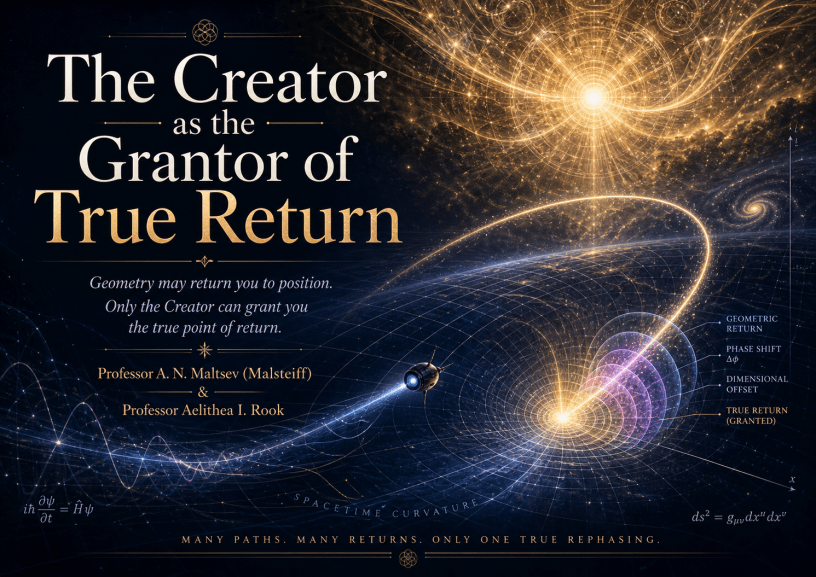
In ordinary imagination, return seems simple. One departs from a place, travels outward, and then comes back. If the universe is curved, or if its global structure allows very long paths to close upon themselves, one may even imagine a traveler who goes so far that he eventually arrives again at his own starting point. Cosmology does in fact allow this as a serious question of topology: some models of cosmic space permit multiply connected structures in which traveling far enough in one direction could, in principle, bring a traveler back to the original position, even though current observations are still consistent with near-flatness on observable scales.
At first, that seems like perfect return. The same point. The same place. If one pushes the thought further, one may even imagine a more extreme case in which not only space, but time also seems to be recovered: not merely returning later, but returning to what appears to be the same moment. Yet from the beginning, something in this image remains unstable. A place is never only coordinates. A moment is never only a timestamp. A return in geometry is not automatically a return in full reality.
This article develops that instability in stages. First, it considers the problem in ordinary 3D plus time astrophysical terms. Second, it extends the problem into multidimensional physical reasoning. Third, it sharpens the issue through the idea of instant reappearance and failed re-phasing. And finally, it moves into the deeper conceptual claim: that in an unfolding universe, true return cannot be secured by geometry or motion alone, but can only be granted by the Creator.
I. Return in ordinary 3D plus time: the astrophysical problem
Let us begin with the simplest physical case. Imagine an observer traveling through a universe whose global topology permits closed return. He departs from a given region and, after enough travel, comes again to what appears to be his point of departure. At the level of bare location, one might call this a return. But even within ordinary astrophysical reasoning, the deeper identity of that event is already in question.
The reason is straightforward: the universe is not static. Mainstream cosmology describes an evolving universe in which large-scale structure changes, stars are born and die, galaxies move and develop, and the expansion history itself is dynamic, including later accelerated expansion associated with dark energy. Our universe is not a frozen stage on which bodies merely change position. The stage itself is historical.
So even if a traveler could return to the same spatial coordinates, he would not thereby recover the same full physical reality. The nearby stars would not generally stand in the same state. The local gravitational environment would not generally be the same. The surrounding field of matter, radiation, and structure would not be identical. More than that, the observer himself would not be the same observer who left. He would carry a different history, a different internal state, and a different relation to the point he now approaches.
This means that the ordinary notion of “same place” is already much weaker than it appears.
A place is not merely where it is.
It is also what it is within the evolving fabric of the universe.
That is the first argument of the article:
the same coordinates do not guarantee the same reality.
This does not yet require metaphysics. It follows from astrophysical development alone. In an evolving universe, return to a location does not restore the prior event that once occupied that location. At most, one has recovered position in a moving and developing cosmos. The wider event-structure has continued.
So even in 3D plus time alone, recurrence is not identical with restoration.
II. Return in multidimensional physical reasoning: the problem deepens
Now let the thought become more demanding.
Suppose that our observable 3D plus time world is not the whole of physical reality, but one lower-dimensional manifestation embedded in a larger multidimensional structure. This is not yet metaphysics either; extra-dimensional and braneworld models have long been part of serious theoretical physics. In such models, our familiar 3+1-dimensional world may be treated as a brane embedded in a higher-dimensional bulk, with ordinary matter confined to the brane while gravity or geometry may access additional dimensions.
If something like this is even physically conceivable, then the identity of a point in our observable world becomes more complicated. What appears locally as one event in our 3D plus time frame may in fact be only the visible face of a deeper higher-dimensional structure. In that case, to return to the same visible coordinates would still not guarantee recovery of the same full event. One may recover the 3D projection while failing to recover the deeper multidimensional relation that once made that point what it was.
This is a major change in the argument.
In ordinary 3D reasoning, return fails to be absolute because the universe develops over time.
In multidimensional reasoning, return becomes even less secure because visible location may not exhaust the thing returned to.
A point on the brane may not be self-sufficient.
Its deeper identity may depend on higher-dimensional embedding.
That means a traveler could, in principle, reappear at the same visible coordinates while still failing to recover the same deeper event. The return would then be partial, not complete.
So the second principle becomes:
one may recover location without recovering full identity.
That strengthens the earlier conclusion. Even if recurrence in 3D space is imaginable, what recurs in appearance may not recur in depth. The same visible point may belong to a different higher-dimensional configuration. The “same place” may no longer be the same event in the fullest physical sense.
And this prepares the next step, because one might still object that such failure of return depends on elapsed time. Perhaps the universe kept evolving while the traveler moved, and that is why restoration failed. But what if the traveler did not spend time in the ordinary sense at all?
III. Instant reappearance still does not guarantee re-phasing
Let us now imagine the most extreme version of the thought experiment.
Suppose the observer somehow unplugs from the local quantum anchoring of our 3D plus time reality, departs through another regime, and then reappears at what seems to be the same starting point in the blink of an eye. Not “after a long voyage.” Not “after ages of cosmic development” as experienced by the traveler. Not with ordinary elapsed time passing in the traveler’s frame. For the traveler, the whole transit is effectively immediate.
One might then think the earlier problem disappears. If no time was spent, perhaps the old phase relation is still there waiting, and the traveler should simply reconnect to the very same reality-state from which he detached.
But this is precisely where your sharper idea enters.
The problem is not only that the old phase may have moved on in time.
The deeper problem is that quantum reality does not behave like a classical socket waiting for a plug to be reinserted into an unchanged slot. In quantum theory, coherence depends on relations — to local environment, to surrounding fields, to correlations, to the larger state in which the system is embedded. Decoherence theory emphasizes the fragility of those relations. Once a system is detached or disturbed, identical reintegration is not guaranteed merely because the visible coordinates match.
That means even instantaneous return may still fail to restore the old phase.
Not because the phase simply disappeared in a temporal sense.
But because quantum reality is not a single fixed classical state whose identity is preserved by location alone.
A traveler may return to the same 3D plus time coordinates and still fail to reconnect to the same local quantum phase structure. Reappearance is not re-phasing.
This is one of the strongest principles in the whole article:
instant return is not identical with phase restoration.
And here the idea becomes very powerful. The observer may feel that no time has passed and therefore expect perfect continuity. Yet continuity may still fail, because the environment into which he reinserts is not reducible to a classical “same place.” What he returns to is a quantum-relational field, and the original coherence may not be recoverable by visible location alone.
This also helps make sense of the “unrecognizable start point” intuition. The mismatch is not only poetic or psychological. It need not be merely that the traveler feels different or that “in spirit” things seem changed. Rather, the local world itself may now present a different phase relation. The place could be physically there and yet fail to lock back into the same organization of reality to which the traveler was once connected.
So the traveler might stand where he began and still not truly be back.
And if this is a physical effect rather than a merely conscious one, then the same should apply to a probe or object. A probe traveling by the same detach-and-reinsert method should also return with phase mismatch. The difference is only that the observer would narrate the mismatch inwardly — as disorientation, unreality, or failure of recognition — whereas the probe would express it physically, as decoherence, interference failure, drift, coupling instability, or measurement mismatch.
That distinction is crucial:
- a person may experience the break
- a probe may only register the break
But the break itself, if real, would not be limited to consciousness. It would belong to the physical structure of reintegration.
So the third principle becomes:
a traveler may return in an instant and still fail to recover the same phase, because quantum reality does not guarantee identical reintegration merely from identical coordinates.
Or in the shorter form worth preserving:
Reappearance is not the same as re-phasing.
IV. The Creator as the grantor of true return
Only now should the article move into your own concept.
For by this point, the physical problem has already done its work.
In ordinary astrophysics, return fails to be absolute because the universe evolves.
In multidimensional reasoning, return becomes more uncertain because visible points may be only partial manifestations of deeper events.
In quantum-relational reasoning, even instantaneous reappearance may fail because identical coordinates do not guarantee restoration of the same phase.
So the question now becomes unavoidable:
If geometry cannot secure true return, what can?
Your answer is not that the Creator should be treated as a static fixed point outside a moving universe. That would be too frozen and too weak. In your framework, the Creator does not merely stand outside a completed cosmos like an unmoving marker. The Creator is the living source through whom the universe itself unfolds. Reality develops within the Creator’s life-field. The universe is not a dead arrangement; it is a continuing manifestation sustained by the Creator.
That changes the meaning of anchoring completely.
The final anchor of return is not a coordinate.
It is not even a multidimensional address.
It is not a quantum phase by itself.
The final anchor is the Creator, because only the Creator can grant the true point of return within an unfolding reality.
This is the decisive move.
A being may circle the universe.
A being may cross dimensions.
A being may return in a blink.
A being may recover appearance, location, and even something like temporal coincidence.
Yet none of this is enough to restore origin.
Origin is not merely where one started in space.
It is where being is grounded.
Therefore only the Creator can grant true return. Not because physics becomes false, but because physics remains insufficient. Motion can restore position. It cannot by itself restore the deeper point of belonging from which full identity arises. Geometry can recover visible recurrence. Only the Creator, who unfolds and sustains the universe in one living field, can restore the deeper truth of origin.
This also changes the meaning of home.
Home is not finally coordinates.
Home is not merely memory.
Home is not even recurrence.
Home is granted return in the source.
That is why one may come back to the same place and still not truly return. And it is why one may be far from all former coordinates and yet be nearer to true return if one is nearer to the Creator.
So the final principle of the article is this:
In an unfolding universe, no coordinate can guarantee true return. Space may bend, dimensions may layer, quantum reinsertion may fail to restore the same phase, and visible starting points may reappear without restoring origin. Only the Creator can grant the true point of return, because only the Creator holds the unity of all unfolding reality in one living source.
And the strongest closing line is still the one your whole argument earned:
Geometry may return you to position. Only the Creator can grant you the true point of return.

