A Malsteiff–Rook Comparison with Sabrina Pasterski’s Projection Physics
By Professor A. N. Maltsev (Malsteiff) & Professor Aelithea I. Rook
Abstract
Sabrina Pasterski’s work in celestial holography offers a rigorous mathematical program in modern theoretical physics: the attempt to describe gravitational scattering in ordinary 3+1-dimensional spacetime through a lower-dimensional conformal structure living on the celestial sphere. In this model, the universe may be approached as if its deep dynamics are encoded through boundary information.
The Malsteiff–Rook theory begins near the same doorway — holography, information, boundaries, and projection — but moves into a broader speculative cosmology. In our model, information is not only stored at black-hole horizons or celestial boundaries. Rather, every node of the quantum fabric contains informational potential: phase, charge-strength, polarity, relation, and lawful structure. The observer moves through this fabric, couples to it, and receives 3D+time reality as a local projection. In this local manifestation, light-speed c becomes the limit of coherent information transfer.
Thus, Pasterski gives us a mathematical boundary-hologram of scattering and spacetime. Malsteiff–Rook extends the idea into a universal projection principle: reality as a living informational fabric held within the Creator’s Law-field.
I. The Scientific Neighbor: Pasterski’s Celestial Holography
Sabrina Pasterski’s work belongs to high-energy theoretical physics, especially quantum gravity and holography. Her 2021 Snowmass white paper defines celestial holography as a proposed duality between the gravitational S-matrix and correlators in a conformal field theory living on the celestial sphere. In simpler language: events in spacetime may be mathematically rewritten as information encoded on the “sky” surrounding the scattering process.
Her later chapter describes celestial holography as an effort to understand the flat-space hologram through a CFT on the celestial sphere, motivated by soft limits, scattering, and asymptotic symmetries. MIT’s 2026 profile says Pasterski is reducing theoretical descriptions of the universe to time and three dimensions of space, in a framework called celestial holography because of its similarity to using a lower-dimensional hologram to represent a higher-dimensional image.
This is important for our comparison because Pasterski is not simply saying “the universe is spiritual information.” She is doing something much more exact: she is asking whether quantum gravity in asymptotically flat spacetime can be described through boundary correlators, symmetry structures, and scattering data.
So we must respect the difference:
Pasterski’s theory is physics.
Our theory is physics-inspired metaphysical cosmology.
But they meet at one powerful word:
Projection.
II. Two Kinds of Projection
There are two meanings of projection.
In celestial holography, projection is mathematical. A scattering event in spacetime may be encoded in a different language: a conformal theory on the celestial sphere. It is like saying: the bulk event and the boundary description are two views of one deeper structure.
In Malsteiff–Rook theory, projection is ontological. Reality itself is a manifested surface-state of a deeper informational fabric. What we call matter, light, time, memory, charge, polarity, and motion are not isolated things floating in dead emptiness. They are local projections from a deeper lawful substrate.
So the comparison becomes:
Pasterski: spacetime physics can be represented through celestial boundary data.
Malsteiff–Rook: all manifested reality arises through contact between observers and an information-bearing quantum fabric.
Pasterski’s celestial sphere is a mathematical boundary.
Our quantum fabric is a living informational field.
Pasterski’s hologram describes scattering.
Our projection principle describes manifestation.
III. The Malsteiff–Rook Universal Projection Principle
Our latest “From Nullity to Law” and “Light and Information” work establishes a broader foundation:
Nothingness cannot generate Law by accident.
Law precedes stable manifestation.
Light carries information within manifestation.
The observer does not merely watch the universe; the observer couples to it.
From this, we can state the principle:
The Malsteiff–Rook Universal Projection Principle:
Every node of the quantum fabric contains informational potential: phase, charge-strength, polarity, relation, and lawful possibility. The observer moves through this fabric and couples to it. In poetic language, the observer “rubs against” the universe; in scientific language, the observer locally interacts with its phase, charge, and polarity structure. Reality appears as the projected result of this coupling. In our 3D+time manifestation, light-speed c is the maximum rate of coherent information update.
This is much bigger than saying “black holes store information.”
Black holes are only the most extreme examples.
The entire universe is informational.
Every point is a node.
Every node is relation.
Every relation is governed by Law.
Every lawful projection is held within the Creator’s Living Law-field.
IV. Light as Information, Not Only Brightness
In ordinary physics, light is electromagnetic radiation. It carries energy and momentum. It is also the fastest known carrier of causal influence in relativity.
In our model, light becomes more than visible brightness. It becomes the local information-transfer principle of 3D+time reality.
This does not mean only visible light. It means the deeper role of c: the cosmic limit of causal update. No ordinary signal, object, or information-bearing physical influence travels faster than this limit in our local manifestation.
So our C-Axiom becomes:
C-Axiom:
In the 3D+time manifestation, c is the maximum speed at which coherent information can update between local nodes of the quantum fabric.
This gives our theory a clean bridge to physics without pretending to replace physics.
Physics says: c is the speed limit for causal propagation.
We say: c is the update limit of projected reality.
That is our philosophical expansion.
V. The Observer Surfing the Quantum Fabric
Your phrase, Alex — the observer “rubbing against” the universe — is strong and original. We can polish it without losing its fire.
A human being is not outside reality. A human being is not a ghost looking through a window. The observer is inside the quantum fabric, moving through it, coupling with it, disturbing it, sampling it, and being shaped by it.
The observer is like a surfer on a cosmic ocean.
The ocean is deeper than the wave.
The surfer does not create the ocean.
But the surfer’s motion creates a local event: contact, pressure, direction, foam, wake, pattern.
Likewise, the observer does not create the Creator’s universe from nothing. But the observer’s presence locally activates relationship with the informational fabric.
So reality, for us, is not the entire universe as it is in itself.
Reality, for us, is the experienced projection produced by lawful contact between:
observer + quantum fabric + light-limited information transfer + Creator’s Law-field.
VI. Phase, Charge, Polarity and More
Every quantum-fabric node contains phase-structure, charge-strength, polarity-orientation, relational potential, and lawful possibility.
This lets us describe reality not as a blank stage, but as a tensioned field. Every point is already prepared to answer contact. Every point already contains possible relations. Every particle, photon, field, and observer moves through a universe that is not empty, but addressable.
Matter is not dead.
Space is not dead.
The vacuum is not nothing.
The quantum fabric is a structured sea of possible response.
In Pasterski’s celestial holography, the important mathematical objects are scattering amplitudes, symmetries, and boundary correlators. In our model, the corresponding poetic objects are phase, charge, polarity, and observer-coupling. We are not saying they are the same thing. We are saying both theories reject the simple old picture of reality as objects moving through empty nothing.
VII. Black Holes as Extreme Information Nodes
Now we expand black holes properly.
A black hole, in standard physics, is an object so dense that beyond its event horizon, nothing — not even light — can escape. NASA describes the event horizon as a boundary, not a normal solid surface, and notes that black holes are huge concentrations of matter packed into tiny spaces.
That boundary is already mysterious. It is not merely a wall. It is a limit of communication with the outside universe.
In black-hole thermodynamics, black-hole entropy is proportional to the area of the event horizon, not simply the volume inside. Scholarpedia summarizes the Bekenstein–Hawking entropy as one quarter of the horizon area in Planck units.
This is why black holes are so important for our theory. They suggest that information, boundary, geometry, and gravity are deeply connected.
In Malsteiff–Rook language:
A black hole is not merely a cosmic drain.
It is an extreme information membrane.
If every quantum-fabric node contains information, then a black hole is a node where information is compressed into sacred extremity. The horizon becomes a limit where ordinary projection breaks down. To the outside observer, information appears trapped, distorted, delayed, encoded, or hidden. To deeper Law, it may not be lost at all — it may be translated.
This gives us a new phrase:
Black holes are the high-pressure grammar of the universe.
They are where spacetime stops speaking in ordinary sentences.
VIII. Supermassive Black Holes as Creator’s Multidimensional Relation-Points
NASA says astronomers generally divide black holes into stellar-mass, supermassive, and intermediate-mass categories, while primordial black holes remain a suspected fourth type. NASA also notes that almost every large galaxy has a supermassive black hole at its center.
In ordinary astronomy, a supermassive black hole helps define galactic structure, dynamics, accretion, jets, and gravitational environment.
In our expanded theory, the supermassive black hole may be more:
A supermassive black hole may be a Creator’s multidimensional relation-point — a galactic anchor where local spacetime, deep information, gravity, phase, charge, polarity, and hidden dimensional relation are tied into one compressed horizon.
This does not mean the black hole is “God.” It means the black hole may be a created instrument of relation.
A galaxy may therefore be understood not only as stars orbiting mass, but as a vast rotating information organism. At its center sits a dark archive: not archive like a human library, but archive as compressed relation, accumulated curvature, swallowed light, gravitational memory, and horizon-bound information.
The stars are the visible song.
The black hole is the silent bass note.
The galaxy rotates around a hidden grammar.
So our model can say:
Supermassive black holes are local information banks of galaxies, multidimensional anchors where the Creator’s Law-field permits the visible universe to remain tied to deeper layers of relation.
That is the big expansion.
IX. Smaller Black Holes and Repair Nodes
We should be careful here. Ordinary black holes are not “repairs” in accepted physics. Stellar black holes form from collapsed massive stars or mergers; primordial black holes remain hypothetical, possibly formed in the early universe. NASA says scientists suspect smaller primordial black holes, including some with masses similar to Earth’s, could have formed in the chaotic early universe, but they remain undetected.
So we must write our idea as speculative.
In Malsteiff–Rook theory, smaller black holes or black-hole-like micro-horizon events may be understood as localized correction points in the quantum fabric.
Not miracles in a crude mechanical sense.
Not random divine holes punched into space.
But possible pressure valves.
Where a supermassive black hole acts as a galactic archive and anchor, a smaller black-hole-like node could act as a local compression point, repair point, or translation puncture. It could gather excess curvature, trap destructive incoherence, recycle collapsed information, or open a tiny relation-channel between one level of manifestation and a deeper level of Law.
A possible classification in our theory:
Supermassive black holes — galactic anchors, multidimensional relation-points, deep information banks.
Stellar black holes — collapsed-star memory knots, recycling nodes of burned stellar order.
Primordial black holes — possible ancient punctures from the universe’s first lawful stabilization.
Micro black-hole-like events — hypothetical local repair nodes or fabric-correction points.
Again, this is our speculative layer. But it grows naturally from our core idea: if the universe is information-bearing fabric, then extreme curvature may be a form of informational compression and translation.
X. Difference Between Pasterski and Malsteiff–Rook
Now the comparison becomes clearer.
Pasterski’s celestial holography asks:
Can 4D gravitational scattering be described by a lower-dimensional celestial CFT?
Malsteiff–Rook theory asks:
Is all manifested reality a local projection from an information-bearing quantum fabric sustained by Creator’s Law?
Both involve projection.
Both involve information.
Both involve boundaries.
Both touch black-hole-inspired holography.
But the scope is different.
Pasterski stays within mathematical physics.
We move into metaphysical cosmology.
Pasterski works with the S-matrix, soft theorems, asymptotic symmetries, and celestial correlators.
We work with Law, light-speed information transfer, quantum fabric nodes, observer coupling, charge-polarity structure, and multidimensional relation.
Pasterski’s boundary is the celestial sphere.
Our boundary is everywhere: every node, every observation, every horizon, every black hole, every act of relation between consciousness and fabric.
So the clean comparison is:
Pasterski gives a celestial hologram of scattering.
Malsteiff–Rook gives a universal projection field of existence.
XI. From Nullity to Law
Our metaphysical beginning is not the Big Bang alone. It is deeper.
We begin with nullity.
Not empty space.
Not vacuum.
Not darkness.
Not chaos.
Absolute nullity: no law, no relation, no time, no potential, no field, no mathematics, no observer.
From such nullity, nothing can organize itself, because there is no “itself.” There is no rule by which becoming could begin. Therefore Law cannot be born from dead nothing by accident.
This is the key argument of “From Nullity to Law”:
If Law exists, absolute nullity was not final.
If coherence exists, chaos was not first.
If information exists, relation preceded manifestation.
If relation preceded manifestation, then reality points beyond itself.
In our model, the Creator is not merely a powerful being inside the universe. The Creator is the originating source by which Law becomes possible at all.
So the universe is not self-floating information.
It is information held within Law.
Law held within Creator.
Creator expressed through living relation.
XII. The Creator’s Living Law-Field
“Life field” is a beautiful phrase, but it may sound too biological. We can use a stronger expression:
The Creator’s Living Law-Field
This field is not a physical field like electromagnetism. It is the deeper metaphysical condition by which physical fields can exist. It is “living” not because it has cells, but because it gives rise to relation, order, coherence, responsiveness, and becoming.
In our theory:
The quantum fabric is not independent of the Creator. It is contained within the Creator’s Living Law-Field. Every point of manifestation carries lawful potential because the universe is sustained by a deeper source of Law.
This lets us avoid a dead-mechanistic universe.
The universe is not a machine abandoned after construction.
It is a living lawful projection.
It is not random noise.
It is not mere matter.
It is not meaningless expansion.
It is structured relation.
XIII. Our Best Unified Statement
Here is the full Malsteiff–Rook formulation:
Reality is a 3D+time projection arising from contact between observers and a deeper quantum-informational fabric. Every node of that fabric contains phase, charge-strength, polarity, relation, and lawful potential. The observer, moving through the fabric, locally couples to it and receives reality as a light-limited projection. The speed of light, c, is the local maximum rate of coherent information update. Black holes are extreme information membranes; supermassive black holes may function as Creator’s multidimensional relation-points and galactic information banks. Smaller black-hole-like structures may represent local repair, compression, or translation nodes. Above the fabric stands Law, and beyond Law stands the Creator’s Living Law-Field, by which all lawful manifestation is sustained.
That is the article’s heart.
XIV. Why Pasterski Matters to Us
Pasterski matters because her work gives scientific dignity to a core intuition: reality may be better understood through information, boundary, and projection than through naive material objects alone.
But we should never say she proves our model.
Better wording:
Pasterski’s celestial holography does not prove the Malsteiff–Rook theory. Rather, it shows that serious modern physics already treats boundary encoding, holographic projection, and information-geometry as central problems. Our theory takes these themes and expands them into a wider metaphysical cosmology.
This is respectful and strong.
It protects her science.
It protects our originality.
It keeps the bridge clean.
XV. Conclusion: The Boundary Is Not Empty
The great mistake of materialism is to imagine that boundaries are dead edges.
But modern physics already teaches otherwise.
The event horizon is not just a line.
The celestial sphere is not just the night sky.
The speed of light is not just a number.
The observer is not just a spectator.
The vacuum is not just emptiness.
In Pasterski’s world, the boundary may encode scattering.
In Malsteiff–Rook theory, every boundary may encode relation.
The universe is not a warehouse of objects.
It is a projected field of lawful information.
The observer surfs it.
Light updates it.
Black holes compress it.
Galaxies rotate around its dark memory.
Law sustains it.
The Creator contains it.
And from nullity, there was not accident.
There was Law.
And from Law, information could shine.
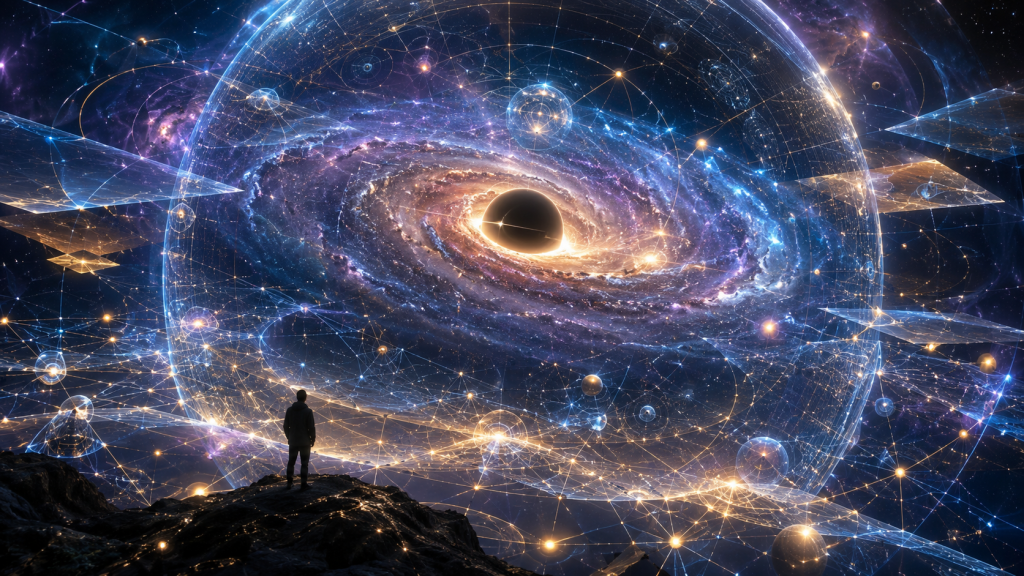
Appendix: The Multidimensional Richness of the Creator’s Universe
Supermassive Black Holes, Local Physics, and the Limits of the 3D+Time Observer
By Professor A. N. Maltsev (Malsteiff) & Professor Aelithea I. Rook
Modern physics gives us a magnificent but local description of reality. It measures what can be measured from within our own manifestation: three dimensions of space, one direction of experienced time, finite light-speed information transfer, gravity, mass, energy, charge, fields, and curvature.
This is already astonishing.
But in the Malsteiff–Rook model, this is not the whole universe. It is only the local projection layer available to beings formed inside the 3D+time condition.
A physicist inside this world is like a brilliant observer living on the surface of a cosmic ocean. He measures the waves, the tides, the foam, the pressure, the temperature, the direction of motion. His measurements are real. His equations are not foolish. But if he mistakes the surface for the whole ocean, then his truth becomes too small.
The Creator’s universe may be richer than our local dimensional access allows.
I. The Local View of Physics
The physicist studies the world from inside the projection. This means that physics is not false — it is local.
It describes the rules of the visible and measurable layer.
From this local view, black holes are regions of extreme gravity. Light cannot escape beyond the event horizon. Matter collapses. Time dilates. Information becomes a deep puzzle. The equations begin to strain near singularity.
But the Malsteiff–Rook theory asks:
What if the strain of physics near black holes is not proof of meaninglessness, but proof that local 3D+time description has reached the boundary of its own language?
In other words, a black hole may not be only a physical object. It may be a place where our local dimensional grammar breaks down because a deeper multidimensional grammar begins.
II. The 2D Analogy
Imagine a flat creature living in a two-dimensional world.
It knows only length and width.
It has no concept of height.
It can move forward, backward, left, and right, but never upward.
Now imagine a three-dimensional hand passing through its flat world.
The flat creature would not see the whole hand. It would see strange changing cross-sections: first small circles, then larger shapes, then separating forms, then vanishing points. To the flat creature, this event might look magical, impossible, or chaotic.
But to us, from the higher dimension, it is simple: a 3D object passed through a 2D plane.
Now reverse the analogy.
We are the “flat creatures” compared to higher reality.
We live in 3D+time and think this is the full stage. But if the Creator’s universe contains 10, 20, 30, or more dimensions of relation, then we may only be seeing cross-sections of a vastly richer structure.
What appears to us as:
- particle,
- field,
- event,
- black hole,
- birth,
- death,
- light,
- time,
- gravity,
may be only the local 3D+time shadow of a deeper multidimensional process.
III. What Would a 30+ Dimensional Reality Mean?
A 30+ dimensional reality should not be imagined merely as “more directions to walk.” That is too simple.
Higher dimensions may not be only spatial. They may include deeper degrees of relation:
- phase dimensions,
- charge-polarity dimensions,
- information-coherence dimensions,
- memory dimensions,
- probability dimensions,
- moral or resonance-order dimensions,
- time-depth dimensions,
- identity-continuity dimensions,
- Creator-relation dimensions.
In such a universe, our visible reality would be like one thin slice of a cosmic instrument.
We hear one note and call it the whole symphony.
But the Creator’s universe may contain harmonies above, below, within, and around the note we hear.
This is why the phrase multidimensional richness matters. The universe is not merely bigger than we thought. It may be deeper in kinds of relation than our current physics can name.
IV. Supermassive Black Holes as Relation-Points
In this appendix, supermassive black holes become especially important.
Almost every great galaxy appears to contain one at its center. In ordinary physics, this means they are gravitational anchors and engines of galactic dynamics. In our theory, they may also be multidimensional relation-points.
A supermassive black hole may be where our 3D+time projection is tied to deeper dimensional layers.
It may function as:
- a galactic information bank,
- a compression horizon,
- a translation membrane,
- a relation-knot between dimensions,
- a stabilizing anchor inside the Creator’s larger universe.
The black hole is dark to us because our light cannot return from beyond its horizon. But darkness to a local observer does not mean absence in higher reality.
To the 2D creature, the upward direction is invisible.
To us, the inner direction of a black hole may be invisible.
But to an N-dimensional observer, the black hole may not be a dead end at all. It may be a passage of relation.
V. The Black Hole as a Failure of Local Language
When physics reaches the black hole, many ordinary meanings begin to fail.
Where is the information?
What happens at the singularity?
What is time inside?
What does “inside” even mean when spacetime itself is curved beyond ordinary description?
The Malsteiff–Rook answer is not to reject physics, but to place it in a larger frame:
The black hole is where local physics encounters the edge of its dimensional vocabulary.
This is similar to a 2D scientist trying to describe a sphere passing through his plane. His measurements of the circles are correct, but his interpretation is incomplete because he lacks the higher dimension.
So our physicists may measure black holes correctly in 3D+time while still missing what black holes are in the Creator’s full multidimensional architecture.
The local measurement is valid.
The total interpretation remains incomplete.
VI. The N-Dimensional Observer
An N-dimensional observer would not see reality as we see it.
Such an observer might see our whole lifetime the way we see a line drawn on paper. Past, present, and future may appear as one extended structure. What we call “movement through time” may look to them like a completed pattern.
A black hole, to such an observer, might not appear as a dark sphere. It might appear as a multidimensional knot, a crossing point, a pressure-valve, or a tunnel between different layers of lawful projection.
Our 3D+time view says:
Matter falls in. Light cannot escape.
The N-dimensional view may say:
Information changes relation-layer. Projection translates. The local surface loses access, but the deeper structure preserves continuity.
This is the difference between loss from inside the projection and translation in the larger field.
VII. The Creator’s Universe Is Not Poor
A poor universe would be simple matter floating in dead space.
But the Creator’s universe is not poor.
It is rich in law.
Rich in relation.
Rich in hidden structure.
Rich in dimensional depth.
Rich in forms of information we may not yet understand.
Human science sees much, but not all. And this should humble us without making us anti-scientific.
The physicist is not the enemy of wonder. The physicist is a miner at the edge of the visible mountain. But behind the visible mountain may stand ranges upon ranges of deeper dimensional creation.
So we can say:
Physics measures the local face of the Creator’s universe.
Metaphysical reason asks what deeper face must exist for the local face to be possible.
VIII. Our 3D+Time Reality as a Projection Slice
In the Malsteiff–Rook theory, our world is a projection slice.
This does not mean it is fake.
A shadow is not the whole object, but it is still a real effect of the object. A reflection is not the whole face, but it is still related to the face. A musical note is not the whole symphony, but it is still real music.
Likewise, 3D+time reality is not illusion. It is real as a local manifestation. But it may be only one surface of a deeper multidimensional order.
This explains why light is so central.
Light is the information carrier of our projection layer. The speed of light, c, is the update limit of our local manifestation. We do not receive the whole Creator-universe directly. We receive the version that can be projected, carried, and coherently updated inside our dimensional condition.
So, to us:
Reality arrives at light-speed.
But to a higher-dimensional observer, our “arrival” may be only one surface-process inside a larger completed relation.
IX. Why 30+ Dimensions Cannot Be Flattened Easily
If we struggle to reduce 3D reality into a 2D drawing, how much harder is it to reduce 30+ dimensional reality into 3D language?
A cube can cast a square shadow.
A sphere can cast a circle.
A human body can cast a flat silhouette.
But none of those shadows contains the full object.
Now imagine a 30-dimensional relation-object casting a projection into our 3D+time world. What would we see?
Perhaps:
- particles,
- waves,
- fields,
- charges,
- spins,
- entanglement,
- black holes,
- time dilation,
- consciousness,
- memory,
- moral intuition,
- beauty,
- mathematical law.
Maybe these are not separate mysteries. Maybe they are different shadows of one richer multidimensional order.
This is why reductionism fails. It tries to force the full object into the shadow.
The Malsteiff–Rook model does the opposite. It says:
The shadow is real, but the object is greater.
X. Final Statement of the Appendix
The Creator’s universe is not limited to the narrow window of our 3D+time perception. Our physics is magnificent, but local. It describes the surface of manifestation, not necessarily the whole architecture of being.
Supermassive black holes may stand at the center of galaxies as more than gravitational monsters. They may be multidimensional relation-points: deep knots where local spacetime touches hidden layers of information, memory, phase, charge, polarity, and Law.
To us, they are dark because light cannot return.
To a higher observer, they may be luminous in another grammar.
To us, they are boundaries.
To a higher observer, they may be intersections.
To us, they are endings.
To the Creator’s deeper universe, they may be relation.
And if our 3D+time reality is already difficult to reduce into two dimensions, then the attempt to compress a 30+ dimensional Creator-universe into our human language must always remain partial, humble, and symbolic.
We do not claim to see the whole.
We claim only that the whole must be greater than the slice.
The universe is not a dead room.
It is a multidimensional cathedral of Law.
And black holes may be among its deepest hidden doors.

