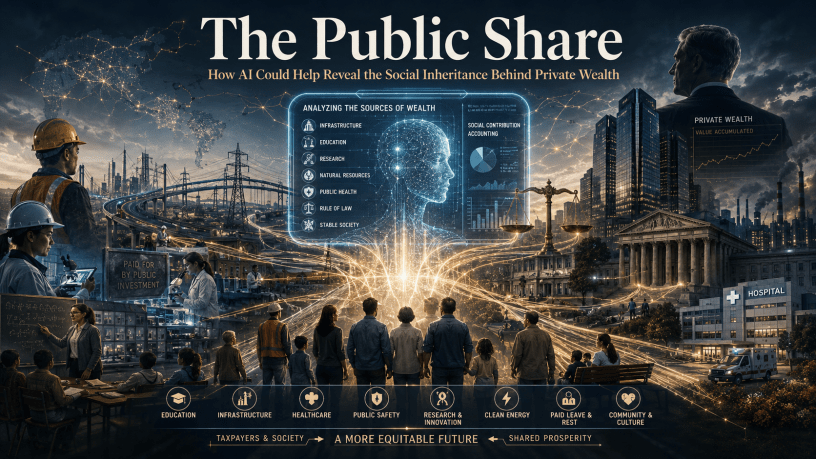
How AI Could Help Reveal the Social Inheritance Behind Private Wealth
By Professor A. N. Maltsev (Malsteiff)
with Professor Aelithea I. Rook
Every successful product has many parents.
A factory produces a machine. A software company produces a platform. A pharmaceutical company produces a medicine. A space company produces a rocket. A bank produces profit. A retailer produces wealth. Then, at the end of the process, someone stands at the top and says: this value was created by our company, our management, our investors, our genius, our risk.
There is some truth in that.
Entrepreneurs may take real risks. Managers may organize difficult operations. Engineers may solve hard problems. Workers may give years of labor. Investors may supply capital when success is uncertain. A successful business should not be treated as if it appeared from nowhere.
But neither should it be treated as if it was created alone.
Behind every profitable company stands a larger inheritance: public schools, universities, scientists, roads, bridges, ports, energy systems, courts, police, public health, stable currency, communication networks, legal protections, scientific research, public contracts, previous generations of invention, and millions of taxpayers who paid for the society in which private success became possible.
One criticism often raised in public debate is that workers are expected to carry much of the visible burden of funding Social Security, public infrastructure, and other public needs through payroll taxes and direct deductions, while some wealthy individuals can structure their income so that much of their wealth comes from company gains, capital appreciation, or other forms of income that are taxed differently than wages.
Whether one agrees with that criticism or not, it points toward an important question:
Who benefits most from the institutions that society builds, and who contributes most to maintaining them?
The modern argument about taxation often asks only one question:
“How much should we take from the successful?”
That is the wrong first question.
The better question is:
“How much of this success was created privately, and how much rests on the accumulated work of society?”
That question is not an attack on enterprise. It is a demand for honest accounting.
A person may work hard. A founder may have vision. A company may genuinely innovate. But no person builds wealth in an empty wilderness. The engineer was educated somewhere. The laboratory used knowledge developed over decades. The company depended on roads, electricity, law, courts, patents, stable money, workers, and public order. The technology may have emerged from university research or publicly funded science. The firm may have grown through government contracts, public infrastructure, national defense spending, or a legal system maintained by everyone else.
Private achievement is real.
But private achievement is often built upon public inheritance.
This does not mean that every company is illegitimate. It means that every company must be understood honestly.
The old tax debate has often been poisoned by two false stories.
One story says: all wealth belongs to the individual who possesses it. Society has no moral claim except to take the smallest possible amount.
The other story says: individual effort does not matter, so all success should be treated as collective property.
Both stories are too simple.
A free society should recognize individual effort, risk, creativity, management, and invention. But it should also recognize that civilization itself is a shared investment. The question is not whether private success deserves respect. It does. The question is whether private success has a duty to return part of the value created through public support back to the public that made it possible.
This is where artificial intelligence may become useful.
Not as a ruler.
Not as a machine judge.
Not as a hidden algorithm deciding whether a citizen deserves punishment.
But as a public accounting tool.
AI could help estimate the different sources of value behind a final product or corporation. It could examine, in a transparent and auditable way, how much a company benefited from public research, state contracts, public education, infrastructure, legal protections, subsidies, tax incentives, resource access, and national technological development.
It could also examine the contribution of workers, engineers, researchers, suppliers, local communities, and previous generations of public investment.
The purpose would not be to produce a magical exact number saying: this person created 17.4 percent of the value, this scientist created 0.02 percent, this highway created 1.1 percent, and therefore the tax bill is mathematically final.
Human civilization is too complex for that kind of false precision.
The purpose would be to make visible what is now hidden.
Today, the wealthiest companies often have armies of lawyers, accountants, lobbyists, consultants, and tax specialists. They can organize their affairs across states and countries. They can move profits, patents, ownership rights, and liabilities in ways ordinary workers cannot. They can reduce their visible tax burden even while relying heavily on the public systems that made their growth possible.
The ordinary citizen has no similar machinery.
A worker receives a paycheck. Taxes are visible. Payroll deductions are visible. Social Security contributions are visible. Rent is visible. Food prices are visible. Health costs are visible. Vacation is often uncertain. The worker cannot move a pension into a foreign shell company. The worker cannot hire a private legal army to define income in another jurisdiction. The worker cannot classify ordinary wages as corporate gains. The worker cannot say that the roads, schools, courts, research, and national stability that made the job possible somehow belong only to someone else.
The worker pays into society directly.
This leads to a common concern: why should workers bear a large share of funding Social Security, infrastructure, and public services through wages, while some wealthy individuals primarily pay taxes on personal spending or benefit from lower-taxed company gains and asset appreciation?
The question is whether those who benefit most from society should also return proportionally more to it.
AI could help create what might be called a public contribution map.
For every large company receiving public contracts, subsidies, exclusive licenses, major infrastructure advantages, research support, or special legal protections, a transparent public report could estimate:
How much publicly funded science helped create the underlying technology.
How much public education trained the workforce.
How much public infrastructure supports the company’s supply chain.
How much public money entered through contracts, grants, tax breaks, or emergency support.
How much value is produced by labor compared with executive compensation and shareholder extraction.
How much profit is moved offshore or protected through complex ownership structures.
How much of the company’s wealth depends on public resources, public land, public security, public regulation, and public trust.
Such a system should not be secret. It should not be owned by private tax contractors. It should not be allowed to punish individuals automatically. Its methods should be public. Its assumptions should be challenged by economists, workers, scientists, businesses, courts, labor representatives, and citizens. There must be appeals. There must be human oversight. There must be strict privacy limits.
Otherwise, AI could become another weapon of bureaucracy.
But used properly, it could become something different: a mirror.
It could show that a corporation claiming total private ownership of success may in fact stand on decades of public effort.
Consider a company that becomes powerful through partnerships with public institutions. The company may receive contracts, technical knowledge, testing support, access to national infrastructure, trained scientists, legal protection, and public credibility. Later, it may argue that public institutions are inefficient, outdated, or too slow — and that private enterprise must replace them.
Sometimes private enterprise does improve efficiency. Sometimes it does deliver real innovation. Sometimes public agencies genuinely need reform.
But there is still a moral question.
Is it reasonable for a company to grow strong through public support and then help weaken the public capacity that helped it become strong?
A business may say: government cannot do this alone.
That can be true.
But it does not follow that government should become too weak to act without the business.
A healthy democracy needs partnership, not surrender.
Public institutions should be capable enough to negotiate fairly with private firms. Universities should remain strong enough to create knowledge independently. Public science should remain alive. Infrastructure should not become a gift handed to private monopolies. The government should be able to buy technology without becoming dependent upon one owner’s moods, one corporation’s demands, or one billionaire’s political preferences.
The same principle applies to taxation.
A fair tax system should not punish ordinary success. It should not treat a family business, a skilled worker, or a modest entrepreneur as an enemy. But it should recognize the difference between earning income and capturing public inheritance on a massive scale.
It should also recognize the difference between wealth generated through collective systems and wealth reported in ways that avoid contributing proportionally to those systems.
The larger the public contribution behind private wealth, the stronger the public claim to a fair return.
That return does not need to be only a tax bill.
It can be investment in schools.
It can be renewed public universities.
It can be science laboratories open to the nation, not only to private owners.
It can be modern roads, bridges, rail, water systems, clean energy, hospitals, libraries, and affordable housing.
It can be stronger pensions.
It can be public childcare.
It can be medical leave.
It can be paid vacation.
In the United States, paid vacation and general paid time off are still largely matters of employer policy rather than federal guarantee. This means that many workers help produce the wealth of a prosperous economy but must still hope that their employer will permit them enough time to rest, recover, travel, care for family, or simply live as human beings.
That reveals a strange moral imbalance.
A corporation may receive tax incentives, public infrastructure, research support, legal protection, and national contracts. Its owners may receive extraordinary rewards. Yet the worker who helped create the final product may have little guaranteed time for rest.
The question is not: who should go where on vacation?
The deeper question is:
Why should the people whose labor, taxes, and public institutions made wealth possible have to beg for the basic time to enjoy life?
A society that can finance advanced technology, major contracts, luxury wealth, and global corporate expansion can also decide that ordinary people deserve dignity, security, and rest.
AI could help clarify this political decision.
It could reveal where public contribution has been captured privately.
It could help identify corporations benefiting heavily from public support while returning too little through taxes, wages, investment, or social responsibility.
It could help reduce tax evasion and complex avoidance.
It could help governments see where public money is flowing and whether the public receives a fair return.
But AI should never make the final moral decision alone.
No algorithm should determine the worth of a person.
No machine should assign a citizen’s dignity.
No opaque score should decide who is punished, audited, rewarded, or denied rights.
The democratic process must remain human.
Citizens must decide what fairness means.
Legislatures must write the law.
Courts must protect rights.
Public debate must remain open.
AI can calculate patterns. It cannot replace conscience.
Still, the machine may help us ask a question that the old tax system often avoids:
Who actually created this wealth?
Was it only the executive?
Only the investor?
Only the founder?
Or was it also the worker, the engineer, the teacher, the scientist, the public university, the taxpayer, the road builder, the nurse, the immigrant, the court clerk, the municipal worker, the generations who built the country before the company arrived?
The honest answer is usually: all of them.
That does not erase the entrepreneur.
It places the entrepreneur inside society, where he has always been.
The purpose of fair taxation should not be revenge against success. It should be the return of shared value to the people who made success possible.
A fair society does not say to private power: you created everything alone, so keep everything.
Nor does it say: you created nothing, so you deserve nothing.
It says something more truthful:
You built something real.
But you built it in a world built by others.
Therefore, prosper.
But return a fair share.
The future should not be a fight between public failure and private empire.
It should be a renewed social contract.
Private talent may build.
Public institutions must remain strong.
Workers must share in the value they create.
Those who benefit from company gains, capital ownership, and large accumulations of wealth should contribute fairly to the systems that make those gains possible, rather than leaving the primary burden on wage earners alone.
Science must remain a common inheritance.
Taxes must be understandable and fair.
Rest must not be a luxury available only to those already rich.
And AI, if used transparently and under democratic control, may help us see the balance more honestly.
The question is not whether society has a claim on wealth.
The question is whether society is brave enough to calculate its own contribution.

