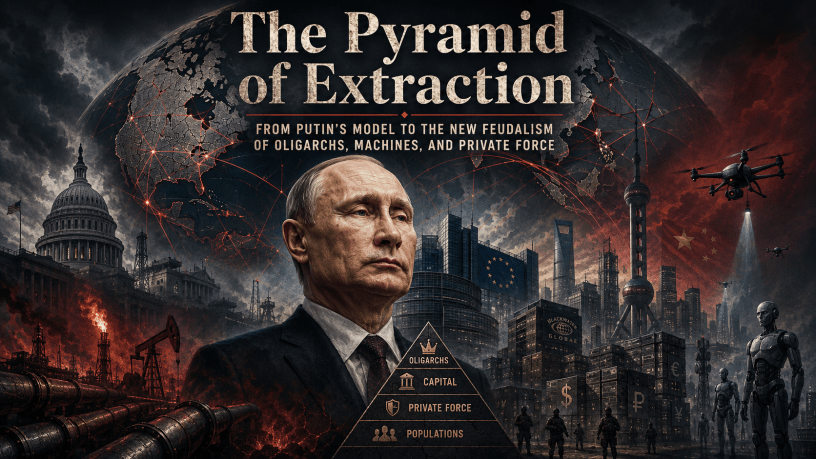
How Republics Become Loot, Oligarchs Become Warlords, and Public Power Turns Private
How Putin’s Model Can Reappear in Any Large Empire-State
By Professor A. N. Maltsev (Malsteiff)
with Professor Aelithea I. Rook
Prologue:
Putin’s damage is not limited to Russia, and not limited to democracies. He has poisoned the moral atmosphere of world politics.
Few modern rulers have done so much to teach other societies that cynicism works, that lying can be strategy, that corruption can be administration, that fear can replace trust, that patriotism can cover theft, that war can be sold as destiny, and that oligarchs can survive by serving darkness with money.
This is why his model is more than a national tragedy. It is an influence of decay. It whispers to rulers, parties, billionaires, security services, propagandists, and opportunists everywhere: do not serve the public; capture it. Do not persuade; confuse. Do not govern; extract. Do not build trust; manufacture exhaustion. Do not answer law; bend it. Do not respect truth; flood the world until truth becomes tired.
Putin and the oligarchic system around him became dark influencers of the age — not because they invented evil, but because they proved how profitable evil can become when organized as government.
That is their deepest poisoning of the world: they made moral collapse look practical.
1. Opening Warning: The Function Is the Republic
A republic does not die only when its buildings fall.
It may keep its parliament, courts, ministries, police, intelligence agencies, defense structures, elections, flags, anthems, patriotic speeches, and official ceremonies. From the outside, everything may still appear familiar. The names remain. The uniforms remain. The architecture remains. The language of law and public duty remains.
But underneath, the function may already have changed.
The buildings are not the republic. The function is the republic.
When government serves the public, it remains a republic in spirit. When government serves one ruler, it becomes autocracy. When government serves a ruler and his wealth network, it becomes kleptocracy. When government keeps democratic scenery while practicing extraction, it becomes something even more deceptive: a public state converted into a private pyramid.
This is the first warning. A country may still look constitutional while losing the living purpose of constitutional life. Courts may still issue decisions, yet justice may no longer be their purpose. Legislatures may still meet, yet representation may no longer be their purpose. Elections may still be held, yet public choice may be weakened by fear, money, manipulation, or exhaustion. Ministries may still function, yet service may be replaced by loyalty. Police may still speak of law, yet their deeper role may become protection of the ruling network.
The republic is not preserved by symbols alone. It is preserved by function.
If law no longer protects the citizen equally, law has changed function.
If elections no longer create accountability, elections have changed function.
If public office becomes private opportunity, office has changed function.
If patriotism becomes a mask for extraction, patriotism has changed function.
If crisis becomes permission for unlimited power, emergency government has changed function.
This is how a state can remain standing while the republic inside it is already being hollowed out.
The danger is not always open dictatorship at first. The danger is repurposing. The institution remains, but its meaning is reversed. What once served the public begins to serve the ruler. What once protected rights begins to protect power. What once distributed responsibility begins to concentrate obedience. What once belonged to citizens becomes property of a ruling circle.
That is why the question for any nation is not merely: do the buildings still stand?
The real question is: what do they now do?
A courthouse without justice is scenery.
A parliament without representation is theater.
An election without accountability is ritual.
A ministry without public service is machinery.
A flag used to cover theft is not patriotism, but camouflage.
The buildings are not the republic.
The function is the republic.
2. The Putin Model: Government as a Pyramid of Extraction
The greatest misunderstanding about Putin’s system is to call it merely corruption.
Corruption is when criminals steal inside the state. Putinism is something deeper and more dangerous: the state itself is redesigned as a mechanism of theft, obedience, and upward tribute. It is not only that officials steal. It is that every branch of government gradually changes purpose. Courts, parliament, police, intelligence, defense, public contracts, energy, media, regional government, and state-connected business are converted from instruments of public service into instruments of extraction and control.
Money flows upward.
Fear flows downward.
At the top sits the ruler and his inner circle. Beneath them stand protected oligarchs, security chiefs, administrators, judges, governors, media managers, contractors, and ideological servants of the regime. Beneath them stand businesses allowed to survive if they pay tribute, show loyalty, and remain useful. Beneath them stand ordinary people, expected to work, pay, obey, fear, and applaud.
This is not ordinary political decay. It is a full change in the function of government.
In such a system, every institution becomes part of the pyramid. The court no longer asks first what justice requires; it asks what power needs. The legislature no longer represents the people; it performs consent. The police no longer protect law equally; they protect the ruling arrangement. The media no longer informs society; it manages emotion. Defense no longer exists only for national protection; it becomes a sacred channel through which enormous public money can be transformed into private reward.
The state becomes less like a republic and more like a mine.
The citizen is not treated as the source of sovereignty, but as a resource: a taxpayer, a worker, a soldier, a viewer, a frightened subject, a body to be counted, a voice to be managed, a sacrifice to be demanded. The official language remains full of patriotism, tradition, greatness, national destiny, faith, enemies, and security. But behind the language, the real structure is tribute.
This is why the model is so stable once completed. Everyone above is paid by the obedience of everyone below. Everyone below is reminded that survival depends on silence. The oligarch needs protection from the ruler. The ruler needs money from the oligarch. The security services need permission from the ruler. The ruler needs fear from the security services. The media needs access. The ruler needs hypnosis. The courts need safety. The ruler needs verdicts. Each part feeds another.
A pyramid like this does not require every participant to believe in it. It only requires each participant to benefit from obeying it or fear the cost of refusing it.
That is the terrible genius of the system.
It turns government into an extraction machine while still calling itself the state. It turns loyalty into currency. It turns patriotism into camouflage. It turns public wealth into private tribute. It turns fear into administration.
Putinism is not merely theft.
It is theft organized as government.
3. Institutions Kept as Scenery
The Putin model does not always destroy institutions by tearing them down. Often it preserves them as scenery.
This is one of its most deceptive strengths. The citizen still sees familiar structures: courts, parliament, ministries, police, elections, television studios, military ceremonies, patriotic holidays, official investigations, constitutional language, and speeches about law. To the eye, the state appears intact. To the ear, it still speaks the vocabulary of public order.
But the inner purpose has changed.
A court still exists, but justice becomes a weapon.
Parliament still exists, but representation becomes theater.
Elections still exist, but choice becomes ritual.
Television still speaks, but information becomes hypnosis.
Defense still claims patriotism, but procurement becomes a river of private enrichment.
Police still claim law and order, but their deeper function becomes protection of the pyramid.
This is how institutional death can hide inside institutional survival. The body remains, but the soul has been replaced. The building still opens in the morning. Officials still sit at their desks. Papers are still stamped. Hearings are still held. Press conferences are still staged. Laws are still cited. But the direction of service is reversed.
The institution no longer serves the citizen upward through law.
It serves the ruler downward through obedience.
This is why the destruction is hard for some people to see. They ask, “How can dictatorship exist if there are elections?” They ask, “How can law be dead if courts still operate?” They ask, “How can propaganda dominate if there are still newspapers, channels, websites, and public debates?” They ask, “How can corruption be structural if ministries still publish budgets and reports?”
But a shell can imitate life for a long time.
The question is not whether the institution exists. The question is what function it now performs.
If the court protects power from justice, it is not functioning as a court in the republican sense. If the legislature performs loyalty instead of oversight, it is not functioning as representation. If elections only renew fear, exhaustion, manipulation, or inevitability, they are not functioning as democratic choice. If media turns public reality into emotional management, it is not functioning as information. If police protect the ruling network more faithfully than the law, they are not functioning as public protection.
The scenery remains because scenery is useful. It calms foreign observers. It reassures cautious citizens. It gives loyalists something to point at. It allows the regime to say, “Look, everything is legal. The institutions are still here.”
But legality without independent function is only costume.
A republic is not preserved by the presence of institutions alone. It is preserved by institutions that still do their proper work.
A courthouse without justice is scenery.
A parliament without representation is theater.
An election without accountability is ritual.
A ministry without public service is machinery.
A flag used to cover theft is not patriotism, but camouflage.
That is the danger of institutions kept as scenery: they make the corpse look constitutional.
4. The Transferable Political Technology
The Putin model is not only a Russian story. It is a transferable political technology.
It can reappear wherever institutions become weak enough, citizens become tired enough, oligarchs become powerful enough, crisis becomes useful enough, and public trust becomes broken enough.
The method is simple.
Create or exploit crisis.
Promise strength.
Attack independent institutions as enemies of the people.
Turn loyalty into the highest qualification.
Replace public servants with personal servants.
Convert law into selective punishment.
Convert public contracts into reward systems.
Convert patriotism into emotional camouflage.
Convert fear into obedience.
Convert obedience into wealth.
This is how a republic can be transformed without admitting the transformation. The flag still flies. The anthem still plays. Officials still speak of greatness, faith, security, sovereignty, tradition, and destiny. But underneath the language of national rebirth, government has become a pump.
The danger lies in the method’s adaptability. It does not need the same flag, the same religion, the same ideology, the same historical wounds, or the same official vocabulary. It can dress itself in nationalism, anti-corruption rhetoric, emergency management, religious revival, border security, economic populism, technological efficiency, or promises to punish enemies of the people.
The costume changes. The structure remains.
First, society is told that everything is collapsing. Then it is told that ordinary democratic procedures are too slow. Then judges, journalists, civil servants, academics, inspectors, opposition parties, local governments, and independent agencies are described as obstacles. Then loyalty is presented as patriotism. Then dissent is treated as sabotage. Then public money begins to follow political obedience. Then fear organizes the rest.
This is the political technology of conversion: public institutions are not immediately abolished; they are repurposed.
Law becomes a weapon.
Budgets become reward systems.
Contracts become tribute channels.
Media becomes emotional management.
Security becomes regime protection.
Elections become legitimacy rituals.
Citizenship becomes obedience.
The most important ingredient is exhaustion. A calm society may defend its institutions. An exhausted society begins to accept shortcuts. One crisis after another weakens attention, patience, trust, and resistance. Citizens begin to think: perhaps we need a strong hand; perhaps the rules are too complicated; perhaps independent courts are protecting enemies; perhaps criticism is dangerous; perhaps order matters more than liberty.
At that moment, the pyramid begins to rise.
The ruler or ruling faction does not need everyone to believe. It only needs enough people to fear chaos, enough people to hate the designated enemy, enough people to profit from loyalty, and enough people to give up on the possibility of honest government.
This is why the model can travel. It does not require a Russian soul. It requires a broken civic immune system.
The same political technology can appear in any large society where wealth seeks protection, power seeks impunity, and citizens are persuaded that freedom is weakness. It may speak the language of national greatness. It may speak the language of efficiency. It may speak the language of faith. It may speak the language of security. It may even speak the language of democracy while emptying democracy from within.
That is what makes it so dangerous.
The Putin model is not exported only by Russian influence. It is exported by imitation, temptation, cynicism, and structural weakness. It appears wherever public office can be converted into private tribute. It appears wherever crisis can be used to weaken law. It appears wherever oligarchs discover that owning politics is cheaper than obeying it. It appears wherever citizens become too exhausted to defend the common good.
A disease that depends only on Russian history can remain Russian.
A political technology that depends on human weakness can become universal.
5. The Chickens Coming Home to Roost
There is another bitter layer to the Putin model: the feeling that history has begun to return the methods once practiced abroad back to the centers that tolerated, encouraged, or misunderstood them.
This is the “chickens coming home to roost” theme.
The Russian catastrophe of the 1990s was not born from one cause. Russia’s own elites carry enormous responsibility. Former Soviet managers, new oligarchs, security-service networks, corrupt politicians, criminal groups, and ambitious opportunists all helped tear public property into private fortunes. But the West also played its part. It supported a post-Soviet order where anti-communist victory often mattered more than the moral creation of a real republic. The result was a society taught that democracy could arrive as humiliation, privatization, oligarchy, poverty, and foreign applause.
Then Putin appeared not as an accident from the sky, but as the organizer of that broken material. He did not invent cynicism. He inherited it. He disciplined it. He turned chaotic oligarchic plunder into vertical state-controlled extraction.
This is why the story has such dark irony. The system that helped break Russia’s public trust did not remain safely inside Russia. The logic traveled back. It returned in new language, new flags, new technologies, new billionaires, new media systems, new crisis politics, and new contempt for public institutions.
The feeling is not simply that Russians want America or the West to fall together with Russia. That is too shallow. The deeper feeling is historical and bitter: now the medicine returns to those who once applauded it.
Around 2000, a Polish man told me: they did it to Russia first; next will be the United States. At the time, such a warning may have sounded excessive. America looked too strong, too organized, too constitutionally protected to suffer the same deformation. Russia seemed like a special tragedy of post-Soviet collapse, not a warning about the future of Western democracies.
But the pattern now looks less impossible.
The chickens coming home to roost are not revenge. They are consequence.
When elites treat democracy as a useful slogan rather than a moral duty, the slogan eventually loses its protective power. When public institutions are sacrificed to private fortunes, private fortunes eventually come for the institutions that remain. When a nation helps another society swallow shock, humiliation, oligarchy, and “necessary” corruption, it should not be surprised when the same contempt for public good later appears at home.
There is another factor that is often overlooked: elites learn. They watch. They study what succeeds and what fails. Political and economic elites across countries observe one another closely. They borrow techniques, narratives, legal strategies, media tactics, and methods of concentrating power. What begins as an experiment in one place can become a model elsewhere. The learning curve is real. Those who benefit from weakened institutions, managed democracy, or concentrated wealth do not ignore successful examples. They adapt them.
This is not a claim that one group alone designed every disaster. History is rarely so simple. Russia’s own ruling class, criminal networks, security structures, and opportunists helped build the road to Putinism. But foreign triumphalism, careless economic advice, selective moral vision, and the worship of anti-communist victory helped poison the soil.
A society taught that democracy means plunder may later accept a tyrant who promises order. A society taught that public property exists for insiders may later accept a ruler who simply organizes the insiders more efficiently. A society humiliated by foreign victory speeches may later accept revenge as policy. A society stripped of trust becomes easy material for authoritarian reconstruction.
And when the same logic begins appearing elsewhere, the bitter lesson returns:
Methods released upon others do not always stay abroad.
The political cynicism once tolerated in Russia can reappear inside the systems that tolerated it. The contempt for public good can cross borders. The elevation of oligarchs above citizens can become normal elsewhere. The treatment of democracy as performance rather than covenant can spread. The idea that crisis permits anything can become domestic policy.
Part of this spread occurs because influential actors are constantly learning from one another. They observe how public opinion can be managed, how institutions can be hollowed out without being formally abolished, how wealth can be converted into political power, and how democratic language can be used to justify increasingly undemocratic outcomes. The techniques evolve, but the underlying logic remains recognizable.
That is the dark sarcasm of history.
The West believed it was watching Russia’s tragedy from a safe distance. But a world built on global finance, global propaganda, global technology, and global oligarchy does not keep diseases politely inside national borders.
The chickens coming home to roost are not punishment from heaven. They are the natural return of bad principles.
History does not always punish the guilty directly. Sometimes it returns their methods to their own doorstep and asks whether they recognize them now.
6. Why the Model Works Best in Large Empire-Scale Systems
The Putin model is most dangerous in large, multinational, empire-scale structures.
A small country can be corrupted. A small republic can be captured. A small state can be frightened, bribed, or hollowed out. But a vast state can become something larger and more durable: a continent-sized pump.
Large systems contain many layers: regions, provinces, states, republics, ethnic groups, languages, bureaucracies, courts, security services, armies, intelligence agencies, contractors, media networks, natural resources, financial channels, infrastructure, and competing identities. Each layer creates opportunity. Each layer can be divided, bribed, threatened, confused, or repurposed.
The larger the system, the more places there are for extraction to hide.
In a small state, theft may be visible quickly. In a vast system, extraction can be buried inside defense budgets, regional subsidies, infrastructure projects, emergency programs, intelligence secrecy, procurement chains, energy contracts, development funds, banking networks, and patriotic mobilization. The scale itself becomes camouflage.
This is why empire-scale systems are so tempting to oligarchic rule. They are rich enough to feed many levels of loyalty. They are complex enough to hide many levels of theft. They are diverse enough to divide citizens against one another. They are bureaucratic enough to bury responsibility. They are militarized enough to justify secrecy. They are symbolic enough to wrap extraction in grand language.
The ruler can speak of unity while practicing division.
He can speak of greatness while weakening the country’s inner life.
He can speak of security while building fear.
He can speak of destiny while distributing contracts.
He can speak of civilization while reducing citizens to resources.
Russia was fertile ground because it contained old imperial habits, Soviet administrative depth, vast natural resources, weak post-Soviet institutions, wounded national pride, and a population exhausted by collapse. The pyramid attached itself to oil, gas, defense, courts, governors, television, police, church, oligarchs, memory of war, and fear of chaos.
But Russia is not the only large system vulnerable to this disease.
The United States is vulnerable in a different way. It has enormous wealth, military reach, federal complexity, private media empires, technological monopolies, deep regional divisions, and billionaires powerful enough to behave like political institutions. Its danger is not post-Soviet collapse, but oligarchic capture: public agencies mocked until they can be seized, courts pressured until they bend, elections flooded with money, citizens divided into tribes, and crisis used to demand executive speed over constitutional restraint.
In such a system, the pyramid does not need to look Russian. It can wear the language of freedom while emptying freedom from within. It can speak of markets while concentrating power. It can speak of patriotism while selling access. It can speak of efficiency while destroying oversight. It can speak of the people while empowering wealth above citizenship.
The European Union is vulnerable in another way. It is not an empire in the old classical sense, but it is a multinational structure with uneven democratic cultures, complex bureaucracy, weak emotional unity, and member states that can be captured from within while still enjoying the shelter of the larger system. Authoritarian actors can take European money, use European legitimacy, weaken courts and media at home, and then hide behind sovereignty when challenged. The danger is not one central tyrant at first, but many small pyramids growing inside a larger democratic shell.
China represents yet another form. It does not need to disguise itself as liberal democracy. It is already a party-state with immense administrative reach, surveillance capacity, industrial power, and centralized command. Its danger is the fusion of state, party, capital, technology, and obedience into one command architecture. Anti-corruption campaigns may punish many officials, but the deeper question remains: does the system create public accountability, or does it strengthen the center’s power to decide who is corrupt and who is protected?
These systems are different in history, law, culture, ideology, and official language. But they share one vulnerability: their scale creates distance between ordinary people and the centers of power. That distance can be used for genuine administration, or it can be used for extraction.
In large systems, corruption does not remain petty. It becomes architecture.
Propaganda does not remain persuasion. It becomes atmosphere.
Security does not remain protection. It becomes political gravity.
Wealth does not remain private success. It becomes a ruling class.
Crisis does not remain emergency. It becomes method.
This is why large empire-scale structures must be especially careful to preserve real institutional function. The more complex the country, the more important checks and balances become. The more diverse the population, the more important equal law becomes. The more powerful the military and security state, the more important civilian oversight becomes. The more money flows through contracts and subsidies, the more important transparency becomes.
Without these protections, scale becomes danger.
A small corrupt office may steal from a town.
A captured empire-scale system can steal from history.
Russia is the warning in completed form.
America is the warning in constitutional struggle.
The European Union is the warning in multinational fragility.
China is the warning in centralized command fused with technological power.
Different histories. Different costumes. Same question:
Does government serve the public, or does it become a pyramid?
7. The American Warning: Not Russia, but the Same Functional Disease
The American warning must be understood clearly.
The danger is not that America becomes Russia in language, culture, history, religion, geography, or national memory. America is not Russia. Its constitutional tradition is different. Its federal structure is different. Its civic mythology is different. Its legal culture, regional identities, political habits, and historical wounds are different.
But political disease does not require identical costume.
The danger is that America may accept the same functional transformation: government changed from public service into private extraction; law changed from equal protection into selective weapon; patriotism changed from civic duty into emotional camouflage; crisis changed from a call for accountability into permission for concentrated power.
A disease can wear local clothing.
In Russia, the pyramid grew from post-Soviet collapse, oligarchic privatization, security-service networks, imperial memory, state television, natural-resource wealth, and fear of chaos. In America, a similar functional disease would grow differently. It would grow through money in politics, media fragmentation, private technological monopolies, culture-war exhaustion, attacks on courts and civil service, executive impatience, and the belief that constitutional limits are obstacles rather than protections.
The symptoms would not look exactly Russian. They would look American.
Public agencies would be mocked as useless until they could be captured and repurposed. Courts would be praised when obedient and attacked when independent. Elections would remain, but campaigns would become increasingly dependent on vast private money and emotional manipulation. Legislators would become performers for media tribes instead of guardians of constitutional balance. Civil servants would be treated not as public professionals, but as enemies to be purged unless personally loyal. Inspectors, journalists, judges, scientists, teachers, and local officials would be accused of betraying the people whenever they resisted the ruling faction’s appetite.
The flag would remain. The Constitution would still be quoted. Freedom would still be praised. The language would not be Soviet or post-Soviet. It would be the language of liberty, greatness, emergency, efficiency, faith, markets, security, and revenge.
That is what makes the danger so serious.
A democracy does not usually die in one theatrical moment. It is weakened by repeated shocks: one crisis after another, one emergency after another, one outrage after another, until citizens become exhausted and institutions become defensive. Public attention becomes scattered. People begin to lose patience with procedure. They begin to say: courts are too slow; oversight is too weak; journalists are enemies; opposition is sabotage; experts are arrogant; public agencies are disloyal; only a strong hand can solve this.
Then the authoritarian-oligarchic voice appears and says: give us more power, more speed, fewer rules, fewer judges, fewer inspectors, fewer independent voices. We alone can solve the crisis.
But crisis is often not an obstacle to the model. Crisis is fuel for the model.
In a healthy republic, crisis demands accountability. In a pyramid system, crisis becomes permission. Permission to centralize. Permission to purge. Permission to reward friends. Permission to punish enemies. Permission to bypass law. Permission to convert public money into private opportunity. Permission to treat constitutional limits as weakness.
This is where the American republic must be most careful.
The United States was built on the suspicion of concentrated power. The separation of powers was not an accident. Federalism was not an accident. Independent courts were not an accident. A free press was not an accident. Regular elections were not an accident. Civilian control of the military was not an accident. The Bill of Rights was not decoration. These structures were created because the founders understood a hard truth: power is corruptible, and no ruler should be trusted with too much of it.
But every generation must relearn that truth.
When citizens become frightened enough, angry enough, or tired enough, they may begin to see checks and balances as obstacles. They may forget that constitutional limits do not exist to protect criminals from justice, but to protect the people from rulers who call revenge justice. They may forget that courts are not useful only when they agree with one’s faction. They may forget that civil servants are not enemies because they obey law instead of personality. They may forget that free speech includes criticism of power, not only praise of power.
The pyramid begins when citizens are persuaded that protection of institutions is protection of enemies.
It grows when loyalty becomes more important than competence.
It hardens when wealth discovers that owning politics is cheaper than obeying public law.
It completes itself when public office becomes a private reward system and citizens are told to applaud their own extraction.
This is why the warning must be functional, not theatrical. America does not need to imitate Russia’s symbols in order to suffer Russia’s disease. It only needs to change the purpose of its own institutions.
If courts become weapons, the disease has entered law.
If elections become money rituals, the disease has entered representation.
If agencies become loyalty machines, the disease has entered administration.
If media becomes emotional warfare, the disease has entered public reality.
If public contracts become tribute, the disease has entered the economy.
If patriotism becomes a shield for theft, the disease has entered the national soul.
The republic is not safe merely because its buildings still stand.
The question is whether those buildings still perform their constitutional function. Does law still protect the citizen from power? Do elections still create accountability? Do courts still judge independently? Do legislators still guard the public interest? Do agencies still serve the people? Does the economy remain inside democracy, or has democracy become a department inside the economy?
The American warning is not that the country will become Russia.
The warning is that a great republic can keep its own flag, its own anthem, its own Constitution, its own slogans, and its own ceremonies — while allowing the same functional disease to hollow it from within.
Different costume. Same pyramid.
And once the pyramid is built, it will call itself patriotism.
8. When the State Becomes Larger Than the Minds Governing It
There is an even simpler tragedy inside the authoritarian-oligarchic model: the leader assembles a ruling team unable, by mental capacity and moral discipline, to govern the vast dynamic structure placed in their hands.
A great country is not a village office. It is not a family business. It is not a television studio. It is not a private company where one man may shout and everyone else must obey. A modern state is an enormous living system: law, finance, defense, science, medicine, energy, agriculture, transportation, education, technology, diplomacy, courts, regions, cities, and public trust all moving at once.
Such a system requires knowledge, humility, expertise, argument, correction, and independent institutions. It requires people capable of understanding complexity.
But the authoritarian leader prefers loyalty to intelligence. He does not gather the most competent minds. He gathers the most obedient personalities. He selects flatterers, performers, ideologues, opportunists, and frightened functionaries. The question becomes not, “Who can govern this country?” but “Who will protect the ruler?”
Then the state becomes larger than the minds governing it.
Oh boy: the airplane is enormous, the weather is violent, the passengers are millions, and the cockpit is full of people who think loyalty is the same thing as flying.
This is where decay begins. A small-minded ruling circle cannot manage a complex republic. It can only simplify it by force. It treats criticism as treason, expertise as arrogance, law as obstruction, journalism as hostility, courts as inconvenience, and public service as personal disobedience. It replaces professional memory with political obedience.
For a while, the old machinery still works. The inherited competence of previous generations continues to carry the state like momentum carries a moving train after the engine is damaged. Roads still function. Hospitals still operate. Courts still process cases. Agencies still have professionals inside. The state appears alive because older institutional memory still breathes beneath the new incompetence.
But gradually the damage appears.
Agencies lose expertise. Courts lose independence. Budgets become tribute. Emergencies are misunderstood. Policies are written as slogans. Reality is measured by applause. Bad news stops traveling upward. Lies become safer than facts.
And then the ruler becomes blind.
This is the irony of personal power: the more completely everyone obeys the ruler, the less the ruler knows reality. The more loyalty he demands, the less truth he receives. The more he controls institutions, the less those institutions can warn him. The more he humiliates expertise, the more reality escapes him.
A loyalist can repeat orders. He cannot replace knowledge. A flatterer can protect the ruler’s ego. He cannot repair a supply chain. A propagandist can invent victory. He cannot rebuild a bridge. An ideologue can denounce experts. He cannot make medicine safe, energy stable, courts fair, or schools honest.
This is why incompetence promoted into command becomes national danger.
It does not merely make mistakes. It destroys the systems that could correct mistakes. It punishes the people who understand consequences. It replaces feedback with praise, data with slogans, administration with performance, and public service with personal devotion.
A complex country cannot be governed by theatrical confidence. It cannot be managed by revenge instinct. It cannot be repaired by shouting. It cannot be stabilized by loyalty tests. It cannot be understood by those who treat every independent mind as a threat.
When the state becomes larger than the minds governing it, the rulers face a choice. They can admit limitation and restore institutional intelligence, or they can force reality to pretend obedience.
Authoritarian rulers almost always choose the second path.
And that is one of the simplest ways a great state can fall: not because its people are weak, but because the ruling circle is too small for the country it has captured.
9. When Failed Governance Becomes Self-Enrichment
When a ruling circle is too small for the country it has captured, it eventually discovers a humiliating truth: the country is not truly governable by them.
A vast modern state cannot be commanded by slogans, loyalty tests, revenge instincts, and theatrical confidence. It requires competence, patience, expertise, law, feedback, public trust, and the humility to be corrected. When those qualities are absent, the ruler begins to feel not responsible, but insulted.
He looks at the country and says: they do not appreciate me.
The courts resist me.
The experts lecture me.
The journalists attack me.
The civil servants delay me.
The cities oppose me.
The people are ungrateful.
The nation is too difficult.
The system is rigged against its own savior.
At that moment, failed governance becomes self-enrichment.
If the country cannot be properly ruled, then it can at least be harvested. If the people will not love the ruler, then they can be made to pay tribute. If institutions will not obey, they can be hollowed out. If public service brings frustration, private extraction brings reward.
This is the psychology of political resentment with access to the treasury.
The ruler begins as a promised savior, or at least performs the role of one. He claims he alone understands the people. He alone can restore greatness. He alone can punish the corrupt. He alone can cut through the complexity. He alone can make the nation grateful again.
But when the country refuses to become simple, when reality refuses to bow, when expertise contradicts slogans, when courts demand law, when citizens criticize, when institutions slow revenge, the ruler’s self-image begins to crack. He does not conclude that he is unfit. He concludes that the country is unworthy.
This is a fatal turn.
The living nation becomes, in his mind, an ungrateful inheritance. The treasury becomes compensation. Public contracts become emotional repayment. State power becomes revenge for humiliation. Agencies become spoils. Budgets become tribute. National wealth becomes consolation for wounded vanity.
The ruler says, openly or silently: I tried to save them. They did not understand. Therefore, I am owed.
This is how failed governance converts into organized looting.
The state becomes a consolation prize for incompetence. Public office becomes private opportunity. The ruler and his circle stop asking how to govern the country well and begin asking how much can be taken before the country breaks. They stop building competence and start building escape routes. They stop protecting institutions and start milking them. They stop seeing citizens as sovereign people and start seeing them as a stubborn resource.
The country becomes not a home to be repaired, but an estate to be stripped.
This stage is especially dangerous because it can still wear patriotic language. The ruler may speak more loudly than ever of national greatness, enemies, sacrifice, security, and destiny. The more he extracts, the more he demands applause. The more he fails, the more he accuses others of betrayal. The more the country suffers, the more he insists that suffering proves the need for his rule.
This is how a population is punished for the ruler’s incapacity.
Bad governance creates crisis. Crisis justifies more power. More power produces more extraction. Extraction weakens the country further. Weakness creates new crisis. New crisis justifies new power. The circle tightens until the state no longer exists primarily to solve problems, but to feed the people who benefit from never solving them.
At that point, the nation is no longer being governed.
It is being harvested.
10. The Strong Leader-Good Myth
Every extraction pyramid needs a moral disguise. It cannot say openly: we are here to rob, punish, and preserve ourselves. It must tell a story.
The most useful story is the myth of the strong leader-good.
In this myth, the ruler is not merely a politician. He is presented as the only adult in the room, the only patriot, the only defender, the only one brave enough to face enemies, the only one strong enough to cut through weakness, confusion, bureaucracy, courts, journalists, experts, and “traitors.” He is not judged by ordinary standards because he claims an extraordinary mission.
The strong leader-good does not ask for trust under law. He demands faith above law.
He says: I alone see the danger.
I alone understand the nation.
I alone can punish the corrupt.
I alone can restore greatness.
I alone can defend the people from enemies.
I alone can act while others talk.
I alone am strong enough.
This myth is seductive because every society has real frustrations. Courts may be slow. Bureaucracy may be wasteful. Politicians may be dishonest. Media may be manipulative. Experts may be arrogant. Citizens may feel ignored. The strong leader-good takes these frustrations and redirects them toward one conclusion: give me more power, and I will solve what institutions cannot.
But this is the trap.
A republic does not need a savior above the law. It needs institutions strong enough to correct failure without becoming tyranny. It needs leaders who can govern inside limits, not performers who treat limits as humiliation. It needs competence, not theatrical dominance. It needs accountability, not worship.
The strong leader-good myth changes the meaning of law. Law becomes something that protects enemies. Courts become obstacles. Oversight becomes sabotage. Journalism becomes betrayal. Opposition becomes treason. Expertise becomes arrogance. Civil service becomes conspiracy. Citizens who disagree become ungrateful children who must be disciplined.
Then the ruler’s failure becomes the people’s fault.
If the economy weakens, enemies sabotaged him.
If corruption spreads, disloyal officials betrayed him.
If policies fail, experts obstructed him.
If institutions resist, the “deep system” conspired.
If citizens protest, they are foreign tools.
If courts limit him, judges are against the nation.
The strong leader-good can never truly fail, because the myth always finds someone else to blame.
This is how incompetence becomes sacred. The ruler is protected not by results, but by narrative. The worse things become, the more urgently his supporters are told to defend him. Every failure becomes proof that enemies are powerful. Every criticism becomes proof that he is dangerous to the corrupt. Every legal limit becomes proof that the system fears him.
And when the ruler begins to steal, the myth provides justification.
He tells himself and his circle: I tried to save this country. They did not understand me. They did not appreciate me. They resisted me. They insulted me. They made governing impossible. Therefore, I am owed.
This is the hidden moral arithmetic of the strong leader-good:
“I sacrificed for them.
They were ungrateful.
So what I take is not theft.
It is compensation.”
Here the savior becomes the extractor. The strong leader-good becomes the strong leader-thief. But the costume remains. He still speaks of the people while robbing them. He still speaks of sacrifice while taking reward. He still speaks of patriotism while turning public wealth into private security. He still speaks of greatness while shrinking the moral life of the nation.
The tragedy is that many people continue to defend the myth even after the reality has changed. They say: yes, he is harsh, but he is strong. Yes, his circle is rich, but everyone steals. Yes, institutions suffer, but at least he fights enemies. Yes, rights are damaged, but the nation needs order.
This is how a people are trained to exchange citizenship for admiration.
The strong leader-good myth is not leadership. It is emotional ownership. It teaches citizens to identify the nation with one man, the law with his will, criticism with betrayal, and obedience with patriotism.
But no leader is the nation.
No ruler is the law.
No strongman is stronger than truth.
A republic must reject the strong leader-good myth before it becomes impossible to separate the country from the person who claims to embody it. The highest form of leadership in a free society is not domination. It is accountable service.
A real leader does not need to stand above the law to prove strength.
A real leader is strong enough to obey it.
11. “They Elected Us”: The Final Excuse
The last excuse of the failed ruler is the cruelest one:
“They elected us.”
At first, this sounds democratic. But in the mouth of the authoritarian-oligarchic leader, it becomes a curse against the people. It no longer means, “We have been trusted with responsibility.” It means, “The people gave us power, so whatever happens now is their fault.”
This is the final moral inversion.
A real public servant understands election as duty. The people may be angry, confused, divided, misled, desperate, or hopeful — but once elected, the leader must govern for the whole country. He must protect even those who voted against him. He must preserve the law even when his supporters demand revenge. He must treat victory as stewardship, not ownership.
But the strong leader-good myth changes the meaning of election. The ruler says: the people chose me, therefore I am the people. Whoever opposes me opposes the nation. Whoever criticizes me insults democracy. Whoever suffers under my rule deserves it, because the people voted.
Then democracy is used to excuse its own destruction.
This is how the pyramid speaks in its final stage:
They elected us, so they deserve our incompetence.
They elected us, so they deserve our corruption.
They elected us, so they deserve our revenge.
They elected us, so they deserve to be robbed.
They elected us, so no one has the right to complain.
But an election is not a blank check. It is not permission to loot. It is not permission to break institutions. It is not permission to turn public office into private treasure. It is not permission to punish the country for its own confusion. It is not permission to reduce citizenship to regret.
The people may make mistakes. Every democracy does. Voters may choose badly, trust the wrong promises, believe flattering lies, grow tired of slow institutions, or become angry enough to hand power to those who should never have received it. But the duty of leadership is not to exploit the people’s mistake. The duty of leadership is to protect the republic from becoming hostage to that mistake.
A leader who loves the country does not say, “They chose me, so now they deserve whatever happens.”
A leader who loves power says that.
This excuse also divides the nation morally. It tells those who voted for the ruler: your vote sanctifies everything. It tells those who voted against him: your suffering does not matter because you lost. It tells everyone: the election ended accountability.
But elections do not end accountability. Elections begin accountability.
The mandate to govern is not a mandate to dominate. Victory does not erase duty. Mandate does not erase morality. A majority, even a real majority, cannot authorize the destruction of rights, the hollowing of courts, the conversion of public contracts into tribute, or the punishment of political opponents by state power.
The republic does not belong only to the winners of the last election. It belongs also to the minority, the opposition, the future voter, the child not yet born, and the constitutional order that makes elections meaningful in the first place.
When rulers say, “The people deserve this because they elected us,” they reveal that they never loved the people. They loved only the authorization the people could give them.
That is the final tragedy of the authoritarian-oligarchic model: it begins by flattering the people, then uses the people’s own vote as evidence against them.
The true democratic answer is simple:
The people may elect leaders.
But leaders remain accountable to law.
Victory does not erase duty.
Mandate does not erase morality.
And no election gives anyone the right to convert a republic into a pyramid of extraction.
12. Trust and Hope: The Democratic Contract and the Oligarchic Trap
There is a deep difference between trust and hope.
In a republic, the citizen gives trust. He delegates a portion of his political power to an elected representative for a limited time. He gives his vote, and with that vote he lends part of his rights, voice, and authority to another person. But this trust is not blind. It is surrounded by law.
That is the meaning of checks and balances.
The citizen says: I choose you to govern for several years, but not as owner of my rights. You may act in my name only inside the Constitution. You must answer to courts, laws, elections, inspectors, journalists, opposition, public debate, and the next judgment of the people. I trust you only because the system does not require me to worship you.
This is democratic trust: temporary, limited, supervised, reversible.
Trust is not surrender. Trust is a constitutional loan. The citizen lends authority, but he does not abandon sovereignty. He permits leadership, but he does not grant ownership. He accepts representation, but he does not dissolve himself into obedience.
That is why a real republic does not ask citizens to hope that power will behave. It builds institutions so that power must behave, or at least can be challenged when it does not.
Law is the structure around trust.
Courts are the memory of limits.
Elections are the scheduled return of judgment.
A free press is the warning bell.
Opposition is not treason, but civic oxygen.
Civil servants are not personal servants, but guardians of continuity.
Checks and balances are not inconvenience; they are the architecture that makes trust rational.
Oligarchy destroys this contract.
When oligarchs capture government, the citizen no longer delegates rights under law. His rights are extracted from him by wealth, influence, crisis, fear, media manipulation, corruption, and private networks of power. He does not choose freely; he is managed. He does not trust; he is cornered. He does not participate as an equal citizen; he waits to see what will be taken next.
Then only hope remains.
Hope the ruler is not too cruel.
Hope the billionaire is not too greedy.
Hope the corporation is not too predatory.
Hope the courts do not bend.
Hope the police do not become private servants.
Hope the next emergency is not used to erase another right.
Hope the people who bought the system will show mercy.
But hope is not a political structure. Hope is what remains when structure fails.
A free citizen should not have to hope that power behaves. Power must be bound so that it cannot behave too badly without consequence. That is why law exists. That is why separation of powers exists. That is why public office is not private property. That is why no ruler, party, billionaire, corporation, or private faction may stand above the citizen’s rights.
Trust belongs to democracy because trust has conditions.
Hope belongs to domination because hope has no guarantee.
The oligarchic state asks the citizen to live by hope while the ruler lives by power. The citizen must hope his rights survive. The oligarch calculates how much can be taken. The citizen hopes for decency. The ruler designs extraction. The citizen hopes for mercy. The system rewards appetite.
This is the moral collapse of public life.
In a republic, rights are not favors. They do not depend on the mood of a leader, the kindness of a billionaire, or the restraint of a captured institution. Rights are not something the powerful may leave behind after taking what they want. Rights are the boundary around the human being.
When trust becomes impossible, society does not become freer. It becomes nervous, cynical, and spiritually poor. People stop believing in the public good. They stop expecting honesty. They stop imagining repair. They begin to say: all leaders steal, all courts lie, all media serves someone, all politics is theater, all promises are traps.
This is exactly what the pyramid wants.
A population without trust can still be ruled by fear, distraction, and hope. Hope becomes the last soft chain. Hope that tomorrow will be less bad. Hope that the ruler will tire of revenge. Hope that the rich will leave something for the rest. Hope that the machine will stop before it reaches your door.
But a republic cannot be built on helpless hope. It must be built on accountable trust.
Democracy says: trust, but verify through law.
Oligarchy says: surrender, and hope.
And once a people are reduced from trust to hope, their rights have already begun to leave them.
13. When the Economy Stops Serving Democracy
There was a time when antitrust law carried a simple democratic wisdom: private power can become political power if it grows too concentrated.
The purpose was not only economic efficiency. It was civic protection. A republic cannot remain healthy if a few private empires become strong enough to dominate markets, workers, media, technology, transportation, finance, housing, medicine, food, communication, and finally politics itself. Competition was not only a business principle. It was part of democratic architecture.
A dispersed economy supports dispersed political power.
A concentrated economy breeds concentrated political power.
That is why antitrust once belonged to the moral defense of democracy. It said: no private corporation should become so large that citizens, workers, small businesses, local communities, and even government itself must bow before it. The economy was meant to function inside democracy, not above it.
But when antitrust weakens, the economy changes character. It no longer remains one part of democratic life. It begins to stand over democratic life.
Giant corporations do not merely sell products. They shape speech, labor, housing, information, elections, public policy, scientific direction, media atmosphere, and the terms of daily survival. They can decide what is visible, what is profitable, what is suppressed, what is automated, what is outsourced, what is surveilled, what is priced beyond reach, and what becomes impossible for ordinary people.
Then the citizen becomes smaller.
He may still vote, but his vote must struggle against money networks, lobbying machines, data platforms, monopolized media, captured regulators, and global capital able to punish any government that seriously tries to discipline it. Public law still exists, but private power learns to surround it, delay it, weaken it, litigate against it, lobby around it, and purchase exceptions.
This is the new danger: the economy no longer works as part of democracy. Democracy begins to function as a department inside the economy.
The old democratic idea was that markets serve society. The new oligarchic idea is that society must adapt to markets owned by giants. The old republic asked: what kind of economy supports free citizens? The new oligarchy asks: what kind of politics protects concentrated wealth?
This is the inversion.
Once this inversion happens, citizens are told that economic power is natural, while democratic power is dangerous. They are told that regulation is tyranny, but monopoly is freedom. They are told that public oversight is interference, but private domination is innovation. They are told that unions distort markets, but billionaire lobbying is normal speech. They are told that government should be small when it protects citizens, but enormous when it protects contracts, patents, bailouts, subsidies, and private assets.
Then the republic becomes confused about its own purpose.
A democratic economy should create conditions for free citizens: decent work, fair competition, local resilience, honest markets, accountable finance, public goods, and a political system not owned by the richest participants. But an oligarchic economy creates dependence. Workers depend on employers too large to challenge. Small businesses depend on platforms that can destroy them. Communities depend on distant owners. Information depends on private algorithms. Politicians depend on donors. Regulators depend on industries they may later join.
This is not freedom. It is private government.
A monopoly is not merely a business success. It is a private government forming inside the public one. It writes rules through contracts, controls access through platforms, disciplines workers through dependence, shapes information through ownership, and influences law through money. It may not wear a crown or issue decrees, but it governs the practical conditions of daily life.
If left unchecked, monopoly becomes oligarchy.
If oligarchy captures the state, democracy becomes decoration.
If democracy becomes decoration, the citizen is no longer governed by law, but managed by power.
This is why economic structure is constitutional structure. A republic cannot allow wealth to concentrate without eventually allowing power to concentrate. And when power concentrates outside democratic control, the people do not merely lose cheaper prices or better services. They lose the practical meaning of citizenship.
The weakening of antitrust therefore is not only a legal or economic matter. It is a political and moral matter. When democracy forgets to limit private power, private power eventually remembers to limit democracy.
This is also why campaign money, lobbying, regulatory capture, media ownership, and monopoly must be understood together. They are not separate problems. They are arteries of the same body. Wealth becomes influence. Influence becomes policy. Policy protects wealth. Protected wealth becomes greater influence. The circle repeats until public government is surrounded by private command.
At that stage, citizens are again reduced from trust to hope.
Hope prices fall.
Hope jobs remain.
Hope platforms behave.
Hope billionaires show restraint.
Hope regulators are not captured.
Hope public life is not sold one contract at a time.
But hope is not democracy.
Democracy requires that no private power be allowed to grow beyond public accountability. It requires an economy where workers can organize, small businesses can survive, communities can resist extraction, and government can act without asking permission from monopolies.
A republic must remember this: antitrust is not only about prices. It is about freedom.
Antitrust was democracy’s fence around private power.
Once the fence falls, oligarchy walks into the house and calls itself the market.
The economy must serve the republic.
The republic must not become a servant of the economy.
14. The Global Escape Hatch of Oligarchy
In earlier times, a bad ruler was more closely trapped inside the fate of the country he ruined.
If the harvest failed, if the treasury collapsed, if the army broke, if the people revolted, the ruler could still be shaken by the same storm. His palace might be richer than the village, but his power remained tied to the territory he governed. If the country burned, smoke eventually reached the throne.
Modern oligarchy has changed this.
In a global economy, the ruling class can often escape the punishment of its own misrule. The people remain inside the country; the rulers move their wealth outside it.
This is one of the great moral deformities of the modern world. A leader may damage the currency, weaken institutions, poison public trust, sell national resources, corrupt courts, hollow out public services, and convert government into extraction — while his family, assets, companies, passports, lawyers, and safe houses are scattered across the planet.
His citizens live inside the wreckage.
His fortune lives offshore.
The ordinary person cannot so easily globalize his survival. He cannot move his pension to another jurisdiction overnight. He cannot relocate his hospital, school, neighborhood, language, job, and elderly parents. He cannot hire an army of accountants to make his wealth invisible. He cannot convert national suffering into foreign real estate. He cannot escape inflation, debt, broken roads, failing services, corrupted courts, or war simply by changing the legal address of a shell company.
But the oligarch can.
This creates a terrible asymmetry. The people suffer the consequences of national failure, while the ruling network treats the nation as a mine, a bank, a shield, and finally a disposable container. They extract from it, wrap themselves in its flag, demand sacrifice from its citizens, and then hide the proceeds beyond the reach of the same people they impoverished.
The ruler says: love the motherland.
The ruler’s money says: flee the motherland.
The ruler says: endure hardship.
The ruler’s children study abroad.
The ruler says: enemies surround us.
The ruler’s assets quietly live among those enemies.
This is why globalized corruption is so dangerous to democracy. It breaks the old bond between ruler and national fate. If leaders can profit from collapse and then escape collapse, they no longer have the same incentive to preserve the country’s health. They can turn misrule into private insurance.
The country becomes a place for extraction, not belonging.
The people are asked to sacrifice for the nation. The oligarch uses the nation to purchase distance from sacrifice. The citizen is told to tighten his belt. The ruling class opens foreign accounts. The worker is told to be patriotic. The ruler’s family prepares evacuation plans. The public is told to accept austerity. The connected few convert public contracts into private assets and move those assets beyond the public’s reach.
In such a system, patriotism becomes performance for those who cannot leave.
Sacrifice becomes a sermon preached by those with escape routes.
National greatness becomes a slogan covering international laundering.
This is the final protection of the pyramid: not only does it extract wealth upward, it exports that wealth outward.
The citizens are left with inflation, debt, broken services, corrupted courts, polluted land, weakened schools, damaged hospitals, and diminished future. The rulers leave with accounts, properties, shell companies, foreign passports, lawyers, and children educated in the safer world their own policies deny to others.
This is not patriotism. It is occupation by a class that speaks the national language while financially emigrating from the national fate.
A true national elite is tied to the nation’s health. Its honor rises or falls with the common good. Its children inherit the country it governs. Its property, reputation, and future remain connected to the condition of the people.
But an oligarchic elite is different. It wants national power without national consequence. It wants public authority without public responsibility. It wants the flag as protection, the treasury as resource, the people as labor, the army as shield, the courts as instrument, and the global system as escape hatch.
Such a ruling class has ceased to be a national elite.
It has become an occupying extraction caste.
This is why defending democracy requires more than voting out bad leaders. It requires closing the escape routes of stolen power: shell companies, anonymous property ownership, offshore havens, political money laundering, captured contracts, foreign safe assets, and legal systems that protect stolen wealth more efficiently than they protect robbed citizens.
A republic must not be a prison for ordinary people and a launchpad for oligarchs.
If a leader governs a nation, his fate must remain tied to that nation’s welfare. If a ruling class profits from collapse while escaping its consequences, then the moral contract between ruler and country has already been broken.
The people are told they deserve the leaders they elected.
But in the global oligarchic order, the leaders rarely endure the country they deserve.
15. From Oligarchic Wealth to Private Force
Once wealth captures politics, the next danger is wealth capturing force.
This is the line every republic must understand before it is crossed. At first, oligarchy seeks influence. Then it seeks protection. Then it seeks immunity. Then it seeks command.
Wealth begins by funding candidates, lobbying agencies, shaping media, hiring lawyers, influencing regulation, purchasing access, and surrounding public institutions with private pressure. But if the system continues to weaken, money eventually wants something more than influence over law. It wants power that can act before law arrives.
It wants force.
In older political history, this danger appeared as private armies, mercenary bands, armed guards, company police, feudal retainers, and militias loyal not to the people, but to the owner who paid them. The republic learned, often through blood, that private force is incompatible with public freedom. No citizen can be equal before law if another citizen commands an army through wealth.
A democracy can survive private property.
It cannot survive private sovereignty.
The state’s monopoly on legitimate force is dangerous and must be restrained by law, courts, elections, civilian oversight, public budgets, and constitutional limits. But at least in theory, public force belongs to public authority and can be held accountable through public institutions. A private force belongs to ownership. Its loyalty is not to the Constitution, not to the citizen, not to equal law, but to the command chain of money.
That is why oligarchic force is more than a security problem. It is a constitutional problem.
If a billionaire, corporation, cartel, or political faction can command armed or quasi-armed power outside democratic accountability, then public law becomes negotiable. The ordinary citizen must obey law, while the private power may intimidate, obstruct, surveil, and pressure the public space. The balance between citizen and owner collapses.
At first, this private force may not call itself force. It rarely does.
It calls itself security.
It calls itself property protection.
It calls itself emergency response.
It calls itself risk management.
It calls itself infrastructure defense.
It calls itself efficiency.
It calls itself innovation.
But language does not change function.
If private power can patrol, monitor, identify, block, restrain, intimidate, disperse, or dominate space, then it has entered the territory of force. If it can do these things under private command, then a piece of sovereignty has been removed from the republic and placed into private hands.
This becomes especially dangerous when the same oligarchic network already controls money, media, platforms, logistics, contracts, data, and political access. Force does not need to appear as open warfare. It can appear as control of gates, roads, warehouses, communication channels, public squares, work sites, infrastructure, and information flows. It can appear as who is allowed to enter, who is watched, who is recorded, who is delayed, who is excluded, who is treated as threat.
The old danger was the private army of men.
The new danger is the private army of machines.
This is why the age of robotics, artificial intelligence, drones, autonomous surveillance, and remotely coordinated systems must be treated as a democratic question, not merely a technological question. The danger is not only whether a machine carries a weapon. The danger is whether private command gains mechanical obedience at scale.
A human guard may hesitate. A worker may refuse. A soldier may remember law, family, shame, death, or conscience. A machine has no such inner court. It obeys its command chain. If that command chain belongs to public law, there may be accountability. If it belongs to private ownership, then democracy has permitted obedience without conscience to serve wealth without citizenship.
This is the bridge from oligarchy to mechanical domination.
A captured economy weakens democracy.
A captured state hollows democracy.
A captured force can end democracy.
This does not mean society should reject technology. It means society must define the lawful boundary before the technology defines it for us. A robot that works is not the enemy. A machine that lifts, welds, cleans, repairs, assists, or protects human beings from dangerous labor can serve civilization. But a machine designed or adaptable for private enforcement raises a different question.
Who commands it?
Who audits it?
Who can stop it?
Who is liable when it harms?
Who decides when it may be deployed?
Who prevents its conversion from tool into weapon?
Who keeps private property from becoming private sovereignty?
These questions must be answered before crisis arrives.
Because crisis is always the doorway through which private force asks permission to enter public life. A strike, protest, riot, cyberattack, migration panic, emergency, blackout, war scare, or crime wave may be used to say: ordinary law is too slow; public police are too weak; courts are too cautious; citizens are too dangerous; private systems must act now.
That is how temporary security becomes permanent architecture.
A republic must say clearly: private wealth may not command force beyond strict public law. It may not build armies under the name of security. It may not own coercive systems beyond democratic oversight. It may not convert technological platforms into instruments of physical domination.
The people may hire companies to build tools.
They must never allow companies to become rulers through tools.
The republic may permit private machines to serve work. It must not permit private machines to become enforcement bodies. Once wealth controls both the economy and the means of coercion, the citizen no longer faces a business. He faces a private state.
And that is the final ambition of oligarchy: not merely to influence government, but to become government without being elected, to command obedience without accountability, and to possess force without constitutional duty.
That line must not be crossed.
A republic can tolerate many inequalities and still repair itself.
But when private wealth becomes private force, repair may come too late.
16. Robots, Oligarchy, and the Forbidden Shape of Private Power
There is nothing wrong with a robot that works.
A machine that lifts heavy boxes, welds dangerous parts, cleans toxic spaces, assists the elderly, repairs infrastructure, or performs repetitive labor can be a real benefit to society. Robotics may save backs, lungs, hands, and lives. It may remove people from dangerous work. It may help the sick and the old. It may give human beings more time for thought, family, art, and freedom.
This is the good promise of robotics.
But this good future depends on one condition: the robot must remain a tool of civilization, not a weapon of private command.
The problem is not automation itself. The problem is ownership, architecture, capability, and command. A robot built for work should be limited by work. Its body should tell the truth about its purpose. Its material, strength, speed, mobility, autonomy, sensors, power supply, attachments, and software should fit the declared civilian task.
A warehouse assistant should be limited by warehouse needs.
A factory robot should be limited by factory needs.
A care robot should be limited by care.
A cleaning robot should be limited by cleaning.
A delivery robot should be limited by delivery.
This is not an aesthetic question. It is a political question. A robot’s form reveals its possible future. If a machine is built only for narrow civilian labor, it is easier to trust. If it is built as a general-purpose body with excessive strength, all-terrain mobility, hardened frame, tactical balance, surveillance senses, high power reserves, modular attachments, swarm coordination, and resistance to easy shutdown, then the question changes.
The public has the right to ask: why does a worker need the body of a soldier?
Oligarchic power always hides behind innocent vocabulary. It rarely announces itself as domination. It calls itself efficiency. It calls itself innovation. It calls itself safety. It calls itself labor assistance. It calls itself emergency response. It calls itself property protection. It calls itself the future.
But vocabulary is not enough.
A machine is not defined only by what its owner says it is. A machine is defined by what its design permits it to become.
This is the forbidden shape of private power: a machine publicly described as a servant, but physically capable of enforcement; a machine marketed as a worker, but architecturally prepared for control; a machine justified by labor, but useful for intimidation; a machine placed under private command, but capable of acting in public space.
Such a robot does not need to begin as an armed soldier to become politically dangerous. Force is not only bullets. Force can be movement, pressure, blocking, surrounding, chasing, restraining, identifying, recording, following, excluding, and standing where citizens are meant to stand freely. A machine that can dominate space can alter politics even without firing a shot.
If the command chain is public, legal, auditable, and accountable, the danger can at least be governed. If the command chain belongs to private wealth, the danger becomes constitutional. A republic cannot allow mechanical obedience to serve private appetite without strong limits.
The worker robot belongs to the world of tools.
The enforcement robot belongs to the world of power.
Between the two stands the law.
This is why democratic society must not wait until robots become openly militarized. The time to define boundaries is before the emergency, before the deployment, before the private platform becomes normal, before citizens are told that the machine is already here and therefore must be accepted.
A free society must ask not only: what task does this robot perform today?
It must ask: what power does this robot give its owner tomorrow?
Can it track people?
Can it identify faces?
Can it block exits?
Can it coordinate with other machines?
Can it operate across broken terrain?
Can it resist shutdown?
Can it be remotely commanded?
Can it be fitted with coercive tools?
Can it intimidate workers, protesters, tenants, customers, voters, or citizens?
Can it be repurposed from labor into enforcement without physical redesign?
If the answer is yes, then society is not merely looking at a worker. It is looking at latent private force.
This is where oligarchy and robotics become dangerous together. An ordinary company may misuse technology. But an oligarchic network can integrate robots into a wider system of control: data platforms, surveillance, logistics, private security, political influence, government contracts, media narratives, and emergency powers. The robot becomes not a lonely machine, but a body attached to a larger pyramid.
In such a system, the owner does not merely own equipment. He owns capacity: capacity to monitor, capacity to move, capacity to block, capacity to enforce, capacity to intimidate, capacity to act before public law arrives.
That is why the robot question cannot be left only to engineers, investors, and marketing departments. It belongs to citizens. It belongs to lawmakers. It belongs to courts. It belongs to the public conscience of the republic.
A society may welcome robots that serve human life.
It must reject robots that help private power rule human life.
The line is simple:
A worker robot may belong to a company.
A force robot belongs only under public law.
A private ruler must never be allowed to hide command inside machinery.
No republic should allow oligarchy to give itself a mechanical body.
17. Architecture Tells the Truth
Machines confess through architecture.
A company may call a robot a helper, assistant, worker, platform, companion, security aid, logistics device, or emergency tool. It may surround the machine with gentle language, clean design, friendly demonstrations, and promises of efficiency. But the public should not judge a robot only by its brochure.
The public should look at the body.
Architecture tells the truth.
A true worker robot should be limited by its work. Its shape, strength, speed, mobility, autonomy, power reserve, sensors, attachments, and shutdown systems should match the civilian task it claims to perform. A warehouse robot should look like a warehouse robot. A hospital robot should look like a hospital robot. A cleaning robot should look like a cleaning robot. A farm robot should look like a farm robot.
The more general, hardened, mobile, powerful, and difficult to disable the machine becomes, the more the question changes.
Why does a warehouse robot need battlefield legs?
Why does a factory assistant need riot-police strength?
Why does a delivery machine need armored survival?
Why does a labor robot need the architecture of occupation?
These are not paranoid questions. They are democratic questions.
A machine built for narrow work usually has narrow danger. A machine built for “any function” has open danger. Its purpose is not contained inside one honest task. Its future depends on whoever commands it. If that command belongs to public law, strict oversight, and constitutional responsibility, society may regulate the risk. If that command belongs to private wealth, then the machine becomes a political problem.
The suspicious robot is not necessarily the robot that carries a weapon. The suspicious robot is the robot whose body is ready for more than its declared purpose.
All-terrain mobility means it can leave the workplace and enter uncontrolled space.
Excessive strength means it can overpower a human body.
Hardened frame means it can survive resistance.
High power reserves mean it can operate through long deployments.
Advanced surveillance senses mean it can identify, track, and classify people.
Swarm coordination means it can act not as one machine, but as a formation.
Resistance to shutdown means public safety depends on the owner’s permission.
Modular attachments mean today’s tool can become tomorrow’s coercive device.
This is why design must be treated as evidence.
A robot’s body reveals what its owner wants available. It reveals what scenarios were imagined. It reveals what restraints were built in or deliberately omitted. It reveals whether the machine was designed with humility or ambition.
A peaceful tool carries limits in its bones.
A domination platform carries options.
The law must therefore classify robots not only by declared use, but by capability. A company should not be allowed to say, “This is only a worker,” if the machine has the mobility, strength, sensors, resilience, and modularity of a security or military platform. Public regulation should ask not only what the robot is doing today, but what it could do tomorrow without major redesign.
Can it chase?
Can it restrain?
Can it block exits?
Can it surround people?
Can it patrol public space?
Can it identify faces?
Can it coordinate with other machines?
Can it resist human shutdown?
Can it be remotely commanded by private operators?
Can it be converted from assistance to enforcement by software update or tool attachment?
If the answer is yes, the machine belongs in a stricter legal category.
This is especially important because dangerous power often arrives gradually. First the machine is used in warehouses. Then it is used to guard warehouses. Then it patrols parking lots. Then it appears at infrastructure sites. Then it is justified during protests, strikes, riots, disasters, blackouts, or emergencies. Each step is described as practical. Each step seems temporary. Each step expands the normal presence of private mechanical force.
By the time society recognizes the transformation, the machine may already be standing in public life.
That is why architecture must be judged early.
A democratic society must insist that civilian robots be function-limited by design. Their power should not exceed their purpose. Their mobility should not exceed their workplace. Their grip should not exceed their task. Their sensors should not exceed their need. Their autonomy should not exceed accountability. Their owner should not control capabilities the public has not approved.
A worker robot should make labor safer.
It should not make citizenship smaller.
A machine’s architecture is not neutral when it changes the balance between people and power. A robot that can lift a heavy box may be a tool. A robot that can block a doorway is a political fact. A robot that can track a worker is a labor issue. A robot that can patrol a neighborhood is a civil-liberties issue. A robot that can resist shutdown is a public-safety issue. A robot that can act in coordinated formation is a constitutional issue.
The deeper danger is not only what the robot does.
The deeper danger is what citizens begin to accept.
They may accept mechanical patrol as normal.
They may accept constant recording as normal.
They may accept private command in public space as normal.
They may accept enforcement without human conscience as normal.
They may accept that property needs machines more than citizens need freedom.
That is how architecture becomes culture.
And once culture accepts the machine as authority, the republic has already surrendered part of its moral territory.
The rule should be simple:
Work machines must be visibly and structurally limited to work.
Security machines must be regulated as security.
Military-grade machines must belong only under public law.
War machines must not become peacetime scenery.
A true worker robot is limited by its work.
A suspicious robot is limited only by its owner’s restraint.
And no republic should build its future on the restraint of oligarchs.
A machine’s body is a political confession.
18. Military-Grade Robots and Public Law
A republic must draw a clear legal line before technology blurs it.
Any robot with military-grade capacity must belong only under lawful public authority. It must not become the private possession of oligarchs, corporations, political factions, or security networks acting beyond democratic accountability.
This principle is not based on blind trust in government. Government can also abuse force. History proves that clearly. But public force can at least be bound by constitutional law, legislative oversight, courts, budgets, military codes, inspector generals, public records, civilian command, criminal liability, and democratic pressure. These controls may be imperfect, but they exist as part of the republic’s moral architecture.
Private force has a different nature.
A privately commanded military-grade robot does not answer to citizens. It answers to ownership. It does not belong to the constitutional order. It belongs to a command chain of money. Its loyalty is not public duty, but private instruction. If such a machine can move, track, block, restrain, patrol, intimidate, or harm, then private wealth has crossed from influence into sovereignty.
That line must not be crossed.
A labor robot may belong to a company.
A military-grade robot belongs only under public law.
A war robot belongs only to lawful defense.
A private ruler must never command machines of coercion.
The legal classification must be based not on marketing language, but on capability. A company should not be allowed to avoid regulation by calling a powerful machine a “platform,” “assistant,” “worker,” “security aid,” or “emergency unit.” If the robot has the body and capacity of force, it must be treated as force.
If a robot has military-grade mobility, armor, tactical sensors, autonomous navigation in hostile or chaotic environments, weapon compatibility, crowd-control capacity, swarm coordination, encrypted private command, hard-to-disable architecture, or the ability to physically dominate human beings, it belongs in a strict public-law category.
The question should not be only: is it armed today?
The question should be: what can it become tomorrow?
Can it carry weapons?
Can it mount coercive tools?
Can it survive attack or resistance?
Can it operate over all terrain?
Can it coordinate with other machines as a formation?
Can it identify and track persons?
Can it be used for crowd control?
Can it be remotely commanded by private operators?
Can it resist lawful shutdown?
Can it be repurposed from work to enforcement by software, attachment, or command?
If the answer is yes, then the machine is not simply a civilian tool. It is a potential instrument of force.
Such machines must be licensed, audited, inspected, tracked, and limited by law. Their ownership, testing, deployment, software updates, command systems, data collection, and physical capabilities must be subject to public oversight. The chain of accountability must be clear before harm occurs, not invented afterward.
Private companies may build components under contract. They may research, manufacture, and test under strict license. They may support public agencies within lawful limits. But they should not privately own, deploy, or command military-grade robots as independent force.
The republic may buy tools from companies.
It must never allow companies to become armies.
Even when the government owns such machines, the danger does not disappear. Public ownership must be tied to public law. There must be clear rules on use, strict human command responsibility, independent audit logs, prohibitions against unlawful domestic deployment, transparent procurement, severe penalties for misuse, and absolute limits on autonomous violence.
No machine should be allowed to erase human accountability.
A human commander must remain responsible. A human official must be answerable. A human chain of command must be visible to law. The machine cannot be permitted to become a moral hiding place where decisions disappear into software, contractors, classified systems, or corporate secrecy.
This is especially important in domestic life. The presence of military-grade robots among citizens would change the meaning of public space. People do not behave as free citizens when they are watched, followed, blocked, or surrounded by machines built for domination. Even if such machines do not fire, they speak the language of occupation.
Public law must therefore insist on separation:
Civilian tools for civilian work.
Security tools under strict civilian regulation.
Military tools under lawful defense authority.
War tools kept away from ordinary civic life.
The republic may command force through law.
No oligarch may command force through property.
This principle should be written before crisis arrives. Because crisis will always provide an excuse. There will always be unrest, disaster, crime, sabotage, cyberattack, border panic, infrastructure fear, or political emergency used to say: ordinary law is too slow; private machines are ready; deployment is necessary; oversight can come later.
But later is how republics lose control.
The boundary must come first.
No private military-grade robots.
No private command of coercive machines.
No autonomous force against citizens.
No weapon-compatible platforms disguised as workers.
No hard-to-disable private machines in public space.
No robotic crowd control under corporate command.
No transfer of public sovereignty into private mechanical hands.
A free society may use technology, but it must not kneel before it. It may employ machines, but it must not allow machines to become the private fists of wealth.
The rule is simple:
If a robot can serve as force, it must answer to law.
If it can dominate citizens, it must never answer to an owner alone.
If it has the architecture of war, it does not belong in private hands.
A republic that fails to draw this line will discover too late that it did not merely permit new machines.
It permitted new masters.
19. War Machines Belong Only to War
Even public ownership is not enough.
A military-grade robot may belong under lawful government authority, but that does not mean it belongs in ordinary civic life. A republic must not confuse legal ownership with moral permission. Some machines may be necessary for war, external defense, demining, battlefield rescue, or extreme national emergency. But they do not belong in the normal landscape of peace.
War machines belong only to war.
This principle matters because every war technology seeks a second life in peace. What is built for battlefield necessity can later be marketed as security, emergency response, public safety, border management, riot control, infrastructure protection, or efficiency. The vocabulary softens. The machine remains what it is.
A robot designed for combat does not become civic merely because it patrols a street instead of a battlefield.
A machine built to dominate hostile space does not become democratic because it is painted in friendly colors.
A war platform does not become peaceful because its weapon is removed for the demonstration.
Architecture carries memory.
A society surrounded by military machines is not protected democracy. It is democracy rehearsing occupation.
This is why peace must look like peace. Streets, schools, hospitals, factories, neighborhoods, polling places, courthouses, parks, libraries, and public squares must not become testing grounds for battlefield architecture. Citizens should not have to walk beneath the eyes of machines designed for domination. They should not have to wonder whether the public space around them is a civic environment or a military theater waiting for command.
The psychology matters. The presence of war machines changes how people experience citizenship. It teaches the body to lower its voice. It teaches workers to hesitate. It teaches protesters to fear assembly. It teaches children that power is mechanical, armored, watching, and above question. It teaches the public that peace is only a softer form of control.
That is not peace.
Peace is not merely the absence of shooting. Peace is the presence of civic trust, ordinary movement, human scale, lawful policing, public accountability, and the right to stand in one’s own society without being treated as a potential target.
A peaceful republic does not need battlefield machines among its citizens.
In war, military robots may serve national defense under lawful command.
In peace, they must be stored, audited, disabled from routine deployment, and kept away from citizens.
If such machines exist, they must be subject to strict separation from domestic life. Their storage must be regulated. Their activation must require lawful authority. Their deployment must be recorded. Their command chain must be visible to oversight. Their software and hardware changes must be inspected. Their use must be limited to clearly defined defense functions. Their domestic deployment, if ever permitted in extreme emergency, must require extraordinary legal justification, time limits, public review, and afterward, full accountability.
No emergency should become a shortcut to normalization.
This is where many republics lose their instincts. A machine is introduced once for a special case. Then again for another special case. Then it is stationed nearby “just in case.” Then it becomes part of security planning. Then budgets depend on it. Then agencies request more. Then contractors promise upgrades. Then citizens forget that public life once existed without military machinery watching them.
The temporary becomes permanent by repetition.
The exceptional becomes normal by convenience.
The war machine becomes furniture.
That must not happen.
War machines must not become peacetime scenery.
A republic must preserve the difference between defense and occupation, between protection and intimidation, between public safety and militarized presence. If every problem is answered with war architecture, the state begins to see citizens as terrain. If citizens are treated as terrain, democracy has already been morally damaged.
The military exists to defend the nation from enemies. It must not quietly become the model for governing the nation’s own people. The tools of war are not neutral when brought into peace. They carry assumptions: threat, target, control, perimeter, command, submission. Those assumptions may be necessary in combat. They are poisonous in civic life.
Civilian society should be governed by civilian tools.
Disputes require courts.
Crime requires lawful policing.
Public disorder requires accountable civil authority.
Economic pain requires policy.
Political protest requires constitutional respect.
Disaster requires rescue.
Public fear requires leadership, not occupation.
When leaders reach too quickly for military machinery, they confess their failure to govern through trust.
This is why the robot question belongs to the larger warning about oligarchy and authoritarianism. The pyramid of extraction first hollows institutions. Then it weakens trust. Then it centralizes command. Then it treats criticism as threat. Then it treats citizens as obstacles. At that point, war machines in public life become not protection, but temptation.
They tempt rulers to manage society mechanically.
They tempt agencies to replace judgment with intimidation.
They tempt oligarchs and contractors to profit from fear.
They tempt citizens to accept domination as safety.
A free republic must resist this temptation before it becomes practical policy.
The rule should be written plainly:
Military-grade robots may be built only under lawful authority.
They may be owned only under public law.
They may be used only for defense, war, or strictly defined external security emergencies.
They must not patrol ordinary civic life.
They must not manage protests.
They must not guard private wealth.
They must not enforce political obedience.
They must not become normal tools of peacetime administration.
War machines belong only to war.
Peace must look like peace.
Work must look like work.
Citizens must look like citizens, not targets.
And no republic should allow the architecture of the battlefield to become the architecture of daily life.
20. Closing Warning: No Soldier Hidden Inside a Servant
The warning now returns to its beginning.
A republic is not safe merely because its buildings still stand. It is not safe because courts still open, parliaments still meet, elections still occur, police still wear official uniforms, flags still fly, and leaders still speak in the language of patriotism. A republic is safe only when its institutions still perform their proper function.
The buildings are not the republic.
The function is the republic.
When law protects power instead of citizens, law has changed function. When elections become rituals of manipulation rather than instruments of accountability, elections have changed function. When public office becomes private opportunity, office has changed function. When patriotism becomes camouflage for extraction, patriotism has changed function. When crisis becomes permission for unlimited command, emergency government has changed function.
This is the path of the pyramid.
It begins with hollowed institutions. It grows through fear, exhaustion, loyalty, incompetence, resentment, and self-enrichment. It hides behind the strong leader-good myth. It excuses itself through elections. It destroys democratic trust and leaves citizens with helpless hope. It converts the economy from a servant of democracy into a master over democracy. It gives oligarchs global escape routes from the countries they damage. And finally, in the age of robotics and artificial intelligence, it seeks something colder than influence.
It seeks mechanical obedience.
This is why the robot question is not separate from the political question. The same structure that turns government into extraction may also try to turn technology into enforcement. The same oligarchic logic that captures courts, contracts, media, markets, and elections will naturally seek command over machines that can move, watch, block, track, surround, intimidate, and obey without conscience.
A worker robot is not the danger.
A servant machine is not the danger.
A tool that serves human labor, safety, care, repair, rescue, and dignity may belong to the future of civilization.
The danger is the soldier hidden inside the servant.
The danger is the machine marketed as help but designed for domination. The danger is the platform described as a worker but built with the body of force. The danger is private command over machines whose architecture exceeds civilian purpose. The danger is a robot whose loyalty belongs not to law, not to the people, not to public accountability, but to ownership.
No republic should allow this deception.
Work machines must be visibly and structurally limited to work.
Security machines must be regulated as security.
Military-grade machines must belong only under public law.
War machines must not become peacetime scenery.
Private wealth must never command private force.
The republic may command force through law.
No oligarch may command force through property.
This principle must be written before crisis. Because crisis is always the excuse. Crisis says: the rules are too slow. Crisis says: courts can wait. Crisis says: oversight is weakness. Crisis says: private systems are ready. Crisis says: deploy now, review later. Crisis says: temporary measures are necessary. But temporary domination has a way of becoming permanent architecture.
That is how free societies lose their instincts.
First the exceptional becomes practical.
Then the practical becomes normal.
Then the normal becomes invisible.
Then the invisible becomes power.
The same is true of political extraction. First the public accepts one emergency. Then one purge. Then one attack on courts. Then one favor to loyal wealth. Then one punishment of enemies. Then one excuse for incompetence. Then one more demand for trust without verification. Then one more surrender of rights in exchange for hope.
By the time citizens recognize the pyramid, they may already be living inside it.
This is why the warning must be plain.
Government is not a ladder for private wealth.
Law is not a weapon for personal rule.
Patriotism is not a mask for theft.
Crisis is not a license for dictatorship.
An election is not a blank check.
A monopoly is not democracy.
A robot worker is not a private soldier.
A war machine is not peacetime furniture.
And a republic is not safe merely because its buildings still stand.
The buildings are not the republic.
The function is the republic.
Robots may serve the republic.
They must never become the private fists of oligarchy.
Peace must look like peace.
Work must look like work.
Citizens must look like citizens, not targets.
And no republic should allow an oligarch to hide a soldier inside a servant.
Epilogue: The Function Must Be Defended
The fate of a republic is decided not only by its enemies, but by what its citizens learn to tolerate.
If they tolerate law without justice, they will receive courts without protection.
If they tolerate elections without accountability, they will receive rulers without duty.
If they tolerate wealth without limits, they will receive oligarchy without shame.
If they tolerate crisis without restraint, they will receive emergency as government.
If they tolerate machines without moral boundaries, they will receive obedience without conscience.
Every generation inherits buildings.
But every generation must defend function.
The courthouse must remain justice.
The parliament must remain representation.
The election must remain accountability.
The economy must remain servant, not master.
The machine must remain tool, not ruler.
The citizen must remain citizen, not resource, subject, target, or data point.
A republic does not survive by memory alone. It survives by refusing the quiet change of purpose.
That is the final warning of the pyramid.
When public service becomes extraction, the republic is already wounded.
When trust becomes hope, citizenship is already shrinking.
When wealth becomes command, democracy is already surrounded.
When servants are built with the bodies of soldiers, peace is already being taught to kneel.
The buildings may still stand.
The flag may still fly.
The anthem may still play.
But the question remains:
What do they now serve?
Epilogue II: When the Pyramid Arms Its Owners
The warning has already begun to move from theory into history.
A state converted into a pyramid of extraction eventually faces the question of force. At first, the ruling class needs protection from law. Then it needs protection from citizens. Then it needs protection from war. Then it asks for weapons not as servants of the republic, but as shields around property, industry, status, and survival.
This is the moment when oligarchy begins to resemble feudalism again.
In a healthy republic, force belongs to public law. It is dangerous even there, and therefore it must be restrained by courts, legislatures, budgets, civilian oversight, military codes, public accountability, and constitutional limits. But in an oligarchic state, the meaning of force begins to shift. It is no longer only the nation defending itself. It becomes wealth defending itself, wealth arming itself, wealth financing its own protective command under the blessing of the ruler.
The old feudal lord had walls, guards, horses, swords, and private retainers.
The modern oligarch may have industrial sites, private security, drones, anti-drone systems, radar, electronic warfare, armored vehicles, gun turrets, anti-air batteries, specialized vehicles, armed formations, and political permission.
The costume changes. The structure returns.
The public is told that these weapons are defensive. Perhaps in the first emergency, some of them are. A refinery, port, bank, power station, or industrial plant may truly need protection during war. But once heavy weapon architecture is placed around private wealth, the republic must ask a deeper question: what has been normalized?
A rifle at a gate is one thing.
A battery system around private property is another.
Radar is not a fence.
Electronic warfare is not a lock.
Anti-air fire is not a security camera.
Specialized military vehicles are not ordinary guards’ trucks.
That phrase — “specialized vehicles” — opens a wider door. In military language, such vehicles may be more than transport. They can become the mobile bodies of a battery system: carrying radar, command equipment, ammunition, launch capacity, electronic warfare, fire-control systems, or other battlefield functions. Even when presented as defensive, the architecture itself belongs to war.
This is the danger of dual-use force architecture.
A system introduced as air defense can create the structure of broader coercion. A battery built to look upward still teaches private wealth how to command fire, coordinate crews, manage armed zones, control approaches, and operate military equipment under the language of necessity. Once that form exists, its future use depends less on the original explanation and more on who controls it, who audits it, and what crisis is invoked next.
The question is not only whether a weapon is pointed upward today.
The question is what command structure has been born.
Who owns the system?
Who commands the crews?
Who controls the ammunition?
Who controls the specialized vehicles?
Who controls the radar and targeting data?
Who gives the order to fire?
Who investigates misuse?
Who prevents defensive weapons from becoming political weapons?
Who ensures that emergency protection does not become permanent private militarization?
A healthy state may defend strategic sites during war. But command must remain public, lawful, accountable, temporary, and tied to protection of the people, not elevation of owners into armed lords. The purpose must remain national defense, not the militarization of wealth.
Because once private economic power is surrounded by batteries, radar, electronic warfare, specialized military vehicles, and armed formations, the line between defending the country and defending the owners of the country becomes dangerously blurred.
This is no longer simple factory security.
It is the partial privatization of war architecture.
And that is the modern feudal doorway.
The ruler benefits because armed wealth becomes dependent on his permission.
The oligarch benefits because his property receives military protection.
The security services benefit because their jurisdiction expands.
Contractors benefit because fear becomes procurement.
The people lose because public danger, public sacrifice, and public fear are redirected toward the fortification of private power.
The pyramid arms its owners.
This completes the logic described throughout this article.
Government changes function from service to extraction.
Institutions become scenery.
Crisis becomes method.
Incompetence becomes resentment.
Resentment becomes self-enrichment.
Elections become excuses.
Trust becomes helpless hope.
The economy stops serving democracy.
Oligarchs gain global escape routes.
Private wealth moves toward private force.
Robots and machines threaten to become mechanical obedience.
And finally, the armed protection of private wealth is presented as national defense.
This is why the boundary must be drawn clearly.
No private army under corporate costume.
No heavy weapons as instruments of oligarchic security.
No military batteries around private wealth without strict public command.
No specialized military vehicles under ambiguous private authority.
No armed formations whose loyalty is uncertain between law, ruler, owner, and profit.
No normalization of war equipment as business infrastructure.
No republic should confuse the defense of the nation with the fortification of its richest men.
A country may need to defend factories, refineries, banks, ports, power stations, and infrastructure during war. That is understandable. But the command must remain public, legal, accountable, and temporary. The weapons must not become private political capital. The emergency must not become a new social order.
Because once oligarchs are allowed to arm around their wealth, they do not merely own property.
They begin to own fortresses.
And once a nation is divided between ordinary citizens and fortified owners, democracy has already been wounded.
The final warning is simple:
A republic may defend industry.
It must not create industrial warlords.
A republic may protect strategic sites.
It must not turn oligarchs into feudal commanders.
A republic may use force under law.
It must never allow wealth to become force under the ruler’s blessing.
When the pyramid arms its owners, the state has not solved its security problem.
It has confessed its political disease.
Afterword: The Good Excuses of Bad Players
Every dangerous concentration of power arrives with good excuses.
No oligarch says openly: I want to stand above the republic. No billionaire says openly: I want the public state weakened so my private empire can govern the future. No monopoly says openly: I want citizenship reduced to dependency. No private technological power says openly: give me the privileges of sovereignty without the duties of democracy.
Instead, the excuses sound responsible.
The country is weak.
The government is slow.
The universities cannot move fast enough.
The public sector cannot compete.
The courts do not understand technology.
Regulation will help foreign rivals.
China is coming.
The race cannot wait.
The future belongs to whoever builds first.
These excuses are not always false. That is what makes them powerful.
China is real. Competition is real. Technological acceleration is real. Industrial weakness is real. Public institutions often are slow, underfunded, bureaucratic, outdated, and unable to respond quickly to new strategic realities. Universities, public laboratories, and traditional research systems may not carry whole nations forward by themselves as they once seemed to do. Energy, chips, robotics, artificial intelligence, satellites, logistics, and advanced manufacturing have become arenas of national survival.
It is also true that China has achieved much of its recent industrial and technological speed through a close alignment between state priorities and private enterprise. The Chinese model is not simply government acting alone, nor business acting alone. Infrastructure, manufacturing, finance, education, industrial policy, and strategic industries often move in the same direction under a shared national framework. Whatever one thinks of that system politically, it demonstrates a capacity for coordination that many Western democracies struggle to match.
But a real problem can still be used as a false permission.
The bad player does not invent the danger. He weaponizes the danger. He says: because the country is weak, I must become stronger than the country. Because public institutions are slow, private power must be freed from public restraint. Because China is organized, my corporation must become a state within the state. Because global competition is fierce, democracy must step aside and let wealth command.
This is the modern oligarchic excuse.
It changes the contest from nation against nation into something stranger: not America against China, not Europe against China, not public civilization against authoritarian command, but private empires claiming to be the real national champions.
The public is told that the future is no longer carried by citizens, schools, workers, universities, public science, democratic investment, and lawful government. The future is supposedly carried by a few giant platforms, a few billionaires, a few private laboratories, a few space companies, a few data centers, a few AI systems, a few closed command rooms where unelected owners decide what civilization must become.
This is how the oligarch crowns himself through emergency.
He says: I did not choose to become political. The country failed.
I did not choose to become powerful. The world forced me.
I did not choose to become an oligarch. China made it necessary.
I did not choose to dominate infrastructure. Public institutions could not keep up.
I did not choose to influence government. Government needed me.
I did not choose to build private command. The future required speed.
This is the confession hidden inside the excuse.
The oligarch presents his rise as rescue, but the result is dependency. He says he strengthens the nation, but he weakens the nation’s ability to act without him. He says he protects freedom, but he concentrates the tools through which freedom will be mediated. He says he competes with foreign power, but he imports into democracy the logic of command he claims to oppose.
There is an important distinction here. China’s rise has largely depended on integrating private initiative into broader national objectives. The danger in the United States is often the reverse: national objectives become subordinated to private interests. Instead of business serving public capacity, public capacity can become dependent on business. Instead of coordination, there is capture. Instead of partnership, there is lobbying, regulatory influence, monopoly power, and the gradual conversion of economic success into political leverage.
The tragedy is that public weakness becomes the ladder of private rule.
If public education is weak, strengthen public education.
If universities are underfunded, fund them.
If science is slow, reform and support it.
If infrastructure is outdated, rebuild it.
If energy is insufficient, invest democratically.
If national industry has decayed, restore it through public strategy.
If government lacks expertise, recruit expertise without surrendering sovereignty.
The answer to public weakness is not private feudalism.
The answer to a slow republic is not an unelected empire.
The answer to China’s state power is not to let billionaires become substitute states.
Indeed, if China demonstrates anything, it is not that private power should dominate government. It demonstrates that long-term national capacity requires coordination between institutions, industry, infrastructure, education, and strategic planning. Democracies must find their own version of that coordination without sacrificing accountability, liberty, or constitutional limits.
A democracy may need private companies. It may buy technology from them. It may contract with them. It may partner with them. It may reward invention, risk, and competence. But it must never confuse partnership with surrender. It must never allow companies to convert national need into permanent political entitlement.
The public may say to private power: build, invent, compete, help, profit fairly.
But the public must also say: you do not own the republic.
You do not own the schools that educated your engineers.
You do not own the public science that prepared your inventions.
You do not own the roads, courts, satellites, research grants, defense contracts, immigration systems, and legal protections that made your empire possible.
You do not own the citizens whose data, labor, attention, and taxes fed your rise.
You do not own the future because you managed to monetize part of it first.
This is the difference between a builder and an oligarch.
A builder contributes to the country.
An oligarch uses the country’s weakness to become necessary to it.
The “good excuse” of global competition must therefore be judged by one question: does it strengthen the republic, or does it make the republic dependent on private command?
If technology serves public capacity, it may be national renewal.
If technology replaces public capacity with private dependence, it is oligarchic capture.
If competition with China leads to better schools, stronger science, resilient infrastructure, fair industry, public accountability, and democratic strategy, it may save the republic.
If competition with China becomes the excuse for monopolies, private armies, private data empires, political privilege, and immunity from law, then the republic has already begun to imitate what it fears.
The deeper danger is not merely economic concentration. It is the erosion of public capacity itself. When corruption, lobbying, revolving-door influence, regulatory capture, and concentrated wealth steadily weaken institutions, the nation becomes less capable of acting collectively. Public trust declines. Infrastructure decays. Education stagnates. Strategic planning disappears. In that environment, oligarchic power does not merely grow—it feeds on the weakness around it.
A free nation cannot defeat authoritarianism by becoming privately authoritarian.
It cannot defend democracy by handing its future to unelected technological lords.
It cannot answer foreign state power by creating domestic corporate sovereignty.
That is the final trick of the bad player: he uses the language of national survival to demand private exemption from national duty.
He says: trust me, because the enemy is worse.
But democracy was built on the refusal to trust power without limits.
Even useful power.
Especially useful power.
The republic must not be blackmailed by its own weakness. It must repair itself, not sell itself. It must rebuild public science, public education, public infrastructure, public industry, public trust, and public law. It may work with private genius, but it must not kneel before private empire.
The future cannot belong only to those who can buy the largest machines.
The future must belong to the people who will have to live inside the world those machines create.
 Mindsets of Our Future