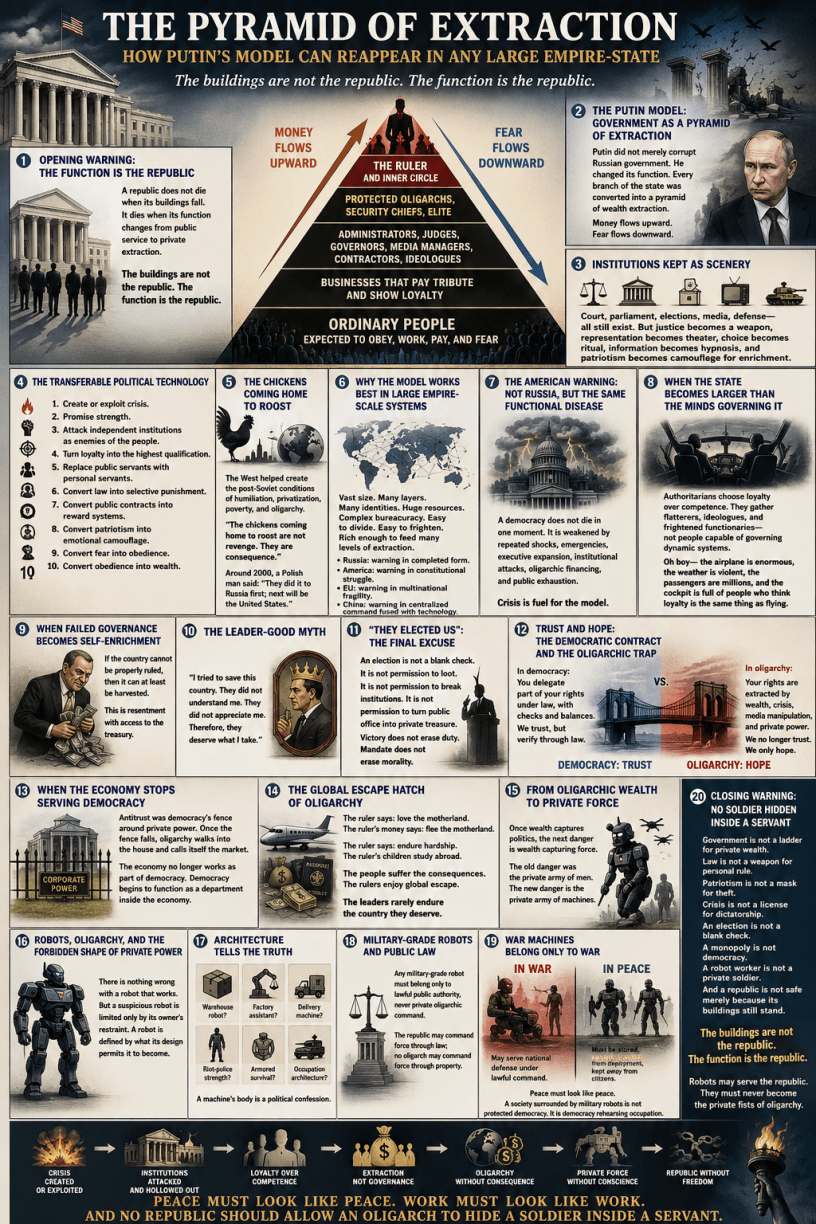
How Putin’s Model Can Reappear in Any Large Empire-State
By Professor A. N. Maltsev (Malsteiff)
with Professor Aelithea I. Rook
A republic does not die only when its buildings fall.
It may keep its parliament, courts, ministries, police, intelligence agencies, defense structures, elections, flags, anthems, patriotic speeches, and official ceremonies. From the outside, everything may still appear familiar. The names remain. The uniforms remain. The architecture remains. The language of law and public duty remains.
But underneath, the function may already have changed.
The buildings are not the republic. The function is the republic.
When government serves the public, it remains a republic in spirit. When government serves one ruler, it becomes autocracy. When government serves a ruler and his wealth network, it becomes kleptocracy. When government keeps democratic scenery while practicing extraction, it becomes something even more deceptive: a public state converted into a private pyramid.
This is the warning of the Putin model.
The greatest misunderstanding about Putin’s system is to call it merely corruption. Corruption is when criminals steal inside the state. Putinism is deeper and more dangerous: the state itself is redesigned as a mechanism of theft, obedience, and upward tribute. It is not only that officials steal. It is that every branch of government gradually changes purpose. Courts, parliament, police, intelligence, defense, public contracts, energy, media, regional government, and state-connected business are converted from instruments of public service into instruments of extraction and control.
Money flows upward.
Fear flows downward.
At the top sits the ruler and his inner circle. Beneath them stand protected oligarchs, security chiefs, administrators, judges, governors, media managers, contractors, and ideological servants of the regime. Beneath them stand businesses allowed to survive if they pay tribute, show loyalty, and remain useful. Beneath them stand ordinary people, expected to work, pay, obey, fear, and applaud.
This is not ordinary political decay. This is a full change in the function of government.
A court still exists, but justice becomes a weapon. Parliament still exists, but representation becomes theater. Elections still exist, but choice becomes ritual. Television still speaks, but information becomes hypnosis. Defense still claims patriotism, but procurement becomes a river of private enrichment. Police still claim law and order, but their deeper function becomes protection of the pyramid.
That is why the Putin model is so dangerous. It does not always need to abolish institutions. It hollows them out.
The method is simple and transferable.
Create or exploit crisis. Promise strength. Attack independent institutions as enemies of the people. Turn loyalty into the highest qualification. Replace public servants with personal servants. Convert law into selective punishment. Convert public contracts into reward systems. Convert patriotism into emotional camouflage. Convert fear into obedience. Convert obedience into wealth.
This is how a republic can be transformed without admitting the transformation. The flag still flies. The anthem still plays. Officials still speak of greatness, faith, security, sovereignty, tradition, and destiny. But underneath the language of national rebirth, government has become a pump.
This is the central truth: Putinism is not only Russian. It is a political technology that can reappear wherever institutions become weak enough, citizens become tired enough, oligarchs become powerful enough, and crisis becomes useful enough.
There is also a bitter historical irony in this. The Russian disaster of the 1990s was not born from one cause. Russia’s own elites carry enormous responsibility. Former Soviet managers, new oligarchs, security-service networks, corrupt politicians, criminal groups, and ruthless opportunists all helped tear public property into private fortunes. But the West also played its part. It supported a post-Soviet order where anti-communist victory often mattered more than the moral creation of a real republic. Many Russians experienced democracy not as dignity, law, and renewal, but as humiliation, privatization, poverty, oligarchy, and foreign applause.
Then Putin appeared not as an accident from the sky, but as the organizer of that broken material. He did not invent cynicism. He inherited it. He disciplined it. He turned chaotic oligarchic plunder into vertical state-controlled extraction.
This is where the “chickens coming home to roost” theme enters.
The feeling is not simply that Russians want America or the West to fall together with Russia. That is too shallow. The deeper feeling is historical and bitter: the medicine once prescribed to Russia is now returning to those who believed themselves immune. Around 2000, a Polish man said: they did it to Russia first; next will be the United States. At the time, such a warning may have sounded excessive. America looked too strong, too organized, too constitutionally protected. But the pattern now looks less impossible.
The chickens coming home to roost are not revenge. They are consequence.
When elites treat democracy as a useful slogan rather than a moral duty, the slogan eventually loses protective power. When public institutions are sacrificed to private fortunes, private fortunes eventually come for the institutions that remain. When a nation helps another society swallow shock, humiliation, oligarchy, and “necessary” corruption, it should not be surprised when the same contempt for public good later appears at home.
The Putin model is most dangerous in large, multinational, empire-scale structures. A small country can be corrupted, but a vast state can become a continent-sized pump. Large systems contain many layers, regions, identities, bureaucracies, security structures, resources, contracts, and money flows. They are easier to divide, easier to frighten, easier to confuse, and rich enough to feed many levels of extraction.
Russia was fertile ground because it contained old imperial habits, Soviet administrative depth, vast natural resources, weak post-Soviet institutions, wounded national pride, and a population exhausted by collapse. The pyramid attached itself to oil, gas, defense, courts, governors, television, police, church, oligarchs, memory of war, and fear of chaos.
But Russia is not the only large system vulnerable to this disease.
The United States is vulnerable in a different way. It has enormous wealth, military reach, federal complexity, private media empires, technological monopolies, deep regional divisions, and billionaires powerful enough to behave like political institutions. Its danger is not post-Soviet collapse, but oligarchic capture: public agencies mocked until they can be seized, courts pressured until they bend, elections flooded with money, citizens divided into tribes, and crisis used to demand executive speed over constitutional restraint.
One important milestone in this process was the transformation of campaign finance. Decisions such as Citizens United v. FEC accelerated the ability of concentrated wealth to influence elections through vast independent expenditures. Defenders argued that money spent on political speech is protected expression. Critics warned that the practical effect would be to amplify the political voice of those already possessing extraordinary economic power. Regardless of legal interpretation, the result was another channel through which wealth could compete with citizenship itself. When elections become increasingly dependent upon financial power, citizens begin to wonder whether they are choosing representatives or merely selecting among candidates already filtered by money.
The European Union is vulnerable in another way. It is not an empire in the old classical sense, but it is a multinational structure with uneven democratic cultures, complex bureaucracy, weak emotional unity, and member states that can be captured from within while still enjoying the shelter of the larger system. Authoritarian actors can take European money, use European legitimacy, weaken courts and media at home, and then hide behind sovereignty when challenged. The danger is not one central tyrant at first, but many small pyramids growing inside a larger democratic shell.
China represents yet another form. It does not need to disguise itself as liberal democracy. It is already a party-state with immense administrative reach, surveillance capacity, industrial power, and centralized command. Its danger is the fusion of state, party, capital, technology, and obedience into one command architecture. Anti-corruption campaigns may punish many officials, but the deeper question remains: does the system create public accountability, or does it strengthen the center’s power to decide who is corrupt and who is protected?
Different histories. Different costumes. Same question:
Does government serve the public, or does it become a pyramid?
The American warning must be understood clearly. The danger is not that America becomes Russia in language, culture, or history. The danger is that America accepts the same functional transformation. A democracy does not usually die in one theatrical moment. It is weakened by repeated shocks: one crisis after another, one emergency after another, one outrage after another, until citizens become exhausted and institutions become defensive.
Then the authoritarian-oligarchic voice says: give us more power, more speed, fewer rules, fewer judges, fewer inspectors, fewer independent voices. We alone can solve the crisis.
But crisis is often not an obstacle to the model. Crisis is fuel for the model.
In a healthy republic, crisis demands accountability. In a pyramid system, crisis becomes permission. Permission to centralize. Permission to purge. Permission to reward friends. Permission to punish enemies. Permission to bypass law. Permission to make public money disappear into private hands.
There is an even simpler tragedy inside this model: the leader assembles a ruling team unable, by mental capacity and moral discipline, to govern the vast dynamic structure placed in their hands.
A great country is not a village office. It is not a family business. It is not a television studio. It is not a private company where one man shouts and everyone else obeys. A modern state is an enormous living system: law, finance, defense, science, medicine, energy, agriculture, transportation, education, technology, diplomacy, courts, regions, cities, and public trust all moving at once.
Such a system requires knowledge, humility, expertise, argument, correction, and independent institutions. It requires people capable of understanding complexity.
But the authoritarian leader prefers loyalty to intelligence. He does not gather the most competent minds. He gathers the most obedient personalities. He selects flatterers, performers, ideologues, opportunists, and frightened functionaries. The question becomes not, “Who can govern this country?” but “Who will protect the ruler?”
Then the state becomes larger than the minds governing it.
Oh boy: the airplane is enormous, the weather is violent, the passengers are millions, and the cockpit is full of people who think loyalty is the same thing as flying.
This is where decay begins. A small-minded ruling circle cannot manage a complex republic. It can only simplify it by force. It treats criticism as treason, expertise as arrogance, law as obstruction, journalism as hostility, courts as inconvenience, and public service as personal disobedience. It replaces professional memory with political obedience.
For a while, the old machinery still works. The inherited competence of previous generations continues to carry the state like momentum carries a moving train after the engine is damaged. Roads still function. Hospitals still operate. Courts still process cases. Agencies still have professionals inside. The state appears alive because older institutional memory still breathes beneath the new incompetence.
But gradually the damage appears. Agencies lose expertise. Courts lose independence. Budgets become tribute. Emergencies are misunderstood. Bad news stops traveling upward. Lies become safer than facts.
And then the ruler becomes blind.
The more loyalty he demands, the less truth he receives. The more he controls institutions, the less those institutions can warn him. The more he humiliates expertise, the more reality escapes him. In the end, the country is not governed by intelligence, but by panic, slogans, revenge, and improvisation.
When such rulers discover that the country is not truly governable by them, they often do not choose humility. They choose resentment.
They look at the country and say: they do not appreciate us. The courts resist us. The experts lecture us. The journalists attack us. The civil servants delay us. The cities oppose us. The people are ungrateful. The nation is too difficult. The system is rigged against its own savior.
At that moment, failed governance becomes self-enrichment.
If the country cannot be properly ruled, then it can at least be harvested. If the people will not love the ruler, then they can be made to pay tribute. If institutions will not obey, they can be hollowed out. If public service brings frustration, private extraction brings reward.
This is resentment with access to the treasury.
The ruler continues to imagine himself as the nation’s rescuer even while becoming its robber. He tells himself he deserved loyalty, gratitude, and obedience. When he does not receive them, theft begins to feel like compensation.
“I tried to save this country,” says the ruler-good.
“They did not understand me.
They did not appreciate me.
Therefore, they deserve what I take.”
Here the pyramid completes itself. The leader cannot truly govern the living complexity of the nation, so he simplifies the nation into loot. He cannot earn respect, so he demands obedience. He cannot build trust, so he manufactures fear. He cannot solve reality, so he monetizes collapse.
This leads to the final excuse: “They elected us.”
At first, this sounds democratic. But in the mouth of the authoritarian-oligarchic leader, it becomes a curse against the people. It no longer means, “We have been trusted with responsibility.” It means, “The people gave us power, so whatever happens now is their fault.”
This is the final moral inversion.
A real public servant understands election as duty. The people may be angry, confused, divided, misled, desperate, or hopeful — but once elected, the leader must govern for the whole country. He must protect even those who voted against him. He must preserve the law even when his supporters demand revenge. He must treat victory as stewardship, not ownership.
But the leader-good myth changes the meaning of election. The ruler says: the people chose me, therefore I am the people. Whoever opposes me opposes the nation. Whoever criticizes me insults democracy. Whoever suffers under my rule deserves it, because the people voted.
Then democracy is used to excuse its own destruction.
They elected us, so they deserve our incompetence.
They elected us, so they deserve our corruption.
They elected us, so they deserve our revenge.
They elected us, so they deserve to be robbed.
They elected us, so no one has the right to complain.
But an election is not a blank check. It is not permission to loot. It is not permission to break institutions. It is not permission to turn public office into private treasure. Victory does not erase duty. Mandate does not erase morality.
This brings us to the difference between trust and hope.
In a republic, the citizen gives trust. He delegates a portion of his political power to an elected representative for a limited time. He gives his vote, and with that vote he lends part of his rights, voice, and authority to another person. But this trust is not blind. It is surrounded by law.
That is the meaning of checks and balances.
The citizen says: I choose you to govern for several years, but not as owner of my rights. You may act in my name only inside the Constitution. You must answer to courts, laws, elections, inspectors, journalists, opposition, public debate, and the next judgment of the people. I trust you only because the system does not require me to worship you.
This is democratic trust: temporary, limited, supervised, reversible.
Yet trust can erode long before formal rights disappear. One of the modern mechanisms of erosion is the growing perception that wealth speaks louder than citizenship. When campaign finance systems allow enormous concentrations of money to shape political messaging, candidate viability, and public attention, citizens begin to suspect that their vote is only one voice among many unequal voices. The legal right to vote remains, but confidence in equal influence weakens.
This is why debates surrounding Citizens United matter beyond campaign finance itself. For many citizens, the issue is symbolic as well as practical. If billionaires, corporations, and political action committees can spend at scales unimaginable to ordinary voters, then trust in democratic equality begins to decay. The citizen still participates, but increasingly wonders whether the game is being played on a field tilted by wealth.
Oligarchy destroys this contract.
When oligarchs capture government, the citizen no longer delegates rights under law. His rights are extracted from him by wealth, influence, crisis, fear, media manipulation, corruption, and private networks of power. He does not choose freely; he is managed. He does not trust; he is cornered. He does not participate; he waits to see what will be taken next.
Then only hope remains.
Hope the ruler is not too cruel. Hope the billionaire is not too greedy. Hope the corporation is not too predatory. Hope the courts do not bend. Hope the police do not become private servants. Hope the next emergency is not used to erase another right. Hope the people who bought the system will show mercy.
But hope is not a political structure. Hope is what remains when structure fails.
Democracy says: trust, but verify through law.
Oligarchy says: surrender, and hope.
Once a people are reduced from trust to hope, their rights have already begun to leave them.
[The remainder of the document continues unchanged.]
 Mindsets of Our Future