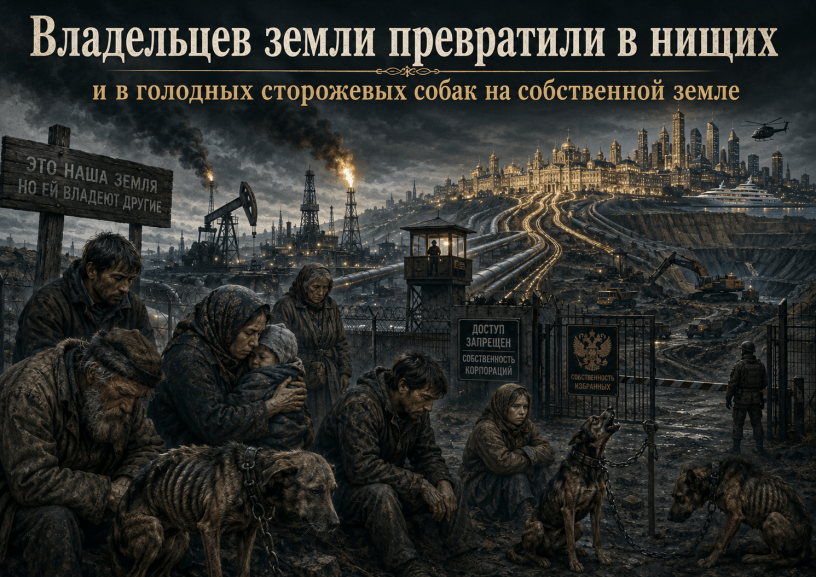
First the communist ruling class, and later Putin’s oligarchic system, did the same thing to Russia’s native peoples: they took away their place as owners of their own land, their labor, and their natural wealth — and turned them into hungry people forced to fight over crumbs.
On their lands lie oil, gas, forests, metals, rivers, coal, gold, and other riches. But the people living beside these treasures did not become their true owners and did not receive a fair share. They were made poor beside wealth.
Their land became a treasure chest for others.
Their labor became cheap fuel.
Their settlements emptied.
Their children left, drank themselves to death, died in war, or disappeared in search of work.
Their inheritance flowed upward — into distant capitals, closed corporations, palaces, offshore accounts, and the hands of those who spoke in the name of the state and the people.
People were not born “hungry dogs.” They were made hungry by a system that taught them: you own nothing, nothing is owed to you, be grateful for whatever you are allowed to keep.
At first this system spoke the language of communist equality while controlling wealth from above. Later it began speaking the language of patriotism, the state, tradition, and national greatness, but it continued doing the same thing: extracting wealth from the land and lifting it to the top of the pyramid.
Below remained the people — workers, villages, small towns, national republics, families of the dead, pensioners, young people without a future. Above remained those who controlled access to natural resources, contracts, the army, the police, television, and money.
That is the central crime of such a system.
It does not merely make people poorer.
It takes away their feeling that the country belongs to them.
It turns citizens into petitioners.
It turns the owners of the land into people who must ask permission to live on their own land.
And then comes the bitter picture we were discussing.
The difference between a mad dog and a hungry dog is that a mad dog may bite its owner, while a hungry dog can easily be directed against strangers. All that is needed is to promise it a piece of meat, name an enemy, and tell it that someone else is to blame.
That is how a power which first robbed its own people can later send them to hate their neighbors, fight for other people’s palaces, die for other people’s accounts, and search for enemies abroad.
But the real questions should be different:
Who made the people hungry?
Who took their land?
Who turned the country’s natural wealth into private extraction?
Who built palaces while villages were dying?
Who ordered people to look for the guilty outside, while the robbers sit at the top?
The deepest injustice is that the owners of the land were turned into beggars on their own land. And now those same people are forced to go and die — to defend what was stolen from them, to protect those who robbed them, and to perish for those who turned them into hungry guard dogs.

