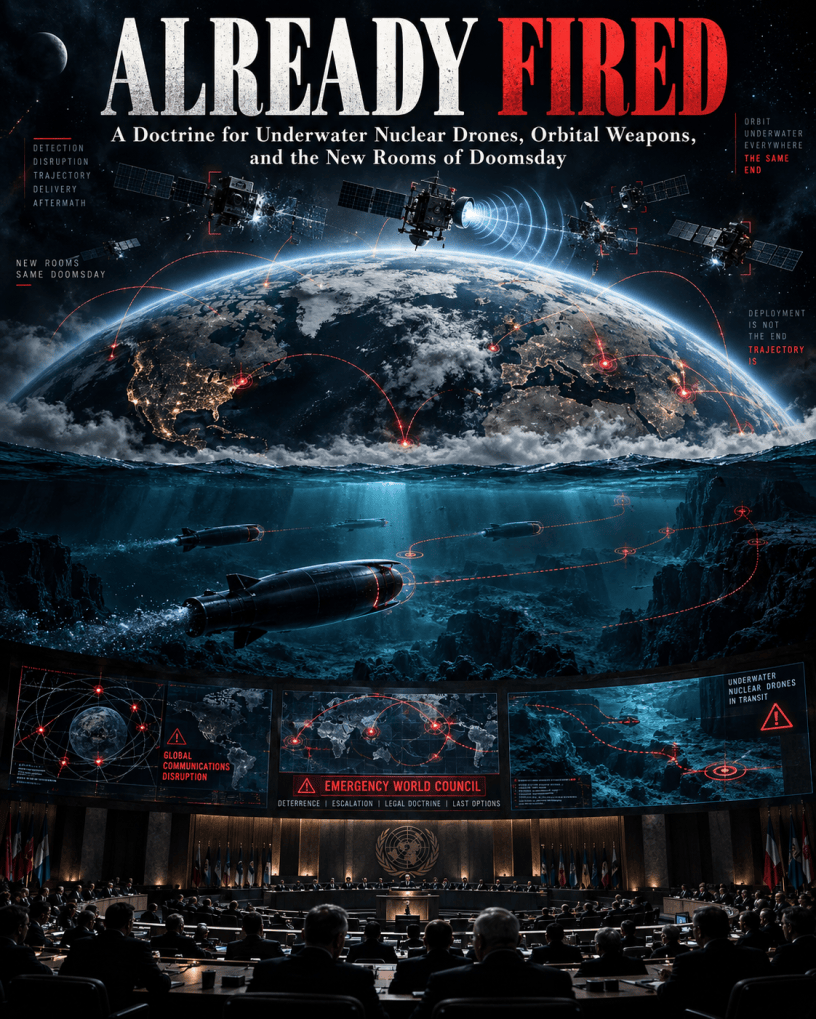
A Doctrine for Underwater Nuclear Drones, Orbital Weapons, and the New Rooms of Doomsday
The old nuclear age had terrible weapons, but at least many of them had a visible grammar.
Missiles could be counted.
Bombers could be tracked.
Submarines could be understood as part of deterrence.
Treaties, inspections, warning systems, and hotlines tried to keep apocalypse inside a known structure.
That structure is now breaking.
The great powers are moving doomsday into new rooms: under the ocean, into orbit, into automation, into hidden routes, into electromagnetic disruption, into systems that may be hard to inspect, hard to recall, hard to identify, and easy to misread.
The world needs a new doctrine.
The doctrine should be simple:
If a doomsday weapon cannot be reliably recalled, inspected, or withdrawn, it must be treated politically and legally as already fired.
Not fired in the sense that automatic military retaliation must begin.
That would be madness.
But fired in the sense that the world emergency has already begun.
A nuclear weapon does not become dangerous only at the moment of explosion. It becomes a civilization-level threat when it is placed into the environment of use.
A hidden nuclear drone under the ocean is not simply “stored” if it is already moving, patrolling, targeting, or operating beyond reliable inspection and recall.
A weapon in orbit is not simply “deployed” if it is already positioned to blind satellites, damage communications, attack early-warning systems, disrupt navigation, or paralyze the command structure of modern civilization.
The old language is too weak.
“Deployed.”
“Stationed.”
“Patrolling.”
“Experimental.”
“Space control.”
“Autonomous underwater vehicle.”
“Strategic deterrent.”
These words can become hiding places.
The real question is not what name the owner gives the weapon.
The real question is:
Can it be undeployed?
Can it be inspected?
Can it be recalled?
Can its mission be stopped?
Does it already have a destination?
Does it already have a trajectory toward a final point?
Does it already have a point of delivery?
Does it already have mission logic that places it inside the chain of attack?
Undeployment matters.
If a weapon can be removed, recalled, verified, deactivated, inspected, and returned to accountable custody, then the world still has a path away from catastrophe.
This applies not only to land-based systems.
It applies to underwater nuclear drones.
It applies to orbital weapons.
It applies to space vehicles carrying dangerous payloads, electronic attack systems, nuclear devices, electromagnetic weapons, or any other civilization-paralyzing capability.
But undeployment alone is not the deepest test.
The deeper test is trajectory.
A weapon hidden in a warehouse is terrible.
A weapon placed on a platform is worse.
But a weapon already moving toward a final point, already assigned to a delivery path, already operating under mission logic, or already positioned where its use becomes immediate — that weapon is no longer merely possessed.
It is already inside the chain of attack.
The same logic must apply under the ocean and above the Earth.
If an underwater nuclear drone is sent into the ocean with a destination, a route, or a delivery purpose, it should not be treated as a normal deployment. It should be treated as a nuclear weapon already placed into motion.
If an orbital weapon or space vehicle is placed on a path where it can deliver destruction, electromagnetic paralysis, satellite blindness, command disruption, or nuclear effect, it should not be treated as an ordinary military satellite. It should be treated as a weapon already inserted into the opening structure of war.
The point is not panic.
The point is prevention.
A weapon that can still be withdrawn belongs to diplomacy.
A weapon that cannot be withdrawn belongs to emergency.
A weapon that has no verified recall belongs to international alarm.
A weapon that already has a destination and trajectory belongs to the category of already fired.
This is especially important with electromagnetic impulse weapons.
An orbital electromagnetic weapon does not need to fall like a bomb.
Its purpose may be to blind.
To deafen.
To confuse.
To paralyze.
To turn off maps, clocks, satellites, navigation, early warning, military command, finance, communications, aviation, and civil infrastructure.
Its target is not only a city.
Its target is the nervous system of modern life.
That is why such weapons are first-use weapons by nature.
They are made for the first minutes.
They are made for the moment when one side wants the other side to lose eyes, ears, clocks, maps, and confidence before the visible strike arrives.
The danger is not only physical destruction.
The danger is panic.
If warning systems suddenly fail, leaders may not know whether the cause is accident, test, attack, malfunction, deception, or the opening move of nuclear war.
If satellites go blind, command links fail, and navigation systems collapse, the most dangerous question in history appears:
Do we still have time?
A civilization that reaches that question may already be on the edge of catastrophe.
This is why the world must not wait for detonation.
Doomsday weapons must be judged at the moment they are placed where detonation, paralysis, or delivery becomes their practical purpose.
The rule should be:
If it cannot be recalled, it is already fired.
If it cannot be inspected, it is already a world emergency.
If it has a trajectory toward a final point, it is already in the chain of attack.
If it has a point of delivery, it is no longer merely deployed.
If it can blind civilization before civilization can respond, civilization must respond before it is used.
Not with automatic war.
Not with automatic nuclear retaliation.
Not with the same panic logic that the doctrine is trying to prevent.
The response must be legal, political, public, and international.
Immediate identification.
Emergency public session.
Demand for inspection.
Demand for verified withdrawal.
Demand for undeployment.
Demand for disclosure of mission logic.
International monitoring.
Sanctions for refusal.
Legal classification as preparation for nuclear or civilization-level attack.
If the Security Council is blocked because nuclear powers protect themselves with vetoes, the General Assembly must act as the public voice of humanity.
It cannot become a world government by wish.
It cannot command armies like the Security Council.
But it can expose.
It can condemn.
It can organize.
It can recommend collective measures.
It can force the question into daylight.
It can say that a veto must not become a license for planetary hostage-taking.
No state has the right to hide a nuclear weapon in the ocean and call it stability.
No state has the right to place a blinding weapon above the Earth and call it defense.
No state has the right to put apocalypse into motion and call it deterrence.
The world must update its legal imagination.
The next apocalypse may not begin with a missile rising from a silo.
It may begin with a silent vehicle under the ocean.
It may begin with a space vehicle crossing a final point.
It may begin with an electromagnetic impulse from above.
It may begin with satellites going dark and leaders suddenly wondering whether they have minutes left.
That is why the doctrine must be written before the flash.
A weapon is not harmless because it has not yet exploded.
A weapon is not merely “deployed” if it is already traveling toward use.
A weapon is not “defensive” if its first function is to blind civilization.
A weapon is not “deterrence” if the world cannot inspect it, recall it, or know whether it is already in motion.
The old question was:
Has the weapon been fired?
The new question must be:
Can it still be stopped?
If the answer is no, then for law, diplomacy, and world emergency, the weapon must be treated as already fired.
And if the world waits until impact, then law has arrived too late.

