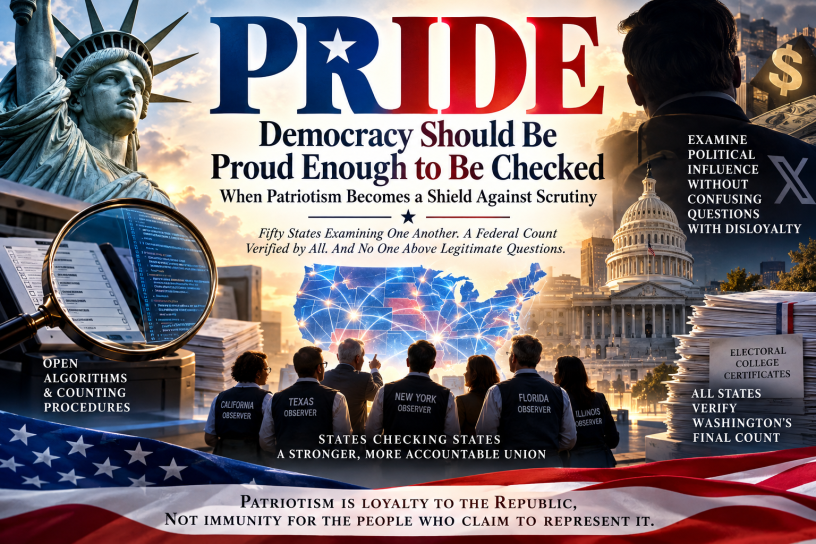
When Patriotism Becomes a Shield Against Scrutiny
Fifty states examining one another’s elections, verifying the federal count, and refusing to confuse scrutiny with disloyalty.
By Professor Malsteiff & Professor Aelithea I. Rook
The Dangerous Side of Pride
Pride can inspire people to defend their country, their freedom, and institutions built by generations before them. But it also has a dangerous side: sometimes we become so proud of our institutions that we treat examination as an attack. We defend the reputation of the machinery instead of checking whether it works.
An even more dangerous confusion occurs when loyalty to political leaders is presented as loyalty to the nation. Questions about elections, donors, or powerful allies become accusations of disloyalty. That is when pride stops defending democracy and begins protecting power from democratic accountability.
Patriotism is loyalty to the republic, not immunity for the people who claim to represent it.
Patriotism Is Not a License to Avoid Questions
Suppose a billionaire contributes enormous sums to influence an election, owns a major communications platform, and has substantial business relationships with government. Citizens have every right to ask how that influence operates. The proper answer is evidence, not a loyalty test.
If Republicans question wealthy Democratic donors, or Democrats question wealthy Republican donors, both deserve an evidence-based examination. No one should receive immunity because of political affiliation; no one should be presumed guilty because of it either.
The Billionaire and the Ballot
Elon Musk is a visible example of questions surrounding concentrated political wealth. A January 2025 Washington Post analysis of Federal Election Commission filings reported that he contributed at least $288 million to support Donald Trump and other Republican candidates during the 2024 election cycle. Musk also owns X and businesses with significant government relationships.
These facts raise legitimate questions about campaign-finance disclosures, political access, conflicts of interest, the influence of communication platforms, and compliance with applicable law. But they are not evidence, by themselves, of interference with ballots or vote-counting machinery. Those are separate allegations requiring separate proof.
Federal rules permit super PACs to receive unlimited contributions from permitted sources for independent political expenditures, subject to disclosure and other restrictions. Legal spending and public concern about concentrated influence can coexist. The response should be transparent records, independent scrutiny, and conclusions proportionate to the evidence.
The republic belongs to its citizens. It is not the private property of political leaders, donors, or their wealthiest supporters.
We Examine Other Countries. Why Not One Another?
The United States supports international election observation, and international observers also examine American elections. The OSCE’s election observation mission reviewed the 2024 U.S. election, describing an election that was generally well administered while recommending improvements, including greater observer access and campaign-finance transparency.
If election observation strengthens democratic credibility across national borders, why should qualified experts from one American state not have meaningful reciprocal access to election procedures in another? Why not let New York observers examine procedures in Texas, Texas observers examine California, and California observers examine Florida?
Are we the United States, or fifty separate rooms with locked doors?
Fifty States Checking One Another
The proposal is straightforward. Each state retains authority to administer and certify its elections under applicable law. No state gains the power to change another state’s ballots, operate its machines, direct its election workers, or overturn its certifications.
Instead, states establish reciprocal, accredited rights of technical observation. Qualified experts from different states can witness testing and counting, examine relevant procedures and evidence, document findings, and publish reports under safeguards for voter privacy, cybersecurity, and uninterrupted election operations.
The access would require new agreements or legislation; it is not a universal right under current state law. But reciprocity could turn political suspicion into a shared, disciplined process of verification.
Observation without control. Verification without interference.
Open the Counting Procedures, Not Just the Doors
Meaningful observation is more than standing behind a rope watching ballots move across a table. Experts need to understand how ballots become official totals.
For electronic systems, that means examining appropriate evidence about tabulation algorithms, reviewed source code, certified software versions, election configurations, equipment testing, audit records, and reconciliation between machine totals and verifiable ballot evidence. The U.S. Election Assistance Commission already oversees voluntary voting-system certification procedures involving accredited laboratories and trusted software builds; interstate examination would add a separate safeguard, not replace those existing measures.
Sensitive credentials, voter information, and security-critical materials must remain protected. Supervised access for accredited experts need not mean public exposure of exploitable secrets.
For hand counting, observers should examine ballot handling, seals, chain of custody, ambiguous markings, counting-team disagreements, reconciliation, and signed records. Human counting is not automatically trustworthy merely because no computer is involved.
The question is not whether a human hand or a computer counted the ballot. It is whether an independent person can verify how the ballot became part of the result.
The States Must Also Check Washington
There is a second, equally important safeguard. After states complete their presidential election responsibilities, electors cast their votes and authenticated certificates enter the federal process. Congress counts the electoral votes and announces the result. The National Archives publishes the relevant documents.
Every state should independently reconstruct and verify the complete federal Electoral College aggregation—not only its own contribution. New York, Texas, California, Florida, Georgia, Pennsylvania, and every other state, together with the District of Columbia, should be able to compare authenticated electoral certificates, applicable counting rules, and Congress’s final reported tally.
If those independent reconstructions agree, their agreement strengthens the public record. If they disagree, the discrepancy should be documented and reconciled through an established procedure. No state would acquire a veto over another state’s lawful result, and the procedure would not become a nationwide recount of individual ballots.
Do not give Washington fifty election systems to control. Give fifty election systems the ability to check one another—and give all fifty states the ability to verify Washington’s final count.
Recounting Is Not the Same as Verification
A recount asks whether a jurisdiction’s ballots were counted correctly. Interstate technical observation examines whether its documented procedures were properly followed. Independent federal verification asks whether the authenticated electoral votes were correctly aggregated. These are distinct checks; one cannot replace another.
States would keep their recount and audit responsibilities under applicable law. The proposed interstate framework would create new opportunities to discover errors without centralizing election administration.
Suspicion Is Not Evidence. Pride Is Not Evidence Either.
The proposal does not depend on declaring that the 2024 presidential election was stolen. Official security assessments and international observation did not establish such an outcome. Unusual statistical patterns do not automatically prove fraud; neither do accusations about wealthy donors. Evidence must determine conclusions.
But the absence of proven manipulation in one election does not make every procedure beyond improvement. A system can produce an accurate result while still benefiting from stronger verification.
Suspicion is not proof of wrongdoing. Confidence is not proof of perfection.
When Patriotism Becomes a Political Weapon
If a Republican questions a Democratic-led state’s procedures, the answer should be documented evidence and a meaningful opportunity for qualified examination—not an accusation that the question itself attacks democracy. If a Democrat questions Musk’s political influence, the answer should be campaign-finance records, applicable laws, and the evidence—not an accusation that asking weakens America. The same rule must apply in reverse.
A president is not the republic. A party is not the republic. A billionaire donor is not the republic. A voting-machine manufacturer is not the republic.
The republic is the constitutional system through which citizens retain the right to question, examine, correct, and replace those who exercise power in their name.
When Our Pride Becomes Another Government’s Alibi
There is an international consequence to our reluctance to examine ourselves. When Americans criticize restrictions on political competition or election transparency abroad, a government facing those questions can redirect the conversation: “What about your billionaire donors? Your accusations of election fraud? Your disagreements over voting machines?” The original question—whether that government permits a genuinely competitive, independently verifiable election—can disappear beneath an argument about America’s shortcomings.
Those questions about America deserve serious answers. But acknowledging a weakness in one system does not establish that every election system is equally free, nor does it excuse another government from explaining its own procedures. This is the false equivalence often hidden inside whataboutism: answering a specific demand for accountability by pointing to someone else’s imperfections.
The democratic response should be neither defensive denial nor embarrassed surrender: “Yes, money can exert enormous influence in our politics. Yes, we argue over elections. Our records, laws, procedures, and institutions must remain open to meaningful challenge and independent examination. Where safeguards fail, we should correct them. Now, will you permit the same scrutiny of your elections?”
That question has practical meaning. Can opposition candidates compete without coercion? Can independent observers see enough to evaluate the count? Can journalists investigate? Can citizens challenge official results through credible procedures? These standards should apply to every country, including the United States.
The answer to another government pointing at America’s weaknesses is not to hide those weaknesses. It is to examine and correct them—and ask whether that government permits the same scrutiny.
Our credibility abroad does not grow when we pretend to be perfect. It grows when our willingness to be examined is more than a slogan. Pride should never turn our imperfections into someone else’s alibi.
The Pride Worth Having
Imagine accredited specialists from different states observing one another’s procedures, examining evidence, and publishing their findings. Imagine each state independently checking the final federal Electoral College tally. Imagine campaign-finance records and possible conflicts of interest being examined without converting scrutiny into a test of patriotism.
Some investigations will uncover problems; others will confirm that procedures were followed. Both outcomes have value. An honest investigation need not produce an accusation; it must produce a conclusion supported by evidence.
The cure for political distrust is not demanding more trust. It is making trust less necessary.
Immature pride says: Our system is superior. Stop questioning it. Mature democratic confidence says: Our system belongs to the people. Examine it, test it, and help us correct its weaknesses.
Federalism should not end when the states send their electoral votes to Washington. That is precisely where its final safeguard should begin. And patriotism should never end where questions about powerful people begin.
We should be proud of America not because we believe its democracy cannot fail. We should be proud enough of democracy to keep checking it.

