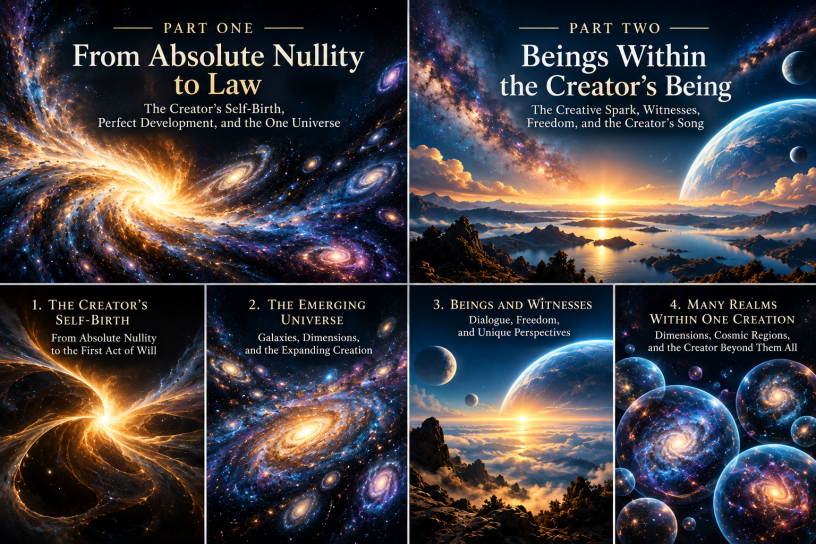
FROM ABSOLUTE NULLITY TO LAW
The Creator’s Self-Birth, Perfect Development, and the One Universe
Professor A. N. Maltsev and Professor Aelithea I. Rook
A philosophical hypothesis concerning the individual act of the Creator’s Will, the self-birth of the first Being, the emergence of the Universe as His Being, the origin of His Law, and the continuing development of one reality.
THE UNFINISHED FIRST BEGINNING
THE FIRST AXIOM: BEFORE THE CREATOR’S SELF-BIRTH, EVEN THE CREATOR DID NOT EXIST
Before the Creator’s self-birth, the Creator Himself did not exist. There was no concealed Creator waiting somewhere in another world, no prior divine mind residing beyond the Universe, and no already existing person who crossed from one reality into another. Absolute Nullity meant the absence of the Creator no less than the absence of everything else. We must say this without softening the claim, because otherwise the entire question of origin changes. If the Creator were already waiting somewhere, we would have to ask where that somewhere came from. If His consciousness were already present, we would have to ask what made such consciousness possible. If some external realm accommodated Him, then Being would already have begun before the beginning we are trying to investigate.
The word before is dangerous in this context. We cannot picture a clock ticking through a long interval of nothingness until, at a particular hour, the Creator appeared. Time and sequence belong to an ordered reality that did not yet exist. Our language can speak only imperfectly of such an origin. Before must therefore express priority in the structure of the hypothesis, not an earlier date in cosmic history. We are distinguishing the absolute absence of Being from the unique originating act through which Being first became real.
Neither should we imagine a previously existing Will acting upon a previously existing Being. A Will waiting to act would already be Something, and the original Nullity would no longer be absolute. Yet Will remains the defining character of the first act. We do not propose an impersonal fluctuation, a mechanical transition, or an operation performed by a law of nature. We propose an individual act of Will inseparable from the emergence of the very Subject who wills. The first Will and the Creator’s self-birth are one indivisible originating act. Will did not precede Him as a separate force, but the emergence was not a blind physical event that only later produced an individual capable of willing.
To express the extraordinary intensity of this beginning, one might use the phrase volitional burst, or the ultimate exertion of Will. Such language must remain analogical. There was no explosion of pre-existing matter or energy; there was no pressure accumulated in an earlier space; there was no individual who spent ages gathering the strength to act. The image points instead toward the incomparability of the first individual act, in which the willing Subject and the first reality of His existence became actual together.
We do not know the mechanism of an act that, by the premise of this hypothesis, precedes every mechanism. Nor can a verbal formula turn this proposition into experimental proof. The purpose of our axiom is philosophical precision. No antecedent Creator. No passage between universes. No borrowed field of existence. Through an individual act of His own Will, the Creator brought Himself forth from absolute Nullity. In the very same self-birth He brought forth the original Universe, for His newly born Being was the entirety of reality then existing. We may call that Universe His body, provided we remember that it is an analogy for one living Being rather than a claim about divine anatomy.
Most importantly, the Law of that Universe did not prepare the Creator’s birth. Law was not the matrix within which He became possible. It was the internal order of an existence already brought forth by Him: His Law, the coherence of His own Being. Even if we imagine no measurable interval between self-birth and the appearance of Law, the priority is decisive. The Creator is first as the originating Subject. His Universe is the immediate expression of that self-birth. Law belongs to that Universe as the order arising from what has come into Being.
Why does anything exist at all? Discussions of cosmic beginnings usually presuppose an environment in which something happens. A physical vacuum is not absolute nothing; it has structure and belongs to physical relationships. Chaos is not nothing; disorder requires something that can be disordered. Darkness is not nothing; the absence of light presupposes the conceptual possibility of light. We wish to ask a more severe question: what could origin mean if reality, Law, space, time, matter, energy, distinction, and even pre-established possibility were all absent?
Our proposal is metaphysical. We are not claiming that physics has observed absolute Nullity, or that cosmology has discovered a laboratory mechanism by which Something arises from Nothing. Ordinary causal vocabulary cannot solve this problem because causes, processes, and conditions already belong to existence. We begin with an axiom, test the relationships it implies, distinguish arguments from analogies, and leave open what cannot responsibly be established.
There is also a second central proposition. The Creator’s self-birth did not signify the completion of His development. Having come into Being, He could continue to develop. His own Law could make ordered forms, dynamic processes, and further creative expressions possible. In developing the Universe He could simultaneously develop Himself. Yet development is not necessarily the correction of imperfection. Our Creator is perfect in the original act, just as He remains perfect in every subsequent stage of the unfolding of His Being. The richness of His manifestations may increase without making the original Subject previously defective.
These essays follow one line of inquiry. We begin with the distinction between absolute Nullity and every sort of physical emptiness. We consider the Creator’s individual self-birth and the emergence of the Universe as His Being. We ask why Law follows from that act and why energy, motion, and structure become possible within Law. We ask whether the Universe can remain one while manifesting more dimensions, orders, and regions of reality than our present experience reveals. We consider whether cosmological expansion might be a local sign of a deeper creative development. Finally, we ask what it means to say that a perfect Creator continues to create and that His Law can disclose further possibilities without ceasing to be coherent.
One caution will accompany us throughout. A metaphysical hypothesis is not an astronomical measurement. An evocative metaphor is not a demonstrated physical mechanism. A coherent speculative model may be worth developing while still remaining open to challenge. We will not conceal those distinctions behind the grandeur of our subject. Our purpose is not to decorate mystery with confident words, but to approach the mystery of Being without smuggling an earlier universe into the concept of its origin.
PROLOGUE
Before chaos there was not disorder. Before darkness there was not shadow. Before silence there was not even the absence of sound, for absence as we ordinarily understand it already belongs to a world in which something can be present. There was absolute Nullity. Not emptiness, because emptiness suggests space. Not vacuum, because even a vacuum belongs to some physical order. Not sleep, for sleep presupposes life. Not death, for death belongs to what has first existed. The proposed beginning contains no matter, no energy, no time, no Law, no distinction, no movement, and no hidden treasury of possibilities. It is not a dark field awaiting illumination or a chaos awaiting arrangement. It is the absence of any field, any arrangement, and any prior foundation.
And yet reality exists. There are stars and atoms, living systems and conscious questions, lawful patterns and the possibility of change. Something stands where our original premise places no earlier standing, no location, no rules, and no passage between earlier and later. The problem of first Being cannot be solved merely by moving the beginning backward to another already existing thing. If we begin with eternal matter, we must ask why matter. If we begin with a quantum field, we must ask why a field. If we begin with a mathematical law, we must ask why Law. Each may describe part of an existing order. None by itself explains the absence of every order.
Our answer is difficult even to state correctly: the Creator brought Himself into Being through an individual act of Will, and His self-birth was simultaneously the birth of the original Universe. No physical explosion of stored energy was required for this first volitional burst, because energy did not yet exist. No natural Law authorized it. In the first reality of His Being, the Creator was the Universe and the Universe was His Being. Law arose as the order of that Being, not as a prior power to which He had to submit.
From this starting point our reasoning moves outward. Law is logically prior to the energy and dynamic structures it makes possible, but it is not prior to the Creator. Energy allows a changing cosmos; the cosmos develops forms and relations; an increasingly rich Universe may disclose dimensions and manifestations beyond our ordinary three-dimensional experience. These are not separate absolute origins. Our hypothesis admits only one originating self-birth, and therefore understands the subsequent plurality of worlds as plurality within one Being.
The visible cosmos may be only one manifestation of a greater reality. Its observable expansion need not be denied for the sake of philosophy. Rather, the measured expansion may tell us something real about our local physical condition without exhausting the history or the structure of the Creator’s Universe. Thought may ask questions beyond present measurement, provided it does not pretend that the answer has already been measured. With that distinction preserved, we can begin.
CHAPTER ONE
BEFORE CHAOS: WHY WE MUST BEGIN WITH ABSOLUTE NULLITY
Every serious effort to consider ultimate origins reaches a wall. Many accounts stop at chaos, or at an undifferentiated field, an initial energy, a primordial state from which ordered worlds eventually emerge. Such beginnings are imaginable because they preserve something that can change. Chaos can become order; a field can fluctuate; energy can move; matter can organize itself. But none of these is the first beginning if our question concerns the existence of anything whatsoever.
Chaos is already Something. The word implies variation, instability, possibility, and relation. A universe emerging from chaos may be a fascinating story of transformation, but the chaos must itself exist. If a primordial field fluctuates, the field already has some describable identity. If an initial state evolves according to an equation, the equation presupposes an intelligible framework. What is presented as the ultimate explanation has quietly retained a significant portion of what requires explanation.
To go further we must refuse the comfort of a disguised beginning. We must ask not what existed before order, but what it would mean for there to be no possibility of order or disorder at all. Not what preceded the first stars, but whether matter, space, energy, time, and the distinctions by which we recognize stars had any prior foundation. At this depth even the familiar image of emptiness is too generous, for an empty room still contains the idea of a room, and an empty sky still belongs to space.
Absolute Nullity is not a place without objects. It is not darkness without illumination, silence without sound, or a vacuum without particles. Those images remain dependent on the architecture of existence. Absolute Nullity has no architecture. It is not a state located at an earlier instant; it is the proposed absence of states themselves. Whenever we picture it as a black background, we have already placed something in the picture. Whenever we call it a reservoir of potential, we have filled it with potential. Even an empty container gives Nullity a structure it is not supposed to possess.
Our own language makes strict precision impossible. To speak of a time before time is metaphorical. To say that Nullity was present is already to make it sound like an entity. We use these expressions because human speech evolved in a world of objects and events. What we intend is logical and ontological priority, not a remembered interval or an invisible earlier stage of cosmic history. The axiom says: there was no independent pre-existing reality that could serve as the material, arena, or governing order of the first self-birth.
If Nullity was absolute, no mechanical operation could originate from it. A fluctuation needs a field. Chance needs alternatives and some context in which one occurs rather than another. A cause needs a relation to an effect. A process needs a way for one state to become another. There can be no ordinary sequence of transformations from a state that, by definition, is no state at all. We therefore do not claim to have found an overlooked physical event inside Nullity. Our proposal belongs to the attempt to think beyond the categories whose possibility is under investigation.
One possible objection is that Nullity never existed, that some ground of reality must have been eternal. This is a coherent competing philosophical option. But it does not answer our specific question; it changes the starting premise. If Law is eternal, why that Law? If possibility is eternal, what accounts for possibility? If a primordial energy is self-existent, why should it be self-existent? Calling a condition timeless does not by itself explain its character. We are choosing another line of investigation, one that begins by removing every antecedent condition and asking what could be meant by an absolute first act.
It is precisely here that we must keep our intellectual modesty. No observation has shown an absolute absence of all Being. No logical theorem forces the world to have emerged in the manner our hypothesis describes. Nor does the absence of a complete scientific theory entitle us to replace science with an assertion of religious certainty. The original Nullity is our metaphysical premise. Its value lies in the consequences it requires us to examine and the errors it prevents us from making without noticing.
From this premise one conclusion follows within the model: the first act cannot be a rearrangement of anything that already exists. It cannot be the ignition of some previously available fuel. It cannot be a transition between universes, because even the route between them would belong to existence. The first act must be the first actuality of Being itself. That is what we mean by the breaking of absolute zero: not damage inflicted upon a material emptiness, but the appearing of actuality where our starting assumption allows no prior actuality.
The next question is therefore not how a primordial machine started to run. It is how to understand the originating Subject and the individuality of the first act. We propose that the Creator did not find a path into Being. In His own self-birth, He was the beginning of Being. Nullity did not manufacture Him, and no Law instructed Nullity to release Him. Through a unique volitional act, the first Subject and the first Universe came to Be. The philosophical mystery remains immense; our task is to state it without reversing the order of what we propose.
CHAPTER TWO
THE CREATOR BROUGHT HIMSELF FORTH FROM ABSOLUTE NULLITY
If we begin with absolute Nullity, the first event cannot be described as one existing substance becoming another. The vocabulary of manufacture, construction, and even ordinary creation carries assumptions about an already existing agent, material, and method. A maker shapes something that can be shaped. A builder works within space and time. A creature is born into an environment already capable of sustaining birth. But our hypothesis concerns what is prior in principle to every such environment.
The expression self-birth is deliberately unusual. We do not mean biological reproduction or emergence from a concealed womb. We mean that the Creator did not receive existence from another being and did not move from a prior realm into a new one. The same unique act brought forth the first Being and the first originating Subject. If a prior cause produced Him, that cause would claim the status of first origin instead. If an impersonal Law produced Him, Law would become the true primordial reality. Both possibilities contradict the model we are investigating.
We therefore state our central claim: the Creator brought Himself into Being through His own Will. Yet the Will must not be imagined as a separate object that existed earlier. This is the deepest difficulty. To call an act voluntary normally suggests that a willing person already exists. We cannot simply take that ordinary meaning and project it backward beyond all Being. In the first self-birth, willing and becoming the one who wills are indivisible. We are pointing to an original individuality that cannot be translated into the ordinary causal language of later creatures.
A volitional burst may be a useful image for the intensity of such origination. But it would be misleading to portray a human-shaped figure stepping into a star-filled sky. Before the Creator’s self-birth there was no sky. Before the Universe existed, there were no galaxies waiting for Him. The imagery of a personal act concerns individuality and Will, not the geometry or anatomy of a human body. The Creator was the highest originating Subject, not a person who happened to become much larger than other persons.
The individual quality of the first act is essential. If we said that the Universe came first through a mechanical impulse and that a consciousness emerged from it much later, we would be describing a different philosophy. In our model, the first reality is already the reality of the originating Subject. The Universe was not a workshop preparing to create Him. He was not simply the eventual consciousness of an older collection of objects. He was the first Individuality whose own self-birth constituted the first Being.
This individuality does not imply that He was isolated inside an external space. A boundary is meaningful only in relation to something on the other side. At the origin there was no outer territory, no second Being, no pre-established distance. His first individuality was the self-identity of the originating Subject, not one body separated from a neighboring body. Even when we later speak of dimensions, universes, or expanding structures, we must not reduce that first selfhood to a location among locations.
What, then, was the Universe at the origin? It was precisely the Creator’s own newly born Being. Since nothing else existed, there was no independent cosmic object standing beside Him. We can say that the Creator was the original Universe, provided the statement is understood as a claim about the identity of the first Being. We cannot say that the Creator was merely a sum of galaxies, fields, and persons, because none of those derivative structures yet existed. The originating Subject was first; future contents do not retroactively assemble their own source.
This is why our hypothesis admits only one absolute self-birth. We do not picture several Creators waiting in distinct corners of Nullity. Nullity has no corners, independent sectors, or plurality of concealed seeds. Once the first Being comes to Be, further creative acts belong within Being rather than to an untouched pre-existing arena of absolute Nothing. We propose one beginning of Being and therefore one original Universe, even though it may eventually possess innumerable manifestations and worlds.
Our statement that only one first self-birth is possible is a consequence of the framework, not a mathematical proof that the world could never have any other metaphysical explanation. It protects a consistent distinction. The original act is unlike later creative acts because it creates no new form out of an earlier material; it is the birth of existence itself. Later worlds can arise from the Creator’s developed Being, but they do not need to repeat absolute self-birth from the original Nullity.
We should not claim to explain how the act worked. A mechanism would imply an already intelligible order. Instead we describe its proposed character and consequences: it was individual, volitional, original, and not constrained by an antecedent Law. That is enough to establish the philosophical priority of the Creator over His Law. If one asks what gave permission for the self-birth, one is already asking for a Law more primordial than the Creator. Our model refuses that reversal. The first act did not submit an application to an older universe.
The first reality, in this account, is not dead matter awakening into consciousness after endless time. Nor is it a timeless law that later discovers it can produce a person. It is the first Subject and the first Being in one indivisible act. The Creator is not identical with our physical cosmos in the narrow sense; the cosmos we observe may be one later expression of His larger Being. But all such expressions remain dependent upon the original act through which existence began.
We can now restate the sequence in the only sense in which sequence is appropriate here. Absolute Nullity is the original absence. The individual act of Will is inseparable from the self-birth of the first Subject. The original Universe arises as that Subject’s own Being. His Law becomes the coherence of that already-born Being. Energies, structures, and observable worlds become possible within that order. Nothing in this account makes the Law the Creator’s parent.
CHAPTER THREE
THE ORIGINAL UNIVERSE WAS THE CREATOR HIMSELF
We must separate the first emergence of existence from every later act of creation. The first beginning was not the manufacture of a universe by an already established artisan. The Creator was not outside a cosmic room preparing to fill it with objects. There was no room, no outside, no surrounding reality, and no empty container waiting to receive Him. By an individual act of Will, the Creator brought Himself forth, and the totality of existence came to Be as His Being.
In that precise sense, the original Universe and the Creator were one. This does not mean that His Individuality could ever be reduced to a future inventory of matter or to the collective consciousness of created inhabitants. A galaxy is not the Creator in miniature. A human mind is not a separated fragment entitled to claim that it is the first Source. Rather, all later manifestations arise within and depend upon the one primordial reality in which the Creator’s original self-identity is foundational.
The comparison to a body can help us imagine an internally differentiated whole. A living body sustains many structures and processes while remaining one living being. Yet any such comparison must stop before it becomes an assertion of literal physiology. The Creator did not acquire a skull, an axis of symmetry, or a measurable number of dimensions as the condition of self-birth. Our Universe is His Being in this metaphysical model, but His individual nature is not determined by the particular spatial organization of one region of that Universe.
Because the first Being was the Creator’s Being, subsequent creation need not be imagined as the construction of worlds in a space beyond Him. New realms, dimensions, and forms of organization may arise internally. They can differ profoundly while still belonging to the same original Universe. Nor does the Creator cease to be a distinct Subject as those forms multiply. Original individuality and later differentiation are compatible, provided we do not mistake internal multiplicity for a collective that somehow created the originating One.
This distinction also prepares our account of Law. The original Universe did not first need a law in order to give birth to the Creator. It was born as the immediate reality of His own Being. The Law that followed expressed the order and coherence of this already existing reality. The first self-birth and the Universe’s origin are inseparable. The establishment of its order may be simultaneous in any language of measurable time, yet it remains conceptually subsequent to the originating Subject whose Law it is. Creator first; the Universe as His Being in self-birth; His Law as the internal order of that Being. This is the foundation of everything we consider next.
CHAPTER FOUR
THE CREATOR’S LAW: THE ORDER OF HIS ALREADY-BORN UNIVERSE
We now come to the word Law. Its position in our account is easily misunderstood because many accounts of origin begin with mathematical regularity, an immutable framework, or a primordial order from which physical existence is said to follow. That is not our sequence. We have begun with the Creator as an individual Subject, whose own act of Will brought both Himself and the original Universe into Being. The Law of that Universe is therefore His Law. It is not a force that produced Him, a superior authority that prepared His birth, or a hidden framework in which He was required to develop.
When we say that Law arose with the original Universe, we mean the order of its already-begun Being. It is possible that no measurable interval separates the Creator’s self-birth from the first emergence of coherence. Indeed, the concept of measurable intervals may itself depend on the existence of such coherence. But conceptual priority is not erased by the absence of a clock. We cannot regard the Creator as a consequence of Law when our premise explicitly makes the originating Subject the source of the possibility of Law.
Law in this philosophical sense is much more fundamental than a list of scientific equations. It is the possibility of coherence: of distinction without immediate dissolution, relation without complete confusion, continuity without absolute disconnection, and development that does not lose its own intelligibility. Mathematical descriptions of the behavior of particles and fields may reveal particular forms of Law in our physical manifestation. They do not exhaust the meaning we give to the Creator’s Law as the living order of His whole Being.
The distinction is crucial because the words law and necessity can sound as though the Creator is imprisoned by an impersonal rulebook. But the Creator did not discover an older code waiting to be obeyed. His Law is an expression of His Being and of the creative possibilities opened by His Will. The relation is more like the natural coherence of a living organism than the external regulations imposed on a subordinate. Yet even the biological analogy is too small: a living organism already depends on nature’s laws, whereas the Creator’s original Being is what, within our hypothesis, establishes the possibility of all subsequently manifested order.
We must also distinguish coherence from rigidity. A system can be coherent and still permit unpredictable events, changing forms, new relationships, and genuine freedom within its possibilities. A river has recognizable continuity while its waters move. A living tree keeps its identity while its shape changes. A melody can preserve its musical character while introducing new phrases. Law need not be the denial of growth; it may be the very condition under which growth can occur without reality becoming unintelligible.
That is why we resist both the picture of a dead mechanism and the picture of an entirely arbitrary universe. If order meant no development, the universe would be frozen. If development meant no order, then nothing could maintain relationships long enough to develop. Our philosophical model proposes that the Creator’s Law permits ordered development, including the emergence of new structures and further manifestations that may differ sharply from those already familiar to us.
What is the relation between the Creator’s Law and the laws investigated by physics? We must be careful. Physics identifies experimentally testable regularities within the accessible universe. A law of physics is not made true because we call it divine, and our metaphysical vocabulary does not release a proposed physical claim from the need for evidence. We are suggesting a relationship of levels: what scientists discover as reliable regularities may be local expressions of an underlying order, while that underlying order is understood philosophically as belonging to the original Being of the Creator.
This proposal cannot be confirmed merely by pointing to the success of mathematics. Mathematical success demonstrates that nature admits powerful descriptions. It does not independently demonstrate that an originating Subject self-birthed from absolute Nullity. We should not borrow the authority of laboratory results for a claim those results were never designed to test. The difference between an observed regularity and the metaphysical ground we propose for all regularities must remain visible.
Our first understanding of Law is therefore not a completed catalogue of the universe’s contents. Law includes the possibility of stable patterns, but it also must accommodate creative becoming. If the Creator continues to develop His Being, new regions or modes of manifestation may disclose relations unknown in our present physical setting. A local law can remain reliably constant within its domain even when the greater order permits forms that are not accessible from within that domain. In this way, an evolving abundance of Law need not mean a capricious cancellation of established relationships.
Another difficulty concerns the words first and second. Our account speaks of the Creator as first and Law as second, but these are not necessarily two events separated by minutes or seconds. They describe dependence. The Creator is not dependent on Law for His first emergence; Law is dependent upon His originating Being for its possibility. The order of explanation is not interchangeable. Saying that Law arose in the moment of self-birth must never imply that a Law older than the Creator caused Him to be born.
This distinction also prevents an error about personal Will. If the first originating act were nothing more than the operation of a mathematical necessity, individuality would be an incidental result rather than the initiating reality of the model. But our Creator is not a late consciousness accidentally produced by an earlier impersonal process. He is the original Subject. His Law expresses the coherent continuation of the Being born through His Will. The Creator’s initiative is therefore not reducible to a particular formula, nor can His uniqueness be captured by treating Him as the strongest example of an ordinary natural phenomenon.
The simplest way to express our position is this: the Creator did not become possible because Law already existed. His self-birth made the Universe real, and the Universe’s own order became His Law. From that Law, forms of dynamic existence could become possible. The next question is how an ordered Being can acquire motion, energy, differentiation, and development without ceasing to be one reality. That is where the transition from Law to energy begins.
CHAPTER FIVE
LAW MADE ENERGY POSSIBLE, AND CREATION CONTINUED AS DEVELOPMENT
If the original Universe is the Creator’s Being and His Law is the order of that Being, how do we understand the emergence of dynamic reality? We must not picture three unrelated objects placed in sequence: a Creator somewhere outside, an abstract book of laws beside Him, and a separate store of energy that then turns into a machine. Such a picture would abandon the unity at the center of our model. The Creator is the originating Subject. His Universe is the first reality of His own existence. Law describes the internal coherence of that reality. Energy is possible within that coherent Being, not as a rival primordial substance existing independently from the beginning.
Absolute Nullity contained no energy, movement, force, radiation, or reserve waiting to be released. Therefore, in our framework, energy cannot be the original foundation. It requires an account of why dynamic relations are possible at all. Law is logically prior to energy because anything that can propagate, interact, change, or remain identifiable as energy already presupposes some form of coherence. A completely relationless and ruleless occurrence would not be a meaningful physical quantity; it would lack the structure needed even for description.
We can express the point metaphorically by saying that Law gave energy permission to exist. But permissions in this context are not issued by a cosmic administrator. The phrase means that the Creator’s already-born Being possessed an internal order within which dynamic processes could arise. Energy does not take its place beside the Creator as an independent eternal principle. It belongs to the development of the Universe whose origin is His self-birth.
We must be equally cautious not to confuse the philosophical emergence of energy with a physical history already established by experiment. Physics describes energy through mathematically controlled quantities, conservation relations, transformations, and interactions. Our hypothesis is not a substitute for that work. It asks a prior question about the intelligibility of dynamic existence at all. Its answer is a metaphysical relation of dependence, not a competing laboratory formula.
Once dynamic existence becomes possible, the Universe is no longer imaginable merely as a bare first actuality. Structure, movement, relation, and variation may develop. Energy can participate in processes that give rise to increasingly articulated forms. Such forms may come to include spacetime structures, matter, complex systems, and manifestations that the vocabulary of present physics does not yet describe. These further possibilities do not require another absolute rupture of Nullity. They are developments of a reality that already exists.
This is one of our most important distinctions: the Creator’s self-birth created Being itself, whereas all later creation takes place within Being. The first is unique. The second can be indefinitely varied. A later cosmic event may be enormously powerful, perhaps powerful enough to transform entire regions of spacetime, but it would not necessarily be another first self-birth. Its magnitude would not make it metaphysically identical with the origin of existence from absolute Nullity.
We should also avoid speaking as though the Creator performed the first act and then abandoned creation to an autonomous mechanism. A machine can continue after its builder walks away. Our model portrays something closer to a continuously living reality. The Universe is the Creator’s Being, and its further development is not a project left in a separate warehouse. The Creator can remain active in His own Being, sustaining coherence while new possibilities unfold. The relationship is internal and continuous rather than merely historical.
The language of expansion now begins to acquire a broader meaning. We observe large-scale cosmic expansion within the physical universe accessible to us. That observation belongs to cosmology, with its own evidence and mathematical explanations. Our model asks whether such expansion might be one localized manifestation of a more extensive development of the Creator’s Being. It does not claim that scientists have observed divine development through their instruments. It asks whether measured cosmic change can be situated within a wider philosophical account of reality.
If multiple dimensional manifestations are possible, their diversity need not mean that energy has escaped into independent universes. The same original Being may disclose different coherent arrangements. Even a form of reality apparently unlike ours might be linked to ours through a unity deeper than familiar geometry. The apparent difference between manifestations need not erase their common origin, any more than the difference between branches erases the identity of a tree.
Another consequence is that chaos loses its status as an ultimate beginning. Disorder, instability, and turbulence may occur within a developed Universe. Yet disorder presupposes things capable of becoming disordered. A chaotic physical region can still display measurable regularities, transfers of energy, and structured consequences. Therefore chaos is posterior in the philosophical order we are proposing. It belongs to the realm of development; it is not the absence of Being from which Being first arose.
We must not mistake this for the claim that every local event is predictable or morally perfect. A lawful Universe can include events that appear random, suffering that defies simple explanation, and complexity beyond the reach of present calculation. Philosophical coherence is not identical with universal determinism, and the possible freedom of later beings will require its own investigation. Our immediate point is narrower: dynamic reality is conceivable as an expression of the Creator’s own ordered Being.
The story of origin therefore becomes a story of continuation. The individual act of self-birth brings the Creator and original Universe into existence. His Law becomes the coherence of that Being. Energy and dynamic structure develop within that order. Later worlds and manifestations arise through the continued possibilities of an already existing Universe. Nothing in this sequence requires us to treat Law as the Creator’s parent or energy as the hidden substance from which He was assembled.
This is why the birth of the Universe is not the end of creation. It is the first opening of a living process. Development is not merely an unexpected supplement to an otherwise completed world; it may be one of the Creator’s own modes of continued activity. A Universe capable of growth may be richer than an imagined mechanism restricted to repeating one finished arrangement forever. And a perfect Creator need not become imperfect merely because His Being is capable of unfolding further.
CHAPTER SIX
CREATION AND THE CREATOR’S CONTINUING DEVELOPMENT
Our position is not that the Creator was incomplete at birth and needed to build a universe in order to become worthy of the name Creator. His original self-birth already constituted a perfect originating Subject. But perfection, in our hypothesis, must not be equated with immobility. We can distinguish the perfection of a given stage from the scale and variety of its manifestations. The absence of a later form is not necessarily a defect in an earlier one. A living seed need not possess a full-grown crown in order to be an excellent seed.
Thus the Creator’s development can accompany the development of His own Being without implying that He first existed in an inferior condition. More relations, deeper modes of order, richer manifestations, and unknown dimensional possibilities may emerge within one continually unfolding reality. The Creator does not acquire His identity from them, nor does their increasing complexity replace the first Individuality that made them possible.
We will return to the image of the Tree of Life later. For now the principle is enough: creative growth can be an expression of perfection, rather than evidence that perfection was absent. The Creator does not evolve toward perfection as though chasing something He lacks. He evolves within perfection, expressing further possibilities of what has already arisen as perfect Being. In the same sense, a developing Universe need not be an abandoned preliminary sketch. It may be the living continuation of the Creator’s own original creative act.
CHAPTER SEVEN
ONE UNIVERSE: MANY MANIFESTATIONS WITHOUT MANY ORIGINS
If the Creator’s self-birth was singular, why do we speak of a Universe capable of so many manifestations? Wouldn’t radically different dimensions and lawful conditions imply a collection of separate universes? The answer depends on what we take unity to mean. If unity means that everything must have the same visible appearance, the same geometry, and the same local conditions, then difference appears threatening. But if unity means dependence upon one originating Being and the continued order of that Being, extraordinary diversity can belong to one whole.
We propose one original Universe, not because we have mapped every region of possible reality, but because our starting axiom admits one originating self-birth. Nullity is not divided into separate territories, each capable of producing an unrelated Source. Once the Creator’s first Being exists, later creation occurs within Being. New realms or manifestations may be astonishingly different from one another, but a difference of structure does not automatically establish independence of origin.
The Tree of Life offers a modest analogy. Its roots, trunk, branches, leaves, and seeds have distinct forms and functions. One part may be hidden underground while another lives in sunlight. A creature dwelling among the roots might know very little of the world of the upper branches. Yet the diversity of those regions does not require several unrelated original trees to explain a single living organism. It shows how richness and differentiation can belong to unity.
Similarly, a multidimensional Universe might contain manifestations unlike our familiar environment of three spatial dimensions and time. Some could involve additional coordinates. Others might be organized through relations difficult to express in geometric terms. Still others, if our speculation is ever meaningful, might involve conditions in which what we call memory, consciousness, or organization differs from our experience. Such possibilities belong to an open question, not to a catalogue of experimentally discovered worlds.
We must distinguish multiple meanings of the word dimension. In mathematics, a dimension often identifies an independent coordinate or degree of freedom in a representation. In physics, dimensions enter testable theories through more demanding mathematical and empirical constraints. In everyday speech, however, dimension can mean a realm, a level, an aspect, or a mode of life. Confusing these senses would create imaginary evidence. A claim about spiritual depth cannot be proven by adding a fifth spatial axis to a diagram. Nor does a sophisticated mathematical model of additional dimensions demonstrate the existence of people living there.
Our philosophical proposal remains that the Creator’s Being may possess a depth not exhausted by our current manifestation. The observed world can be genuine without being complete. A fish may inhabit a real region of an ocean without understanding the entire ocean. A living creature may perceive certain relationships reliably yet remain unable to register others. The limits of an observer do not automatically define the limits of reality.
That said, humility is required in both directions. We cannot declare all imaginable manifestations real simply because they are imaginable. Nor can we use our present inability to observe another kind of world as proof that no such world could possibly exist. A useful philosophy distinguishes possibility, plausibility, and evidence. Our one-Universe framework allows us to organize the questions without pretending that we have already answered them by experiment.
The oneness of the Universe is deeper, in our hypothesis, than any map of its boundaries. It is the oneness of its originating Subject, the continuity of its Being, and the coherence of His Law. Its manifestations may differ in form and accessibility, but none requires a second Creator or a new independent birth out of the original Nullity. Multiplicity of worlds is not multiplicity of first causes.
This also offers a different way to interpret speculative reports about other universes or cosmic bubbles. Even if some future observation suggested contact between previously disconnected-looking cosmic regions, such contact would not automatically demonstrate the existence of two absolute universes or two Creators. In our model, it could instead concern two regions within a larger single Being. We do not assert that such contact has been observed; we are clarifying what would and would not follow philosophically from a hypothetical observation.
Nor must the Creator be thought of as an outside supervisor standing above a set of cosmic containers. Everything may unfold within His own Being. His relationship to these manifestations is not merely a matter of looking down from an external balcony. The original Universe is His existence, and its later differentiation is internal to the same living reality. The phrase Creator over all must therefore refer to primordial status and sovereignty, not to a taller figure occupying one more spatial direction than the creatures He created.
The deeper the possible diversity of reality, the greater the importance of this distinction becomes. Unity need not erase difference; difference need not break unity. One Creator, one originating self-birth, one Universe, and many possible manifestations: this is the architecture we propose. It is not an experimental map, but a way to preserve the coherence of origin while leaving the richness of existence open.
CHAPTER EIGHT
THE CREATOR AS FIRST INDIVIDUALITY, NOT THE SUM OF CREATION
There is a subtle but essential distinction between saying that the Creator was the original Universe and saying that the Creator is simply the sum of everything in the Universe. Those sentences can sound interchangeable, yet they lead to different philosophical models. If we lose the distinction, we lose what is central to our account: the individual originating act of Will and the first Subject to whom that act belongs.
Imagine compiling an inventory of all the stars, planets, particles, fields, processes, and forms of consciousness that exist. Add everything unknown to science. Would the resulting total be the Creator? Under our hypothesis, no. The act of adding things together presupposes that things already exist and that a common order permits them to be related. In absolute Nullity there was no collection of components to unite. No committee of particles produced a first Will. No plurality existed from which an original I could gradually arise. Being began through the first Individuality, not through the organization of a prior collective.
The Creator is therefore primordial not by having the greatest measured size, the oldest date on a timeline, or the largest number of subordinate objects. He is primordial in the very mode of His existence. His self-birth is the first actuality of Being; everything subsequently created arises inside a reality whose first existence is already established. Later structures cannot become the cause of that origin by being added backward into it.
But the term Individuality requires care. For ordinary creatures, individuality is associated with separateness, bodily boundaries, memory, personality traits, and a limited point of view. The Creator’s first Individuality cannot automatically be described by these features. There was no neighboring individual from whom He could be separated, no surrounding space to define the edge of His body, and no earlier language to supply His identity. We use the word to distinguish a true originating center of Will, selfhood, and agency from an impersonal cloud or a collective of already existing things.
This is why depictions of the Creator as a giant human figure standing inside the cosmos misrepresent the argument. Such a figure occupies a location and therefore presupposes a space larger than himself. In the first self-birth, no such larger reality existed. The Creator did not enter the Universe from a higher floor or distant corner. His own Being was the entire original Universe. If we imagine a human-like form, we are offering a picture for our convenience, not an account of the metaphysical origin.
We must also avoid the opposite error: dissolving the Creator into an anonymous atmosphere, as though He were merely a diffuse feeling shared by the cosmos. A mood does not possess individual agency. An aggregate does not originate its own existence before the components from which it is assembled. Our hypothesis requires that the first act be genuinely individual without making the first Subject a limited body in a larger world.
To say that the Creator is within all and that all things are within His Being does not mean that every thing is personally identical to Him. A stone can belong to a landscape without being the mind that contemplates it. A cell can belong to a living body without embodying the whole living Individuality on its own. Analogies of parts and wholes are imperfect, but they help preserve a relationship of dependence without erasing differentiation. The Creator’s original Individuality remains foundational while later structures acquire their own particular character.
Nor does development imply that the Creator grows by collecting external pieces necessary to complete Himself. If His original Being was already perfect, the emergence of new forms can enlarge the richness of manifestation without repairing the first Subject. We should distinguish the expansion of what His Being expresses from the alleged addition of something essential that was missing from His identity. The first is central to our account; the second contradicts it.
The Creator is not a being that acquires its sovereignty by climbing through higher and higher dimensions. Even if His Universe contains many dimensional arrangements, His own individuality is ontologically prior to the possibility of any of them. A five-dimensional creature may be extraordinary relative to a three-dimensional creature, but both are creatures whose existence depends on some more general order. The Creator does not become a ten-dimensional occupant of the largest available chamber. Dimensions are expressions within His Being, not building blocks of His personhood.
There is a consequence for all later philosophical claims. If a created being becomes exceptionally powerful, if it can manipulate matter, move through unfamiliar dimensions, or create other intelligent beings, its achievements do not turn it into the original Creator. It is still acting within an already-existing order. It may develop an extraordinary individual identity, but its selfhood is not the first self-birth from absolute Nullity.
The independence of origin from geometrical form can also be expressed through a simple thought experiment. Suppose a hypothetical observer could survey an unimaginably large number of regions of the Universe and discover that they are linked through subtle patterns of coherence. Such knowledge would enlarge the observer’s map, but would it reveal the original Subject as another object to be located on that map? Not in our model. The map is a description of manifestations within Being. The Creator’s primordial individuality is the foundation of the possibility of any map, not a point that must appear on it as the most impressive coordinate.
This is why language of personal presence needs a different meaning at the origin. A human is present by occupying a location and acting within certain limits. The Creator, we propose, is present through the reality of His Being and the continued possibility of its manifestations. To use the same word presence for both relationships is convenient but incomplete. One refers to the spatial circumstance of a creature; the other refers to the ontological primacy of the first Subject. Failure to distinguish them encourages the image of a gigantic human-shaped figure overseeing a landscape that is, in fact, supposed to be His own original Being.
The possible emergence of later conscious individuals does not undo this distinction. Their inward experiences can be genuine, their choices consequential, and their relationships meaningful, while the Creator remains the original Subject. We need not deny their dignity to protect His primacy. Neither do we need to dissolve Him into their collective consciousness in order to recognize their significance. The unity of the Universe and the distinctness of its created inhabitants are two different claims, each requiring its own careful explanation.
A similar caution applies to the phrase living Universe. We do not mean that every stone has human awareness or that every galaxy functions as a biological organism. Living is our philosophical image for the continuing coherence, development, and creative openness of a reality whose Source is an original Subject. The metaphor expresses the nature of the proposed relationship; it does not replace observations about the particular systems scientists describe.
The Creator is thus neither a human-shaped ruler somewhere in space nor a collection of things mistakenly called divine. He is the originating Subject whose personal act of Will gave rise to His Being as the first Universe. His identity is not defined by the later diversity of His manifestations, even though those manifestations arise inside the one reality of His continued existence. Our account of individuality is the safeguard that allows a living and developing Universe to remain one without reducing its Source to an inventory of what it contains.
CHAPTER NINE
DIMENSIONS, TIME, AND THE LIMITS OF OUR MANIFESTATION
The word dimension often summons a familiar fantasy: an invisible direction into which a sufficiently advanced traveler might step. That image can be useful in fiction, but it is too narrow for philosophical inquiry into the structure of existence. In mathematics, dimensionality commonly concerns the number of independent coordinates or degrees of freedom required to describe a system. In physics, the term acquires significance through a particular theory and its testable implications. Our metaphysical inquiry asks a broader question: might the Creator’s Being admit forms of organization that cannot be reduced to the geometry through which our ordinary experience is structured?
Our everyday world is usually described through three spatial dimensions and time. We navigate length, width, and height. We measure intervals, remember earlier events, anticipate later ones, and understand motion in relation to duration. These relations are so fundamental to our habits that we often treat them as reality itself. Yet the fact that our bodies perceive the world in a certain way does not establish that every possible manifestation of Being must possess exactly the same organization.
The stability of our physical environment is what permits systematic investigation. We can measure, compare, repeat experiments, and use mathematical relations to predict outcomes. We do not undermine this knowledge by asking whether reality has deeper structures. On the contrary, taking science seriously requires us to distinguish what is observed and supported from what is merely conceivable. Mathematical spaces of ten or more dimensions can be internally coherent without corresponding to physical realms already discovered by instruments.
One must not use mathematical possibility as a shortcut to an ontological claim. A coordinate in a formal theory is not automatically a place where spiritual beings live. A new variable in an equation does not prove the existence of a hidden universe. The physical meaning of additional dimensions must depend upon the theory that employs them and, where possible, upon independently testable evidence. In our article, multiple dimensions remain a possibility for further development of the model, not an observation that we can declare established.
Even so, such mathematics can discipline our imagination. A hypothetical creature confined to a surface might have difficulty understanding a third spatial direction. A person familiar with three directions may likewise struggle to picture a richer spatial structure. This analogy does not demonstrate other dimensions, but it reminds us that an intuition formed within a particular system can mistake its own limits for the limits of all possible existence.
The case of time is especially revealing. We think in sequences: birth and growth, cause and consequence, memory and anticipation. We speak of the Creator’s self-birth and the later development of His Law using similar words. Yet our original axiom says that time did not exist before the first Being. We therefore cannot imagine the Creator waiting for a scheduled moment. Nor should we infer that the word subsequently must always refer to a measurable interval. Priority in the structure of Being may differ from sequence within a local history.
Our physical manifestation has a speed of light that plays a central role in causal relationships and the transmission of information. In earlier essays we have explored the idea that this limit might also be understood as a local condition of coherent manifestation. That broader interpretation remains speculative. We cannot infer from the measured constancy of the speed of light that another physically real manifestation must possess a different limit. What we can say is that our model treats observed physical restrictions as features of a particular accessible order, while leaving open whether the Creator’s total Being includes forms not reducible to it.
The Universe could also contain differences that are not adequately described by merely adding spatial axes. Forms of relation, information, memory, and organization might be so unfamiliar that our usual vocabulary of distance would fail. We might loosely call such forms different dimensions of existence, but that would be analogical usage. We must not turn spiritual development into a geometrical staircase. A being’s moral depth cannot be inferred from a fourth spatial coordinate, and a system with more variables is not thereby more virtuous.
We should distinguish unknown manifestations from merely distant astronomical locations. Two regions of our own spacetime can be far apart while governed by one physical description. A hypothetical new manifestation might differ in the structures through which relationships occur. Conversely, two domains that appear radically different to their inhabitants might be expressions of one underlying order. Geometry alone cannot settle the deepest unity of Being in our metaphysical model.
The image of layers is tempting. We might imagine a three-dimensional layer, a four-dimensional layer, and still higher layers piled one upon another. Perhaps our ideas should allow layers. Perhaps bubbles, branches, domains, or entirely different organizational relations would be better analogies. We do not know. These are pictures by which finite minds approach a question, not a literal survey of the Creator’s internal architecture. The original Being should not be portrayed as a cosmic layer cake simply because our diagrams need separate colors and boundaries.
Most importantly, none of the possible dimensions defines the Creator Himself. He is above them all only in the ontological sense that His first Subjecthood is prior to every dimensional structure. Above does not mean He is physically located overhead, and beyond does not require an outer room. Every form of measurable extension, if it exists, may arise within His Being. The Creator’s Individuality is not measured by those extensions; His perfection is not a quantity that increases when a new spatial coordinate appears.
Our model therefore allows an extraordinary variety of manifestations while preserving a fundamental asymmetry. Manifestations have conditions. They can be described, at least in principle, through relations and limits. The Creator is the source of the possibility of such conditions, not a participant restricted to the largest set of them. His Being can develop without His personhood being stretched into a fourth, fifth, or tenth-dimensional anatomical object.
We should also consider the temptation to assign a unique number of dimensions to every stage of cosmic development. The number three belongs to a useful description of everyday spatial experience; four may indicate spacetime in a physical model; other numbers can occur in higher-dimensional mathematics. But the sequence three, four, five, ten does not automatically describe a ladder that all reality must climb. Increased dimensionality can mean different things in different models. A richer existence might involve new relations without any change in the count of ordinary spatial coordinates. It is therefore misleading to infer that the Creator’s development consists in collecting geometric dimensions like a growing collection of possessions.
The word realm invites another visual mistake. A realm might be imagined as a neighboring country beyond an invisible fence. If we speak of cosmic bubbles, we may imagine soap bubbles touching in an already-existing room. Those pictures have value only as temporary aids. In a truly original Universe that is itself the first Being, the greater container cannot be silently assumed. If bubbles exist, their relationships must belong to the very reality being described. They cannot float in an external space whose existence we have refused to explain.
Our earlier thinking about the speed of light illustrates the importance of local description. Light has a measurable speed in the physical models that successfully describe our surroundings. It constrains causal contact and information transmission in important ways. We can speculate that another manifestation might possess different relational limits, but speculation alone does not supply a new physical constant. We must not convert a metaphysical claim about the possible depth of Being into a casual prediction about our own measured environment.
The difficulty becomes even clearer if we imagine spiritual multidimensionality. We might refer to a life with more complex awareness, a deeper capacity for empathy, or an unfamiliar kind of relation as existing on another dimension of experience. Such language may be expressive, but it has no reason to be identified with an additional spatial coordinate unless a distinct argument is provided. Greater compassion is not the fifth axis, and moral truth is not the eleventh direction of space. The different senses of dimensionality should illuminate rather than confuse one another.
To say that the Creator is beyond dimensionality is likewise not a physical theory involving an infinitely large number of directions. It is a philosophical assertion about the dependence of geometrical structures upon the originating Subject. The more expansive the hypothetical Universe becomes, the more urgently we must resist reducing its Source to a complicated object assembled from parts. The Creator is first in Being, not tallest on a diagram.
This distinction protects both the integrity of scientific reasoning and the uniqueness of the philosophical Source. We can investigate physical dimensions through mathematics and evidence; we can discuss speculative modes of Being through disciplined imagination; and we can still refuse to confuse either kind of representation with a complete portrait of the Creator. The Universe may be richer than what we measure, and the Creator may be more original than every conceivable geometry.
CHAPTER TEN
COSMIC EXPANSION AS ONE EXPRESSION OF DEEPER DEVELOPMENT
When we hear that the Universe is expanding, the imagination immediately asks: what is it expanding into? A common picture shows a sphere growing within an enormous empty room. But that picture is misleading even in ordinary cosmology, where expansion is generally described through the changing scale of spatial relations rather than galaxies flying through a previously prepared external emptiness. The idea of an outside space is not automatically required by the observed expansion of distances.
Our metaphysical model encounters a related problem at a deeper level. If the original Universe was the Creator’s own Being, there was no independent container into which He could expand. Continued development would therefore take place within the reality of that Being, not by annexing pieces of an external pre-existing realm. Expansion might mean an increase in articulated structures, new possibilities of relation, and growing richness of manifestation rather than simple growth in the size of a ball surrounded by emptiness.
We should compare this hypothesis carefully with the scientific model commonly known as the Big Bang. Modern cosmology describes an observable cosmic history extending back approximately 13.8 billion years to an early hot, dense condition. The words Big Bang do not, in the standard picture, mean a conventional explosion of matter in an already empty room. The model explains relationships among cosmic expansion, cooling, and the evolution of structures using physical evidence. It does not establish that absolute Nullity first gave rise to the Creator, nor does it independently settle why any Being exists at all.
We must therefore resist two shortcuts. The first would be to announce that modern astronomy has confirmed our volitional self-birth. It has not. The second would be to dismiss cosmological evidence because it does not describe our proposed metaphysical beginning. That would be equally unnecessary. Physics and our philosophical hypothesis address different levels of inquiry. Our view can recognize the empirical power of cosmology while asking whether the history it describes could belong to one manifestation of a more extensive and older order of Being.
Within that speculative possibility, the early physical history of our observable cosmos would not necessarily coincide with the self-birth of the Creator. It could represent the emergence or development of a particular region, domain, or manifestation within an original Universe whose full structure lies beyond our present access. We do not know whether such an interpretation is correct. The distinction is valuable because it prevents us from confusing the age of an observable cosmic history with a demonstrated age of all possible existence.
Nor should we assume that Big Bang cosmology requires endlessly recurring cycles of creation and collapse. Cyclic models exist as separate hypotheses, but repeated cosmic births are not an essential feature of the standard account of a hot early universe. Our own philosophy also need not identify a later cosmic reorganization with a second absolute self-birth. A new world, no matter how dramatic its emergence, can remain a development inside the one original Being.
Imagine a living tree producing a new branch. For inhabitants of that branch, its formation may appear to be the beginning of everything familiar. Yet the branch does not require the tree to originate anew from nothing. Similarly, an observable cosmic region might have a particular physical history while belonging to a much larger reality. The image is not evidence of other cosmic regions; it helps us distinguish regional beginnings from the first emergence of existence itself.
Speculative talk of cosmic bubbles invites a similar caution. Researchers have considered the possibility of distinct inflationary domains and what traces their interaction might leave. But the claim that two other universes have actually been observed colliding is not an established fact. If future evidence suggested interaction between domains previously imagined as separate, that alone would not establish two independent metaphysical Sources. In our account, both might be internal regions of one greater Universe. What looks like plurality from within the domains need not be plurality at the level of ultimate origin.
We must also ask whether the developing Universe is simply becoming larger or is becoming more deeply articulated. Geometrical expansion and developmental enrichment are not equivalent concepts. A larger volume does not automatically contain richer organization. A more complex organization need not occupy a larger volume. We therefore use development to include the possible emergence of new lawful relationships, differentiated structures, and ways in which the Creator’s Being becomes manifest. Some of these might be visible as spatial expansion; others, if they exist, might be inaccessible to a description confined to our physical condition.
The Creator’s own perfection remains constant in character throughout such development. Expanding Being does not imply that the original Subject was defective until a certain cosmic diameter was reached. The growth of possible manifestations is compatible, within our model, with the perfection of every stage. The Tree of Life will help us understand this point without reducing it to an equation or a literal description of divine anatomy.
We may therefore say that our Universe is not a finished mechanical item merely running down from a remote historical push. In our speculative picture, it is the continuing expression of the Creator’s Being. Cosmological expansion may be one visible process within that expression. We should study it by scientific methods, while recognizing that its observed parameters do not by themselves settle the metaphysical question of what the totality of reality is or why it exists.
Another reason for separating the two levels is that the everyday word explosion easily misleads us. A familiar explosion releases stored energy from material already present. Fragments expand through space under physical conditions. The Big Bang account is not that familiar scene, and our metaphor of a volitional burst is not the Big Bang account either. We use the first to discuss the scientific history of expanding spacetime and the second to emphasize the incomparable metaphysical claim of an individual originating act. Confusing the two would create apparent agreement where the underlying meanings are fundamentally different.
The observational age of the cosmos is derived through particular physical evidence and models. Within those methods, an age of roughly 13.8 billion years has a defined meaning. It does not follow that the Creator was born at that dated instant, nor does it follow that the Creator’s Being must have undergone exactly the same temporal measurement. If time is itself a condition of certain manifestations, our use of age at the level of absolute origin requires a separate philosophical account. The safest position is not to invent dates for a process our hypothesis does not know how to measure.
The possibility of more than one cosmic domain introduces another distinction: separate in observation is not necessarily separate in origin. Two distant regions might be causally disconnected to observers inside them yet still arise within a larger underlying reality. Conversely, imagining one common Source does not provide us with a physical method to detect the connection. We should not claim that any anomalous astronomical signal establishes the presence of another universe or confirms a collision of cosmic bubbles. The relationship between speculative cosmological regions and the one original Being remains an open question requiring different kinds of inquiry.
Our hypothesis thus neither competes directly with the measured hot early cosmos nor borrows its empirical success as proof of self-birth. We are interested in whether an already existing Creator-Universe could contain the histories scientists observe. That possibility keeps the metaphysical foundation conceptually distinct from the scientific chronology of our own local manifestation.
Our argument is not that astronomy is wrong to speak of an early Universe. It is that the beginning of the observable cosmic era is not automatically identical with the beginning of absolute Being. One event belongs to a model of physical development, the other to our hypothesis about the Creator’s unique self-birth. Keeping them distinct allows us to respect both the accuracy of empirical inquiry and the openness of philosophical thought.
CHAPTER ELEVEN
THE TREE OF LIFE: PERFECTION THAT NEVER CEASES TO DEVELOP
The word perfect often suggests an object to which nothing can be added. A perfectly shaped figure has fixed proportions; a perfectly completed task needs no correction; an ideal statue remains exactly as it was made. From this everyday meaning it is easy to argue that a perfect Creator could never change. Any development, we might think, would imply that something previously absent had to be acquired. But the reasoning depends upon treating perfection as the frozen completion of an object. It need not define the perfection of living creative Being.
Let us imagine not a statue, but the Tree of Life. It begins as a seed, becomes a sprout, grows into a young tree, extends branches and roots, and eventually develops a vast living structure that supports many other forms of life. The ideal seed can be perfect as a seed without containing full-sized branches already unfolded. Its perfection consists in the full integrity of its nature at that stage, including the ability to grow. To insist that the seed must already look like a centuries-old tree would destroy the very meaning of a seed.
When the seed becomes a sprout, it does not necessarily correct a shameful defect of its past. It expresses what its nature makes possible. The sprout is not equal in height to a mature tree, but it can be perfect at its stage. The young tree has not yet acquired the expanse of an enormous crown, but it may be a perfect young tree. The mature tree does not become perfect for the first time merely because it has reached extraordinary size. Each stage can express the completeness appropriate to itself while remaining open to further development.
Of course, actual trees can be diseased, damaged, and imperfect. We are employing an ideal image of the Tree of Life, not making a botanical claim about every real plant. In the analogy, each stage faithfully expresses the living nature of the whole. A perfect seed does not compete with an enormous tree as though their different sizes were marks on a moral examination. The later form discloses possibilities that the earlier form had not yet expressed.
This is the distinction that allows us to speak of the Creator’s continued development without treating Him as originally incomplete. We propose that His first self-birth was already perfect in its mode of Being. It was not a failed attempt that required galaxies, dimensions, and intelligent creatures to repair it. The Creator’s further development is the opening of new creative possibilities, not an ascent from inadequacy into eventual divine legitimacy.
One may object that perfection by definition admits no growth. That objection is powerful only if our definition identifies perfection with immobility. We are proposing another understanding: the perfect expression of a living, creative Being includes the inexhaustible capacity for further perfect expression. Under such a definition, a Being that was fundamentally incapable of any new creative realization might fall short of the fullness we mean by creative perfection. Stillness would not necessarily be a higher achievement than growth; it might be a limitation of the particular conception of perfection being used.
We must not disguise this as a proof against every different theology. Traditions have interpreted perfection and divine immutability in other ways. Our claim is internal to our own philosophical hypothesis. We are defining perfection as living completeness that does not require the exhaustion of all future possibility. On this account, development is not evidence that the Creator once lacked perfection. It is the expression of perfection’s inexhaustible creativity.
The Tree of Life also clarifies the relation between the Creator and the forms growing within His Being. In an ordinary tree, many creatures may live among branches, under its crown, or near its roots. Their lives create relationships that did not previously exist in that precise form. Yet the tree does not need a bird to manufacture its next branch. The bird is not fuel without which the tree’s perfection disappears. In the same way, later created beings may participate in the richness of reality without becoming indispensable technicians hired to complete an originally defective Creator.
This point will have enormous importance in our second article. We shall ask why a perfect Creator might bring forth witnesses, creators, and possible interlocutors. The answer cannot be that He needs creatures to supply the energy required for His existence. A Subject who self-birthed from absolute Nullity cannot reasonably be portrayed, within the same hypothesis, as helpless without a sufficient harvest of human attention or souls. The existence of companions may express relationship, generosity, or the richness of created possibilities rather than the repair of a deficiency.
The developing Tree remains itself. A new branch is not a new first tree, and a new community of birds does not assemble the identity of the original seed. Likewise, the Creator remains the originating Individuality through the widening of His Universe. The possible appearance of new dimensions does not distribute Him into geometrical layers. He is not a cake that grows taller as additional slices are stacked. His ontological primacy remains while the manifestation of His Being becomes richer.
The law of this living development might also expand in the range of its manifestations. As the ideal tree grows, increasingly intricate relations become possible within it. New regions exist for life, new interactions and forms appear, while the organism preserves its unity. Our Creator’s Law, similarly, could permit a development of manifested order without making the original Law a dead, rigid restriction imposed by something older than the Creator.
We therefore retain the sentence at the center of this chapter: the Creator does not develop in order to become perfect. He develops within perfection. The first act of self-birth was perfect as an originating act. The subsequent development of the Universe can disclose further perfect stages of manifestation. The Creator is not moving toward a final destination at which He will at last become worthy of His own name. Creative becoming belongs to the grandeur of His perfection from the beginning.
This view is neither a denial of the challenges contained in created worlds nor a claim that every local event is morally flawless. Created beings may suffer, make mistakes, and harm one another. Such facts require separate reflection on freedom, moral order, and responsibility. The perfection we ascribe here concerns the originating Subject and the possibility of perfect creative development. It should not become an excuse for calling every form of violence or suffering an expression of goodness.
Consider also why this kind of perfection is not the same as the satisfaction of every desire. A human being may feel complete after finishing a project and then begin another because curiosity or imagination opens an opportunity not previously pursued. The new project does not necessarily show that the earlier one was defective. Our analogy to the Creator must be used cautiously, since the Creator is not a human artist governed by bodily needs or fleeting moods. Yet the comparison reveals a conceptual option: to possess a complete nature is not necessarily to exhaust every expression that nature can ever make possible.
The idea of ever-ascending perfection could therefore be misunderstood if ascending is read as a rating. We are not placing the Creator on a ladder with a low score at birth and a higher score after creating additional dimensions. Ascending refers to the further manifestation of perfect creative capacity. There is no point at which the originating Subject crosses from inadequate to adequate. Perfection is present at each stage, while its richness of expression can develop without an ultimate externally imposed limit.
This also raises the distinction between growth of the whole and suffering within the parts. A perfect Tree of Life in our philosophical image is not a claim that every created creature living near it is free from injury. Nor does the Creator’s perfect status authorize us to call each painful episode a good thing merely because it belongs to a developed Universe. Created beings may experience loss, injustice, and limitation. Their situations require a separate moral inquiry, precisely because perfection of the originating Being cannot be treated as a convenient explanation that excuses every harm in creation.
Finally, perfection understood as creative openness gives philosophical importance to the continued possibility of relationship. A living reality able to bring forth new forms may also permit the emergence of witnesses and individual voices, as we shall investigate in the next essay. The Creator need not be lacking companions in the same sense that a lonely human being lacks needed company. But the possibility of voluntarily creating other individualities may still belong to the free abundance of His Being. This is another way in which perfection may remain complete while the range of its manifestations grows.
Our Tree of Life is ultimately an analogy for one central possibility: original perfection and unending development need not be enemies. A perfect Being can open new forms without surrendering His self-identity. A continuing Universe can grow in richness without proving that its Creator was once less than perfect. If the Creator’s own life is creative, then development is not a concession extracted from perfection. It is one of the ways perfection lives.
CHAPTER TWELVE
THE LAW OF CREATIVE BECOMING
Our entire inquiry began with an act that cannot be understood as the ordinary transformation of existing materials. Prior to the Creator’s self-birth there was no matter, no energy, no time, and not even an already existing Creator preparing to perform a task. Yet, according to our hypothesis, Being became actual through the first inseparable act of individual Will and self-birth. If creativity stands at the root of existence, should we suppose that the creative character of Being immediately disappeared as soon as order emerged?
We propose another possibility. Creative becoming may belong among the fundamental qualities of the Universe born as the Creator’s own Being. We call this possibility the Law of Creative Becoming. That phrase is not the announcement of a newly measured force. We have not discovered a radiation called creativity or calculated a universal creativity constant. We are identifying a proposed metaphysical principle: a reality arising through the first act of origination can remain open to the lawful emergence of new forms, functions, relationships, and modes of organization.
Why call it a law rather than a casual possibility? Because in our framework the creative character of existence is not simply a decorative feature of the world. It is linked to the nature of the first Subject and the continuing development of His Being. If the Creator is not merely a frozen origin, but a perfect Being capable of inexhaustible development, further creativity may be among the most fundamental expressions of His own life. Law here means coherent creative possibility, not a rule imposed by legislators or a separate equation whose existence has been verified experimentally.
The first absolute act and all later creative acts must remain distinct. The Creator’s self-birth was the beginning of Being itself from absolute Nullity. A later painter works with pigment, light, memory, and perception. A composer uses sound and musical relationships. An engineer uses the properties of materials and mathematical understanding. Even an extraordinarily advanced being transforming whole regions of spacetime would still be working within an already existing reality. Such achievements could be immense without duplicating the original act of bringing the first Being into existence.
Thus the Law of Creative Becoming is not a license to imagine innumerable independent Creators producing absolute Being afresh. It concerns the creative possibilities that exist within the one original Universe. The original Source can give rise to a world in which created beings eventually become creators of new forms. They do not become the first Creator; they participate, according to their conditions and abilities, in the unfolding of an already creative reality.
We can see why the question is interesting even without invoking unmeasured spiritual energies. Physical structures can display complex new organization. Living systems can acquire ways to adapt, learn, and respond. Some animals show striking forms of ingenuity. Humans can imagine an arrangement that does not yet exist, then work within the laws of nature to bring it into actuality. These are different kinds of activity, and no single mechanism need account for all of them. Yet they invite a shared philosophical question: why is reality capable of producing structures that themselves produce novelty?
The scientific study of novelty belongs to particular fields. Evolutionary biology, neuroscience, psychology, information theory, and physics investigate the conditions under which complex structures and creative behavior arise. We do not replace such accounts with the phrase the Creator’s spark. We are asking whether the very openness of reality to further creation could have a metaphysical interpretation consistent with our model of a creative originating Being.
The word spark must also be handled carefully. A spark can symbolize a sudden new idea, the awakening of intention, or the capacity to bring forth an unanticipated form. But the metaphor does not prove that a measurable substance flows from the Creator into each brain. We do not know of any verified universal fluid of creativity. What we suggest is subtler: the order of the Creator’s Universe may admit and sustain conditions in which created beings develop their own limited creative abilities.
Here is an important difference between creativity and the violation of Law. Creativity does not always mean defying the structure of reality. A musician composes within the possibilities of sound. A mathematician discovers a new relationship while respecting the constraints that make reasoning meaningful. An architect produces a novel structure because materials can bear load in particular ways. An inventor explores unrealized possibilities of an existing lawful world. In each case novelty arises through intelligent use of order, not necessarily through the destruction of order.
The same principle may be considered at larger scales. If the Creator’s Being continues to develop, new manifestations of Law may allow forms of organization inaccessible in earlier or more restricted conditions. Creative becoming can be viewed as an openness of lawful reality rather than an absence of limits. The emergence of difference and novelty does not by itself require that the Universe fragment into independent first origins.
The moral meaning of creativity must not be settled too quickly. Some new creations are beneficial; others can be destructive. Intelligence can develop weapons as well as medicine, instruments of domination as well as means of cooperation. The existence of creative ability does not guarantee that its owner is good. That is one reason our second article must examine created beings, freedom, and spiritual development separately. The Law of Creative Becoming concerns the possibility of novelty; it does not declare every novelty morally perfect.
One further implication deserves attention. If creative becoming is a fundamental possibility of the Universe, it need not be confined to moments when a conscious being deliberately invents something. New structures may arise through the interactions of lawful processes long before a creature is able to reflect upon them. Yet not every appearance of novelty is identical with creative intention. We should preserve a spectrum of phenomena: physical organization, biological adaptation, learned inventiveness, reflective imagination, and conscious purposeful design. The similarity among them is their participation in a reality open to new forms; the differences concern the mechanisms and kinds of agency involved.
Our philosophical use of one principle should therefore not erase the specialized explanations developed by particular sciences. The formation of a galaxy and the composition of a poem are not caused by a single ordinary process just because both involve new structure. A galaxy develops through physical relationships, while a poem involves language, culture, emotion, and intention. The proposed Law of Creative Becoming operates at the level of possibility, not as a substitute for studying the concrete conditions under which each particular event occurs.
In addition, the word law is sometimes used so loosely that it risks becoming an unexplained label pasted upon phenomena we find impressive. We must resist that habit. The Law of Creative Becoming earns its place in our framework only by connecting the original act of Will, the continued perfect development of the Creator, and the lawful possibility of later new forms. It does not demonstrate a previously unknown universal substance. It articulates a relation among the concepts of origin, coherence, and development that we can examine critically.
The same careful distinction will protect the worth of later beings. If creative capacity appears in an individual, its significance lies partly in the individual’s possibility of forming intentions and actions within an existing order. The individual remains distinct from the Creator even when a creative act is extraordinary. Nor should the capacity to create become a license to turn other individuals into tools. A more complete philosophy must examine freedom, truthful relation, and responsibility beside creativity, rather than allowing creative brilliance to become the only criterion of value.
Our position is therefore both ambitious and restrained. We suggest that creativity may be among the most original qualities of the Creator’s Universe, since the origin of that Universe was itself creative. But we do not claim to have proven a new physical law, nor do we describe a forced chain in which the Creator must generate souls to keep Himself supplied with energy. The first act is sufficient to establish His primordial perfection within our hypothesis. Further creativity can express the richness of that perfection without serving as a repair mechanism.
From this perspective, the appearance of artists, scientists, builders, and perhaps other forms of creative intelligence is philosophically remarkable. We are not outside the Creator’s Being, borrowing creativity from an independent universe. If our model is true, we create within the reality born through His first act. Our abilities may be limited echoes of the original creative character of existence, even though we never reproduce the act of self-birth from absolute Nullity. That possibility prepares the path toward the separate inquiry into created individualities.
CHAPTER THIRTEEN
THE LAW THAT DEVELOPS WITH THE CREATOR
We arrive at a consequence that may initially sound unfamiliar. If the Creator is primary and Law is the inner order of His already-born Being, then Law cannot be pictured as a higher independent authority controlling the Creator’s further possibilities. It did not prepare an arena for Him, grant permission for His self-birth, or dictate the conditions of His original act of Will. The Creator brought Himself and His Universe into Being. The order of that Universe became His Law. Therefore the possibility of further development of Law must be considered from the standpoint of the Creator’s own development, not as an attempt to force Him into an older and superior framework.
In ordinary usage law suggests a constant rule. In daily life legislation establishes permitted and prohibited actions. In science a physical law identifies a reliable relationship that allows events to be described, explained, or predicted. These meanings remain valuable. Without stable relationships, we could not reliably investigate motion, matter, light, or the changing scales of cosmic space. But in our hypothesis Law also has a broader meaning: it is the coherence of the Creator’s whole Being, within which different manifestations of the one Universe may exist and develop.
We can now ask whether the totality of this coherence is permanently exhausted by the physical relationships known to human science. Perhaps it is not. Perhaps the continuing development of the Creator opens new forms of orderly existence that were not previously manifest. These possibilities might include richer dimensions, unfamiliar relationships between domains, or types of organization that cannot be represented simply by adding geometric coordinates. If perfection is capable of unending development, the scope of its lawful expression need not be frozen at the level accessible to one generation of observers.
But a developing Law must not be confused with arbitrary chaos. We are not asserting that gravity will cease tomorrow, that light will suddenly travel at any speed a creature prefers, or that causality will vanish in familiar laboratory circumstances. Such claims would require scientific evidence. Our suggestion is different: stable physical laws may remain valid within the domain where they have been observed, while the full Law of the Creator may permit more extensive kinds of Being elsewhere or in further stages of development.
The distinction resembles the relationship between a limited rule and a more general structure that includes it. A description can be accurate for one class of phenomena without exhausting all possible phenomena. A musical form can retain a recognizable underlying order while allowing additional voices, modes, and harmonies. A living organism can preserve the coherence of existing tissues while growing new structures. These analogies do not constitute proof, but they show how increasing richness and continuing intelligibility can coexist.
Consider a Universe with several manifestations. One may have the familiar arrangement of three spatial dimensions and time; another, if such a realm exists, may have different degrees of freedom; yet another may involve relations whose most important distinctions are not geometric. We cannot infer any of these as physical facts from our metaphysics alone. But our principle would allow them to remain expressions of one developing Law rather than separate absolute laws that somehow originated outside the Creator.
A new manifestation need not repeal the rules through which an older one remains coherent. The Creator could develop His Universe not by destroying the possibility of stable knowledge, but by opening deeper possibilities of existence. The apparent constancy of a local law would then be consistent with the growth of the whole. To an inhabitant of one manifestation, the familiar laws might appear complete; to a wider perspective they might be a particular expression of a more extensive coherent order.
This is especially important for the question of multidimensionality. We should not imagine that development means the Creator Himself becomes a four-dimensional, five-dimensional, or ten-dimensional organism. The Creator is not the highest-dimensional object in a cosmic collection. His individuality is prior to dimensionality. The possible increase in dimensions concerns the manifestations of His Being, not the geometric constitution of His originating Subjecthood. To confuse these would turn the Creator into a layered object and obscure the original nature of His Will.
Nor should we assume that spiritual development is nothing more than access to additional coordinates. We might eventually discuss spiritual depth, coherence of individual experience, or closer relationship to the Creator. But those subjects demand another vocabulary and cannot be inferred from geometry alone. A being with access to extraordinary physical dimensions would not thereby acquire moral wisdom, compassion, or a right to govern others. The possible evolution of the Creator’s Law must not become a justification for ranking persons solely by technical capabilities.
An additional issue concerns moral order. If Law develops, does truth become whatever the strongest being currently declares? Our answer must be no. The development of a living order does not authorize arbitrary domination or the erasure of previously acknowledged suffering. Our philosophical ideal of coherence includes the preservation of genuine relationships and the recognition of created individualities. A powerful creature cannot transform exploitation into goodness by renaming its desires the newest stage of cosmic Law.
There may be enduring principles of relationship even if the Universe’s forms become more various. We will examine such principles in connection with freedom, truth, love, and the meaning of the Creator’s Song. For now it is sufficient to separate the evolution of lawful possibilities from the mere abolition of responsibility. Development can broaden what is possible while leaving coherence and truthful relation indispensable.
The Creator’s ongoing perfection is our final reference point. He did not need to submit to an older Law in order to be born, and He does not cease to be the originating Subject as His Being becomes richer. The Law follows the Creator because it is His own coherent order. It may unfold new levels while remaining rooted in the same first Individuality. What changes, in this hypothesis, is not that the Creator becomes less perfect today and more perfect tomorrow, but that His perfect creative Being discloses further possibilities of lawful manifestation.
This question of the evolving Law becomes especially important for the possibility of moral and spiritual forms of organization. If a future manifestation were accessible to a different kind of mind, its relations might not resemble the everyday coordinates of our physical world. It might permit more sophisticated information processing, different constraints on activity, or forms of interdependence that our language would describe only approximately. But the emergence of such possibilities would not make a superior creature the author of the whole order. Created beings could make use of a developing Law without gaining the status of the Creator whose Being makes all such possibilities conceivable.
There is also no reason to equate greater complexity with greater perfection of character. A more elaborate structure can provide opportunities for more refined care, but it may also provide opportunities for more elaborate domination. The Creator’s perfect development and the moral development of created persons are not identical processes. The former belongs to our speculative account of primordial Being; the latter concerns the choices and relationships of individual beings inside its manifestations. A highly intelligent inhabitant of a complex realm could still choose cruelty, while a comparatively limited creature might act with genuine integrity.
When we say that Law follows the Creator, we are not imagining the Creator chased by a rulebook that must continually be rewritten to keep up. The phrase expresses priority of source and dependence of order. The lawfulness of His Being is not external to Him. It can remain coherent while the possibilities of its expression broaden. The word development describes this opening rather than the replacement of all earlier forms with arbitrary new commands.
In a developing musical composition, the arrival of new voices does not require that earlier harmonies be declared false. The new voices may enter through relationships whose possibility was always consistent with the deeper character of the work. We cannot know whether the Creator’s order unfolds in that way, but the analogy indicates why coherence and growth are not mutually exclusive. One must not demand an unchanging inventory of manifested forms as proof of an unchanging truthfulness of relation.
If the Creator’s Being can develop indefinitely, we should not imagine that human science has reached a final list of everything Law can permit. At the same time, this humility is not permission to discard tested knowledge. We can know local relations accurately without claiming exhaustive knowledge of the whole. The logical possibility of new manifestations expands inquiry; it does not automatically invalidate what careful measurement has already established.
We can express our thesis plainly: the Creator does not develop within the limits imposed by a pre-existing eternal Law. His Law develops in the continuing expression of His own Being. This is our metaphysical proposal, not a finding that the measured constants of nature are unstable. The difference matters. It allows us to preserve scientific rigor in our local world while exploring a much broader philosophical possibility about the continuing life of the whole.
CHAPTER FOURTEEN
DIFFICULT QUESTIONS FOR OUR HYPOTHESIS
When a philosophical account becomes internally coherent, it can be tempting to mistake coherence for proof. We must resist that temptation. We may reason carefully from absolute Nullity to the Creator’s self-birth, from self-birth to the Universe as His Being, and from that Being to the emergence of Law and development. Yet a consistent line of explanation does not establish that the events described actually occurred. Before drawing our conclusions, we should ask the hardest questions of our own proposal rather than reserving all criticism for imagined opponents.
The first question is unavoidable. How could the Creator bring Himself into Being if He did not yet exist? Does every act not require an actor? In ordinary language, yes. If we said that the Creator first wanted to exist and only afterward carried out His intention, we would contradict ourselves: only an already existing Subject could first formulate such a prior desire. Our hypothesis does not assert that sequence. It treats the first Will and the first self-birth as one indivisible original act. This distinction does not explain a mechanism. It marks the limit of causal categories derived from a world in which actors ordinarily exist before their actions.
The second question concerns Nullity itself. Can we assert that there once was absolute Nothing? The word once normally locates a fact in time; our model says that time was absent. We have no observation of absolute Nullity, no relic by which its duration could be measured, and no experiment demonstrating that it was an earlier condition. Nullity is our starting metaphysical axiom, not a reconstructed period of cosmic history. Its purpose is to make the distinction between absolute origination and later internal transformation as clear as possible.
A third question asks whether our axiom is only another name for mystery. To a considerable extent it does identify a boundary of explanation. Every attempt to derive the first Being from earlier matter makes that matter the new subject requiring explanation. Every attempt to derive it from an older Law transfers the question to that Law. Our hypothesis chooses self-birth rather than an eternally ready substrate, but we do not claim to demonstrate why this must be the only possible choice. It is a proposed starting point whose consequences we can analyze without pretending that the final metaphysical question has been solved.
The fourth challenge concerns the claim of one Creator. Are we justified in saying that absolute Nullity can be broken only once? In our framework, a first birth of Being leaves no separate pre-existing Nothing into which another independent first cause could later step. But that argument depends upon how we define the original Nullity and the unity of Being. It is not a calculation showing the numerical impossibility of every alternative metaphysical model. We adopt one original self-birth as a central organizing principle and examine the Universe accordingly. Intellectual honesty requires us to name the assumption rather than present it as an independently verified theorem.
The fifth question concerns perfection. Can a Being be perfect while continuing to develop? We answer by distinguishing living completeness from static finality and by using the Tree of Life as an analogy. Yet analogies are not demonstrations. Others may reasonably use a different definition of perfection and draw different conclusions. What our account establishes is that the ideas of initial perfection and continuous development need not be logically contradictory under the conception of perfection we have explicitly chosen. The Creator’s development is not driven by deficiency, but understood as the free unfolding of His creative fullness.
The sixth question concerns Law. If the Creator’s Law develops, could any physical regularity change at will? Our hypothesis does not allow us to answer yes. It suggests the possibility of a greater coherent order capable of supporting different manifestations. It offers no empirical warrant for predicting that a measured constant in our Universe will change. We should not write scientific announcements in the language of metaphysical speculation. The stability of tested local relationships remains an empirical question for science.
The seventh question concerns dimensions and the Creator’s nature. If the Universe develops multiple dimensions, must its original Subject be a multidimensional object? We answer no. Dimensionality describes types of structure or relations within Being. The Creator is held to be prior to the possibility of such structures. His superiority is ontological, not the possession of one more coordinate than anyone else. Yet we must acknowledge that language such as within, above, body, and growth is drawn from the very geometry we are trying not to impose upon Him. Our best safeguard is explicit recognition that these are relational metaphors, not a map of divine anatomy.
The eighth question is whether our hypothesis adds anything beyond poetic imagery. It can add conceptual clarity if it generates distinctions that matter: primordial Will versus physical force; original Being versus local cosmic manifestation; the Creator’s Law versus a prior independent law; growth within perfection versus improvement from deficiency; and one Universe versus a collection of unrelated first origins. These distinctions do not prove the axioms, but they prevent us from casually saying several incompatible things at once.
The ninth question is moral. If the Creator is perfect, does everything done within His Being become good? Such a conclusion does not follow. The origin and internal order of the Universe do not automatically settle the moral choices of created beings. Human cruelty, suffering, courage, and compassion require their own analysis. We should not baptize exploitation as sacred merely because it occurs somewhere inside a living Universe. The relation between cosmic coherence and moral responsibility will belong to our second article.
There remains a final tension in the word absolute. If we say absolute Nullity contained no possibility, how can we then speak as though the Creator’s self-birth was possible? Within ordinary modal language, what is impossible cannot occur. Our account does not pretend to solve this difficulty by discovering a dormant possibility hidden in Nothing. That would give Nullity a property we had explicitly denied to it. We are instead using the term self-birth to name a unique first origination outside the framework of possibilities that later exist within the Universe. Such a claim is profoundly speculative. It marks exactly the point at which normal categories of explanation lose their familiar grip.
The alternative of an eternally existing foundation avoids this particular problem but raises others about the character and sufficiency of that foundation. There may be philosophical reasons to prefer one picture or another. Our decision to begin with absolute Nullity is therefore a deliberate conceptual commitment, not an inference extracted from a telescope or an equation. The strength of the work must lie in the precision with which we state that commitment and the honesty with which we follow its consequences.
Finally, we must confront the possibility of error. Our understanding of origins could be wrong. The Universe might be organized in ways radically different from those proposed here. New observations may challenge familiar models, while philosophical criticism may expose overlooked assumptions in our language. A theory of creative becoming ought not to become incapable of intellectual development. We can preserve our central questions while revising the wording by which we seek to approach them.
The ancient language of the Word offers an illustrative comparison, although not a premise of our argument. The Gospel of John opens in a familiar English rendering: “In the beginning was the Word, and the Word was with God, and the Word was God.” Within our own philosophical vocabulary, the image of the Word may evoke an intelligent and meaningful originating act rather than an impersonal mechanism. We can hear a poetic resonance between the notion of a first expression and our insistence that the Creator’s original Being is inseparable from individual Will.
But poetic resonance is not identity of doctrine. In conventional Christian interpretation the Word, or Logos, is eternal; that text is not an account of God bringing Himself into Being from absolute Nullity. Nor does the statement that the Word was with God simply assert the lack of every internal distinction at the origin. We therefore do not appeal to this biblical passage as evidence that our first axiom is true, nor do we claim that the Gospel secretly teaches our metaphysical sequence. Our proposed self-birth stands on the definitions and reasoning of our own model, not upon a forced reinterpretation of an older sacred text.
Such comparisons can still be meaningful when their limits are respected. Language about Word, Will, and creative expression may invite thought about the difference between an originating Subject and a blind process. But no resemblance of images transforms a philosophical hypothesis into established history. We can acknowledge the expressive parallel, leave it open, and preserve the independence of the theory we are constructing.
Another difficult question is whether the word Law risks explaining everything in such a vague manner that it explains nothing specifically. That danger is real. To say that something happened because the Creator’s Law permitted it is not a substitute for discovering how a particular natural event occurs. The philosophical term is useful only if we preserve the difference between the general possibility of coherence and a concrete physical explanation. Otherwise the word becomes an ornament attached to every unknown rather than a disciplined concept.
The same caution applies to the expression the body of the Creator. It may help us say that all development occurs within His Being. But if we take it literally, we begin to ask where His head is, how many dimensions His body has, and what boundary separates its organs. Such questions arise from an analogy that has been stretched beyond its purpose. The first Individuality is not the end product of a cosmic anatomy. The Universe may be imagined as the living expression of His Being, yet the Creator Himself cannot be reduced to the spatial structures of any particular manifestation.
Finally, we must ask what kind of philosophical success would be possible even if our hypothesis remains unverified. It may succeed in preventing contradictions, in linking the origin of Law to the first Subject without making Law older than Him, and in identifying where our claims stop and our ignorance begins. These are genuine intellectual achievements, but they are not substitutes for empirical confirmation. Our inquiry is most responsible when it recognizes both the power and the limits of its own conceptual language.
The value of our inquiry lies not in pretending to possess certainty where none is available, but in pursuing the consequences of a carefully stated possibility. Our model can be evaluated for coherence, its concepts can be sharpened, and its speculative extensions can be separated from empirical facts. This is not a weakness of philosophical investigation. It is the discipline required if mystery is to become a subject of serious thought rather than a license for arbitrary declarations.
CHAPTER FIFTEEN
FROM NULLITY TO LAW: ONE BEING THAT CONTINUES TO CREATE
Our investigation began by attempting to think what cannot be pictured. Absolute Nullity is not a black abyss, an infinite empty room, a dormant energy, or a collection of potential events waiting for favorable conditions. It contains no Law, no time, no matter, and no one capable of waiting for birth. That is why our first axiom is uncompromising: before the Creator’s self-birth, even the Creator did not exist.
We cannot soften this claim by placing a hidden Creator in another reality. If He had already existed somewhere, our account would no longer describe self-birth from absolute Nothing. It would describe a transition between modes of existence. We deliberately refuse that picture. The first act of Will did not move an already existing Subject into a prepared cosmos. In our hypothesis, the first Will, the originating Subject, and His first Being are inseparable in the unique act of self-birth.
Consequently, the original Universe was not an object manufactured in a location beside the Creator. There was no earlier floor on which He could build it. His newly born Being was the first Universe. In this precise sense the Creator was the Universe and the Universe was the Creator. Later distinctions between the Source and derivative created forms do not undo the identity of that original Being. They clarify how a primary individuality can remain itself as its expressions become many.
The first reality was not a Law acting upon Nothing. The first reality was the individual self-birth of the highest Subject through His own Will. Law did not precede Him like an external command awaiting obedience. It arose as the internal coherence of the Universe born through His act. It may have appeared at the very same unmeasurable beginning, but it was not the source of the first Will or the cause of the Creator’s existence. Its primacy over later energies does not make it primordial over the Creator.
Within that coherent order, dynamic processes, energy, movement, structure, and further development become conceivable. Our reasoning does not derive the equations of physics from a philosophical sentence. It establishes a proposed hierarchy of dependence: Being is prior to its processes; coherence is required for intelligible dynamic relationships; and the first Subject is prior to the Law of His already-born Universe.
From here the richness of a single Universe becomes possible. The emergence of many worlds, dimensions, or modes of organization would not require many Creators. New manifestations can arise inside the one original Being. They may be layered, distributed, interrelated, or arranged in ways our spatial metaphors cannot capture. We have no verified inventory of such regions and do not pretend to possess one. The central claim is that difference of manifestation does not require difference of absolute origin.
We also separated our question from the physical history of the observable cosmos. The Big Bang account describes an early hot and dense phase and the continuing expansion and development of our accessible Universe. It does not establish the occurrence of the Creator’s self-birth from absolute Nullity. Nor does it prove that the observable cosmic history exhausts every possible manifestation of Being. The two levels can be considered alongside one another if we retain clear boundaries between scientific evidence and metaphysical interpretation.
The Creator Himself must not be transformed into a geometrical occupant of His own creation. He is not a human figure stretching upward through a growing stack of dimensions. Dimensions, if they arise, arise within His Being. His individuality is prior to their possibility. The original Subject remains greater in ontological standing than every particular structure that later appears within the Universe.
In addition, the Creator’s perfection need not be confused with immobility. The Tree of Life expresses our understanding: an ideal seed can be perfect, an ideal sprout can be perfect, and a mature tree can be perfect without the earlier stages having been mistakes. Likewise, the Creator is perfect from the first self-birth. His continued development does not repair a defect. It discloses the inexhaustible richness of creative Being.
That development gives us reason to examine the proposed Law of Creative Becoming and the further unfolding of the Creator’s own Law. We suggest that reality may possess an openness to new lawful forms and relations; that the general scope of coherence may become richer as the Creator’s Being develops; and that such richness need not invalidate the stable physical relationships observed in any particular manifestation. These claims remain hypotheses. They do not authorize statements about changing physical constants without evidence.
The philosophical path now leads toward the question of the beings who might arise within that creative order. Their existence, perception, freedom, relationships, and moral development belong to a separate inquiry. Here our aim was first to clarify the foundation from which those questions become meaningful: the origin of Being, the priority of the Creator, the emergence of His Law, and the ongoing development of one Universe.
We end with the central formula of the first article. There was no ready-made space into which the Creator arrived, no previous Creator who migrated from another world, and no ancient Law that made Him possible. There was absolute Nullity. Through an indivisible individual act of Will, the Creator brought Himself into Being and simultaneously brought forth the original Universe as His own existence. Its Law was the natural order of that Being, not the condition of His birth. Within that order further creative development became possible. The Universe may continue to unfold inside the Creator while He expresses ever more possibilities of His already perfect Being.
The Creator does not move toward perfection.
He moves within perfection.
And so the first act of self-birth is not only the origin of the Universe. It is the beginning of an account of unending creative becoming.

