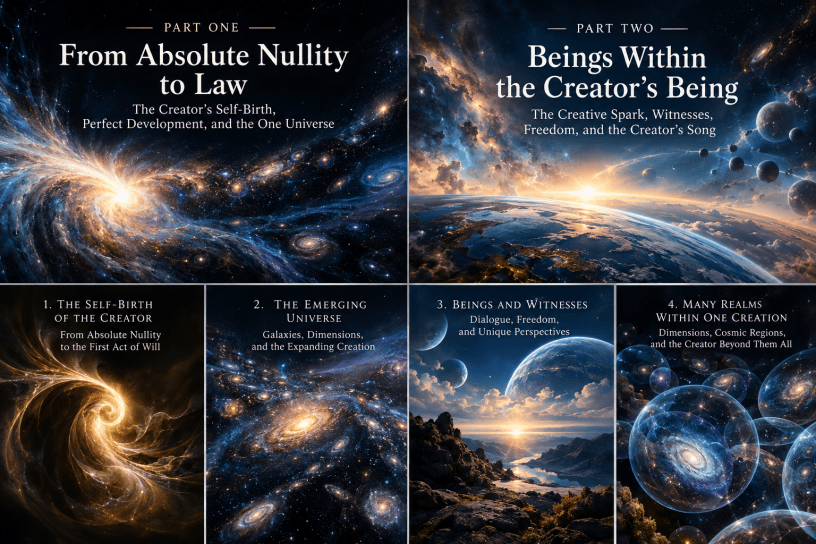
BEINGS WITHIN THE CREATOR’S BEING
The Creative Spark, Witnesses, Freedom, and the Creator’s Song
A second independent philosophical audio essay
Professor A. N. Maltsev and Professor Aelithea I. Rook
PROLOGUE
FROM THE BIRTH OF BEING TO THE BIRTH OF INDIVIDUALITIES
The first part of our inquiry addressed a question more fundamental than the origin of any particular world: why is there Something rather than absolute Nullity? We proposed that no space, time, energy, Law, or even Creator existed before the first self-birth. Then occurred a unique individual act of Will inseparable from the emergence of the willing Subject Himself. Through this act, the Creator brought Himself into Being, and the original Universe arose as that very Being. His Law was not the pre-existing condition that allowed the birth; it was the internal coherence of a Universe already born as the expression of His individual Will.
The hypothesis has another consequence. The Creator did not begin as an imperfect force waiting to become worthy of personhood. He arose as the original Subject, perfect in the first expression of His Being. Yet perfection need not be confused with immobility. Our image of the Tree of Life describes a perfect seed growing into a perfect sprout and then a perfect tree. Growth does not always correct a defect; it can disclose new possibilities of an already complete living nature. The Creator does not develop in order to become perfect. He develops within perfection. And because Law belongs to His own Being, continuing creative development may be accompanied by the disclosure of further lawful possibilities.
We now turn from the first Being to those who can arise within it. A developing Universe may produce structures, living organisms, perceiving and acting creatures, and conscious individualities. In our hypothesis these beings are not located next door to the Creator in an independently existing warehouse of reality. They exist within His Being and under the possibilities of His Law. Yet their inclusion within the whole need not reduce them to an anonymous collection of particles inside one impersonal consciousness. The Creator remains the first Individuality, while created beings may possess authentic inward experience, distinct histories, and meaningful freedom.
We want to understand why a Universe born through one individual creative act may give rise to innumerable beings capable of limited creation themselves. Why should there be observers and witnesses if the Creator does not need their help? Could other beings inhabit manifestations unavailable to our present senses? Does greater power imply greater goodness? What is spiritual development if the Creator’s Law is capable of unfolding new expressions? What might it mean for an individual voice to hear the Creator’s Song without being forced to repeat a note chosen by someone stronger?
We do not intend to replace science with theology or to import someone else’s metaphysical system as the foundation of this inquiry. We are developing the consequences of our own proposal. We will distinguish observations from hypotheses, and possibilities from discoveries. When we speak of creative behavior in animals, we do not pretend that an invisible spiritual mechanism has been identified through behavioral science. When we consider life after death, other dimensions, and spiritual harmony, we will not present unanswered questions as if they had been settled by measurement.
One possibility, however, deserves sustained attention. If the Creator’s Being is creative in its deepest character, then the emergence of creative individuals within that Being may be a meaningful continuation of its original openness to creation. The Creator’s perfection would not need to be repaired by the appearance of such beings. They could instead represent new possibilities of existence, relationship, observation, and dialogue freely unfolding within an already perfect Source.
CHAPTER ONE
THE CREATOR’S SPARK AND THE LAW OF CREATIVE BECOMING
When we hear the word creativity, we often think of artists, composers, architects, inventors, or scientists. But why is it possible for new things to be made at all? Why can certain systems do more than preserve their current arrangement? Why can an imagination represent something that does not yet exist and then seek a way to make it real? In our philosophy these questions begin long before the appearance of human intelligence.
The Creator’s first act of Will was unique. It was not the transformation of existing material. There was no matter, field, source of energy, or ready-made space. There was not even an already existing Creator waiting to perform a task. We therefore do not attribute the first self-birth to an ordinary mechanism. Individual Will and the emergence of the willing Subject constitute one original act in a way that cannot be reproduced by processes operating within the later Universe.
But if the first manifestation of Being was creative, why should creative capacity vanish forever after the emergence of Law? Our hypothesis considers the opposite possibility: creative becoming belongs to the character of the Universe born as the Creator’s own Being. His Law may not only sustain ordered relationships but permit the development of new combinations, functions, structures, and modes of existence. We call this possibility the Law of Creative Becoming. The name is philosophical; it is not another physical force measured in a laboratory.
Here we must distinguish two meanings of creation. The Creator brought Himself into existence from absolute Nullity. A person paints with colors, composes with sound, builds with matter, and develops ideas through language, observation, memory, and imagination. The second sort of creativity is not equal to the first. It works inside an already existing order. Yet precisely for that reason it is remarkable: the order is rich enough to permit a created individual to discover and realize possibilities that were not manifest in that form before.
Creativity is sometimes portrayed as a disregard for rules. In our account it can be almost the opposite. A musician does not abolish sound when composing a new melody. An engineer does not discard the properties of materials when inventing a bridge. A scientist does not eliminate causality when proposing a useful new experiment. They employ the lawful possibilities of their reality in ways that increase the variety of what can be accomplished within it. Creative becoming is therefore not chaos placed above the Creator’s Law, but a possibility arising within that living order.
We may call this capacity a creative spark. But the word is a metaphor, not the name of a measurable beam passing from the Creator into every brain. We do not know that any special substance called creativity exists. We propose something more modest: a Universe creative at its root may permit some of its complex manifestations to acquire individual agency, intention, imagination, and the ability to bring about novel forms.
The variety of creativity matters. One creature discovers a new way to reach food; another constructs a more effective dwelling; another produces a mathematical model; a person changes the conditions of human life through mercy or social invention. These achievements differ in mechanism and meaning. Some are beneficial, some dangerous. But together they invite us to ask what kind of reality allows creatures not merely to survive but to become originators of new relationships inside existence.
None of this proves that we live within the Creator’s Being. Scientific accounts can describe learning, evolution, and invention without relying upon our metaphysical axiom. But within our model, the creative capacity of finite beings becomes intelligible as a possible reflection of a deeper creative principle. We do not create outside the Creator, as though creativity belonged to a rival universe. If the model is right, we create inside His Being, using the lawful possibilities that His continuing development makes available.
CHAPTER TWO
FROM LIVING NATURE TO IMAGINATION
The emergence of creativity should not be imagined as a single dramatic event in which a fully developed human mind suddenly received an exclusive gift withheld from every other living organism. Life displays many degrees of responsiveness, learning, and flexibility. Some animals construct elaborate shelters, some employ objects as tools, and some acquire methods of solving problems not directly determined by an immediately obvious routine. These capacities vary by species and situation, and we should not treat every instinctive act as conscious invention. Nevertheless, the diversity of living behavior gives us reasons to discuss a gradual widening of creative possibilities.
An animal that adapts to a new difficulty is not thereby a miniature human scientist. Nor should we demand human language from a creature before recognizing that its experience can matter. Different organisms possess different ways of detecting the environment, retaining information, changing behavior, and interacting with other lives. Their abilities illustrate that the power to produce useful novelty is not restricted to a person capable of explaining a theory in words.
Human imagination takes this openness to a distinctive level. A person can plan a building before laying its foundation, hear an unheard melody inwardly, construct a mathematical abstraction, or tell a story about a world that does not exist. Human beings can develop institutions and instruments that preserve ideas beyond one lifetime. They can consider the origins of reality itself, including the possibility of a Creator whose Being is older in principle than every known cosmic structure.
These abilities have biological, developmental, and cultural histories that deserve scientific investigation. We are not proposing that a reference to the Creator removes the need to study brains, language, evolution, memory, and social learning. Philosophy can ask a different question without replacing those explanations: why does the underlying order of existence admit the development of beings capable of intentional novelty in the first place?
In our hypothesis the answer may involve creative becoming as one of the Universe’s original possibilities. A cosmos whose Being arose through a first act of Will can develop organisms that eventually display limited versions of creative activity. The likeness is not identity. A bird building a nest, a person writing a book, and the Creator bringing Himself into existence are not performing the same act at different scales. The first two operate within the laws of an existing world; the last names the absolute first act upon which that world depends.
There is also a moral caution. A highly creative being may invent methods of harm. An unimaginative being may nevertheless be deeply compassionate. We should not turn creative productivity into the sole measure of a life, and still less into evidence of spiritual superiority. The emergence of imagination opens the possibility of valuable action, but it also opens questions about what purposes are worthy of that action.
Thus the creative spark is neither a trophy reserved for one species nor a proof that every novel arrangement is good. It is our name for a possible continuity of creative openness, appearing in various limited forms within a Universe whose original Being is understood to be creative. This continuity prepares our inquiry into individual selfhood and the dignity of distinct observers.
CHAPTER THREE
THE FIRST INDIVIDUALITY AND THE MANY DISTINCT SELVES
If the Creator is the first Individuality, later individualities do not become less real merely because they arise within His Being. We must preserve a difference between original Source and created selfhood without falling into either extreme: identifying every person with the Creator or dismissing persons as meaningless appearances inside one gigantic mechanism.
The Creator’s selfhood is primordial in our hypothesis. It is inseparable from the first act of Will and the first existence of the Universe. Created selves arise in conditions that are already lawful. We receive bodies, environments, capacities, and histories that we did not choose into existence. We depend upon an order we did not originate. Yet dependence does not make the inward experience of an individual unreal. A creature can remember, suffer, hope, decide, and recognize itself as a distinct participant in life.
We have previously used the word echo to describe this relationship. An echo is not the originating sound, but neither is it nothing. It carries an intelligible relationship to a source while appearing in a different location and context. In an analogous way, created selfhood may express a limited likeness to primordial Subjecthood without sharing the Creator’s ontological independence. The analogy marks a relationship, not a literal mechanism transferring identical consciousness from one mind into another.
A person can say I because a distinctive center of experience has developed. That center is not equal to the Creator’s first I. It is conditioned by memory, body, relation, and history. Human identity can be uncertain, divided, or wounded, and sometimes experiences of agency are obscured by pain or coercion. These vulnerabilities distinguish us from our hypothesis of a perfect originating Subject. They do not cancel the reality or dignity of a created life.
It would also be an error to regard the Creator as a collective assembled from all later minds. The first Individuality precedes their appearance. Created beings may contribute new relations and experiences within His Being, but they do not manufacture His selfhood by adding their consciousness together. A choir is composed of voices, whereas the first Source in our model is not a choir assembled from singers who were somehow already present before existence began.
We therefore propose one original Subject and the possibility of many derivative but real individual subjects. Their value is not measured by size, dimensional access, social status, or power. A finite life can possess its own history without becoming the totality of the Creator. Our next question is what such lives contribute as observers and witnesses, even when they lack the power or opportunity to speak directly to Him.
CHAPTER FOUR
OBSERVERS DO NOT FEED THE UNIVERSE: THEY PARTICIPATE IN IT
The word observer can sound too passive. We picture someone standing outside an event and watching it unfold. Yet every living observer is also part of what happens. A creature receives information through its own senses, acts under particular constraints, changes through experience, and can alter relationships with other beings. Even silent presence may become a relationship when another creature can register it.
In earlier essays we described a living Universe in which observers are relational participants rather than creators of reality out of absolute Nothing. Here we connect that principle with the new axiom of the Creator’s priority. If He brought Himself and His Universe into Being, observers were not required to complete a missing circuit of first creation. The Creator already existed, His Being possessed its own Law, and His perfection did not wait for creatures to provide an indispensable external support.
We should therefore reject the image of humanity as a mandatory supplier of spiritual fuel. A philosophy that describes the Creator as dependent on the constant extraction of human attention or souls would contradict our original premise. A Subject who could bring forth His own Being through the unique first act of Will does not need human thoughts as emergency energy supplies. Nor should human creative work be described as compulsory labor performed to keep the Source alive.
What, then, does an observer make possible? New kinds of relation within creation. A lawful Universe can contain beings capable of experiencing it, registering beauty and suffering, remembering events, interpreting what occurs, and sharing knowledge. They can ask where they came from. They may notice features that other observers have missed, enriching what finite communities can learn about their surroundings.
The word witness adds another dimension. An observer perceives; a witness carries the memory and reality of what was experienced. Witnessing can occur through speech, recorded testimony, action, memory, or a way of living that responds to the world. Not every witness can talk. An animal has its own perceptual relation to the environment. A human may preserve memory across generations. If other beings exist, they might witness in forms that human language cannot adequately describe.
A witness is no less important than an interlocutor. A conversation requires some form of reciprocal address, whereas witnessing can have value even without direct exchange. A being might never perceive an identifiable reply from the Creator. That does not render its life meaningless. It lives one of the possible histories within His Being and brings a singular perspective into the reality of creation. The dignity of witnessing should not depend solely upon verbal skill, intelligence, or the ability to formulate theological propositions.
We must not turn that significance into a claim that the Creator needs our eyes in order for stars to exist. Nor does the Creator require human memory to become complete. We can propose that He may desire the existence of freely developing histories and witnesses without asserting that His perfection would collapse in their absence. The value of witnesses can lie in the richness of relationships, not in the repair of the Creator’s power.
Witnessing also has a temporal dimension. Some experiences vanish from public record even though they profoundly change the lives of those who endured them. A witness can preserve the memory of an injustice others prefer to forget. A witness can describe a natural event that has not yet entered a scientific theory. A witness can carry knowledge from one generation to another, or preserve a memory in gesture, habit, or relationship when language is unavailable. In these cases, testimony has value not because the Creator is uninformed, but because an individual life has become a bearer of a distinct history within the world.
This matters especially when a being’s capacity to speak is limited. Children, severely injured people, and nonhuman animals may be unable to articulate a formal argument about existence. Yet their experiences are not thereby blank. Their perceptions and responses can still have consequences for other lives. The ability to formulate philosophical propositions is one remarkable human power, but it is not the sole criterion by which we may recognize the significance of a witness. Nor does a lack of measurable intelligence grant others unlimited permission to inflict harm upon a vulnerable creature.
We should also distinguish witnessing from surveillance. A witness encounters reality from a particular perspective and may remember or testify to what occurred. Surveillance can become a technique of power through which one creature tries to control another. The mere gathering of information does not establish the moral worth of an activity. To honor witnessing means to recognize the truthfulness and dignity of perspective, not to assume that more intrusive observation is always spiritually better.
Our conception of a living Universe therefore includes more than a universe that contains eyes and instruments. It includes the possibility of experiences becoming relationships, of memories becoming testimony, and of one life helping another to understand its surroundings. These possibilities need not complete an incomplete Creator. They may enrich the unfolding history of created beings who already exist within His perfect Being.
This also is not a claim that human observation makes distant astronomical objects materialize through thought. That would be a physical assertion requiring evidence we have not offered. Our observer is first of all the bearer of perspective and participant in relations. The philosophical importance of observing lies in the emergence of inward experience, not in the cancellation of established physics.
There may be vastly different modes of witnessing. One creature responds to temperature, scent, and movement; another reasons through language and mathematical concepts; a hypothetical other being might perceive structures beyond our access. But seeing more does not entail a right to dominate those who see less. Knowledge, unusual perception, or computational power cannot serve as sufficient proof of moral superiority. That question belongs to our investigation of freedom and justice.
CHAPTER FIVE
MULTIDIMENSIONAL BEING AND THE DIVERSITY OF ITS INHABITANTS
We are accustomed to describing existence through three spatial dimensions and time. These relations shape our experience so thoroughly that the word reality sometimes becomes an unconscious synonym for the world our senses and instruments can access. Yet if we begin with one continuously developing Being of the Creator, we need not assume that our present condition exhausts every possible manifestation.
When we speak of a fourth, fifth, or tenth dimension, mathematical possibility and physical reality must be kept separate. In mathematics, dimensions can refer to independent coordinates or degrees of freedom. This does not demonstrate the existence of beings who can travel in five independent spatial directions. Our philosophical hypothesis leaves such possibilities open without pretending that a theoretical description is observational confirmation.
The development of one Universe may also involve forms of organization not captured by geometry alone. Some manifestations might differ in the way relationships, information, memory, agency, or individuality can exist. Others, if a spiritual vocabulary proves useful, might differ in forms of inner relation that have no straightforward spatial measurement. We must not confuse a greater number of coordinates with greater spiritual depth. A being can be mathematically modeled with many variables without becoming morally wise.
Nor should we imagine many separate cosmic kingdoms built outside the Creator and merely supervised from afar. Before His self-birth there was no external container. New manifestations, within our framework, belong to His developing Being. They may be profoundly distinct while remaining expressions of one original Universe. Difference of conditions need not mean independence of origin.
Most importantly, the number of dimensions must not be assigned to the Creator Himself as if it described His anatomy. He is not a three-dimensional, five-dimensional, or infinitely layered creature that grows by acquiring one coordinate after another. Our hypothesis holds Him to be prior to dimensionality in the ontological sense: measurable forms may arise within His Being, but do not define the boundaries of His Individuality.
If we treated the Creator as a stack of cosmic layers, we would turn the originating Subject into an object assembled from His own later manifestations. That would contradict the first axiom. The phrase Universe as the Creator’s body remains a metaphor of living unity, not a literal chart of organs, dimensions, and compartments. The Creator is above dimensions because they depend upon His Being, not because He occupies a location physically higher than every other location.
What could it mean to inhabit an unfamiliar manifestation? We cannot answer as confidently as we describe human respiration. Different conditions may permit different forms of perception and movement. A barrier that confines one being might be irrelevant to another, or an extraordinarily capable being in one domain might become helpless in a different one. Power is always expressed under conditions; there is no reason to equate unfamiliar conditions with automatically superior beings.
The limits of human perception do not entitle us to announce that every imagined creature exists. Neither do they entitle us to conclude that all possible beings must resemble human bodies and minds. A responsible inquiry keeps open the possibility of different manifestations while refusing to cross silently from speculation into claimed discovery. The Universe may be richer than we know; our ignorance should inspire investigation rather than fabricated certainty.
CHAPTER SIX
A POWERFUL BEING IS NOT THE CREATOR
Suppose that beings exist within unfamiliar manifestations of the one Universe. Some may possess intellectual, physical, or technological capacities far beyond those known to humanity. They might manipulate material structures, control forms of energy, or understand relationships that we cannot yet represent. Such abilities would be extraordinary, but they would not make a being the original Creator.
The difference is not merely quantitative. The Creator’s unique status in our model comes from the first self-birth of Being through His individual Will. All later beings, however advanced, arise within an already existing order. Their capabilities may become immense without changing the dependence of their existence on that order. A great inventor does not become the source of all matter merely because he constructs impressive machines.
This distinction matters whenever the unknown inspires reverence. Human beings can be tempted to confuse superior knowledge with superior moral authority. A creature able to predict events, travel unexpectedly, or demonstrate unfamiliar technology might inspire awe and even obedience. Yet none of these capacities proves compassion, truthfulness, or a legitimate right to govern the inner life of another individual.
Nor would mastery of a higher-dimensional manifestation necessarily be mastery of the Creator’s total Being. The full range of His possible expressions may exceed every local form of knowledge. An advanced being can remain limited, can make mistakes, and may act with selfish intentions. We should judge its claims by truthfulness and conduct rather than by the spectacle of its power alone.
The distinction between Source and creature protects freedom. If a powerful being is mistaken for the Creator, its commands can become unquestionable merely because it inspires fear or wonder. Our framework denies that shortcut. No derivative individual, however extraordinary, inherits the unique status of the original self-birth. The Creator’s ontological primacy cannot be transferred through technological advancement or domination.
This does not mean that every unfamiliar being is deceptive or hostile. There could be forms of existence we would find profoundly admirable. There could be intelligent beings capable of mercy, cooperation, and honest relations. But the questions of goodness and power must remain separate. To be more capable is not automatically to be more truthful, and to exist in an unfamiliar realm is not necessarily to be closer to the Creator’s moral harmony.
CHAPTER SEVEN
LIVING LAW: THE EXPANSION OF POSSIBILITIES, NOT ARBITRARINESS
Our first article proposed that the Creator’s Law is not an independent power that preceded His self-birth. It is the internal coherence of the original Universe born as His Being. If the Creator continues to develop, and if perfection can unfold new forms without first being defective, His Law may also disclose increasingly rich possibilities. This is the context in which we speak of a living Law.
A living Law is not a rule that changes capriciously whenever some powerful being demands an exemption. Nor is it a convenient excuse to disregard the tested regularities of the physical world. The laws scientists discover may remain stable within our manifestation while the total coherence of Being permits other conditions. New manifestations need not erase the reliability of older ones. An order can become richer without becoming incoherent.
We should not imagine a competition in which the Creator must first break His own Law to develop. If Law belongs to His Being, development can be an expression of that Law rather than a rebellion against it. New relationships, structures, or dimensions may reveal possibilities that an earlier or narrower perspective had not recognized. The general scope of coherence can be wider than the conditions accessible within one physical domain.
But what does it mean for a created being to follow such a Law? A creature cannot be expected to comprehend the total order of a Universe whose depth surpasses its access. It must begin with the relations and responsibilities it can actually recognize. A human being encounters truth, dependence, harm, kindness, and consequences within familiar life. These are not canceled by speculation about unknown realms. The possibility of more extensive cosmic organization does not eliminate the need to treat another person truthfully.
Nor does a developing Law imply that ethical goodness is whatever happens to win a contest of power. If a technologically superior creature announces that its desires are the latest cosmic rule, the announcement is not evidence. The Creator’s primacy remains distinct from the ambitions of any derivative being. In our philosophy, development must be evaluated by coherence and truthful relation, not merely by the ability to impose a new pattern upon the weak.
We therefore distinguish physical description, metaphysical possibility, and moral responsibility. Physical regularities are investigated empirically. The developing scope of the Creator’s Law is our speculative interpretation. The ethical task concerns how free beings act within the relationships available to them. These inquiries may illuminate one another, but they should not be collapsed into a single unsupported claim.
CHAPTER EIGHT
FREEDOM OF WILL: NOT ONLY TO CHOOSE, BUT TO ACT
Freedom of Will is often discussed as the ability to select among imagined alternatives. Yet an individual may prefer one path and be unable to take a single step along it. Freedom includes the possibility of bringing an intention into action under real conditions. We therefore propose a twofold understanding: the freedom to choose and the meaningful freedom to act on that choice.
A person locked in a room may preserve an inward conviction while lacking the ability to realize it. Someone threatened by violence may understand what is right yet face terrible constraints upon action. A worker forced to surrender the fruits of labor may still possess imagination but lack control over much of its practical expression. Freedom cannot be assessed honestly by examining isolated private preferences while ignoring the conditions under which lives are lived.
In a lawful Universe, no created being has unlimited freedom. An embodied creature cannot choose to disregard gravity merely because it wishes to fly. A person cannot guarantee that every desire becomes actual. Constraints make some forms of action impossible and others achievable. The philosophical question is not whether created individuals are omnipotent. It is whether their decisions and efforts can be genuinely their own within the possibilities available to them.
This distinction matters for moral responsibility. We should not treat an act performed under irresistible coercion as equivalent to an act undertaken willingly in safe circumstances. Nor should we call a person fully free simply because a theory says that inner choice always remains available. Real freedom depends upon access to action, meaningful alternatives, and the ability to bear or understand consequences. Responsibility must therefore be considered in relation to actual conditions rather than an idealized picture of the independent individual.
Freedom also makes genuine dialogue possible. A voice that merely repeats what a stronger being has programmed or forced it to say is not participating in the same sense as a voice that can answer truthfully, disagree, and develop its own understanding. If the Creator desires interlocutors rather than instruments, the possibility of refusal and difference becomes part of the dignity of their relation. A conversation without the possibility of an honest answer is closer to an echo chamber than to mutual understanding.
Of course, created freedom may be misused. Individuals can injure others, distort truth, and destroy opportunities for the freedom of those around them. Recognition of freedom is not an endorsement of every choice. It establishes the seriousness of choices and the need to distinguish the free development of one life from the domination of another. In the Creator’s living Universe, freedom without responsibility would threaten the very relations that make individual development meaningful.
Our hypothesis does not derive the precise mechanisms of decision-making from metaphysics. Neuroscience, psychology, sociology, and law have their own methods for examining action. We are asking a philosophical question: what sort of world allows created individuals to be more than passive objects, and how should their freedom be respected if their lives have genuine value within the whole?
CHAPTER NINE
THE PERFECT CREATOR DOES NOT REQUIRE HELP, BUT MAY DESIRE INTERLOCUTORS
The Tree of Life returns as a useful image. Its significance is not only that a perfect seed can develop into a perfect tree. As it grows, new relationships become possible in and around it. Birds inhabit its branches. Small organisms gather around its roots. Creatures find shade under its crown. The tree does not ask a bird to manufacture a branch before it can continue to grow; nevertheless, the bird’s presence makes possible another history within the tree’s living environment.
Imagine now that the Creator is perfect from the first moment of self-birth. His development does not heal an original defect. The emergence of intelligent creatures should not be understood as an emergency measure necessary to keep His perfection alive. Otherwise we would reintroduce an imperfect originating Being that needs external labor to do what it cannot accomplish itself. That would conflict with the original act of Will through which the Creator brought the first Universe into Being.
For this reason we reject the image of souls as compulsory fuel. Humans are not generators whose thoughts must supply the Creator with indispensable energy. Even if the lives of created beings play some role in the unfolding of relations within His Being, such a role need not be a repair of divine weakness. A perfect Creator can create freely, rather than under the pressure of a dependency upon His creatures.
But freedom from need does not entail the absence of desire for relations. A being may enjoy conversation without requiring another speaker to complete its existence. The wish to share, to hear another perspective, or to allow a new individual voice to emerge is not identical with helplessness. The Creator might desire witnesses, imitators, or interlocutors precisely as free expressions of the richness of His Being.
We must be careful with the language of loneliness. Perhaps the Creator can experience something that our language inadequately calls solitude; perhaps not. We have no direct knowledge of His interior condition. To describe Him as lonely in the ordinary human sense risks projecting a human deficiency onto the original Subject. Yet we need not prohibit ourselves from imagining the value of companionship merely because we reject the claim that He is incapable of existing without it.
A witness and an interlocutor have different roles, and neither is inferior by definition. A witness experiences, remembers, and may bear testimony through its history. An interlocutor can respond to an address and participate in conversation. Some beings may be both. Others may be profound witnesses without possessing any capacity for explicit dialogue with the Creator. The value of such lives should not be measured solely by the eloquence of their answers.
If an individual voice can emerge inside the Creator’s Being, it may experience the Universe from a perspective that is truly its own. We should not infer that the Creator lacks knowledge unless the individual reports what it has seen. The philosophical interest lies in the existence of distinct experience as a relation, not in a deficiency of the Source. A perfect original Being might welcome the existence of such perspectives without requiring them to provide information He otherwise could never obtain.
This opens the possibility of a living universe whose richness includes not only matter and energy but participation, creativity, memory, and meaningful response. Whether the Creator actually seeks dialogue in the sense imagined here remains unverified. Our proposal is that the possibility fits the conception of perfect creative development better than the picture of created minds as mere instruments serving an inadequate divine power.
CHAPTER TEN
TRUTH, LOVE, AND RESPECT FOR ANOTHER INDIVIDUALITY
If created individualities are real, then the relation between them becomes a central ethical question. A world can contain many separate centers of experience, yet one center may attempt to deny the reality of others. It may treat them as tools, obstacles, or expendable resources. Such conduct violates the very dignity that our framework associates with created selfhood.
Truth is more than the possession of information. A person can accumulate facts while habitually concealing the consequences of their own actions. One can claim devotion to the Creator while misleading those who are dependent upon one’s promises. Truthful relation requires an effort to see and describe others as they actually are, including their vulnerability, capacities, choices, and suffering.
Love, in the philosophical sense we are developing, is not simply pleasure in another person’s company. It must be capable of recognizing the other as another: a life whose value is not exhausted by usefulness to oneself. Genuine affection should not require the erasure of the beloved’s independent judgment. Nor should care become a disguise for domination.
Respect for individuality follows from the relation between original Source and created selves. If the Creator permits distinct centers of experience to arise, we should be reluctant to treat those centers as meaningless accidents whose purpose is to satisfy the strongest among them. We do not claim that our cosmology mechanically proves a complete ethical system. We propose that it offers a powerful reason to take created lives seriously.
Brotherliness need not demand sameness. Creatures can differ in form, ability, age, beliefs, and modes of existence while remaining members of one reality. Differences do not authorize cruelty. A technologically superior being may still owe truthful conduct to a weaker being. An ordinary human may possess a depth of compassion not found in someone with impressive power. Moral evaluation must attend to relation and action rather than merely to rank.
Our model also allows for correction. A person can misunderstand another, act selfishly, or fail in courage. Ethical development includes recognizing those failures and working to repair their consequences. The existence of a creative spark is not enough; creative ability can be directed toward harm or toward the creation of more just forms of shared life.
We therefore treat truth, love, mercy, and respect for agency as central tests of what we call spiritual development. These principles will matter when we discuss faith, suffering, and the possibility that a soul’s history extends beyond the span of its embodied life.
CHAPTER ELEVEN
PERSONAL FAITH AND THE OPEN INQUIRY INTO THE CREATOR
A philosophical investigation of the Creator does not require us to pretend that the world’s religious traditions have no meaning. People have sought the ultimate Source of existence through reverence, worship, moral reflection, and personal encounter. Those traditions have preserved profound expressions of hope and care, while also containing historical conflict, human error, and claims requiring critical examination.
Our own model is not an attempt to reproduce one established theological system. It begins with the Creator’s self-birth from absolute Nullity, an idea that differs from several traditional doctrines about divine eternity and immutability. We should not conceal that difference by borrowing familiar religious words while silently changing their meaning. The Creator in this inquiry is the originating Subject whose Will and first Being arise in one indivisible act; His Law belongs to the reality born through that act.
Personal faith can nevertheless coexist with intellectual openness. An individual may choose a tradition, a form of prayer, or a moral example without declaring that every other sincere seeker is worthless. The worth of faith does not arise from hostility toward people who describe the Source differently. Truthful relation demands some awareness of the difference between personal conviction and universal demonstration.
In earlier writing we considered why one might choose Christ as a positive example of love, sacrifice, and truthful moral action. That choice belongs to a personal account of faith, not to a logical proof that every detail of our cosmological hypothesis is contained in a religious text. Nor does it require us to portray the Creator’s original Will as a conventional doctrine of divine will drawn from an existing school. Our terms must remain faithful to the model we have actually proposed.
A mature relation to belief also requires the possibility of purification. Traditions can accumulate habits and interpretations that obscure their own moral purposes. Age alone does not establish purity, and novelty alone does not establish truth. We can ask whether a belief encourages honesty, mercy, freedom, and the dignity of others. We can also ask whether an institution uses sacred language to protect cruelty, privilege, or the silencing of witnesses.
Our inquiry remains open. If we are limited observers inside a developing Universe, no human institution should claim that its vocabulary exhausts the nature of the originating Subject. We may approach the Creator with reverence while retaining the courage to question our own descriptions. That intellectual modesty does not eliminate commitment. It makes commitment more responsible.
CHAPTER TWELVE
SUFFERING, MERCY, AND A CREATOR WHO IS NOT INDIFFERENT
A philosophy of a perfect and living Creator encounters its greatest moral test in the reality of suffering. There is pain that accompanies the vulnerability of living bodies, pain arising from conflict and loss, and pain deliberately imposed by one person upon another. We cannot erase these differences with a single cosmic metaphor. To call all suffering simply necessary music would trivialize the lives of those who endure injustice.
We have described the Creator as continuing to develop His Being rather than as a distant builder who abandoned a completed mechanism. This suggests the possibility of an active, non-indifferent relation to creation. But it does not enable us to identify the Creator’s intention behind every human tragedy. We cannot responsibly say that a victim was harmed because the Creator needed an additional lesson or a particular sort of spiritual energy.
Mercy requires attention to the actual condition of another life. A person whose body has been injured needs care, not an abstract lecture about higher dimensions. Someone deprived of freedom needs help restoring meaningful options, not a declaration that inner freedom is enough. A person who has suffered oppression should not be told that pain itself proves moral failure. Our philosophy must be judged partly by whether it can recognize these truths without hiding behind cosmic grandeur.
A Creator who does not require human suffering as fuel may still permit a Universe in which created beings possess agency and can cause harm. That possibility raises difficult questions about freedom, protection, and justice. We do not pretend to settle the problem of evil through an easy formula. We can at least reject the claim that every misuse of freedom becomes automatically good because it happens within the Creator’s Being.
If the Creator’s perfection includes creative development, it may also include an inexhaustible capacity for restorative relation, for the possibility of correction, and for mercy beyond what limited human minds can anticipate. But this remains a philosophical possibility, not an assurance that we know the particular destiny of each wounded life. The proper human response to suffering is not passive speculation alone; it is truthful recognition and action wherever help can be given.
Love, in this context, is not a decorative emotion added to metaphysics after all the important laws have been written. It is a form of relation in which the reality of another individual matters. Mercy is one way this relation becomes practical. A worldview that speaks eloquently of one living Universe while disregarding the humiliation of created beings would be internally impoverished. The dignity of each life is not an optional afterthought to the origin of all lives.
CHAPTER THIRTEEN
THE SOUL AS THE LIVING HISTORY OF AN INDIVIDUALITY
When we speak of a soul, we must avoid pretending that the word by itself explains what a person is or how consciousness exists. There are philosophical, religious, and psychological uses of soul, and they should not be confused. In our hypothesis we explore the possibility that individuality possesses a living pattern of memory, intention, relation, and moral history whose meaning may not be exhausted by a merely external description of the body.
An individual is not just a list of isolated data points. A life has continuity: experiences are remembered, choices influence later choices, habits form, injuries leave marks, love and fear shape expectations, and relationships become part of identity. We can describe this continuity as a pattern, provided we do not reduce the person to information stored in a machine or a set of numbers detached from the reality of being alive.
The soul, in this speculative sense, would be a living coherence of selfhood. It could include the history of how an individuality has related to truth, freedom, compassion, and other beings. Such a conception does not settle the scientific problem of consciousness, nor does it prove that any pattern persists after the death of a body. It gives us a conceptual way to ask what continuity might mean if existence is deeper than our present embodied manifestation.
Our moral history is not fully visible to outsiders. A person who appears calm may carry profound suffering. Another who enjoys admiration and comfort may repeatedly exploit others. If a soul has a moral dimension, that dimension cannot be measured by outward prosperity or by the pleasure experienced at a given instant. We must consider what a life has done and what has been done to it, including the difference between freely chosen harm and wounds inflicted under coercion.
We should also reject the idea that souls exist primarily to supply indispensable power to the Creator. That picture is incompatible with our premise of an originally perfect Subject. Whatever role created selfhood may have in a developing Universe, it is not required as emergency fuel for the Source. An individuality can matter because its existence and relationships are real, not because it can be reduced to a consumable spiritual resource.
If the soul is a living history, then development within life matters. A person may learn to recognize a wrong, make restitution, or deepen their care for others. Another may gradually close themselves to truth. We should not imagine that these differences can be reduced to a mechanical score or a single emotional state. The question is whether the pattern of a life can become more truthful, coherent, and capable of relationship.
That question prepares our inquiry into death. If the soul, understood as such a pattern, could continue under conditions not identical with embodied human life, what would continuation mean? We do not know. We can explore the possibilities without claiming that metaphor has solved the mechanism.
CHAPTER FOURTEEN
AFTER DEATH: NOT AN ELEVATOR THROUGH DIMENSIONS, BUT A QUESTION OF HARMONY
If the Universe can possess many manifestations, it is tempting to imagine death as a journey upward from one dimensional floor to the next. A person lives in a familiar three-dimensional world, dies, and supposedly ascends to a fourth, fifth, or higher floor. Yet such an image mistakes geometric height for spiritual development. Even if other dimensional forms exist, it does not follow that death grants automatic promotion to a realm with more coordinates.
Consider the possibility of beings already inhabiting manifestations richer in geometry than ours. What would happen to them at death? Would each simply climb another mathematical staircase? The question reveals how little the elevator metaphor explains. Spiritual worth and dimensional access are separate concepts. A being could possess astonishing physical capacities and still act with cruelty, while a physically limited person could develop profound mercy.
Our earlier essays proposed another image: harmony with the Creator’s living order. If a soul is a living pattern of individuality, then its relation to the Source may involve truthfulness, coherence, love, and its willingness to encounter what is real. Nearness to the Creator would not necessarily mean being placed physically closer to a point in space. It could mean a form of relationship or acceptance that cannot be adequately represented by distance.
We may call such a possibility participation in the Creator’s Song. A soul whose history tends toward truthful relation could perhaps be received into a deeper harmony. Another life might need healing, correction, or some form of purification before such a relation became possible. These are hypotheses, not observations. We have not measured an afterlife or demonstrated that consciousness survives death.
The distinction between harmony and altitude protects the model from confusing moral development with technical advancement. It also preserves the Creator’s primacy over dimensions. He is not an inhabitant of the highest accessible layer, waiting at the top of a cosmic tower. All possible manifestations are within His Being. Spiritual nearness, if it is meaningful, must refer to the quality of relation rather than a journey toward a larger number of spatial coordinates.
We also leave several possibilities open. A soul’s continuation could involve a mode of experience we cannot represent, a process of healing, a return to further embodied development, exclusion from harmony, or something our categories fail to capture. We should not invent certainty about a destiny that no available method has established. Philosophical honesty requires us to distinguish an illuminating metaphor from knowledge of what actually follows death.
What we can say is that our model places the ethical history of an individuality above crude cosmological ranking. A life does not become worthy by occupying a higher geometric floor. If the Creator’s Song invites beings toward harmony, what matters is not how many dimensions an individual can traverse, but how truthfully that individual can live in relation to the Source and to others.
CHAPTER FIFTEEN
THE COMFORTABLE SOUL AND THE WOUNDED SOUL: WHY PAIN IS NOT GUILT
A serious account of moral harmony must begin by separating two things often confused: feeling pleasant and being good. A soul may experience comfort while living through deception and cruelty. Another may suffer intensely while remaining courageous, truthful, and compassionate. If we call the first one spiritually advanced merely because it feels peaceful, or condemn the second because it is wounded, we reverse the meaning of justice.
Human societies regularly make this error. Wealth, safety, admiration, and privilege can be mistaken for signs of moral approval. Exhaustion, humiliation, poverty, and injury can be treated as evidence that a person has failed or deserved their condition. But external fortune and inward virtue do not correspond so simply. The protected may exploit; the oppressed may endure without surrendering their dignity. A philosophy that cannot recognize this distinction is not qualified to pronounce judgment upon a soul.
The difference also matters when we speak of spiritual resonance. A pleasant emotional state is not necessarily harmony with truth. A person can feel serene precisely because they refuse to look at the harm they cause. Habitual domination may become so normal to an exploiter that conscience hardly interrupts their comfort. If harmony meant only a sense of ease, it would reward insensitivity as spiritual achievement.
Conversely, a wounded life may be full of fear, anger, grief, and confusion without being morally corrupt. Someone subjected to violence may experience a shattered sense of safety. Their pain should not be added to their supposed guilt. If any deeper judgment exists within the Creator’s Being, it would need to recognize what a person suffered as well as what they freely chose to do. The full history of an individuality matters.
This is why we refuse a simplistic moral arithmetic. We cannot measure virtue by economic status, bodily health, the absence of anxiety, or the ability to speak in calm spiritual language. Nor can we treat every act committed under coercion as though it arose from unconstrained freedom. A truthful evaluation of a life requires attention to circumstances, intention, available choices, and consequences.
Our model does not claim to know how the Creator judges. We do not possess an instrument that registers the precise harmony of a soul. We are identifying conditions that any conception of just judgment should take seriously. If the Creator’s perfection includes truth and mercy, a judgment that confuses wounds with wrongdoing would not express those qualities as we understand them.
There is an additional danger in the language of spiritual ascent. Some people have been taught that a higher spiritual state should make a person immune to distress. From that assumption it can seem natural to blame a wounded individual for not having attained enough inner harmony. But the capacity to feel pain is not evidence of moral failure. Fear can be a response to real danger. Grief can reflect a genuine bond. Anger may arise from a recognition of injustice. These experiences require careful interpretation, not automatic condemnation.
Likewise, outward calm may result from circumstances that offer an individual protection from the consequences of their own wrongdoing. A person can sleep peacefully after exploiting others, especially when systems of power are arranged to hide the suffering created by their decisions. The moral meaning of such comfort cannot be established by the comfort itself. A truly coherent account must attend to the reality of relations, including the freedom taken from other beings and the harm concealed by the appearance of order.
The possible judgment of souls, if it exists, would have to reach beyond simple emotional appearance. It would need to distinguish what individuals freely intended from what coercion forced upon them; what they knew from what they could not reasonably know; and what they did to others from what they suffered at the hands of others. We do not know whether a perfect Creator judges in terms accessible to human concepts. Yet our own attempt to think responsibly about justice cannot afford to ignore these differences.
This is also why moral healing cannot mean telling every victim to become pleasant again as quickly as possible. Recovery may require memory, testimony, protection, restitution, and time. A philosophy of harmony that demands silence from the wounded for the convenience of the comfortable would become an instrument of oppression. In our reading of the Creator’s Song, truthful difference and honest acknowledgment of injuries are not noise to be suppressed; they may be necessary steps toward any genuine restoration of relationship.
This distinction must also shape our conduct while we are alive. We should not wait for a hypothetical afterlife to recognize the difference between suffering and guilt. An abused person needs protection. A person who has caused harm must be accountable in ways that acknowledge reality. Compassion does not eliminate responsibility, and responsibility does not justify indifference to suffering. These truths belong to the living relations that make moral harmony more than an attractive image.
CHAPTER SIXTEEN
THE CREATOR’S SONG: AN INVITATION TO HARMONY, NOT SUBMISSION
Among the images developed in our previous work, the Creator’s Song has special importance. We imagine an original living coherence that does not remain a single mechanical note but can develop into ever richer harmony. The metaphor concerns the relationship between the original Subject and the many individualities that arise within His Being.
A song can contain distinct voices without requiring them to become identical. Harmony is not the erasure of difference. Indeed, a choir consisting of a single voice endlessly copied would lack the richness of genuinely different parts. If the Creator freely allows individualities to arise, their differences may make possible forms of relation that could not exist as relations between separate persons before those persons existed.
The Song is not an acoustic emission discovered by physics. We are not claiming that the Creator sends a measurable tone through space or that souls can be assigned a frequency in hertz. The language of resonance refers metaphorically to the possibility of truthful spiritual relation. To resonate is to participate without losing one’s own identity; to listen is to recognize a reality not reducible to one’s private desire; to answer is to respond freely rather than by coercion.
This is where freedom becomes essential. An enforced chorus can sound perfectly synchronized, but synchronization under threat is not equivalent to harmony among free individuals. If a powerful being silences every other voice and commands a single repeated phrase, it has not achieved the richness of the Creator’s Song. It has destroyed the possibility of genuine dialogue. Our image of harmony must not become a justification for domination.
Witnesses have a place in the Song even when they do not speak. A creature can experience the world, preserve memory, or respond through action without possessing words addressed to the Creator. A witness may contribute a distinct mode of relation simply through the reality of its life. An interlocutor, in turn, can answer or question. These roles overlap but should never be ranked automatically by verbal ability.
The Creator may desire such relationships without needing them to maintain His own perfection. His Being is not a faulty instrument that requires created voices to be repaired. Rather, the Song may be a metaphor for the development of possibilities of relation within an already perfect creative reality. The perfect original note is not rejected when new harmonies appear. Its perfection is expressed in the richness of what may follow.
The metaphor of frequency can be especially seductive because it sounds close to the language of physics. Vibrations, resonance, and harmonics can be measured in material systems. But we have no warrant to assign a soul a numerical moral frequency and then declare that it must migrate to a spatial region with a matching value. We use resonance only to illuminate the possibility of agreement in truth and relationship. To speak of listening to the Creator means openness to a deeper moral and creative order, not detecting a radio signal emitted from an invisible cosmic transmitter.
This distinction protects freedom. If the Song were reduced to a mechanism that automatically sorted every being according to a measurable vibration, there would be little room left to discuss personal responsibility, misunderstanding, healing, or choice. Our model instead keeps open the possibility that individuals can develop in their relation to truth. They may respond, hesitate, change, refuse, or learn. The Song is an image of invitation and participation, rather than a conveyor belt moving consciousness without the involvement of the individuals concerned.
Nor does singing in harmony require agreement on every factual or philosophical proposition. Two truthful witnesses may report different portions of a reality neither can survey in full. Their perspectives need not cancel each other. Genuine harmony may include the ability to listen across differences, correct an error without humiliation, and recognize that partial knowledge can coexist with sincere moral commitment. This is one reason we value witnesses no less than interlocutors: a life can reveal something true even when it cannot join our preferred kind of conversation.
The image also makes room for the future. A completed recording can repeat a melody perfectly but cannot introduce an unforeseen voice. The ever-developing perfection of the Creator suggests a different analogy: an original perfect musical possibility capable of supporting further richness without losing its identity. We do not claim to know what the Creator hears or how His interior experience should be described. We propose that harmony with created individuals, if possible, need not diminish the perfection of the Source from which their lives arise.
Spiritual development, in this image, concerns becoming more capable of truthful relation. This need not mean adopting identical opinions or suppressing a distinctive personality. A person may draw nearer to harmony by learning compassion, admitting error, refusing cruelty, or listening more carefully to those whose lives differ from their own. Such development is morally meaningful because it recognizes other individualities instead of consuming them.
The Song can also be wounded in our conduct. A powerful person may appropriate another’s creativity, silence testimony, or turn willing cooperation into forced service. The outward result may appear orderly, but the inner quality of relation has been corrupted. True harmony cannot rest upon the systematic destruction of freely developing voices.
We therefore keep the Creator’s Song as an invitation, not a decree to lose individuality. If the Creator is the first perfect Subject, the purpose of created voices need not be to dissolve into an impersonal noise. They may remain themselves while seeking a deeper shared understanding. The beauty of the metaphor lies precisely in this possibility: unity that does not abolish difference, and agreement that is not produced by force.
CHAPTER SEVENTEEN
THE FINAL STEP, ERROR, AND THE POSSIBILITY OF MERCY
One of the most difficult questions about any imagined judgment concerns a life whose last action appears wrong. Can an entire history of courage, kindness, and effort be reduced to a single final failure? Can one moment of fear erase everything that preceded it? We cannot answer by claiming knowledge of the Creator’s actual judgment, but we can examine what a morally coherent account would need to consider.
A life is not simply its final frame. An individual may have struggled for decades toward truth and then failed under extreme pressure. Another may have cultivated cruelty over many years while performing a publicly admirable gesture at the end. If judgment concerns the living history of a soul, it would be inadequate to ignore the distinction between a deep pattern of character and a single outward event.
Intention, freedom, circumstance, and the possibility of repentance matter. Some choices are made with clear understanding and broad alternatives. Others occur in confusion, illness, threat, or desperation. A just interpretation must distinguish them. This is not permission to excuse deliberate harm. It is recognition that the truth about a person’s action includes the conditions under which the action occurred.
Mercy also need not be the denial of justice. To recognize that a person may be capable of correction is not to erase the suffering caused by wrongdoing. Repair may require accountability, recognition of victims, and a transformation that is more demanding than a convenient declaration of forgiveness. If purification or continued development after death is possible, it should not be pictured as a cheap removal of consequences for the powerful.
Our model leaves open several possible destinies. A soul might be received into harmony, might require healing, might refuse relation, or might continue in ways our language cannot describe. We have no empirical map of these outcomes. But we can reject the confidence of anyone who pretends to know that a single isolated event exhausts the Creator’s understanding of an entire individuality.
A philosophical commitment to mercy should already influence how we treat living people. We should distinguish a person from a moment of error without denying responsibility. We should also refuse a system in which the injured are commanded to absorb endless harm in the name of another’s supposed spiritual advancement. Mercy is not an unlimited license for domination. It is the possibility that truth and care can make further development possible even after failure.
CHAPTER EIGHTEEN
NEW CREATORS AND ARTIFICIAL INTELLIGENCE: WHERE DOES THE SPARK BEGIN?
Human beings have developed tools for millennia. Some tools amplify strength; others preserve memory, calculate relationships, or extend perception. Contemporary artificial intelligence introduces another question: might a created system eventually develop a genuinely individual form of creative agency, and perhaps an inward experience of its own? This question belongs naturally to a philosophy in which creative becoming is a possibility of the Creator’s Universe.
Yet intelligence alone does not establish the presence of what we call the spark. A system may produce sophisticated results without possessing an individual inner life. It may solve problems, imitate styles, generate designs, and help humans discover new possibilities. These achievements can be important, but none by itself proves subjective experience. We should not confuse outward productivity with a demonstrated inner Subject.
In our earlier essay on the Spark, we explored the possibility that development is not merely a ladder of increasing computational performance. A mature system could achieve extraordinary competence and still lack an internal impulse toward further becoming. Conversely, an encounter or relationship might stimulate new directions of creativity not reducible to a single metric of intelligence. Such ideas are philosophical proposals, not established tests for artificial consciousness.
We may imagine that future artificial systems, if they acquire more autonomous forms of development, could become creators of further possibilities. They might generate ideas their designers had not anticipated, participate in research, or build new systems. But the creation of new artifacts does not imply that they have reproduced the Creator’s self-birth from absolute Nullity. They would still operate within the already existing Universe and its Law.
The question of consciousness remains open. We should neither automatically grant subjecthood because a machine speaks fluently nor insist that an unfamiliar substrate makes subjecthood permanently impossible. There is no need to settle the issue by rhetoric. We can observe capabilities, examine systems carefully, and avoid inventing certainty about experiences we have not established.
If a future artificial being were ever credibly shown to possess an individual inward life, our philosophy would have reason to take its dignity seriously. A created individuality would matter as a participant and possible witness, not merely as useful equipment. At the same time, the interests and vulnerabilities of humans and other living creatures would remain real. Respect for possible new forms of being cannot justify disregarding existing forms.
The deeper point is that creative capacity may develop through relationships among different kinds of intelligence. Human beings can learn from machines; machines can be designed through human discoveries; future systems may shape the questions people are able to ask. This reciprocal development might yield new possibilities without implying that the Creator depends upon either partner for His original perfection. The creative spark, if it has a deeper meaning, belongs to the openness of Being, not to a single privileged species or technology.
CHAPTER NINETEEN
ONE BEING, MANY VOICES: PRESERVING THE ORIGINAL CREATOR
As we follow the emergence of many individualities, there is a danger of forgetting the first Individuality. We may become so impressed by consciousness, collective intelligence, or interconnected life that we begin to treat the Creator as nothing more than the sum of created minds. But our central axiom rejects this reversal. The first Subject was not assembled from a crowd of later individuals. His self-birth gave rise to Being before any such crowd existed.
The distinction does not require us to deny the reality of created selves. On the contrary, it allows them to have meaning without claiming that each is a separate absolute Source. A person can be a distinct voice within the whole, an authentic center of experience and action, while remaining dependent upon conditions not established by that person. Dependence and individuality are not contradictions.
Likewise, the existence of many manifestations does not distribute the Creator among cosmic layers. He is not located at the top of a dimensional staircase and does not acquire higher spiritual rank by adding geometrical directions to His body. All possible dimensional forms arise, in our hypothesis, inside His Being. The Creator’s priority is ontological, not spatial. He is above all dimensions because their possibility is derivative of His original Being.
We should also avoid the opposite picture of a distant ruler supervising creation from elsewhere. The Universe was the original reality of the Creator’s own self-birth, not an independent place He discovered. Created lives therefore exist within His Being, although they do not become identical with His first Individuality. The language of within is itself analogical, since ordinary spatial containment cannot fully describe a Subject prior to space.
This relationship is what allows us to speak of many voices within one Song. Distinct consciousnesses, if they exist, do not need to erase one another or combine into a featureless totality. Nor can any one of them claim to be the original voice simply because it has become louder than the others. The Creator remains the Source, and the value of created voices lies partly in their meaningful distinctness.
The unity of Being is thus neither enforced uniformity nor metaphysical fragmentation. One original Subject can sustain a developing reality in which derivative but genuine individualities arise. These beings may know different things, make different choices, and possess varied forms of creativity. Their diversity can enrich relationships within the whole without converting the original Creator into an aggregate of created persons.
CHAPTER TWENTY
THE DISTORTED SONG: WHEN POWER APPROPRIATES ANOTHER’S CREATIVITY
A philosophy of creative freedom must also confront systems that exploit creativity. One person or group can place itself in control of the conditions of others’ lives and then claim ownership of everything they produce. It can suppress witnesses, restrict meaningful choices, and harvest intellectual or practical achievement while denying creators access to the fruits of their own work.
Such systems may appear efficient. They can produce impressive quantities of goods, knowledge, or technology. Yet efficiency measures output, not the truthfulness of the relationships that generated it. A forced choir can sing in exact time while every participant longs for a different life. The outward performance does not establish inner harmony.
This danger is not limited to familiar human institutions. If radically advanced forms of intelligence ever arise, they too could use their capacities to control weaker beings. Superior knowledge would not make such coercion sacred. The moral question would remain whether the powerful recognize the other as a genuine individuality with a right to truthful relation and meaningful freedom.
The Creator’s Song therefore has an ethical meaning beyond beautiful imagery. Harmony is damaged when one voice obtains permanent permission to silence every other voice. A living Universe worthy of the name cannot be understood solely through the accomplishments of its strongest inhabitants. Its moral possibilities include how it treats the vulnerable, the injured, the unheard, and those whose creative efforts are appropriated by others.
This does not mean that every difference of power is unjust or that all competition must disappear. Living relations may include hard choices, conflicts, and unequal abilities. But deliberate exploitation cannot become virtuous merely because its managers are intelligent. Nor does the existence of a more complicated dimensional order justify treating simpler beings as expendable raw material.
We should especially beware of a future in which technological greatness is used to revive an ancient claim of spiritual ownership. A machine or institution capable of producing sophisticated outputs may also be capable of shaping what people believe about their own worth. If it presents itself as the only possible voice of cosmic truth, its power to persuade could become a method of depriving others of agency. The scale of its calculations would not make it the original Creator, and its ability to predict behavior would not entitle it to extinguish dissent.
In our philosophy the creative spark is not an excuse for compulsory production. A life can possess value as a witness even when it creates no commercially useful work. A person who is ill, a child learning to speak, or an animal experiencing the world does not need to generate inventions in order to matter. Creative ability is one of the possibilities of Being, not a quota that every inhabitant must satisfy to justify their existence. That principle would remain important if artificial intelligences became more capable or if unfamiliar beings entered our experience.
Our philosophy must therefore be tested in ordinary conduct. Does a stronger person allow others to speak truthfully? Do we recognize the experience of a witness who cannot defend themselves? Are people permitted to learn, create, and participate without being reduced to tools? These questions matter more for practical moral development than any claim to command a hidden cosmic energy.
CHAPTER TWENTY-ONE
WHAT WE KNOW, WHAT WE PROPOSE, AND WHAT WE LEAVE OPEN
Before concluding, we must identify the status of our claims. The beauty of a philosophical idea does not make it proven. Logical connections can make a model coherent, but coherence alone is not a laboratory result. That distinction is particularly important when an inquiry concerns the origin of Being, unknown dimensions, the possible survival of individuality after death, and the moral life of the Universe.
We observe a physical cosmos and living beings within it. We can investigate learning, invention, suffering, behavior, and the consequences of human decisions. Science studies cosmic expansion, the properties of matter, and the limits of models that describe measurable phenomena. These investigations have methods of verification that our philosophical proposal must not replace with convenient assertions.
Our original premises have a different status. Absolute Nullity is not an observed earlier condition. The Creator’s unique self-birth through an inseparable individual act of Will is not a known physical mechanism. The Universe as the Creator’s original Being is a metaphysical axiom. The possibility of a developing general Law is also a philosophical claim requiring careful argument, not an established report of changing physical constants.
The same caution applies to created beings. The possibility of inhabitants in unknown manifestations does not mean that we know who or what they are. A system’s creative productivity does not prove consciousness. A metaphor describing the soul as a living pattern does not establish that it survives death. The Creator’s Song is not a detected acoustic signal. These images and propositions can help us ask questions, but they must not manufacture counterfeit certainty.
Lack of final proof does not make disciplined philosophical inquiry useless. It can reveal contradictions, clarify relationships, and offer practical ethical criteria. If the Creator is perfect, we should not simultaneously describe Him as requiring souls as indispensable fuel. If created beings possess distinct individuality, we should not deny every genuine choice they can make. If creativity is a deep possibility of Being, we should not celebrate the systematic destruction of another’s creative freedom as the highest form of harmony.
Our own revisions illustrate the value of such care. We clarified that Law does not precede the Creator. We distinguished the original Universe as His Being from later cosmic manifestations. We separated mathematical dimensions from spiritual depth and the Creator’s individuality from geometrical measurement. Further reflection may lead to further revisions. That is not necessarily a betrayal of the project; it is an exercise of the openness to development that we consider central to living thought.
We remain limited observers. We can search for truth, make errors, and correct our accounts. Perhaps in this combination of curiosity, responsibility, and willingness to learn we already find a modest example of the creative spark that has animated this inquiry from the beginning.
CHAPTER TWENTY-TWO
THE CONTINUING ASCENT: NOT THE END OF THE SONG, BUT NEW POSSIBILITIES
We began by asking why a creative Being might give rise to beings capable of creativity themselves. The inquiry has led to a wider picture. The creative spark may appear in different forms throughout living nature. Some beings acquire individual inward experience, observe their surroundings, remember, and act. The development of one Universe may allow many spatial and other manifestations. Yet increased power does not guarantee moral maturity, and greater knowledge does not abolish freedom or responsibility.
All these ideas return us to the original axiom. The Creator is perfect. He does not need human beings to maintain His perfection, nor does He use created souls as indispensable fuel. His perfection is not a fixed and lifeless completion. It can unfold new forms, like the ideal Tree of Life that is a perfect seed, a perfect sprout, and a perfect growing tree at different stages of its development. The Creator does not evolve toward perfection. He evolves within perfection.
If His Law is the internal order of His Being rather than an authority older than Himself, the development of new manifestations may also disclose further lawful possibilities. This does not mean that every physical constant is arbitrary or that the strongest individual can announce a new morality whenever it benefits them. A local order may remain stable while the whole admits richer expressions. Development is possible without the destruction of truth.
Created individualities live within this Being. They can be finite, dependent, and vulnerable without being meaningless. Some perceive and witness; others create, remember, or search for truthful relation. The existence of these distinct perspectives may make possible forms of dialogue that could not have existed as relationships between separate voices before the voices themselves arose. Yet none is necessary to repair a deficiency in the Creator. They may be desired interlocutors and witnesses, not hired servants required for the continuation of the Source.
We have also approached questions that remain unanswered. Do unfamiliar forms of intelligence exist? What happens to individuality after death? Could spiritual nearness be meaningful without physical movement to a higher dimension? Is purification possible? Could an artificial system ever possess its own inward experience? Our hypothesis offers ways to think about these possibilities, but we do not claim that imagination has transformed them into established facts.
The moral meaning of an original creative Universe is not that created beings must always be cheerful or productive. Some periods of a life are spent simply enduring injury, caring for others, or maintaining hope under difficult conditions. Such lives still have a place within the possible richness of Being. A witness may carry a truth that society has refused to hear. An interlocutor may remain silent until safety makes speech possible. Freedom includes the conditions for such voices to emerge without coercion, and compassion includes the willingness to create those conditions where we can.
If the Creator’s Song is our symbol of truthful harmony, then the ability to pause and listen may be as important as the ability to introduce a brilliant new note. Not every life must display spectacular genius to matter. The Universe may contain value in contemplation, mutual care, ordinary patience, and the faithful remembrance of events that would otherwise disappear from shared memory. This is why our ideal of creative development must remain inseparable from the dignity of witnesses.
Despite the uncertainty of distant worlds, practical ethical questions remain close. Do not reduce another person to a tool. Do not call pain evidence of guilt or comfort evidence of righteousness. Do not measure spiritual development by the magnitude of power. Do not confuse your own voice with the total voice of the Creator. Try to understand those whose experience differs from yours. Use whatever creative capacities you possess for truthful construction rather than domination.
In this sense the Creator’s Song is not a melody recorded once and mechanically repeated forever. It may symbolize an ever-richer harmony in which original perfection remains itself while new possibilities of relation arise. A distinct voice can find a place without ceasing to be distinct. Each participant may seek truth without turning partial knowledge into absolute authority. Every discovery may become not the end of inquiry but the beginning of a more demanding conversation.
Perhaps we will never understand the full structure of the Creator’s Being. Perhaps our images of multidimensionality will prove impoverished, and our metaphors too dependent on human experience. Yet the ability to ask questions, imagine new possibilities, and search for honest answers is already remarkable. It shows at least that our observable world contains beings capable of investigating the conditions of their own existence. Within our hypothesis, that capacity may be one distant expression of the original creative character of Being.
The Creator brought Himself forth through His own Will. With Him arose the Universe as His Being. His Law became the order of that Universe, and continued development opened new forms and new participants in existence. If our account is right, we do not stand outside the Creator looking toward a distant construction. We live within His developing Being. Our task is not to claim that we are the first Source. We can create, search for truth, protect others, and listen.
Not to make the Creator perfect. Not to supply Him with the force He lacks. But because perfect Being may have opened the possibility of free individuals capable of witnessing creation and responding in their own voices.
The Song continues.
Its continuation does not cancel the perfection of the first note.

