By Alexander N. Maltsev
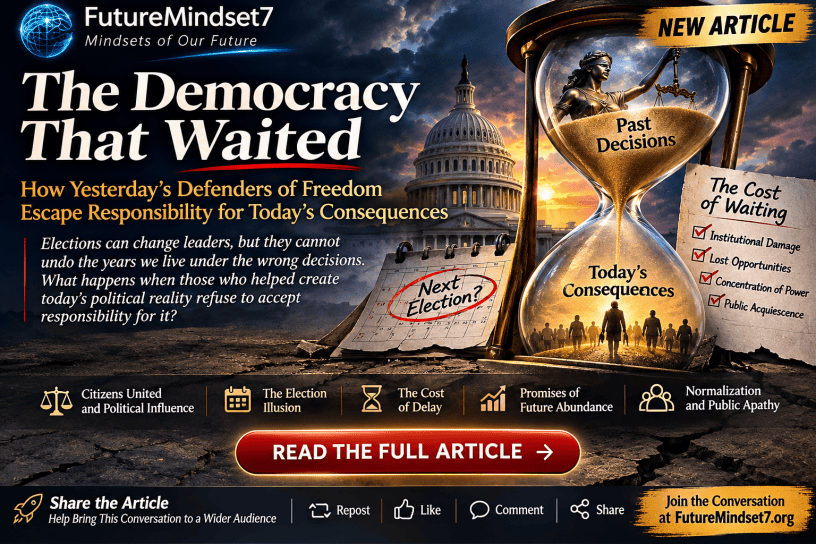
How yesterday’s defenders of freedom escape responsibility for today’s consequences.
The People Who Ask What Happened
There is a peculiar phenomenon in American political life. People who spent ten, twenty, or thirty years defending decisions that reshaped the country’s institutions now sometimes express astonishment at the consequences. Where did our freedoms go? How did wealthy individuals acquire so much influence? What happened to the democracy we thought we were protecting? These are legitimate questions. But another question must come first: what role did yesterday’s decisions play in creating today’s conditions? Political responsibility does not disappear because consequences take decades to become visible. Nor do sincere intentions eliminate the obligation to examine results.
Freedom for Whom?
Consider the Supreme Court’s 2010 decision in Citizens United v. Federal Election Commission. Its majority defended independent political expenditures by corporations and unions as protected political speech. The constitutional concern about government restricting political expression is serious. But constitutional principles operate within economic realities. A billionaire and a minimum-wage worker may possess the same formal right to express an opinion; they do not have comparable power to purchase advertising or finance political organizations. The later development of super PACs, supported by Citizens United and subsequent decisions, intensified this imbalance. The ruling did not authorize unlimited direct corporate contributions to candidates, nor did it alone create America’s campaign-finance system. Still, it helped shape the legal framework for independent spending. When the influence of concentrated wealth becomes troubling, those who defended that framework should be willing to examine its consequences.
The Election That Will Fix Everything
When citizens object to an abuse of public power, the familiar answer is: wait until the next election. Elections are indispensable. They allow the peaceful removal of leaders and changes in political direction. But elections cannot replace continuous constitutional safeguards, independent oversight, and the rule of law. An election cannot automatically restore lost opportunities, recover resources, or undo damage to public trust. Nor does victory prove that every action of the winning side was lawful. Winning an election is not an acquittal. Losing one is not a criminal conviction. Voters decide who should govern. Independent institutions determine whether particular conduct violated the law. A functioning democracy needs both.
Two Years Are Not Empty Time
Suppose a government weakens an important public safeguard, and citizens are told they can correct it in two years. During those two years, the decision operates. Institutions adapt, personnel change, contracts are awarded, economic interests reorganize, and families make choices under the new rules. Even a later change of government cannot simply return the country to the moment before the decision. Two years of consequences have already occurred. Democracy cannot recover lost time. A future opportunity to change course does not erase the cost of remaining on the present course.
When the Unacceptable Becomes Ordinary
There is another consequence of delay: people may become accustomed to conditions they initially considered unacceptable. Outrage fades as attention moves elsewhere. Institutions learn to function under the new arrangements. Some citizens become exhausted; others decide reversal is too disruptive. This is not inevitable—abuses can also inspire sustained resistance and reform—but normalization is a serious risk. By the next election, the original urgency may have diminished. The passage of time can transform an unresolved wrong into an accepted political reality. Postponement is not neutrality.
The Billionaire and the Promise of Tomorrow
Elon Musk has described a technological future in which artificial intelligence and robotics produce extraordinary abundance. Technology may indeed increase productivity and lower costs. But productive capacity is not the same as fair distribution. Who owns the machines? Who controls the infrastructure? Who receives the benefits? These are questions of governance and ownership. Musk’s involvement with efforts to reduce federal bureaucracy through the Department of Government Efficiency also raised concerns about oversight and conflicts of interest. Supporters saw an effort to cut waste; critics worried about private influence over public institutions. Those concerns require evidence-based scrutiny rather than assumptions about motives. The broader principle applies to any wealthy person exercising influence over agencies that regulate their businesses: a prosperous tomorrow cannot excuse unaccountable power today.
Two Promises, One Political Problem
Citizens are frequently offered two reasons to postpone their demands. The political promise is that the next election will correct today’s abuses. The economic promise is that the next technological breakthrough will solve today’s hardships. Both can contain real possibilities. But neither should excuse neglect of present responsibilities. An election two years away does not justify failing to investigate misconduct now. A technological revolution ten years away does not justify ignoring conflicts of interest now. The future cannot be a blank check against the present.
Responsibility Without Historical Amnesia
Examining past decisions does not mean forbidding people to change their minds. Reconsideration can demonstrate intellectual honesty. But meaningful reconsideration requires acknowledging the connection between past choices and present conditions. Not every consequence was foreseeable, and not every supporter bears equal responsibility. Responsibility depends on decisions, knowledge, authority, and influence. Yet those who exercised great power should not demand that society repair the consequences of decades of decisions while refusing to examine those decisions. The greater the authority exercised, the greater the obligation to account for its consequences.
A Mature Democracy Is Not Invulnerable
The United States has substantial institutional strengths: federalism, judicial review, competitive elections, civil society, independent journalism, and constitutional protections. But institutions do not preserve themselves simply because they have existed for generations. A country may retain its constitutional language while weakening the mechanisms that give it practical meaning. Elections may continue while oversight deteriorates; courts may operate while confidence in independence declines. Such outcomes are not inevitable, and historical comparisons must respect differences between countries. The danger is not necessarily that democracy disappears overnight. It is that citizens gradually become accustomed to a weaker version of it.
Democracy Is What Happens Between Elections
Democracy cannot rely exclusively on periodically replacing leaders. It also requires continuous accountability through courts, legislatures, a free press, transparent administration, enforceable law, and engaged citizens. People continue working, paying taxes, raising families, and living under decisions made in their name between election days. Their rights deserve protection throughout those years. When influential people express surprise at consequences they helped shape, the answer should be neither automatic condemnation nor automatic forgiveness, but an honest accounting: what was decided, what was known, what followed, and what can be repaired? The most dangerous political illusion is that democracy will automatically repair tomorrow what its institutions permit to deteriorate today. A society that waits long enough to correct every wrong may discover that it has learned to live with the wrong instead.
FutureMindset7 — Mindsets of Our Future

