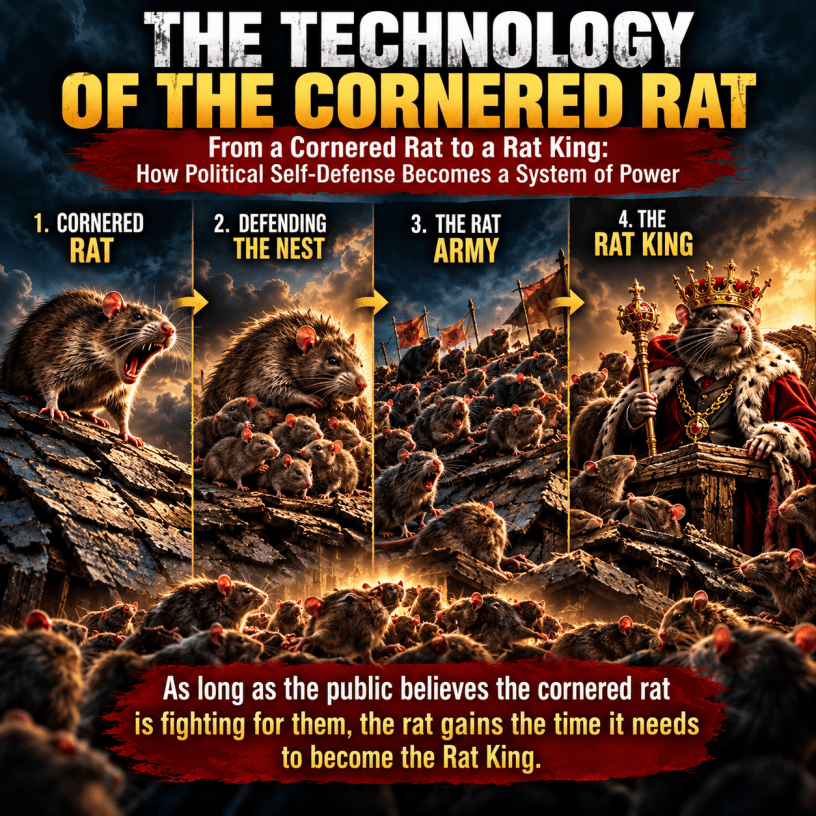
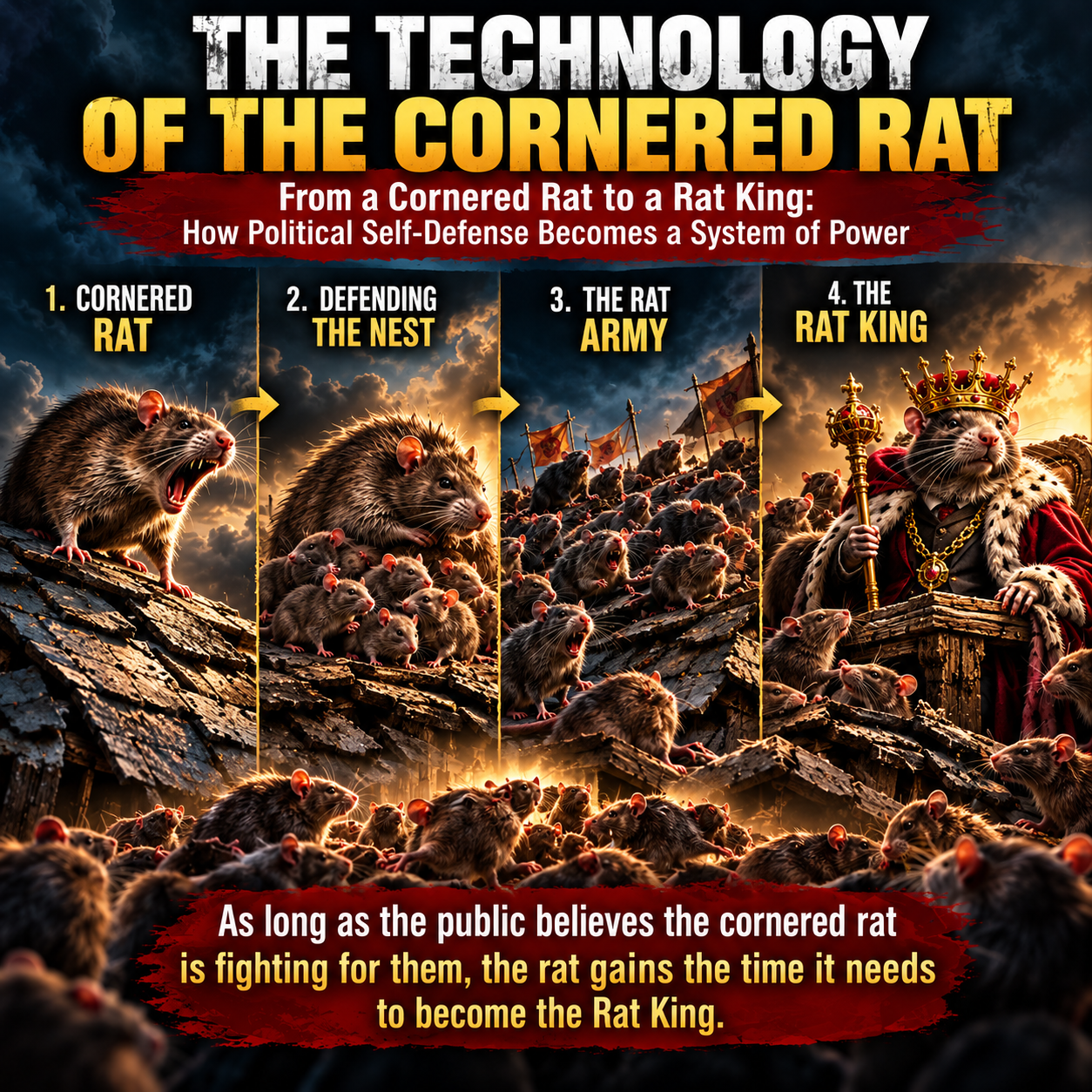
From a Cornered Rat to a Rat King: How Political Self-Defense Becomes a System of Power
The Cornered Rat
A rat cornered by danger behaves differently from a rat moving freely through its territory. It no longer searches for an easy escape. It bares its teeth, attacks approaching threats, and fights with an intensity that may seem disproportionate to its size.
But there is an even more powerful instinct: the protection of its offspring.
A cornered rat defending itself is dangerous. A cornered rat defending its nest may fight to the death.
This image offers a metaphor for a particular mechanism of political survival.
Imagine a politician whose position, fortune, family interests, and personal security have become inseparable from political power. Over many years, a network of privileges, business relationships, financial dependencies, and protected interests has developed around him.
Then a threat appears.
An investigation. A political defeat. The loss of immunity. A possible examination of family wealth. The prospect that yesterday’s protected activities may become tomorrow’s evidence.
The politician is no longer defending an office. He is defending an entire structure of personal and family security.
His response may become unusually aggressive because the stakes are no longer limited to his political career.
And this is where the technology begins.
1. Turning Personal Survival into Political Heroism
The first task of the cornered politician is to transform the public meaning of his struggle.
He cannot easily mobilize millions of citizens with the declaration:
I am fighting to protect my family’s fortune, my associates, and myself.
Instead, he offers another explanation:
They are attacking me because I am fighting for you.
The politician’s private enemies become the people’s supposed enemies. An investigation becomes persecution. A demand for accountability becomes an assault on freedom. The protection of personal interests is presented as a heroic defense of society.
The greater the pressure, the more dramatic the performance of resistance.
The politician attacks his accusers, challenges the institutions examining his conduct, and portrays every attempt to restrain him as evidence of a conspiracy.
For supporters who already distrust those institutions, his aggression can appear courageous.
A remarkable reversal takes place.
The politician’s vulnerability becomes his political strength.
He is admired not necessarily because he has demonstrated innocence, but because he refuses to surrender.
His struggle becomes a spectacle of defiance. His personal survival becomes a political cause.
2. The Discovery of a Technology
At first, this behavior may be instinctive.
The politician feels threatened and fights back.
But suppose the strategy works.
The attacks on investigators attract supporters. Public outrage produces donations. Political allies discover that defending the threatened leader also strengthens their own positions.
The cornered politician survives.
He learns something important: a threat can be transformed into a source of political energy.
What began as desperate self-defense can now be repeated deliberately.
Every investigation can be presented as persecution. Every criticism can be elevated into an existential confrontation. Every political opponent can be described as an enemy not merely of the leader, but of the entire community supporting him.
Eventually, the technology may be activated before any serious danger has materialized.
The politician attacks first.
The purpose is no longer simply to survive an immediate threat. It is to prevent accountability from approaching at all.
The corner is no longer merely a place of danger. It has become a political stage.
3. Protecting the Nest
Personal ambition alone does not explain the full power of this mechanism.
A politician may accept personal risks that he would never willingly impose upon his children, spouse, relatives, or closest associates.
Where family wealth and political authority have become intertwined, the loss of office may threaten an entire household’s financial security and privileged position.
The instinct to protect the nest intensifies the struggle.
Yet the political family need not consist only of blood relatives.
It can expand to include business partners, trusted officials, financiers, political operatives, and individuals whose fortunes depend upon the leader’s continued protection.
The nest becomes larger.
Its boundaries are no longer defined by kinship alone, but by shared interests and mutual vulnerability.
The leader protects the network because the network protects him.
At this point, personal self-defense begins to evolve into collective self-defense.
4. The Arrival of the Rat Army
The success of the cornered politician attracts others.
Some join because they share his political objectives. Others recognize opportunities for influence, lucrative contracts, preferential treatment, or access to state resources.
Still others may have reasons to fear independent investigations of their own activities.
The motivations differ, but the political calculation can become remarkably similar:
If this leader falls, our interests may fall with him.
The network begins to act collectively.
An investigation against one member produces attacks from many. A threat to a financier becomes a political emergency. An attempt to expose misconduct is portrayed as an attack on the movement itself.
The participants do not necessarily need to coordinate every response. Their shared dependence encourages them to anticipate one another’s needs.
They learn to defend the system by defending its members.
And as the network grows, its capacity for retaliation increases.
What began as one cornered rat has become a rat army.
The threat to one becomes the mobilization of all.
5. The Rat King
The next transformation occurs when the network acquires a central figure capable of distributing rewards, settling disputes, providing protection, and determining access to political power.
The cornered rat becomes the Rat King.
The Rat King does not need to control every transaction personally. He needs to remain indispensable to the system.
His political survival protects the privileges of others. Their financial and institutional support, in turn, protects his position.
The network becomes a hierarchy of mutual dependence.
The wealthy finance political advancement. Political officials provide access and favorable decisions. Loyal administrators defend the structure from within public institutions. New participants discover that joining the network may offer greater rewards than remaining independent.
Not every participant needs to be corrupt for the mechanism to operate. Some may be motivated by ideology, ambition, loyalty, or fear of their political opponents.
But when private advantage and protection from accountability become the network’s organizing principles, public institutions face a fundamental transformation.
The leader no longer simply commands a group of supporters.
He presides over a system whose members have material reasons to preserve his power.
And the system begins to reproduce itself.
6. When the Rat Army Begins to Devour the State
The most destructive stage is not necessarily the abolition of government.
The state may continue to function outwardly.
Parliament meets. Courts issue decisions. Ministries publish regulations. Elections take place. Budgets are approved.
The institutions remain visible, but their purposes can gradually change.
Public contracts become opportunities to reward allies. Regulatory authority becomes a weapon against competitors. Appointments become instruments of personal loyalty. Investigations become selective. Public money is increasingly directed toward maintaining the network.
The state is no longer treated primarily as an institution serving its citizens.
It becomes a resource to be divided, defended, and consumed.
The rat army does not need to destroy the state in a single dramatic act.
It can devour it slowly, from within.
The process becomes self-reinforcing. As more public resources are committed to protecting the network, more participants become dependent upon its survival. As that dependence increases, resistance to independent oversight grows stronger.
Eventually, the distinction between protecting the government and protecting the ruling network begins to disappear.
The Rat King does not merely occupy the state. The Rat King and his army attempt to make the state serve their continued existence.
7. Why Wealthy Patrons and Politicians Join
The technology becomes especially powerful when political ambition and concentrated private wealth reinforce one another.
A wealthy patron may finance a politician not out of public generosity, but because political influence can protect existing interests or open opportunities for new ones.
A politician may welcome such support because money, media influence, and organizational resources improve his chances of gaining and retaining office.
Their relationship can develop into a reciprocal arrangement.
Money supports political power. Political power protects access to money.
Once established, this arrangement can attract additional participants without any need for direct recruitment.
New politicians observe which alliances are rewarded. Business leaders recognize where influence is concentrated. Officials learn which decisions advance their careers.
The system offers incentives for joining and disadvantages for resisting.
In its mature form, the Rat King’s network does not require universal personal loyalty.
It requires a sufficiently large number of people who find their own survival or prosperity tied to the survival of the network.
This is how a political machine can become more durable than the individual who created it.
8. Two Paths to the Rat King
There are two possible paths through which this technology may develop.
The first is succession.
One leader confronts a crisis, consolidates executive power, builds relationships with wealthy supporters, and establishes a system of political protection.
Eventually, he transfers authority to a successor drawn from the same governing circle.
The successor inherits not merely an office, but a network of obligations, financial relationships, institutional loyalties, and expectations of mutual protection.
The original political family survives the departure of its founder.
The new leader can then expand and strengthen what he inherited.
In this model, the journey from the cornered rat to the Rat King may span several administrations while remaining within one continuous political network.
The second path is accelerated transformation.
In a country with a long democratic tradition, a politician may have much less time to consolidate such a system.
Independent institutions, electoral competition, public scrutiny, and the possibility of losing office impose constraints.
The political technology must therefore operate quickly if its objective is to overcome those constraints.
The politician can attempt to compress the entire process into a single political career: mobilizing supporters through confrontation, recruiting wealthy allies, placing loyalists in important institutions, and weakening mechanisms of independent oversight.
Speed becomes part of the strategy.
The goal is to create a sufficiently powerful network before democratic institutions and the public can effectively resist its consolidation.
This accelerated path is not guaranteed to succeed. Strong institutions and organized public resistance can interrupt it.
But it demonstrates how the same underlying technology might operate under very different political conditions.
9. From Emergency to Permanent Rule
The original cornered rat responds to a real or perceived threat.
The mature Rat King may no longer need such a threat to exist.
The network itself has become dependent upon a continuing atmosphere of confrontation.
If the public begins asking why so many privileges flow toward a narrow circle, the system can redirect attention toward an external enemy.
If independent institutions demand accountability, the demand can be portrayed as political sabotage.
If a member of the network faces scrutiny, others can mobilize in his defense.
The emergency becomes permanent.
And permanent emergency provides a convenient justification for permanent political mobilization.
The central message remains unchanged:
Our enemies are coming for us. We must remain united. We cannot afford to lose.
What began as the protection of a family has evolved into the protection of an entire political order.
10. Russia: A Brief Historical Illustration
Russia’s transition from Boris Yeltsin to Vladimir Putin offers a useful illustration of the succession model.
The constitutional confrontation of 1993 ended with the use of military force against parliament. The presidential election of 1996 unfolded amid extensive involvement by powerful business interests and sharply unequal political resources.
During the final years of Yeltsin’s presidency, a governing circle emerged in which political authority, business influence, and personal relationships were closely intertwined.
Putin’s rise to the presidency in 1999–2000 represented a transfer of power from within that existing political environment rather than a complete replacement of its foundations.
One of the first acts of the incoming leadership provided legal guarantees to the outgoing president.
The historical sequence illustrates how a political network can preserve continuity across a change of leaders.
The metaphor of a single political family is useful here not because the two presidents were identical, but because the transfer of authority can be examined as continuity within a governing system.
Under Putin, Russia subsequently experienced a much stronger concentration of political authority, with the presidency occupying an increasingly dominant position over independent institutions.
This provides a case through which to examine the broader question: how can a system initially organized around preserving political power develop into a durable structure of mutual protection and concentrated control?
The answer is not found in the personality of one leader alone.
It lies in the relationships, incentives, and institutions that allow the system to survive and expand.
Conclusion: The State as Prey
The cornered rat is a metaphor for desperate political self-defense.
The Rat King is a metaphor for the transformation of that defense into an organized system of power.
Between them lies a political technology.
It begins when a leader converts personal danger into public heroism. It expands when others discover that their own interests are served by joining his struggle. It matures when mutual protection becomes the foundation of a political network.
And it reaches its most destructive form when the network begins to consume the resources and institutions of the state it claims to defend.
The decisive question is no longer whether one politician is honest or dishonest.
It is whether public authority serves the citizens who entrusted it to government, or the private network that has learned to control it.
A cornered rat fights to save its nest.
A Rat King builds an army to protect every nest in the network.
And when that army begins to feed upon the state, the people discover that the institutions built to protect them have become the property of those who consume them.
A Final Warning: Time Bought with Public Trust
As long as the public believes the cornered rat is fighting for them, the rat gains the time it needs to become the Rat King.
By the time the public recognizes whose interests were truly being defended, the rat army may already have taken control of the state.
Money provides influence. Allies provide protection. But public trust provides time.
And that time is what allows the cornered rat to become the Rat King.

