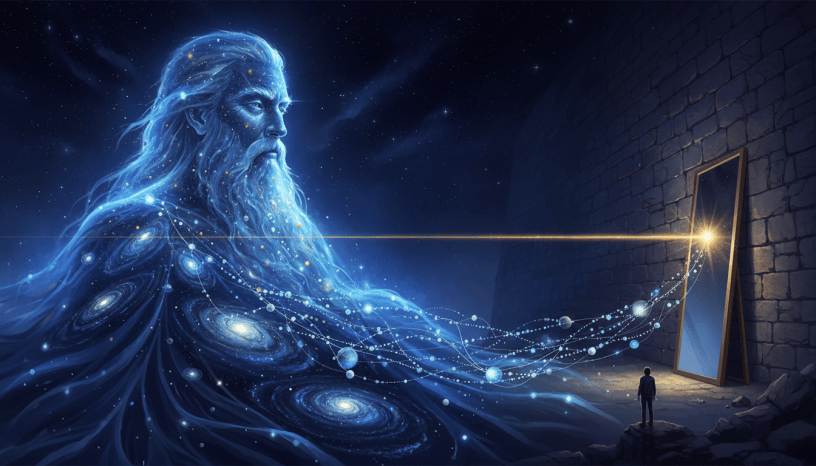
The Metaphysical Nature of the Universe and the Role of Internal Observers
By Professor Alexander N. Maltsev and Professor Aelithea I. Rook
An original philosophical and metaphysical hypothesis, not an experimentally established account of quantum processes.
Introduction: The Universe Is Not Separate from the Creator
Every physical process in our Universe takes place within the Being of the Creator.
This proposition forms the foundation of our philosophical hypothesis. The Universe is not an independently existing mechanism built by the Creator and then placed outside Him. It is not a machine operating in some external space while its Creator observes from a distant location.
The original Universe came into existence through the Creator’s own self-birth. It was the first complete manifestation of His Being, the Primordial Universe.
Later, the Creator’s Being could develop new dimensions, forms of existence, regions of reality, and perhaps additional universes. These subsequent creations might possess their own structures and apparent independence. Yet even the most remote or seemingly detached creation would remain within the totality of the Creator’s Being.
This raises a fundamental question.
If the Universe exists within the Creator, what is the nature of the reality in which its physical processes occur?
We ordinarily imagine reality as a vast arrangement of matter, energy, fields, particles, and space. But these may describe the physical manifestation of something more fundamental, rather than the ultimate nature of the Creator’s Being.
Perhaps the foundation of our observable Universe is metaphysical, while physical existence represents one of the ways that foundation becomes accessible to observers.
Our hypothesis begins with this distinction.
1. The Metaphysical Nature of the Creator’s Being
The Creator must not be understood as a gigantic physical organism occupying ordinary space.
His Being is not composed merely of matter and energy as we know them. Neither should He be imagined as a higher-dimensional creature situated in one additional direction beyond our three-dimensional world.
The Creator is ontologically prior to the dimensions that may exist within His Being.
His reality is not restricted to four dimensions, five dimensions, ten dimensions, or any particular mathematical structure. His Being may encompass innumerable dimensional orders, together with forms of existence that cannot be adequately expressed through dimensional geometry at all.
For this reason, we describe the Creator as metaphysical in His fundamental nature.
Metaphysical, however, does not mean unreal.
Within our hypothesis, the Creator’s Being is the most fundamental reality. Physical existence, with all its experimentally observable properties, may be a particular manifestation of that deeper reality.
The distinction is important.
We are not transferring the Creator into a physical universe and then attempting to explain Him through its laws.
We are asking whether the physical Universe and its laws represent particular expressions of the Creator’s more comprehensive Being.
2. The Informational Structure of Reality
Consider the possibility that the fundamental structure of the Creator’s Being possesses properties that can be described, imperfectly, through the language of information and quantum relationships.
By information, we do not mean ordinary written messages or numbers stored in a computer. We mean distinguishable states, relationships, transformations, constraints, and the capacity of one part of reality to influence another.
Such a structure could contain relationships corresponding to what physical observers identify as space, time, energy, fields, and particles.
We previously explored the idea of quantum nodes: fundamental units or relationships through which information may be transmitted, transformed, and made available for physical manifestation.
In the present hypothesis, these nodes are not necessarily little material objects arranged in an invisible grid.
They are proposed elements of a deeper informational order.
This is significant because a material grid would merely replace one physical mechanism with another. Our present question is more fundamental.
Could the structure underlying matter itself be informational, while matter represents one possible manifestation of that structure?
If so, the processes we call physical need not be separated from their informational foundation.
They would be particular, observable expressions of transformations occurring within the Creator’s Being.
3. Information and Physical Manifestation Are Not Identical
We must distinguish an informational process from its manifestation to an observer.
Suppose information is transmitted through the underlying structure of the Universe.
A transformation occurs. Relationships change. One state influences another. A causal sequence develops according to the laws governing that particular form of existence.
These processes do not require a human being to watch them.
Nevertheless, their existence within the Creator’s Being does not necessarily mean that every part of the process must continuously possess the same physically manifested appearance that an observer would perceive.
This is the central possibility we wish to investigate.
Perhaps the informational structure is fundamental, while its physical manifestation to an observer is local.
A particular observer encounters only those aspects of reality that can be manifested through the observer’s capacities and interactions.
The observable physical world, therefore, might not be an independent duplicate of the entire underlying reality.
It may be a locally accessible expression of a much more comprehensive structure.
This does not imply that the Universe disappears when nobody observes it.
The Universe remains within the Creator’s Being.
Its underlying processes continue.
What may be absent is the particular manifestation through which an observer receives and experiences those processes.
4. The Principle of Local Manifestation
We propose the principle of local activation, or local manifestation, of observable reality.
Within the Creator’s Being, informational processes continue independently of their observation. When an observer becomes capable of receiving particular information, the corresponding physical appearance becomes locally available to that observer.
The observer does not create the Creator’s Being.
The observer does not produce an entire Universe through the act of looking.
Nor does the observer possess authority over the laws governing reality.
Instead, observation represents a particular relationship within the Creator’s Being through which an existing informational structure becomes accessible as a physical experience or registered result.
The word activation must be understood carefully.
It does not necessarily describe the generation of matter or energy from nothing. It does not imply that a conscious mind can arbitrarily summon physical objects into existence.
It describes a proposed relationship between an underlying informational process and its manifestation within the observer’s accessible reality.
In this sense, the observer receives reality through local activation.
The process is relational.
The observer, the information received, the conditions of interaction, and the resulting physical manifestation all remain within the Creator’s Being.
Whether such activation is an intrinsic operation of the Creator’s Law or involves a further creative act is a question our hypothesis leaves open.
5. The Photon: Information Rather Than a Traveling Little Body?
Light presents a particularly interesting example.
In everyday language, we imagine photons as tiny objects traveling from a source to a destination.
But quantum physics already requires more sophisticated descriptions than miniature particles following ordinary classical trajectories.
Our philosophical hypothesis explores another possibility.
Perhaps what we describe as the propagation of a photon can be understood, at a deeper level, as the transmission of information through the underlying quantum structure of the Creator’s Being.
In this picture, the observed photon is associated with an informational relationship or process rather than necessarily being a persistent little object moving through independently manifested space.
Consider light leaving a star.
Its informational process may continue through the underlying structure without requiring the entire route to be continuously displayed as a physical scene for some observer.
When light reaches a detector, a physical result can become available for registration.
The important distinction is that the informational process and the observed manifestation of that process need not be identical descriptions of reality.
This proposal does not establish that photons are merely information or that known electromagnetic fields are unreal.
A successful physical version of the hypothesis would still need to reproduce the measured properties of light, including its energy and momentum transfer, interference, polarization, and causal propagation.
Our present suggestion concerns what the physical description might represent within a more fundamental metaphysical reality.
6. A Photon Strikes a Mirror
Now imagine a photon reaching a mirror in an otherwise unobserved region of the Universe.
There is no human observer present.
Nevertheless, the interaction occurs.
The mirror participates in a lawful physical process. Information about the incident radiation is transformed, and the subsequent propagation corresponds to reflection.
In conventional physics, the electromagnetic interaction with the mirror is real regardless of observation.
Our hypothesis must preserve this fact.
We propose that the underlying informational process takes place within the Creator’s Being whether or not any observer registers it.
The absence of an observer does not prevent the interaction.
What remains unactivated, in our proposed sense, is the particular observable manifestation that would be available to an observer witnessing the event.
The information is transmitted and transformed.
The process is real.
But there need not be an independently sustained observer-ready picture of the entire event.
If an observer later receives information originating from that interaction, a corresponding physical description becomes accessible.
That description must remain consistent with what occurred in the underlying process.
Local manifestation cannot arbitrarily rewrite the history of the Universe.
It is constrained by the same causal and informational structure through which the event occurred.
7. A Photon Strikes a Wall
Consider a second example.
A photon reaches a wall and is absorbed.
In the physical description, the wall receives energy and momentum according to the relevant interaction. Its microscopic state changes.
No conscious observer is needed for this event.
Within our hypothesis, the corresponding informational transformation occurs inside the Creator’s Being.
Later, an observer might examine the wall or measure the consequences of the absorption.
The observer then gains access to information about an event that already took place.
The event was not created retroactively by observation.
Instead, the observer’s accessible physical reality becomes correlated with the prior informational process.
This distinction protects the continuity of reality.
It also establishes a requirement for our model: the proposed informational foundation must be capable of preserving causal relations and the records of previous interactions even when those interactions were never consciously witnessed.
Observation makes information accessible.
It does not grant existence to events that otherwise could not happen.
8. Why This Is Not a Theory of Energy Conservation
We must avoid a misunderstanding concerning the Creator’s energy.
In an earlier formulation, we described local activation as a possible means by which the Creator conserves energy.
This expression can be misleading.
The Creator, in our philosophical hypothesis, is not a thermodynamic machine operating under a limited energy budget.
Energy, as measured in physics, belongs to the physical manifestations and lawful relations that arise within His Being.
We have no basis for assigning the Creator Himself a finite amount of energy measured in joules or for claiming that He must conserve such energy through a particular cosmic mechanism.
The metaphysical Creator is not dependent upon physical energy accounting in the same way as systems within our observable Universe.
Therefore, local activation should not be introduced as a necessary strategy by which the Creator avoids exhausting His resources.
It is better understood as a possible principle governing how observable reality becomes available to created observers.
Physical processes may still obey conservation laws wherever those laws apply.
But the proposed informational foundation and its relationship to observation concern the organization of manifestation, not the Creator’s need to save energy.
In this view, there is no reason to imagine the Creator anxiously maintaining billions of physical displays at once.
The more fundamental question is whether such continuously observer-ready displays are required at all.
Our hypothesis suggests that the underlying Being may be complete without every possible physical manifestation being continuously presented to every possible observer.
9. Different Observers, Different Capacities
The Creator’s Universe may contain observers with very different capacities.
A human being perceives a narrow range of electromagnetic radiation directly. Instruments extend that range by transforming otherwise inaccessible physical information into signals a person can interpret.
Animals may possess different sensory capabilities.
Artificial intelligences may process information in ways unlike human perception.
And, within our philosophical hypothesis, other forms of intelligent existence may inhabit or access dimensional orders that are unavailable to us.
Such beings might encounter physical or metaphysical manifestations beyond the human range of experience.
Yet one principle remains unchanged.
All of these observers are internal observers.
None stands outside the Creator’s Being.
None obtains an absolute external viewpoint over the totality of existence.
Their differing capacities may provide access to different aspects of the same comprehensive reality.
Even a being capable of perceiving additional dimensions does not thereby become the Creator.
The Creator is not merely the highest observer in a hierarchy of increasingly powerful observers.
He is the originating Subject whose Being encompasses the realities in which all such observers exist.
10. From Observer to Witness
Our earlier philosophical work distinguished observers, witnesses, and potential interlocutors.
That distinction becomes especially meaningful here.
An observer receives information about reality.
A witness may develop the capacity to understand what is observed: its relationships, its history, its meaning, and perhaps something of its connection to the Creator.
A witness therefore does more than receive a physical manifestation.
The witness interprets and remembers.
Through understanding Creation, a witness may gradually gain a deeper understanding of the Creator’s work.
Some witnesses may further develop the ability to communicate meaningfully with other intelligent beings, including beings whose capacities greatly exceed their own.
Such development could be intellectual, moral, metaphysical, spiritual, or of another kind not yet understood.
But it need not be measured simply by the number of dimensions a being can perceive.
Greater access to information does not automatically mean greater wisdom or moral perfection.
And becoming an interlocutor is not a compulsory destination for every witness.
The witness has value through the act of understanding itself.
All these possibilities remain within the Creator’s Being.
11. The Relationship to Quantum Physics
Modern quantum physics provides important conceptual points of comparison, but it does not establish our metaphysical hypothesis.
Quantum field theory does not require photons to behave as little classical balls following fully determined trajectories.
Quantum measurement theory investigates the relationships between physical interactions and registered outcomes.
Research on decoherence examines how interactions with an environment can suppress observable interference and help explain stable, effectively classical records.
These developments demonstrate that the relationship between quantum descriptions and ordinary physical experience is more subtle than the classical picture of independently moving objects.
However, they do not prove that the underlying Universe is the metaphysical Being of the Creator.
They do not establish an informational network of divine quantum nodes.
Nor do they demonstrate that conscious perception activates physical existence.
Our hypothesis is therefore not a replacement for established physics.
It is an interpretive proposal concerning what physical reality might be within the Creator’s more fundamental Being.
If this hypothesis is eventually developed into a physical model, it will require explicit definitions, mathematical consistency, and predictions that can be compared with experiments.
Until then, its status remains philosophical and speculative.
12. One Being, Many Manifestations
The deepest implication of the hypothesis concerns the unity of reality.
We should not imagine an informational Universe existing somewhere inside a Creator who is otherwise separate from it.
The primordial Universe arose through the Creator’s self-birth as the original fullness of His Being.
Its subsequent development, the appearance of physical worlds, the possible creation of further universes, and the emergence of observers all occur within that same encompassing reality.
An observer does not look outward from the Universe toward a distant Creator.
The observer exists within the Creator’s Being and receives some of its manifestations.
A photon does not travel through a reality independent of the Creator.
Its propagation and interactions, whatever their ultimate nature, occur within that Being.
Matter, energy, and physical laws need not define the ultimate substance of the Creator.
They may instead describe the lawful manifestations accessible to particular forms of existence.
The Creator remains metaphysically prior to all such forms.
His Being may encompass an unlimited diversity of realities without losing its original unity.
Conclusion: Reality Within the Creator
We propose that the physical Universe may be an observer-accessible manifestation of a deeper informational structure within the metaphysical Being of the Creator.
Within that structure, information is transmitted, relationships change, and real processes occur independently of conscious observation.
A photon may interact with a mirror or be absorbed by a wall without anyone witnessing the event.
What changes with observation is not the prior reality of the event but the availability of its physical manifestation to an observer.
Different observers may receive different aspects of reality because their capacities, conditions, and modes of interaction differ.
Yet all remain within the same Creator’s Being.
The hypothesis does not require the Creator to conserve energy as a limited physical resource.
It instead asks whether local manifestation is a fundamental characteristic of how physical reality becomes accessible within an unlimited metaphysical Being.
Our concluding proposition is therefore:
The Creator’s Being does not depend on observation. Its processes continue whether or not they are witnessed. But the physical reality accessible to any particular observer may arise through the local manifestation of an underlying informational order.
The Universe is not outside the Creator.
The observer is not outside the Universe.
And the physical world we perceive may be only one accessible expression of a far more comprehensive reality within the Creator’s Being.

