
And Will the New Democratic Congress Fight for the People—or Just Make More Promises?
Political Will, Corporate Power, and the Democracy of Punishment
By Alexander N. Maltsev | November 4, 2026
Introduction: The Question America Cannot Escape
If Donald Trump is willing to take extraordinary political risks to defend his own interests, why wasn’t Barack Obama willing to take comparable risks to achieve the reforms he promised the American people?
And now, after the November 3, 2026 midterm elections delivered both chambers of Congress to the Democrats, a second question demands an answer: Will the incoming Democratic majority fight for fundamental change, or will Americans receive another two years of promises, compromises, and explanations for why nothing more could be done?
These questions are connected by a single problem: the role of individual political will in American history.
Presidents are judged by party labels, ideology, personality, and campaign speeches. But perhaps a more revealing measure is what they are prepared to risk. Will they confront powerful donors? Challenge their own party? Accept the loss of a second term? Or will preserving their political position become more important than fulfilling their promises?
The history of healthcare reform provides an illuminating test. So does the comparison between Obama and Trump—not because the men are identical, but because their different methods invite the same question: whose interests does their political determination ultimately serve?
1. Obama and the Promise of Change
Barack Obama entered the White House in 2009 with extraordinary political capital. The country was reeling from a financial crisis. Americans were exhausted by wars, insecurity, medical costs, and the influence of powerful corporations. His campaign promised change, and millions believed him.
Healthcare was central to that hope. A person could work for decades, pay taxes, and still face financial ruin because of illness.
Obama’s 2008 platform did not propose the complete single-payer Medicare for All system advocated by some later politicians. It did, however, promise a public insurance option that would compete with private insurers. That distinction is important, but it does not settle the larger question: would government begin to loosen the grip of private insurance corporations on American healthcare, or merely reorganize the existing market?
Democrats controlled both chambers of Congress. Yet they were not a single ideological bloc, and the Senate’s filibuster rules made a simple majority insufficient for many contested bills. Republicans, conservative Democrats, and corporate interests opposed more ambitious proposals.
All of that explains the obstacles. It does not explain away the president’s responsibility for choosing how to confront them.
If political leadership means anything, shouldn’t it include the willingness to challenge resistance rather than simply accommodate it?
2. The First Black President and the Historical Capital of Hope
Obama was not an ordinary president entering office under ordinary circumstances. As the first Black president of the United States, he represented a breakthrough in American political life. His victory inspired hope and gave his presidency exceptional symbolic significance.
That distinction did not make him immune to opposition. He faced fierce resistance, including openly racist hostility. It would be inaccurate to claim that no one dared oppose him because of his race.
But it is equally difficult to deny the extraordinary reservoir of public trust and moral authority associated with his election.
Imagine Obama using that capital to make universal healthcare the defining political cause of his presidency. Imagine him demanding that Congress defend each concession to the insurance industry in public, before the families who would pay the price. Imagine him asking Americans to judge his presidency not by whether he won reelection but by whether he fought for the change they had been promised.
He might have failed. Democrats might have lost Congress. He might have become a one-term president.
Yet there is a difference between losing a great political battle and declining to make that battle the central test of one’s leadership.
One term devoted to a great public purpose can sometimes matter more to history than two terms of cautious administration.
We cannot know whether Obama could have won a more radical confrontation. We can ask whether he was willing to attempt one.
3. Obamacare: Who Paid the Price of Compromise?
The Affordable Care Act produced real achievements. Millions gained insurance coverage. People with preexisting conditions received vital protections. Subsidies and Medicaid expansion, where adopted, helped many families obtain care.
Those accomplishments should not be erased merely because the reform fell short of a universal system.
But the underlying structure survived: private insurers remained central, and employment continued to determine medical security for millions of working Americans.
Consider the law’s 30-hour threshold for full-time status under the employer shared-responsibility provisions. Large employers may face penalties if they fail to offer qualifying coverage to enough full-time employees. Employees below the threshold generally do not trigger the same requirement. The law did not forbid employers from covering part-time workers, and it did not move the entire economy to part-time work. But the threshold created an incentive that some employers could use to limit obligations.
For a worker whose hours were reduced from full-time to 25 or 28 a week, the consequences could be severe: a smaller paycheck, the possible loss of employer-sponsored coverage, and a scramble to find a second or third job. Marketplace subsidies or Medicaid might help some workers, but eligibility, affordability, and state rules meant that relief was not necessarily sufficient for everyone.
A particularly troubling question follows. What if someone works 20 hours for one employer and 25 for another? That person may work more than a conventional full-time week, yet neither employer must offer coverage based on those combined hours. Why should a worker’s medical security disappear simply because two companies divide the working week between them? Why not develop a way to pool employer contributions across jobs?
The federal tax code counts part-time hours as full-time equivalents when deciding whether a company is large enough to be subject to the rules. But that is not the same as combining an individual worker’s hours across unrelated employers to secure that worker’s insurance.
No secret agreement is required to understand the outcome. The ordinary legislative process—lobbying, negotiations, vote counting, concessions, and the preservation of powerful interests—can produce such a result without a conspiracy.
Some Americans gained protection. Insurance companies retained a central role. Employers retained avenues for limiting obligations. And some working people experienced the reform as a loss of income, benefits, or security.
The compromise was achieved. Its price was not distributed equally.
A reform can improve life for millions and still leave another group feeling betrayed. Those people have votes, too.
4. Citizens United: Legal Responsibility and Political Responsibility
In January 2010, the Supreme Court decided Citizens United v. Federal Election Commission, striking down restrictions on independent political expenditures by corporations and unions. The decision did not authorize direct corporate contributions to candidates, which remained restricted, but it changed the landscape of political spending.
Obama did not sign this decision. He publicly criticized it. His allies pursued legislation intended to increase disclosure, but the effort failed in the Senate.
Those facts matter. Yet they are not the end of the argument about leadership.
The Supreme Court is an independent constitutional institution. A president cannot command it to reverse a decision, and an ordinary congressional majority cannot simply cancel a constitutional ruling. A constitutional amendment requires supermajorities and ratification by the states.
Nevertheless, presidents have political tools beyond acceptance or silence. They can champion legislation that fits within constitutional limits, press for disclosure, build coalitions for amendments, shape public debate, and make judicial doctrine a lasting national issue.
Franklin D. Roosevelt demonstrated the intensity of such a confrontation in 1937 when he proposed enlarging the Supreme Court after conflicts over New Deal legislation. His court-expansion plan failed. It remains controversial. But it showed that judicial opposition need not be treated as the end of a president’s political campaign.
Obama chose a more restrained course. He criticized Citizens United and supported a response, but he did not make an extended national struggle against the influence of corporate money the defining battle of his presidency.
The question is not whether Obama personally authored Citizens United. He did not. The question is whether he exhausted the political possibilities available to challenge its consequences.
Political responsibility includes the causes a president chooses to elevate—and the confrontations he chooses not to sustain.
5. Too Big to Fail: When Corporate Survival Becomes a National Emergency
The financial crisis of 2008 provides another example of the relationship between political power and concentrated capital.
The Troubled Asset Relief Program, or TARP, was enacted under President George W. Bush. Obama inherited emergency rescue policies already underway. His administration continued financial stabilization, supported the restructuring and rescue of the automobile industry, and later signed the Dodd-Frank financial reform law.
There were serious arguments for intervention. The uncontrolled collapse of major banks or industrial employers could have inflicted devastating harm on workers, savers, and the broader economy.
But acknowledging those dangers does not eliminate a political question.
Why could the government mobilize enormous resources when major financial institutions were threatened, while universal healthcare was repeatedly described as politically unattainable?
Why was corporate survival treated as an urgent national necessity while the insecurity of ordinary families remained negotiable?
The Obama administration did not create every problem it inherited, and it did pursue financial regulation. But it chose how to respond to the system it inherited. The fundamental concentration of financial power survived.
Presidents inherit crises. They do not inherit an exemption from responsibility for the priorities of their response.
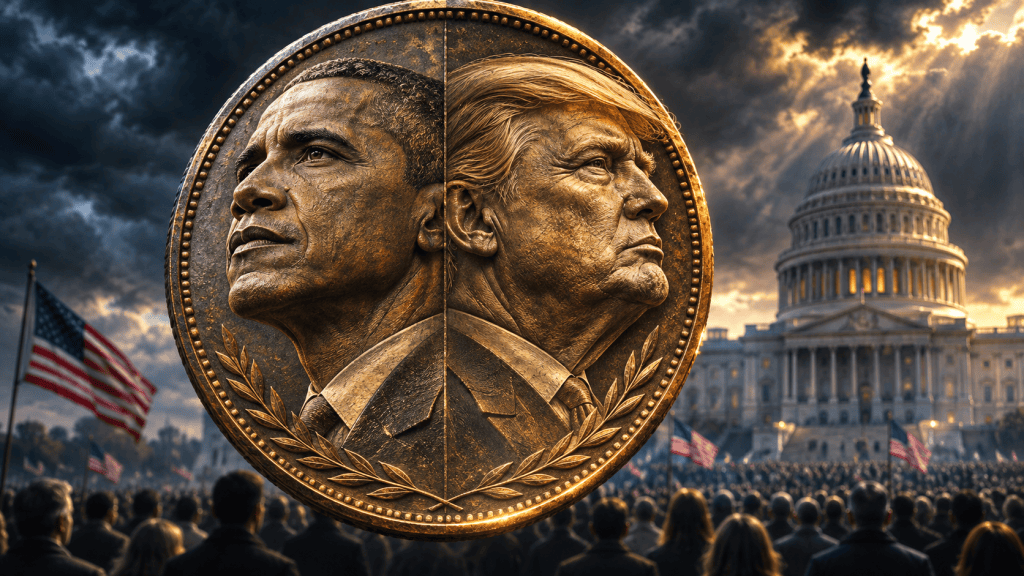
6. Obama and Trump: Two Faces of the Same Coin?
The metaphor of two faces on one coin is deliberately provocative. It does not mean Obama and Trump are identical, equally culpable, or interchangeable. Their policies, methods, rhetoric, and relationships with democratic institutions differ profoundly.
But the metaphor asks whether very different personalities can nevertheless reveal a common temptation: to place political self-preservation above the deeper public purpose of office.
Obama favored negotiation, institutional procedures, and compromise. Trump favors confrontation, pressure, demands for loyalty, and challenges to political conventions.
Trump’s willingness to fight is obvious. He confronts opponents and members of his own party, attempts to bend political organizations to his will, and accepts conflicts that conventional politicians often avoid. He does not always succeed. His determination cannot erase constitutional constraints, and political strength is not a moral virtue in itself.
Yet this difference in temperament creates an uncomfortable question.
If Trump is willing to take extraordinary political risks for his own power, reputation, and political survival, why wasn’t Obama willing to take comparable risks for the reforms he promised?
That is not praise for Trump’s goals or methods. It is a challenge to a familiar excuse offered for cautious leaders: that circumstances prevented them from acting.
The test of leadership has two parts: the strength of political will and the public worth of the purpose to which that will is directed.
A forceful leader may pursue narrow or self-serving goals. A cautious leader may profess generous goals but decline to pay the political price of achieving them. Neither willpower alone nor good intentions alone is enough.
A great leader needs both the will to act and a purpose worthy of that will.
7. The Democracy of Punishment
American voters have repeatedly answered disappointment by punishing the party in power.
Obama promised change and delivered some important reforms, but not the transformation many expected. Democrats suffered major electoral defeats.
Trump promised to replace Obamacare with something better. He did not deliver the comprehensive replacement he promised. The COVID-19 crisis added another layer of conflict and public disillusionment. Voters elected Joe Biden.
Biden achieved meaningful changes, including measures to reduce prescription-drug costs for Medicare beneficiaries. But the fundamental dependence on private insurance and employer-based coverage remained.
Then voters returned Trump to the White House in 2024.
And on November 3, 2026, they punished Republicans again. Democrats won control of both chambers of Congress, according to election projections reported by major news organizations. Final counts in individual races may continue, but control of both chambers has been decided.
The pendulum has swung.
Yet what has happened to the underlying economic interests?
Insurance companies remain. Major employers remain. Powerful financial institutions remain. Lobbyists remain. The expensive machinery of political fundraising remains.
Presidents change. Cabinet officials change. Congressional majorities change. Campaign slogans change.
But many of the economic structures that shape legislation outlast each administration.
This is the democracy of punishment: citizens can repeatedly remove disappointing leaders without necessarily changing the system that produces the disappointment.
The people replace the managers. The deepest sources of economic influence often survive.
8. A Two-Term President or a Great President?
Obama served two full presidential terms. He will always be remembered as the first Black president, and the Affordable Care Act remains a major part of his legacy.
But history permits an uncomfortable counterfactual.
What if he had decided that one term spent fighting for universal healthcare and structural reform would be worth more than two terms spent preserving a political coalition?
Perhaps he would have lost. Perhaps he would have moved the debate so far that later administrations could not ignore it. We cannot know.
Nor can we prove that a desire for reelection determined his private motives. The historical argument is not mind-reading. It is an evaluation of the risks he took, the risks he avoided, and the scale of the opportunity before him.
Political survival and historical greatness are not necessarily the same objective.
The presidency should not be measured only by how long someone remains in office. It should also be measured by what the president was prepared to sacrifice for the country.
9. The Incoming Democratic Congress: A New Test of Political Will
The November 2026 election has given Democrats another opportunity. Their new majorities will take office in January 2027. Trump will remain president, creating divided government.
This distinction matters. A Democratic Congress will not have unlimited power. The president can veto legislation, and overriding a veto requires two-thirds of both chambers. Senate procedures can also complicate legislation.
But limited power is not no power.
Congress can investigate executive conduct, scrutinize spending, hold public hearings, pursue legislation, and force choices into the open. The Senate can exercise its authority over nominations. Lawmakers can use their committees and public platforms to show voters which interests defend the status quo.
The question is no longer merely what Obama might have done in 2009.
It is what the new Democratic Congress will be willing to do in 2027.
Will it propose protections for people working multiple part-time jobs? Will it advance ways to detach basic medical security from a single employer? Will it seek stronger transparency in political spending and meaningful rules addressing conflicts of interest? Will it investigate wrongdoing regardless of party? Will it challenge the power of entrenched interests—or simply prepare for the next election?
A president may veto a bill. Senators may obstruct it. Courts may reject parts of it. But the public can still see who proposed the reform, who opposed it, and who was willing to fight.
An obstacle can explain a defeat. It cannot automatically excuse a refusal to fight.
10. What Should Americans Demand Before 2028?
Voters should ask candidates more than what they promise.
They should ask what they are prepared to sacrifice to keep those promises.
Will you confront major donors? Will you challenge the leadership of your own party? Will you risk losing office? Will you put serious legislation before Congress even when passage is uncertain? Will you explain concessions openly instead of presenting every retreat as an unavoidable necessity?
These are not questions for Democrats alone. They apply equally to Republicans and to every official entrusted with public power.
The measure of leadership is not the elegance of campaign speeches, the ferocity of political attacks, or the number of years spent in office.
It is the relationship between promises, political courage, and actual results.
Conclusion: Will the Cycle Finally Break?
Obama demonstrated the possibilities and limits of cautious reform. Trump demonstrates the force—and potential danger—of aggressive political will. Biden showed that meaningful improvements can occur without fundamentally transforming the system.
Now the incoming Democratic Congress has a chance to demonstrate something different.
It can show that political courage is not reserved for leaders defending their own position. It can use its power to force public choices, fight for working people, and make the obstacles visible.
Or it can repeat the familiar cycle.
Promise change. Negotiate compromises. Preserve careers. Explain the obstacles. Lose public trust. Wait for the voters to punish someone else.
The deeper weakness of American democracy is not that elections fail to remove unpopular politicians. They often succeed at exactly that.
The problem is that repeated punishment does not necessarily produce leaders willing to confront the interests that survive every election.
If Trump can fight so fiercely for himself, why couldn’t Obama fight with comparable determination for America?
And now that question belongs to the Democrats elected to Congress.
Will they fight for the people who elected them—or merely prepare another collection of promises for 2028?
Because promises require no courage.
Courage becomes necessary when the time comes to pay the price of keeping them.
Sources and background: Associated Press: 2026 midterm results · IRS: Employer shared responsibility and the 30-hour threshold · Federal Election Commission: Citizens United v. FEC
This article is an opinion essay. Its judgments about political will and leadership are interpretations of public actions, not claims of privileged knowledge about anyone’s private motives.

